She Built a $9 Million Hotel on Toxic Land—Then My Evidence Got It Shut Down!
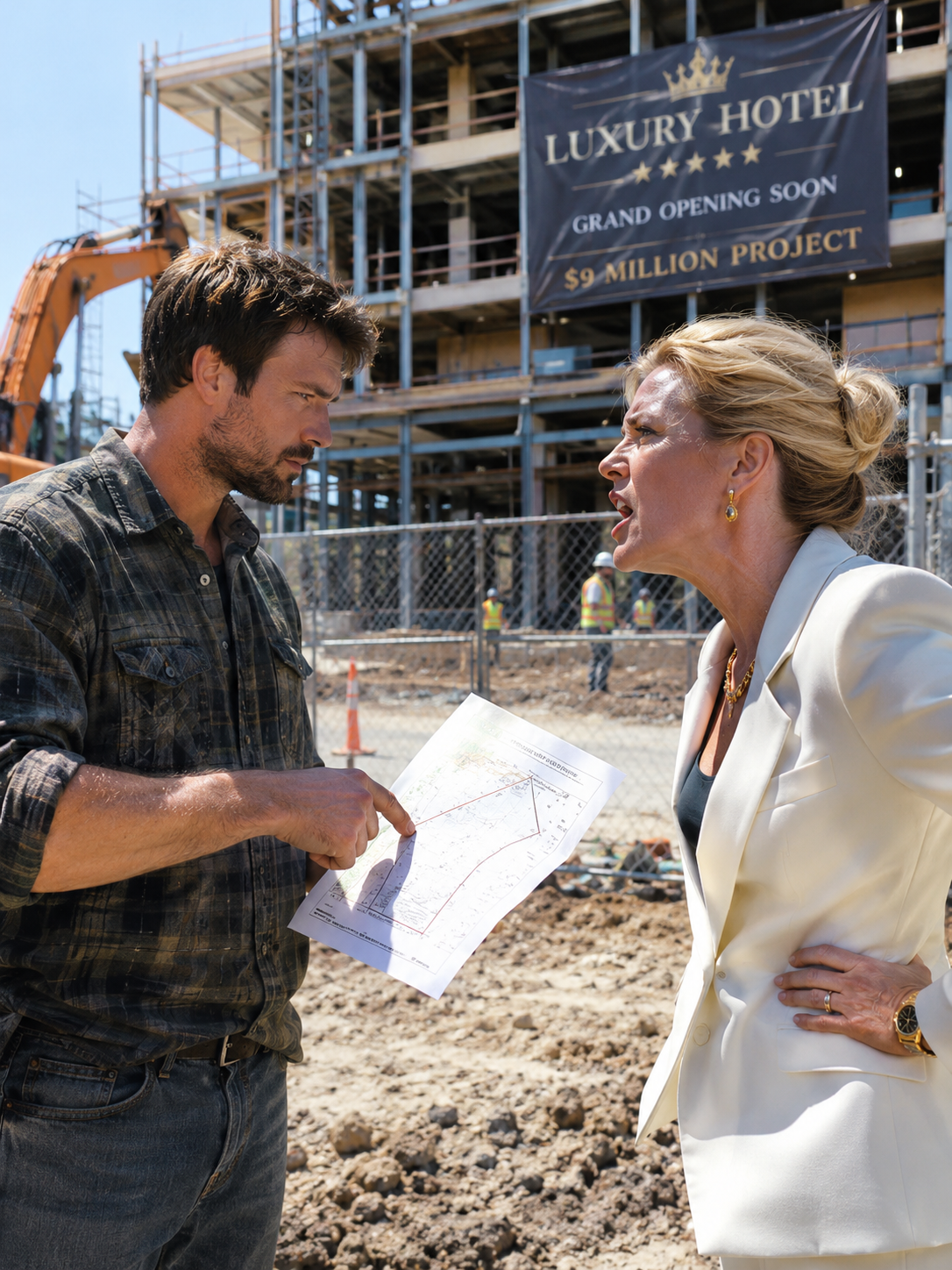
The morning I saw excavators digging into the old landfill my father left me, I thought somebody had made a terrible mistake. Then I met Victoria Hayes, the developer putting a $9 million luxury hotel on that ground. She said she had every right to build there, until I came back with a certified survey she couldn’t wave away…
“I told you to stop working on this property,” I said. Victoria Hayes stood near the construction fence, watching an excavator swing a bucket of dirt across ground my family had owned for decades. She barely looked at me before saying, “We’re well within our rights to be here.”
My name is Ethan Carter, and that morning I was trying to understand how a hotel could be rising from my father’s old landfill without anyone ever asking me a question. Concrete foundations were already in place, machinery was moving, and stacks of materials waited to become part of a luxury building. It wasn’t a little misunderstanding over a driveway or a few feet of fence.
My father had bought that land outside a town that has grown considerably over the years. He ran a legal landfill there, back when it was still a place people knew by the loads that came in and the trucks that drove out. The landfill eventually closed for good, but closing a business didn’t erase the property lines or the land’s history.
After my father died, the property became my responsibility. So did the documents he left behind: the ownership records, the papers about the landfill, and the history that explained what lay beneath the surface. I never confused owning that ground with owning a pretty piece of real estate. It was land that needed to be treated carefully.
As the town spread outward, the old landfill seemed to disappear from people’s minds. New developments went up, roads got busier, and the parcel sat apart from the bright new signs and polished storefronts. I could understand why someone driving by might see empty land and imagine something profitable. I could not understand how a developer could begin building without establishing whose land it was.
I had been driving past when I first noticed the excavators. At first, I thought they might be working on a neighboring tract, so I slowed down and looked again. Then I saw where the excavation ran and how far the foundations extended. I pulled over because the shape of that work was impossible to reconcile with what I knew about my boundaries.
Victoria was the developer behind it. She was planning a $9 million luxury hotel, and by the look of the site she had already committed a great deal of money to contractors and building materials. She spoke as though the project had passed the point where anyone could question it. To her, I seemed like an inconvenient man who had wandered onto a busy job site.
I told her my name and explained that my family owned the land. She didn’t ask to see my papers; she insisted her project had the right to be there. I tried to keep my voice level, partly because workers were nearby and partly because I wanted her to hear the next thing I had to say.
“This used to be a landfill,” I told her. “You can’t treat it like ordinary ground. There could be methane underneath, and there could be contaminated soil. You need a proper environmental investigation before people are expected to work or stay in a building here.”
She laughed at the warning. Modern engineering could handle anything, she said, and her team knew what it was doing. I wasn’t claiming that every former landfill was impossible to develop. I was telling her that engineering starts with knowing what conditions exist, not dismissing the possibility of danger because construction has already begun.
Her attention drifted back toward the machines while I was still speaking. I could hear work continuing behind us, each movement another reminder that this was no longer just an argument about an idea on paper. Actual foundations were sitting in the ground. If the location was unsafe, the consequences could reach far beyond her investment.
I asked her again to stop the work while ownership and safety were checked. Victoria refused and told her contractors to carry on. I remember looking past her at the exposed earth and realizing that neither a raised voice nor another warning was likely to change her mind. She had decided that I had nothing she needed to take seriously.
So I went home to the records instead of staying there to argue. My father had kept the important documents, and I had kept them after he died. But I knew an old folder in my possession would not settle a dispute with someone who had already spent heavily on construction. I needed proof she couldn’t dismiss as a family story.
At the county recorder’s office, I obtained certified records showing that the property was still legally in our family and had passed to me. The documents didn’t depend on whether Victoria remembered the landfill or believed what I said. They recorded ownership. Seeing the official copies in my hands steadied me in a way the confrontation hadn’t.
Still, ownership on a deed and a building’s precise position on the ground are two different things. I needed to know exactly how much of that hotel site crossed the boundary. Rather than guessing from an old map, I hired a licensed land surveyor to establish the parcel lines professionally.
The surveyor worked from the property records and measured the actual site. I wasn’t looking for a result that would embarrass Victoria; I wanted an answer that would stand up to scrutiny. While the measurements were being made, I kept thinking about the amount of concrete already poured and how casually she had brushed off the ground beneath it.
When the certified survey came back, the answer was unmistakable. The hotel’s foundations and most of the construction site were inside my privately owned parcel. This wasn’t an overlap of a few inches along an edge. The project at the center of Victoria’s plans was occupying land that belonged to me.
For a moment I sat with the survey spread in front of me. The lines were so plain, yet I knew how much money and pride had already been poured into the wrong place. I thought about my father and all the paperwork he’d kept from a business that had closed years ago. Without those records, I might have been left trying to prove something everybody else had forgotten.
I took the certified survey back to Victoria and showed her where the property line ran. I pointed out the foundations and the large part of the hotel site that crossed it, then formally demanded that construction stop immediately. This time she studied the paper instead of looking over my shoulder at the equipment.
The confident smile she’d worn during our first conversation disappeared. She looked from the survey to the building and back again, as if the two ought to agree with the story she had been telling herself. But she still refused to accept responsibility or halt the project. I had proved where the hotel stood; I hadn’t yet established whether it was safe for anyone to be there. Part 2…..
IF FACEBOOK BROUGHT YOU HERE, HERE’S THE CONTINUATION YOU’VE BEEN WAITING FOR. ENJOY! 👇 That second question had been with me since the first day I saw the excavation. A certified survey could settle the location of a property line, but it couldn’t tell me what was happening below the foundations. I didn’t want to use a possible hazard as a bargaining chip. If methane or contamination was present, I wanted qualified people to determine the risks.
I contacted Dr. Sarah Mitchell, an environmental engineer who specialized in former landfill sites. I explained what my father had operated there, when it had closed, and what construction was taking place now. She asked for the historical records before offering any opinion about the hotel. That was the first response I’d had that made me feel someone was taking the ground itself seriously.
After reviewing the records, Sarah agreed to conduct an independent assessment. She assembled a qualified inspection team, and they approached the site as a place that needed evidence rather than assumptions. They reviewed the landfill history, collected soil samples, and carried out professional monitoring for underground gas. Every step was documented so the findings could be evaluated beyond a conversation between me and Victoria.
I didn’t pretend to understand every instrument or sampling method. What I understood was that the team was asking questions Victoria hadn’t wanted to ask before building. Where could landfill gas be accumulating? What had been left in the soil? Could the conditions beneath the construction create a danger for the people expected to use the hotel?
The first gas-monitoring results were troubling. Sarah showed me that methane concentrations were elevated beneath parts of the construction site. She explained that gas from a former landfill can move through the ground and accumulate in places where it creates serious fire or explosion hazards. It was not a prediction that an explosion would happen; it was a risk that had to be evaluated and controlled.
I remembered Victoria saying that modern engineering could handle anything. Sarah didn’t dismiss engineering at all. She explained that proper design and protective systems have to respond to actual site conditions. No responsible engineer could simply assume a problem was solved without investigating whether it was there in the first place.
Then the soil tests came back from the laboratory. They showed contamination associated with the property’s former use as a landfill, with further investigation and a formal environmental response needed. Sarah was careful not to claim the samples proved every part of the site was equally affected. What they did establish was that the hotel could not responsibly treat this as ordinary, clean ground.
When she finished the initial investigation, she gave me a written report documenting the elevated landfill gas and contaminated soil, along with the questions that still had to be resolved. I read it slowly, stopping whenever a technical phrase needed explaining. I had hoped the land might turn out safer than I feared. Instead, I had a professional reason to worry about the building and everyone who might enter it.
By then Victoria was preparing for a glamorous grand opening. The project she’d put $9 million into was supposed to become a success story for her company, and I could understand why she wanted to protect that investment. But her reasons didn’t make the survey disappear, and they certainly didn’t make the monitoring results less serious.
I sent Sarah’s report, the property records, and the survey to the appropriate state environmental authorities. I wasn’t asking them to take my side in an argument over pride. I wanted an independent government investigation that could determine what safety measures were necessary. Once I submitted the material, the question was no longer something Victoria and I could settle by arguing beside a fence.
Part 3 A few days later, state environmental inspectors and fire safety officials arrived at the site. They examined the reported hazards and began their own inspection rather than simply adopting Sarah’s conclusions. I was relieved to see professionals looking closely at the conditions, even though I knew the results could bring painful consequences for a project that was nearly ready to open.
Victoria came outside when she learned why they were there. She looked at the officials and then at me, her frustration showing in the way she held herself. “You’re destroying my business,” she said. I understood that she was looking at years of planning and millions of dollars, but all I could think about was what might happen if people entered a building before the hazards were addressed.
“You should have investigated the land before building your hotel,” I told her. I didn’t say it to win an argument in front of the inspectors. I said it because a review before excavation could have changed the decisions she made, and there was no way to put the foundations back into the ground as if none of this had happened.
The government’s independent inspection confirmed serious environmental concerns. Methane migration and contaminated soil were not matters that could be dismissed with an assurance about modern technology. The officials had to consider immediate safety while the required investigation and corrective response remained unresolved. This was no longer just my warning or Sarah’s professional assessment.
Officials ordered people out of the affected areas as a precaution. The hotel had not had its grand opening, but workers and others involved with the project still had to leave the unsafe portions of the site. An emergency closure order restricted access to the building, and it could not be occupied while the hazards were unresolved.
I watched Victoria take in what the order meant. The opening she’d been preparing for could not go ahead, and the building she’d planned to fill with guests would remain closed. I didn’t feel the satisfaction I might have expected after she’d laughed at me. All I could see was how far an avoidable decision had carried everyone.
The closure addressed the immediate danger, but it didn’t decide who had the right to the ground beneath the hotel. That was a separate matter, and I wasn’t going to leave it unsettled simply because the authorities had stopped occupancy. I took the ownership dispute to court with the help of an attorney, bringing the certified records, survey, construction history, and government findings.
Final Victoria arrived with a team of corporate lawyers. I couldn’t pretend I was comfortable looking across the room at people hired to protect a $9 million investment. But my attorney wasn’t asking the court to decide who could afford better arguments. We were asking it to decide who legally owned the land and what the evidence showed about the building placed on it.
The ownership records traced the property from my father’s purchase to my responsibility for it after his death. The certified survey showed where the hotel foundations and most of the development actually sat. Those facts were separate from whether Victoria had intended to trespass. Whatever she had believed when construction began, the physical location of the building was established.
Dr. Sarah Mitchell also explained the environmental investigation in clear technical language. She described the elevated methane readings, the soil contamination, and why the findings demanded further investigation and a proper response. The government inspection and its restrictions were part of the record as well. No one needed to imagine a disaster to understand why occupancy had been stopped.
The judge considered the ownership documents, the survey, the construction evidence, and the relevant regulatory findings. The court ruled in my favor on the property dispute and recognized that Victoria’s hotel could not lawfully remain on land she did not own. I listened to the ruling without saying anything. It was the legal recognition I had been trying to get since the morning I saw those excavators.
Separately, following the regulatory proceedings, the authorities determined that the building was unsafe for occupancy. It was officially condemned and remained closed while the required environmental and safety issues were unresolved. A court ruling over property lines did not make the contamination vanish, just as a closure order did not by itself settle title to the land. Both problems had to be taken seriously.
Victoria had invested $9 million in a luxury hotel she could no longer legally operate. Her grand opening was gone, and the financial and legal consequences of the development were far from simple. I didn’t know how she would sort through them, and I wasn’t going to invent an easy ending for her. The building stood as a reminder of what had happened when ownership and environmental history were treated as obstacles to ignore.
I also knew the land itself still needed responsible attention. My family owning it never meant the old landfill was harmless. That was why I had kept telling Victoria to investigate before inviting people onto the site, and why I had asked the authorities to examine the evidence instead of leaving the decision to either of us.
I thought about my father, who had bought that parcel, operated the landfill legally, and kept the records even after it closed. Those papers had seemed like the dullest part of what he left me. In the end, they protected something important: the truth about whose land it was and the chance to address what lay underneath before somebody got hurt.
I never wanted a hotel to fail or anyone to lose everything they’d put into a project. I wanted my property respected, and I wanted a dangerous possibility investigated before it became a tragedy. If there’s one lesson I took from standing on that ground, it’s a simple one: before you build something worth $9 million, make certain you own the land—and understand what you’re building on.
THE END. I’ve shared the complete story, and I truly hope it touched your heart. If this story moved you, please , like, and share the post. Thank you for reading! ❤️
✓ Lynn R. Adams
The morning I saw excavators digging into the old landfill my father left me, I thought somebody had made a terrible mistake. Then I met Victoria Hayes, the developer putting a $9 million luxury hotel…