She Brought Their Newborn
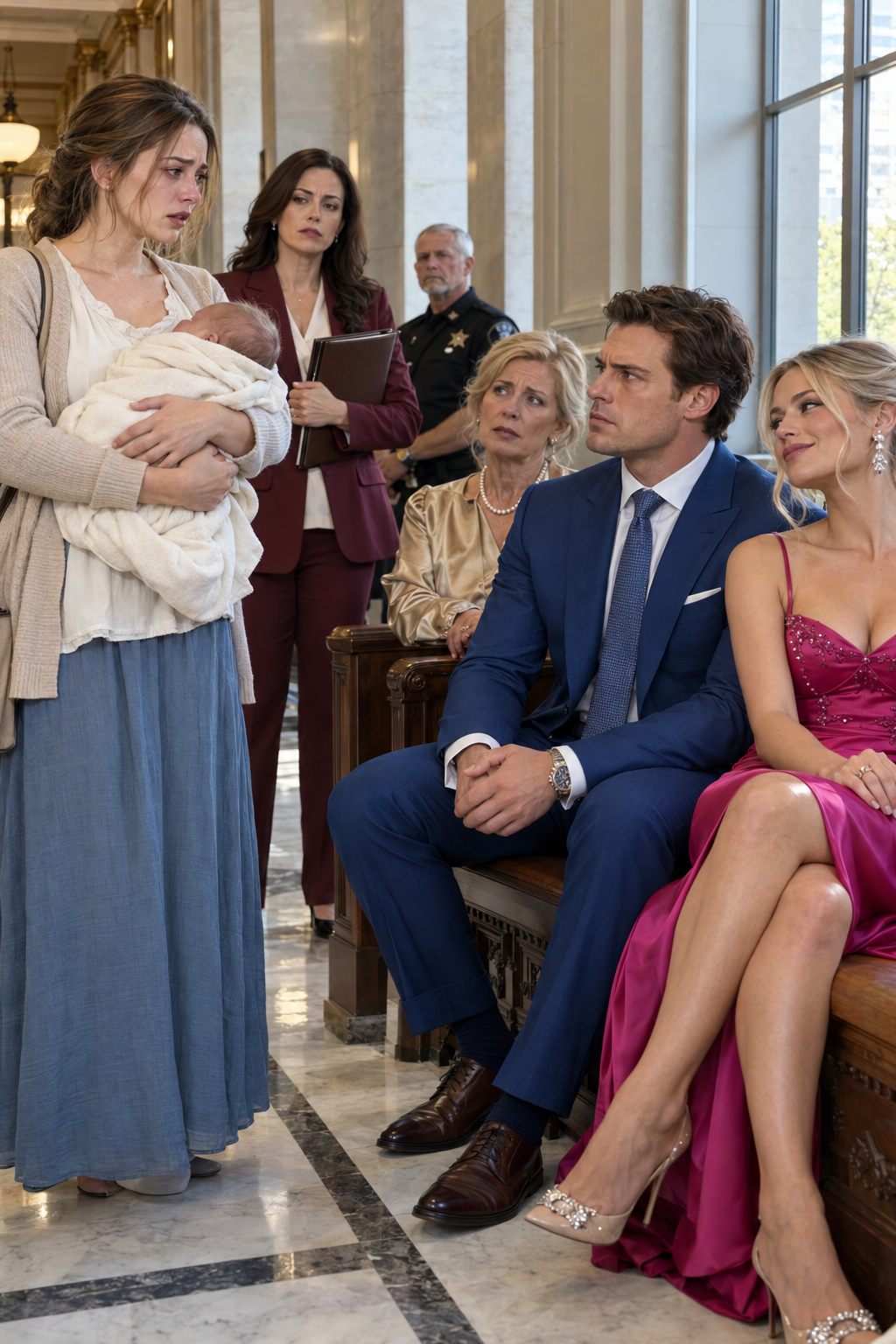
She Brought Their Newborn to Custody Court—Her Husband Brought His Girlfriend, Never Guessing What She Carried
My husband brought his girlfriend to the custody hearing for our twelve-day-old son.
She was wearing my coat.
Not one like mine.
The camel cashmere coat I had bought three winters earlier, back when I still believed a marriage could survive anything if one person loved hard enough for two.
Madison Vale sat beside my husband on the polished wooden bench outside Courtroom 4B, one manicured hand resting on his thigh as if she were afraid someone might forget who had won.
Ethan looked up when I came through the security doors carrying our newborn against my chest.
His eyes dropped to the baby.
Then to the diaper bag.
Then to the thin black leather folder tucked beneath my arm.
For the first time that morning, his smile disappeared.
Only for a second.
Then he leaned back and said, loud enough for his mother, his sister, Madison, and their attorney to hear, “You could’ve at least dressed like you cared about the judge’s impression.”
I looked down at myself.
Black trousers.
Cream blouse.
Flat shoes because my incision still pulled when I walked too quickly.
No makeup except lip balm.
Hair tied low at my neck.
No wedding ring.
Ethan’s mother, Patricia, gave a small laugh.
“She never understood presentation,” she said.
Madison smoothed the sleeve of my coat.
“She’s tired,” she offered sweetly. “New motherhood is probably overwhelming.”
My son stirred against me.
I slipped two fingers beneath his tiny cap, feeling the warmth of his temple.
He had Ethan’s mouth.
My father’s strange little crease between the eyebrows.
A crease my father had carried into every courtroom photograph I had ever seen of him.
That detail mattered more than anyone in that hallway understood.
Ethan stood.
He walked toward me with the slow confidence of a man entering a house he believed he already owned.
“Hand him over,” he said.
I looked at him.
His face tightened.
“You know why we’re here, Claire.”
“You’ve been keeping him from me.”
“You saw him Tuesday.”
“For forty minutes.”
“You left after twenty-seven.”
Madison shifted behind him.
Ethan lowered his voice.
“You’re really going to do this in public?”
I almost smiled.
He had said the same thing five days earlier when his mother told me I had three hours to leave the house.
Three hours.
I had been seven days postpartum.
Seven days after delivering Noah by emergency C-section.
Seven days after losing enough blood that a nurse stood beside my hospital bed and quietly told me not to climb stairs without help.
Seven days after Ethan kissed my forehead in the hospital, took a photograph holding our son, posted it online with the caption My whole world, and then drove directly to Madison’s apartment.
I found that out later.
Not from him.
From the toll records.
But that was not the worst part.
The worst part came forty-eight hours after I returned home.
Patricia arrived at nine in the morning with Ethan’s sister Lauren and a locksmith.
Ethan was already in the kitchen.
Madison was upstairs.
In my bedroom.
Wearing my robe.
I had stopped in the foyer with Noah sleeping in my arms and stared at her bare feet on the staircase.
Madison smiled.
Patricia did not bother.
“This arrangement is unhealthy,” she said.
I looked at Ethan.
He stared into his coffee.
Patricia continued.
“You’re emotionally unstable. You’re exhausted. Ethan needs calm around him right now.”
I had almost admired the sentence.
Not because it was kind.
Because it was efficient.
She had turned my surgical recovery into a character flaw in twelve words.
Lauren folded her arms.
“You’ve been difficult for months.”
“I was pregnant.”
“That doesn’t give you permission to make everyone miserable.”
I looked at Ethan again.
“Is she staying here?”
Madison answered.
“We’re trying not to make this uglier than it needs to be.”
That was when I understood.
They had already written the story.
I was the unstable wife.
Ethan was the patient husband.
Madison was the compassionate friend who had become something more only after the marriage supposedly failed.
Patricia was the concerned grandmother.
Lauren was the witness.
Their attorney, Gregory Pike, was the man who would translate lies into respectable language.
And Noah was the prize they expected me to surrender because I was too tired to fight an entire family.
They had spent years mistaking quiet for weakness.
They were about to learn the difference.
I did not scream.
I did not throw Madison’s suitcase down the stairs.
I did not beg Ethan to remember the eleven years I had spent beside him.
I did not call Patricia a monster.
I did not ask Lauren how she could betray the woman who had paid her rent for six months after her divorce.
I did not tell Madison to remove my robe.
I simply walked upstairs.
Because my stitches hurt.
I changed Noah’s diaper.
I packed three onesies, two blankets, my breast pump, medication, my laptop, and one navy dress.
Then I opened the bottom drawer of the nightstand.
Under a stack of old tax receipts was a brass key tied to a faded blue ribbon.
I put it in my pocket.
That was all.
Because I had learned something from my father before he died.
The loudest person in the room usually wanted you to notice the noise.
The dangerous person wanted you to miss the paperwork.
I came back downstairs carrying my son.
Patricia looked almost disappointed.
“That’s it?” she asked.
I paused beside the front door.
“No,” I said.
“It’s just what I’m taking today.”
Ethan laughed then.
He actually laughed.
He thought I meant clothes.
He thought I meant furniture.
He thought I meant the usual scraps people fight over when a marriage collapses.
He had no idea the brass key in my pocket opened a safe-deposit box my father had told me never to touch unless somebody in Ethan’s family tried to take my child.
My father had been dead for four years.
Judge Samuel Whitmore had spent thirty-two years on the bench in Franklin County, Ohio.
To strangers, he had been precise, intimidating, and almost impossible to impress.
To me, he had been the man who packed peanut butter sandwiches badly, burned pancakes every Sunday, cried during old Westerns, and called me Kid even when I was thirty-four.
He had disliked Ethan quietly.
That was his way.
Dad rarely told you who he distrusted.
He simply documented why.
The year before he died, he asked me to meet him at the First National Bank downtown.
He looked older that day.
Cancer had already begun taking pieces of him, though I did not know how many.
He slid a brass key across the desk.
“If you ever use this,” he said, “something has gone very wrong.”
“What is it?”
“I can see that.”
His smile was tired.
“You married a charming man.”
I stared at him.
“Charm isn’t a crime.”
“You don’t like Ethan.”
“I didn’t say that.”
“You didn’t have to.”
He looked through the bank’s glass wall toward the lobby.
Then he said something I would remember word for word.
“Claire, people reveal themselves fastest when they believe you have nowhere else to go.”
I rolled the key between my fingers.
“What’s in the box?”
“Protection.”
“How much?”
Dad did not.
Then he placed his hand over mine.
“But money is the least important thing in there.”
Four years later, standing outside Courtroom 4B with my newborn strapped against my chest, I finally understood why.
Ethan turned when his attorney came through the corridor.
Gregory Pike was silver-haired, expensive, and permanently irritated by people he could not bill.
He shook Ethan’s hand.
Then Patricia’s.
Then Madison’s.
He did not shake mine.
“Mrs. Vale.”
“Ms. Whitmore,” I corrected.
His eyebrows lifted.
Ethan muttered something beneath his breath.
Gregory opened a file.
“We’ll be asking for temporary shared physical custody with alternating three-day blocks.”
I stared at him.
“That isn’t your decision.”
“No twelve-day-old nursing infant should be moved every three days between households.”
“You are not a pediatric expert.”
“No. But Dr. Salazar is.”
Gregory paused.
I handed him a copy of the pediatrician’s written recommendation.
His eyes moved across the page.
Then stopped.
Patricia leaned forward.
“What does that say?”
Gregory ignored her.
Ethan reached for it.
“What did you do?”
“I took Noah to his doctor.”
“You’re trying to make me look dangerous.”
I adjusted the blanket near Noah’s cheek.
“You’ve managed that without my help.”
Madison whispered, “Wow.”
I looked at her.
Not angrily.
Just long enough.
She dropped her eyes.
A bailiff opened the courtroom doors.
“Vale versus Whitmore.”
Ethan smiled.
He thought the real game had begun.
He did not know it had started four days earlier in a private viewing room beneath the First National Bank.
The safe-deposit box was number 314.
My father’s birthday.
Inside was no pile of cash.
No jewelry.
No dramatic stack of gold bars.
There were three envelopes.
A flash drive.
A property deed.
A sealed letter from my father.
And a thin red binder labeled in his handwriting:
IF THEY COME FOR NOAH.
My knees weakened when I saw my unborn son’s name.
Not Future Grandchild.
The name Ethan and I had not chosen until two years after my father died.
For several seconds I only stared.
Then I realized the label had originally said:
IF THEY COME FOR YOUR CHILD.
Someone had written Noah beneath it later.
Different ink.
Different handwriting.
That fact was disturbing enough.
What I found inside was worse.
The first envelope contained records from Vale Development Group, Ethan’s family company.
Property transfers.
Internal emails.
Copies of handwritten notes.
My father had apparently investigated them quietly for years.
Not as a judge.
As a man protecting his daughter.
At first I was furious.
Then I understood why.
The Vale family fortune had a beautiful public story.
Ethan’s grandfather had built homes for returning veterans after Vietnam.
His father expanded the business.
Patricia managed its charitable foundation.
Ethan modernized operations.
That was the story printed in magazines.
The documents in my father’s box told another.
The family’s biggest residential project, Brookhaven Commons, sat partly on land acquired through shell companies after elderly owners were pressured into selling for fractions of market value.
One widow had refused.
Her name was Margaret Ellis.
She was seventy-nine.
She had lived in the same farmhouse for fifty-two years.
The Vales wanted her twelve acres for an access road.
She would not sell.
Three months later, her property taxes were suddenly recorded as delinquent despite bank records showing payment.
A foreclosure action followed.
The land was transferred.
Margaret Ellis died in assisted living eighteen months later.
My father had represented her before he became too sick to continue.
Not officially.
He discovered the tax delinquency had been manufactured.
A county clerk eventually admitted a record had been altered.
Then the clerk vanished from Ohio.
No charges were filed.
The matter died.
Except my father had not forgotten.
The second envelope contained something more personal.
Dozens of them.
Made out by me.
Some from my old consulting account.
Some from a trust Dad established after Mom died.
Ethan had told me his company was struggling during the 2020 downturn.
I loaned him money.
I covered payroll once.
A development loan twice.
Patricia’s emergency property-tax bill.
Lauren’s rent.
The renovation of Ethan’s office.
The legal fees when one of their subcontractors sued.
I had never added the numbers.
My father had.
$1,863,400.
I sat in that bank viewing room staring at the total.
Not because I regretted helping.
I regretted what helping had taught them.
Every time I rescued them quietly, they mistook rescue for dependence.
Every time I signed a check, they assumed the money somehow belonged to Ethan.
Every time I stepped back so he could look successful, they decided I had accomplished nothing.
Every time I protected the family name, they became more certain I had no name of my own.
Every time I swallowed an insult to keep peace, they mistook peace for permission.
Every time I loved them, they made love evidence that I could be used.
That was the lie beneath my marriage.
Not the affair.
Not Madison.
The deeper lie was that Ethan believed I existed inside the world he had built.
In truth, much of his world had been standing on things I had quietly provided.
The deed in the box proved how literal that was.
Brookhaven Commons—the crown jewel development Ethan was currently refinancing for nearly forty million dollars—required one private access strip connecting the property to County Route 16.
A narrow band of land.
Barely wider than a road.
Without it, hundreds of homes technically lacked guaranteed legal access to the main highway.
The Vales believed their corporation owned that strip.
They did not.
My father did.
More precisely, the Samuel Whitmore Justice Trust did.
After Margaret Ellis’s foreclosure irregularities became known privately, her surviving niece had challenged one piece of the original transfer.
Years of quiet negotiations followed.
Eventually the disputed access strip had been conveyed into a trust controlled by my father.
The trust terms were strange.
No beneficiary could sell it casually.
No corporation controlled by the Vales could acquire it without a supermajority consent from three trustees.
One trustee was dead.
The second was his old law partner, Rebecca Stone.
The third was me.
And following my father’s death, his voting rights transferred to the beneficiary identified in a sealed amendment.
I assumed that beneficiary was me.
It was my first living child.
A newborn baby owned the controlling beneficial interest in the strip beneath the road supporting Ethan’s biggest financial deal.
That was why Dad’s letter began with:
Claire, if you are reading this because someone has threatened your child, do nothing quickly.
Men like the Vales expect emotion.
Give them arithmetic.
The temporary custody hearing lasted thirty-seven minutes.
Ethan’s side spoke first.
Gregory described me as “postpartum fragile.”
He used the phrase twice.
Patricia testified that I had become “withdrawn.”
Lauren said I had “isolated the baby.”
Madison was not called as a witness.
But she sat where I could see her whenever I looked toward Ethan.
My coat remained around her shoulders.
When Gregory suggested that Ethan’s new relationship did not affect his fitness as a father, Judge Ellen Marlowe’s expression hardened slightly.
“Mr. Vale began this relationship before or after the child’s birth?” she asked.
Ethan hesitated.
Gregory answered.
“Approximately during the parties’ separation.”
Judge Marlowe looked at me.
“Were you separated?”
“No, Your Honor.”
“When did you learn of the relationship?”
“Seven days after delivery.”
The courtroom became quiet.
Even Gregory looked annoyed.
Not at Ethan’s affair.
At the timeline.
Judge Marlowe turned back to Ethan.
“You introduced a romantic partner into the marital home while the child’s mother was one week postpartum?”
Ethan shifted.
“The marriage had been over emotionally for months.”
That was the sentence he had rehearsed.
I knew because he had texted it to his sister.
My attorney, Rebecca Stone, had the screenshot.
We did not use it.
Judge Marlowe asked, “Who resides in the marital residence currently?”
Ethan answered, “I do.”
“With Ms. Hart?”
“With your mother?”
“My mother is staying temporarily.”
I almost looked at Rebecca.
Three adults.
All living in a house titled solely in my name.
That was another detail Ethan had apparently forgotten.
The house had been purchased two months before our marriage using money from my mother’s estate.
Ethan paid utilities.
I paid the mortgage.
When the mortgage was satisfied, the deed remained mine.
He had convinced himself marriage changed that.
His lawyer should have checked.
Maybe Gregory had.
Maybe Ethan had lied to him too.
Judge Marlowe reviewed Dr. Salazar’s recommendation, Noah’s feeding schedule, and the fact that Ethan had visited the child twice in five days despite having been offered daily supervised time at Rebecca’s office.
“Why did you not attend the scheduled visits Wednesday and Thursday?” the judge asked.
Ethan glanced toward Madison.
“We had business obligations.”
Rebecca wrote something on her legal pad.
I knew what she wrote because I saw the words upside down.
He chose wrong answer.
The judge granted me temporary primary physical custody.
Ethan received daily visits for ninety minutes at a neutral family center, with expansion possible after two weeks.
No overnight visits yet.
No three-day exchanges.
No immediate victory for him.
But no destruction either.
A careful ruling.
A sane ruling.
Exactly what I had asked for.
Ethan’s face went red.
Patricia looked stunned.
Madison whispered something to him.
Judge Marlowe heard.
“Ms. Hart,” she said.
Madison froze.
“If you need to converse, you can do so outside my courtroom.”
“Yes, Your Honor.”
When the hearing ended, Ethan followed me into the corridor.
His attorney tried to stop him.
He ignored Gregory.
“You think you won?”
I adjusted Noah against me.
“I think Noah can sleep in one place tonight.”
“You planned this.”
“I prepared.”
“You’ve turned my son against me before he can even hold his own head up.”
I stared at him.
For the first time, I felt something close to pity.
Not enough to save him.
Just enough to see how far he had fallen.
“Babies don’t choose sides, Ethan.”
“You know what I mean.”
“No. I know what you need it to mean.”
Patricia arrived beside him.
“This stunt changes nothing about the house.”
I looked at her.
“What about the house?”
“You have until Friday to collect the rest of your things.”
Rebecca stepped between us.
“Actually, Mrs. Vale—”
I touched Rebecca’s arm.
She stopped.
Patricia smiled.
She thought I was stopping my lawyer because I was afraid.
“Friday,” I said.
Her smile widened.
“That works.”
Ethan laughed again.
Madison looked relieved.
Rebecca waited until we were inside the elevator.
Then she turned to me.
“You enjoyed that.”
“You did a little.”
I looked down at Noah.
“Maybe a little.”
Friday morning, Patricia had a real-estate photographer at my house.
That was how confident they were.
Ethan had apparently decided we would sell the property and divide the proceeds.
He had also called a private lender about using his “anticipated marital share” as collateral.
I knew because Rebecca’s investigator had discovered the application.
At ten fifteen, I parked across the street.
Noah was with Rebecca’s assistant.
I carried one cardboard box.
That was all.
Patricia opened the door before I reached it.
“You’re early.”
“By ten minutes.”
“The photographer’s working.”
“I noticed.”
She looked at the box.
“That won’t hold much.”
“It doesn’t need to.”
Inside, Madison stood in the living room in cream trousers and a bright green sweater.
My grandmother’s silver vase was on the mantel behind her.
Lauren sat at the kitchen island drinking coffee.
Ethan came down the stairs.
“I thought Rebecca would come.”
“She’s busy.”
He nodded toward the box.
“You can take your personal items. We’ll inventory everything else.”
“My attorney advised documentation.”
That was not what Gregory had advised.
I knew because Rebecca had spoken to him.
But I let Ethan perform.
He followed me upstairs.
I walked into the bedroom.
My bedroom.
Half my clothes were gone.
Madison’s things occupied the closet.
Her perfume sat beside my jewelry box.
A framed photograph of Ethan and me had been removed from the dresser.
In its place was a photograph of Ethan and Madison at a charity gala from the previous year.
Three months before Noah was conceived.
I picked it up.
Ethan stiffened.
I turned the frame over.
On the back, in silver marker, someone had written:
Finally our turn.
The date beneath it was almost sixteen months old.
I looked at Ethan.
He said nothing.
There was no need.
One twist was enough.
The affair had not started during my pregnancy.
It had not started during some imaginary separation.
It had been going on long before Noah.
I placed the photograph in my cardboard box.
“That’s mine now,” I said.
Ethan reached for it.
I stepped back.
“Touch me and we’ll both explain the security footage.”
His hand stopped.
He looked toward the ceiling corner.
The camera was small.
He had forgotten I installed the home system myself.
“You’re recording me?”
“My house is recording the hallway.”
“Our house.”
I looked at him.
There it was again.
He used it whenever my assets were involved.
I opened the nightstand drawer.
Second drawer.
I checked the closet shelf.
Then the small cabinet inside.
Ethan crossed his arms.
“What are you looking for?”
“Blue document case.”
“What document case?”
“About this long.”
I showed him with my hands.
“Never seen it.”
That was when Madison appeared in the doorway.
“Is it the one with the brass clasp?”
Ethan turned so fast I almost smiled.
Madison’s face changed.
She knew she had said too much.
I looked at her.
“Where did you see it?”
“In the office.”
“What office?”
Ethan cut in.
“She’s confused.”
Madison looked at him.
“No, I’m not.”
He stared at her.
That was the first crack.
But visible.
I walked past them toward his study.
Patricia came out of the kitchen.
“What’s going on?”
I ignored her.
The office door was locked.
I looked at Ethan.
“Then I’ll call the police.”
“For what?”
“Property.”
He laughed.
“You cannot be serious.”
I took out my phone.
Patricia stepped forward.
“Claire, don’t create a scene.”
I looked at her.
That was the part they still did not understand.
I was not trying to create anything.
I was allowing what already existed to become visible.
Ethan unlocked the office.
The blue case sat on his desk.
My father’s sealed letter lay beside it.
Already cut.
I stopped breathing.
Not because of what they had found.
Because they had opened something addressed to me in my father’s handwriting.
For a second, grief arrived harder than anger.
Dad’s hand.
Dad’s careful block letters.
And Ethan had sliced through the envelope with a silver opener.
He followed my eyes.
“It was in my house.”
“My father addressed it to me.”
“I needed to know what you’re hiding.”
“What did it say?”
He did not answer.
Patricia walked in behind us.
She looked less confident now.
That told me she had read it too.
I picked up the letter.
The final page was missing.
I turned slowly.
“Where is the last page?”
“No idea,” Ethan said.
I looked at Patricia.
She looked at the desk.
Madison looked at Lauren.
Lauren looked toward the hallway.
Four liars.
Four different instincts.
That was useful.
I placed the surviving pages into the case.
Then I saw what Ethan had placed beneath them.
A photocopy of the Brookhaven access deed.
Or he thought he knew.
The dangerous part about partial information was that it could make a foolish person brave.
Ethan leaned against the desk.
“So that’s your play?”
“What play?”
“You think you own Brookhaven’s road.”
“There it is.”
“I don’t own it.”
“Your trust does.”
His smile weakened.
Patricia said sharply, “Stop playing games.”
I closed the case.
“You expect us to believe your father secretly controlled our access road?”
“I expect you to believe whatever your lawyer tells you after he reads the actual trust.”
Ethan’s face shifted.
Calculation.
“What actual trust?”
I lifted the box.
“Friday was fine.”
Then I left.
By four that afternoon, Gregory Pike called Rebecca.
By five, Vale Development Group had scheduled an emergency board meeting.
By six, Ethan had sent me thirteen text messages.
I answered none.
At seven thirty, Patricia called.
I let it ring.
At eight twelve, Madison sent one message.
I think they took the missing page.
I stared at the screen for a long time.
Then typed:
Who is they?
Three dots appeared.
Disappeared.
Appeared again.
Patricia and Lauren.
That surprised me.
Not Patricia.
My sister-in-law had spent years complaining about Ethan’s control, Patricia’s criticism, and the family company’s obsession with image.
I had paid Lauren’s legal fees during her divorce.
I had sat on her bathroom floor while she cried.
I had driven six hours when her daughter was hospitalized with pneumonia.
Blood was supposed to matter to them.
Apparently my blood did not.
The next morning, Ethan filed an emergency motion claiming I was attempting to sabotage a marital business asset.
That was mistake number one.
The filing required him to swear that Vale Development had a financial dependency on the Brookhaven access strip.
Mistake number two was attaching his refinance documents.
Those documents showed a pending $38.6 million loan scheduled to close in nine days.
The lender required clear access rights.
No road, no loan.
No loan, no refinance.
No refinance, and several other Vale projects faced immediate cash problems.
Rebecca read the filing twice.
Then looked at me across her conference table.
“He just documented your leverage under oath.”
She smiled slowly.
“Your father would have enjoyed this.”
I looked out the window.
“He would’ve hated that I needed it.”
Rebecca’s smile disappeared.
That was true.
Dad did not build traps because he enjoyed catching people.
He built them because he knew some people only stopped taking when the door locked behind them.
The following Monday, representatives from Vale Development requested a private meeting.
Rebecca attended with me.
Ethan arrived with Gregory, Patricia, and the company’s CFO, Martin Hale.
Madison was absent.
Lauren too.
We sat in a glass conference room downtown.
Martin began.
“Everyone here benefits from resolving this rationally.”
I almost laughed at the phrase.
People often discovered rationality when consequences arrived.
He continued.
“Brookhaven employs hundreds of people. Families live there. Contractors depend on ongoing development.”
“This shouldn’t become personal.”
“It became personal when Ethan tried to take a nursing newborn from his home every three days while his girlfriend slept in my bed.”
Gregory interjected.
“We’re not here to discuss custody.”
“Then don’t tell me what isn’t personal.”
Patricia placed both hands on the table.
“What do you want?”
There it was.
Not How do we fix this?
Not What happened to Margaret Ellis?
Not What did Samuel discover?
What do you want?
I looked at her.
“I want the Ellis record corrected.”
She blinked.
“Publicly.”
Martin frowned.
I slid a document across the table.
“Vale Development acknowledges that the 2009 foreclosure involving Margaret Ellis contained material irregularities. Her estate receives compensation based on current fair-market value of the land taken. The company funds independent legal review for similar acquisitions between 2007 and 2014.”
Ethan stared at me.
“This is insane.”
I slid another document forward.
“Second, the Brookhaven access strip becomes part of a permanent community trust. It cannot be leveraged for private debt. Residents keep access regardless of what happens to Vale Development.”
Patricia said, “Absolutely not.”
“Then there is no agreement.”
Gregory spoke carefully.
“Claire, you realize blocking access could hurt innocent homeowners.”
“I’m not blocking access.”
I looked at Martin.
“Have I ever threatened to close the road?”
He shook his head.
“I offered permanent protection.”
Martin looked at the documents again.
That was another crack.
The CFO understood numbers.
More importantly, he understood risk.
Ethan understood humiliation.
Patricia understood control.
Those are not the same language.
“What else?” Gregory asked.
I folded my hands.
“The company repays documented loans made from my separate funds.”
Ethan laughed.
“You gave me that money.”
“Some was gifted.”
Rebecca slid a ledger forward.
“Most wasn’t.”
He stopped laughing.
Patricia scanned the numbers.
Her face tightened when she saw nearly two million dollars.
“You kept track of this?”
“My father did.”
That was when Patricia’s eyes changed.
Only slightly.
But enough.
She knew more about Dad’s investigation than I had realized.
I leaned back.
“What did Samuel find that scared you?”
Gregory said, “We’re done here.”
Patricia remained still.
Ethan turned to her.
“Then why—”
He stopped.
That was the moment I understood something I should have seen years earlier.
Ethan was not the center of the Vale family system.
Patricia was.
Ethan was merely the polished front.
Lauren was the emotional messenger.
Madison was useful because she made me look replaceable.
Gregory sanitized the paperwork.
Martin kept the company breathing.
But Patricia controlled the story.
And my father had been afraid of something large enough that he built protection around a grandchild he never lived to meet.
The meeting ended without agreement.
As we stepped into the elevator, Rebecca said, “Did you see her face?”
“She knows.”
“I don’t know.”
That was the first thing all week that frightened me.
Not knowing.
That evening, I fed Noah at Rebecca’s guesthouse while rain moved against the windows.
For the first time since the custody hearing, the world was quiet.
No attorneys.
No courthouse.
No Patricia.
No messages.
Just the soft click of the heater and my son’s tiny fist opening against my chest.
I thought about the sacrifices nobody had noticed because I had stopped announcing them years ago.
I had left a consulting partnership when Ethan begged me to help stabilize his company.
I had deferred my own plans.
Covered debts.
Hosted donors.
Fixed spreadsheets at midnight.
Smiled through dinners where Patricia introduced me as “Ethan’s wife” to people who knew I had drafted half the restructuring plan that saved their company.
I never needed applause.
But there was a difference between not needing credit and allowing people to erase you.
That difference had taken me eleven years to understand.
Noah finished nursing.
I lifted him to my shoulder.
His head fit beneath my chin.
“I’m sorry,” I whispered.
Not because his father cheated.
Not because the family hated me.
Because one day my son would need to understand that love and surrender were not synonyms.
I wanted him to learn earlier than I had.
My phone vibrated.
I almost ignored it.
Then I remembered her message about the missing page.
I answered.
She was whispering.
“I can’t talk long.”
“Then talk clearly.”
A shaky breath.
“They know I messaged you.”
“I don’t know.”
“Where are you?”
She was quiet.
Then she said, “Because he hit the wall beside my head.”
I closed my eyes.
“Are you safe?”
“I think so.”
“Think is not safe.”
“I locked the door.”
“Which hotel?”
She hesitated.
I did not ask again.
Finally she told me.
I wrote it down.
“Call the front desk. Tell them no visitors. Then call the police if he comes.”
“I don’t want police.”
“That is your choice.”
“You hate me.”
She actually laughed.
A broken little sound.
“You should.”
“I don’t know you well enough to hate you.”
Then she said, “The affair wasn’t what you think.”
I looked at Noah.
“I saw the photograph.”
“No. I mean—yes, we were together. I’m not denying that.”
“Then what am I thinking incorrectly?”
“He told me you knew.”
I said nothing.
“He said your marriage was financial. That you were staying until some trust changed. He said you had separate rooms.”
“We didn’t.”
“I know that now.”
“Why are you calling me?”
She breathed in.
“Because I saw the missing page.”
Every muscle in my body went still.
“Patricia’s kitchen.”
“Friday night.”
“Did you read it?”
“Part of it.”
I stood, supporting Noah’s head.
“What did it say?”
“I only saw the bottom half.”
“Read me what you remember.”
“There was something about a secondary beneficiary.”
My heart began beating harder.
“What else?”
“A condition.”
“What condition?”
“If the primary beneficiary was threatened, displaced, or used as leverage in custody litigation.”
I closed my eyes.
He had anticipated exactly this.
“What happens then?”
“I don’t know. Patricia came in.”
“What did she do with the page?”
“She burned it.”
My eyes opened.
“In the sink.”
“Did you photograph it?”
I heard movement on her end.
Then Madison whispered, “Oh God.”
“He’s here.”
She hung up.
I called back.
I called the hotel.
Then the police.
Then Rebecca.
Twenty-six minutes later Madison called from the lobby.
Hotel security had reached her room before Ethan did.
She refused to make a police report.
But she agreed to come to Rebecca’s office in the morning.
She never arrived.
At a.m., Madison texted:
I’m sorry. I can’t do this.
Do not trust Lauren.
Your father knew about the house.
Then nothing.
Number disconnected.
By noon, Ethan’s attorney claimed he had no idea where she was.
Patricia said Madison had “returned to family.”
Lauren refused Rebecca’s call.
At three, I drove to the marital house with a sheriff’s deputy to retrieve the rest of my personal property.
The locks had been changed.
The deputy knocked.
A court order required access.
At , Patricia opened the door.
She smiled when she saw the deputy.
“How dramatic.”
I said nothing.
She stepped aside.
The living room had changed.
My grandmother’s vase was gone.
So were several paintings.
The house looked staged.
Empty in the way expensive houses become empty when people are preparing to sell them.
I walked upstairs.
My clothes were boxed.
Photographs.
Baby items.
Everything.
Except one object.
The walnut jewelry chest my father had made for me when I turned sixteen.
I searched the closet.
The office.
The guest room.
“Where is my jewelry chest?”
Patricia stood in the hall.
“It was here Friday.”
“Perhaps you took it.”
The deputy looked between us.
Patricia smiled again.
She thought she had won that exchange.
I carried nothing downstairs.
“Leaving your things?” she asked.
“You only have today under the order.”
The deputy opened the front door.
Before leaving, I turned.
“Patricia?”
“Did my father ever visit this house without telling me?”
Something flashed across her face.
Gone instantly.
“Thank you.”
That evening, Rebecca found the record.
The house had been inspected seven years earlier during a refinancing.
One unusual note appeared in the appraisal file:
Sub-basement storage room inaccessible. Owner states sealed due to structural concern.
I had lived there nine years.
There was no sub-basement.
At least none I knew about.
The next morning, we obtained the original architectural plans.
They showed a narrow service stair behind the wine-storage wall.
Leading down.
I stared at the blueprint.
Rebecca whispered, “Claire.”
“I see it.”
“There’s a room under your house.”
“Did Ethan know?”
“I don’t know.”
“Did Patricia?”
I thought of Madison’s message.
Your father knew about the house.
Patricia knew.
And if she knew, there was only one reason she wanted me gone quickly enough to bring a locksmith while my C-section wound was still bandaged.
Not Madison.
Not the affair.
Not even custody.
They needed the house without me in it.
We filed for emergency access.
Patricia fought it.
That was mistake number three.
By fighting access, she made the hidden space relevant.
The judge approved a limited inspection because the property was legally mine.
Ethan objected through counsel.
Two sheriff’s deputies accompanied Rebecca and me.
We moved the wine rack.
Behind it was drywall.
Newer than the surrounding wall.
The contractor tapped three places.
He cut a rectangular opening.
Behind it stood a steel door.
No visible handle.
Just a small keyhole.
Rebecca looked at me.
I already had the brass key in my hand.
The one from the bank box.
The door opened inward.
The smell came first.
Cold concrete.
We used phone flashlights.
The stair descended twelve steps.
At the bottom was a room no larger than a bedroom.
Metal shelves lined three walls.
Some labeled by year.
Vale Development.
Brookhaven.
County Records.
And one box labeled:
SAMUEL WHITMORE—PERSONAL.
Rebecca whispered something I did not hear.
I stepped closer.
The box lid was dusty except for one clean handprint.
Someone had been there recently.
Very recently.
I lifted the lid.
Inside were photographs.
Bank statements.
Copies of deeds.
Recorder tapes.
Three old cell phones.
A notebook.
And my missing jewelry chest.
I opened the chest.
No jewelry.
Inside were two flash drives and another envelope.
This one had my father’s handwriting.
If this room has been opened before you arrive, assume the documents are compromised.
Trust copies, not originals.
Trust dates, not stories.
Trust anyone who risks something by telling you the truth.
And above all, never mistake possession for ownership.
Beneath the letter was a photograph.
My father standing beside Margaret Ellis.
Another man stood beside them.
Expensive suit.
I recognized him immediately.
Ethan’s father.
Charles Vale.
He had been dead six years.
They were shaking hands.
The date written on the back was two months before Margaret’s supposed foreclosure.
Rebecca studied it.
“This proves they knew each other.”
“A photograph proves a meeting.”
I looked at the shelves.
“My father taught me better than to fall in love with the first piece of evidence.”
That afternoon changed everything.
Not publicly.
But privately.
The boxes showed that Margaret Ellis had entered negotiations to sell her property willingly.
The price had been fair.
Then Charles Vale discovered something under her land.
An abandoned municipal water easement connecting multiple parcels.
Control of that easement would dramatically increase development value.
Margaret learned its significance before signing.
She changed her price.
Charles refused.
Soon after, the tax record problem appeared.
My father suspected fraud.
But here came the twist.
Charles may not have created it.
One notebook entry from my father read:
C.V. frightened. Claims Patricia “fixed” Ellis problem without authorization. Says she has done this before. Wants immunity. Not willing to testify yet.
I read the sentence three times.
Ethan’s father had tried to expose his own wife.
The family matriarch.
The charitable foundation president.
The woman who lectured me about appearances while wearing pearls and serving tea.
My father had been preparing something with Charles Vale.
Then Charles died suddenly from what the family called a heart attack.
Dad died two years later.
The investigation disappeared with them.
There were copies.
Enough to reopen questions.
Not enough to prove every answer.
That mattered.
Because justice built on rage collapses.
Justice built on evidence survives appeal.
So I waited.
That was the hardest part.
Ethan interpreted waiting as fear.
Within forty-eight hours, he made another offer.
He would withdraw his request for expanded custody if I signed a release concerning the Brookhaven access strip and agreed not to pursue claims against Vale Development.
Rebecca read the proposal aloud.
Then stopped.
“They just put the baby and the road in the same contract.”
I looked at her.
“You understand what this is?”
“Claire, this could be coercion.”
She looked at me carefully.
“You’re smiling.”
I took the paper.
At the bottom was Ethan’s signature.
Not just Gregory’s.
He had tied custody of his newborn son to a multimillion-dollar property dispute in writing.
I signed nothing.
Instead, I attended the next custody conference.
Ethan arrived alone.
No Madison.
No Patricia.
His confidence looked different now.
Manufactured.
Judge Marlowe asked whether the parties had made progress regarding visitation.
I answered yes.
Ethan had attended every scheduled visit that week.
That was true.
He had held Noah carefully.
Changed diapers badly.
Learned how to warm milk.
For ninety minutes at a time, I saw the father he might have become if being a Vale had mattered less to him than being a man.
That complicated my anger.
People are easier to hate when they are monsters every minute.
Ethan was not.
He was weak where it mattered most.
He wanted approval.
His mother’s respect.
The image of winning.
He loved Noah.
But he loved being seen as powerful more.
That made him dangerous in a quieter way.
Judge Marlowe expanded visits to two hours.
I did not object.
Outside court, Ethan caught up with me.
“You could’ve fought that.”
He seemed confused.
“You’re okay with me seeing him?”
“He’s your son.”
His eyes shifted.
I stopped walking.
“What does that mean?”
He realized too late what he had said.
“No. Say it again.”
“I said nothing.”
Rebecca approached.
Ethan left.
That evening, the meaning arrived by email.
Ethan was challenging paternity.
I sat staring at the screen.
Then laughed.
Not because it was funny.
Because the move was so desperate it exposed everything.
If Noah was not Ethan’s biological child, the trust’s beneficiary designation might fail.
That was their theory.
The Samuel Whitmore Justice Trust named my “first living issue,” but later amendments tied certain control rights to “a child of the Whitmore-Vale marriage.”
If Ethan could disprove paternity, maybe he could attack Noah’s rights.
There was only one problem.
Noah was Ethan’s child.
Completely.
Undeniably.
We had undergone fertility testing eighteen months earlier.
A genetic carrier screen already established compatibility markers from both parents.
Still, I agreed to testing immediately.
No emotional speech.
Ethan looked unsettled when Rebecca informed Gregory.
They wanted resistance.
Resistance would support their story.
I gave them cooperation.
The DNA result came back 99.9998 percent.
Ethan was Noah’s father.
Judge Marlowe ordered him to pay the testing costs.
Small victory.
But useful.
More useful was the discovery request triggered by his paternity challenge.
Rebecca subpoenaed communications related to why paternity suddenly mattered.
That led to emails between Patricia and Gregory.
Most were privileged.
One was not.
Patricia had mistakenly forwarded an attorney discussion to Martin Hale, the CFO, with a short note:
If child is removed from trust equation, Claire becomes manageable.
Manageable.
That word stayed with me.
Eleven years of marriage.
Two million dollars in financial support.
A dead father.
A hidden room.
And the goal was to make me manageable.
We used the email carefully.
Not publicly.
First, Rebecca contacted the Ellis estate.
Margaret’s niece was still alive.
Her name was June Reynolds.
She was seventy-one and living in Dayton.
I met her in a diner.
She arrived wearing a red raincoat and carrying an old grocery bag full of documents.
“You look like Samuel,” she said.
“People usually say I look like my mother.”
“They didn’t know Samuel when he was angry.”
“What did my father promise your aunt?”
June stirred coffee.
“He promised he’d make sure the road never belonged to them.”
“The Vales?”
“Patricia.”
Not the Vales.
June opened the grocery bag.
Inside was a cassette recorder.
“Your father gave me this.”
“What’s on it?”
“Your father told me never to listen unless someone came for the land again.”
My skin prickled.
“Did you listen?”
“Yesterday.”
She pushed the recorder toward me.
“There are two voices.”
“Your father.”
She paused.
“And Charles Vale.”
We listened in Rebecca’s office that night.
The recording quality was poor.
Low voices.
A clock ticking.
My father asked questions.
Charles answered.
He said Patricia had pressured county staff.
Moved money through consultants.
Used friendly officials.
He said she considered the Ellis parcel “too important to lose over sentiment.”
Then my father asked:
“Does Ethan know?”
Charles answered immediately.
“Who else?”
Then Charles said a name.
Gregory Pike.
Ethan’s attorney.
Rebecca stopped the tape.
We looked at each other.
“That destroys privilege arguments if Gregory participated in wrongdoing,” she said.
“If the recording is authentic.”
“We authenticate it.”
The next sentence mattered more.
My father asked Charles why he was coming forward.
Charles sounded tired.
“Because Ethan is going to marry your daughter.”
My throat closed.
The recording continued.
“I can’t undo Patricia,” Charles said. “But I can keep her from owning whatever comes next.”
That was why my father built the trust.
Not simply to protect land.
To protect me.
To protect any child I might have.
He and Ethan’s father had secretly worked together because both men believed Patricia would eventually use family, property, or children as leverage.
The betrayal had been growing beneath my marriage before I ever walked down the aisle.
But so had the protection.
That realization did something money never could.
It gave me back the dignity I had lost inside that house.
I had not been foolish for loving Ethan.
I had not been weak for helping his family.
Two fathers had seen the danger.
Two fathers had tried, imperfectly, to build a wall around the people who came after them.
The asset was never merely a road.
It was evidence.
Restitution.
A chance to correct what had been done to Margaret Ellis.
A chance to keep hundreds of Brookhaven homeowners from becoming collateral in another Vale financial maneuver.
A chance to teach my son that inheritance can mean responsibility rather than privilege.
The following Friday, Vale Development’s lender postponed the refinance.
Not canceled.
The company’s board panicked.
Martin Hale requested another meeting without Patricia.
He arrived alone.
He looked ten years older.
“I need to know whether you intend to destroy the company.”
He exhaled.
“That simple?”
“I intend to remove Patricia’s control, compensate people who were harmed, secure homeowner access permanently, and recover what I’m owed.”
“That could destroy the company.”
“Then the company is already destroyed.”
He rubbed his forehead.
“She’ll fight.”
“She has board proxies.”
“She has political relationships.”
“She has files on people.”
That was new.
“What kind of files?”
Martin looked toward the closed conference-room door.
“Enough to keep people loyal.”
“Are you one of them?”
He did not answer.
That was an answer.
Before leaving, he placed a flash drive on the table.
“What is this?”
“Something I should’ve given Charles years ago.”
Then he walked out.
The drive contained corporate backups.
Internal accounting.
Foundation transfers.
Land files.
More importantly, a scanned copy of the missing final page from my father’s letter.
Martin had found it in a shared legal archive after Patricia ordered staff to search old files.
My hands trembled when I opened it.
The page read:
If your child becomes the subject of coercion connected to Vale property, control transfers automatically to the independent trustee pending judicial review. This prevents you from being forced to choose between motherhood and the estate.
You are not required to save them, Claire.
You are required to save yourself and the child.
Whatever remains after that must answer for itself.
I read the last paragraph six times.
Then cried for the first time since Ethan threw me out.
Not because I felt weak.
Because for four years I had missed my father as a dead man.
In that moment, he felt briefly alive again.
Three weeks later, everything came to a head.
The company board convened an emergency session.
I attended as trustee representative.
Patricia sat at the far end of the table.
Ethan beside her.
Lauren on the opposite side.
Gregory near the door.
Martin was there too.
Patricia looked directly at me.
“You’ve caused enough damage.”
I sat down.
“Then this should be easy.”
She slid a settlement across the table.
Ten million dollars.
Full repayment of my documented loans.
The marital house uncontested.
A generous child-support arrangement.
And Ethan would agree to primary custody remaining with me.
In exchange, the trust would grant permanent easement rights to Vale Development and all parties would release claims.
Ten million dollars.
A month earlier, the number might have stunned me.
Now it looked small.
Not financially.
I closed the folder.
Ethan leaned forward.
“You’re being irrational.”
“I’m being specific.”
Patricia’s voice cooled.
“What do you want?”
I looked at the faces around the table.
“Margaret Ellis’s estate compensated.”
“Independent review of every acquisition in the listed period.”
No one moved.
“Permanent homeowner access placed beyond Vale corporate control.”
Martin looked down.
“Repayment of documented loans.”
Ethan’s jaw tightened.
“And Patricia resigns from the board and foundation.”
Patricia laughed.
A single cold sound.
“There it is.”
“There what is?”
“Your revenge.”
I looked at her.
I slid a document across the table.
“Your resignation is the only condition benefiting me emotionally. Everything else benefits people you treated as disposable.”
Her eyes sharpened.
“You think you know what Samuel knew.”
“I know enough.”
“You know papers.”
“You know stories told by dead men.”
“You know what Martin decided to give you after decades of cowardice.”
Martin looked up.
She continued.
“But you don’t know why Samuel stopped.”
The room changed.
Rebecca, seated behind me, leaned forward slightly.
I said, “He got cancer.”
Patricia smiled.
Ethan turned toward her.
She ignored him.
“Samuel stopped because he learned the truth.”
“What truth?”
She said nothing.
Rebecca whispered, “Don’t take it.”
Patricia wanted me to ask.
Wanted control of the rhythm.
So I leaned back.
Her smile faded.
I turned to Martin.
“Call the vote.”
Patricia’s face hardened.
The board voted.
Not on her resignation.
On whether to enter formal settlement negotiations under my framework.
One abstention.
Ethan stared around the table.
He had believed his mother owned everyone in the room.
She did not.
Not anymore.
The lender’s pressure had changed loyalty.
So had Martin’s evidence.
So had fear.
Patricia remained seated after the meeting ended.
Everyone else filed out.
Ethan followed me into the hall.
He looked exhausted.
For once, no polished performance.
No Madison.
No mother beside him.
Just the man I had married.
“Did you ever love me?” he asked.
The question almost hurt.
His eyes moved.
“That fast?”
“You answered that fast.”
“Because I don’t need to rewrite my past to survive my present.”
He swallowed.
“I loved you too.”
“You don’t sound like you believe me.”
“I believe you loved me as long as loving me didn’t cost you status.”
“That isn’t fair.”
I looked toward the boardroom where his mother remained.
“It’s accurate.”
He stepped closer.
“What happens now?”
“You become Noah’s father if you choose to.”
“There is no us.”
His face broke for a second.
Then he asked, “Is this because of Madison?”
That surprised him more than anything.
“Madison showed me the door,” I said. “You’re the one who opened it.”
He said nothing.
I walked away.
The divorce was filed Monday.
The marital house remained mine.
Ethan moved into a rented condo.
Patricia moved back to her own residence.
Madison was still missing from their circle, though Rebecca confirmed she was safe and staying with relatives out of state.
Lauren contacted me once.
She asked if I hated her.
She asked if I could forgive her.
I said forgiveness was not the same as access.
Some doors close quietly.
That does not make them less closed.
Vale Development eventually accepted most of the framework.
Margaret Ellis’s estate received a multimillion-dollar settlement.
The company funded an independent acquisition review.
Brookhaven residents received permanent protected access.
My documented loans were repaid with interest.
Patricia resigned from the charitable foundation but refused to leave the board voluntarily.
That dispute remained.
Custody stabilized.
Ethan attended visits.
Then longer afternoons.
He stopped bringing his mother.
He stopped challenging paternity.
He stopped using Noah as leverage.
Whether that change came from growth or defeat, I did not know.
I only cared that my son was safer because of it.
For the first time in months, life became almost ordinary.
Legal calls.
Noah smiling in his sleep.
Coffee going cold beside my laptop.
Three hours of rest feeling like luxury.
Then, six weeks after the first custody hearing, I received a package.
No return address.
Inside was my father’s old fountain pen.
A photograph.
Not the brass key.
A small black key with the number 27 stamped on it.
The photograph showed my father standing outside a storage facility.
Beside him was Charles Vale.
And beside Charles stood a woman I had never seen before.
Maybe twenty-five.
On the back, someone had written:
Ask Patricia who the child was.
Below that, in different handwriting:
Samuel lied to protect you.
I stared at the photograph until Noah began crying in the next room.
Then my phone rang.
Unknown number.
I answered.
No one spoke at first.
Then Madison whispered, “Claire, I found the part they were really afraid of.”
My hand tightened around the black key.
“What part?”
A long pause.
When Madison answered, her voice shook.
“It isn’t about Brookhaven.”
“What is it about?”
“Your father.”
I looked at the pregnant woman in the photograph.
“What about him?”
Madison took one breath.
Then said the sentence that made every victory of the past six weeks suddenly feel like the first page of something much larger.
“Before Samuel Whitmore died, he changed one more beneficiary—and Claire, it wasn’t you, and it wasn’t Noah.”
I went still.
“Who was it?”
Madison did not answer immediately.
Behind her I heard a door slam.
A man shouted something too far away to understand.
Then she whispered, “Go to storage unit twenty-seven before Patricia does.”
The line went dead.
I looked down at the key in my hand.
At my father’s fountain pen.
At the unknown pregnant woman standing between two dead men.
Then I picked up Noah, pressed his warm cheek against mine, and asked the quietest question I had asked since the day his father brought his girlfriend to custody court.
“What exactly were you trying to protect us from, Dad?”
✓ Lynn R. Adams
She Brought Their Newborn to Custody Court—Her Husband Brought His Girlfriend, Never Guessing What She Carried My husband brought his girlfriend to the custody hearing for our twelve-day-old son. Sh…