She Asked Grandma to Bake Her Dream Wedding Cake Then Refused to Pay — So I Gave Her a Gift She Could Never Return
She Asked Grandma to Bake Her Dream Wedding Cake Then Refused to Pay — So I Gave Her a Gift She Could Never Return
What do you do when someone takes your family’s kindness and throws it away like it never mattered?
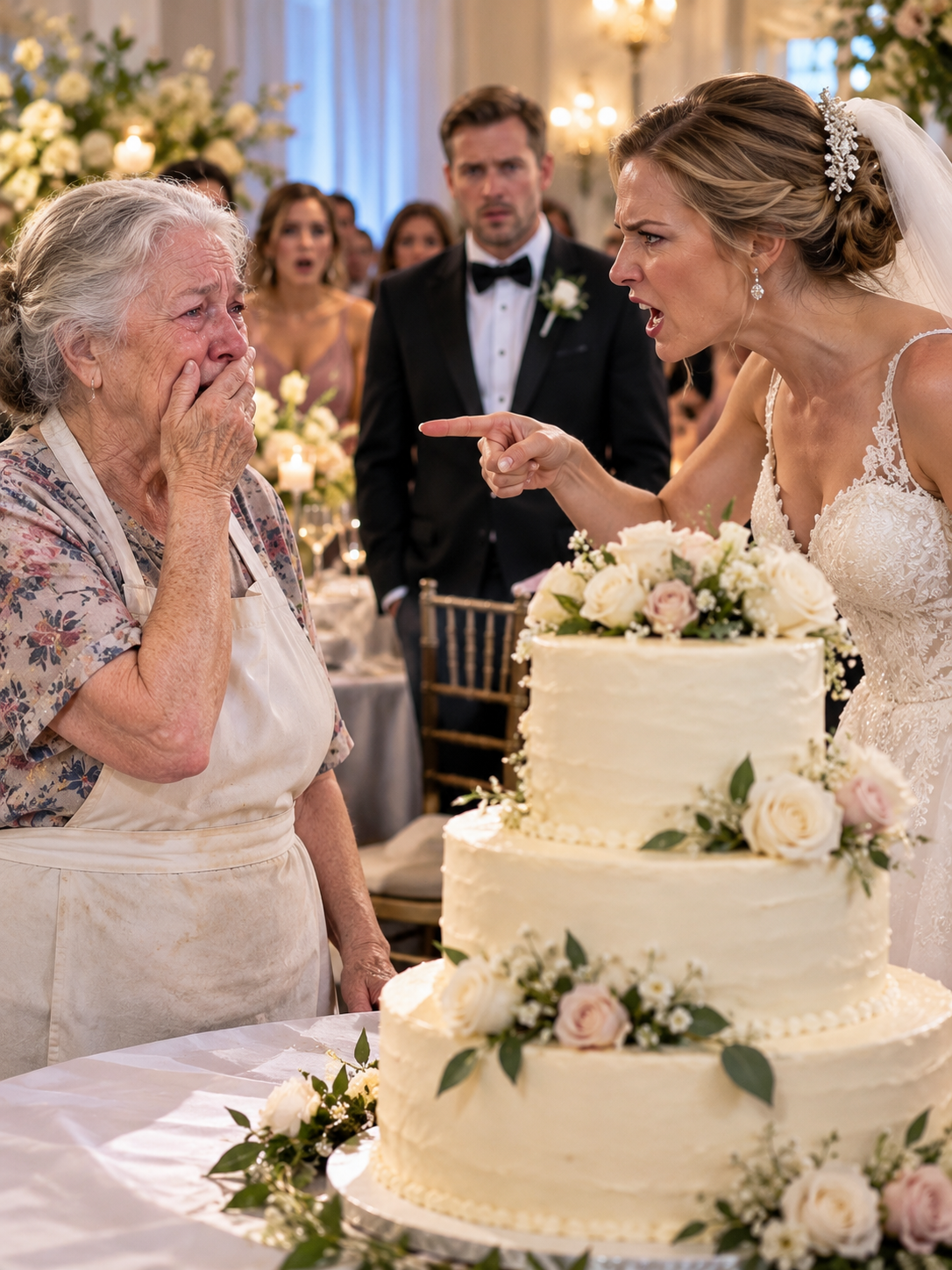
Grandma’s hands shook as she set the finished cake box on her kitchen table. Three tiers, ivory frosting, hand‑piped roses, gold ribbon — every detail exactly as Lila had begged for. Then my brother’s fiancée laughed, bright and sharp, and said the words that stopped us cold: “Oh, I never intended to pay. I just knew your family would do it for free if I asked nicely enough.” She winked, turned, and walked out the door without a backward glance.
I did not chase her down the driveway shouting insults. I did not demand payment in front of the whole neighborhood. I did not let her see how deeply her cruelty stung. I did not let her make Grandma feel small for loving too freely. I did not waste breath arguing with someone who already knew exactly what she’d done. I did not promise to make her apologize — I promised to make her remember.
I sat with Grandma that evening, wiping flour from her hands and listening to her quiet hurt. I looked at the recipes she’d kept in her head for sixty years. I thought of the wedding photos Lila had already posted all over social media — every detail bragged about, every expense mentioned except this one. I did not have much money. But I had something better: the truth, and the courage to speak it.
I waited. I planned. I stayed calm. I did not act out of anger. I acted out of respect — for Grandma, for our name, and for the family I knew my brother deserved to have beside him.
My name is Jenna Carter. I’m twenty‑four, the younger sister, the one who always notices the things people try to hide. Grandma is seventy‑eight. She’s been baking wedding cakes since she was sixteen — for neighbors, for friends, for strangers who couldn’t afford a bakery. She never turned anyone away. And Lila knew that.
She’d come to Grandma three months before the wedding. Sweet as honey. Hugs, compliments, stories about how she’d always dreamed of a cake “made with real love, not just sugar and flour.” She’d sat at Grandma’s kitchen table for hours, picking out every detail, writing nothing down, signing nothing — just promising, “I’ll pay you every penny right after the reception, I swear it.”
Grandma had worked for ten days straight. Up at four a.m. each morning. Resting when her back ached. Tasting, adjusting, perfecting. And when the cake was done, Lila changed. “Family shouldn’t charge family,” she said, standing in our doorway, arms crossed. “If you loved us, you’d give it as a gift.”
My brother, Tyler, stood beside her, quiet and confused. “Lila, you said you’d pay.”
She rolled her eyes. “Don’t be ridiculous. Why would I pay when I can get it for free? She’s your grandmother. She should be happy to do it.”
She didn’t know I’d recorded that conversation.
I hadn’t planned to. I’d just been testing my phone, standing in the hallway, and hit record by accident. But as her words played back — cold, calculating, rehearsed — I knew I had something she couldn’t talk her way out of.
I didn’t send it to everyone right away. I didn’t post it that night. I waited. I wanted to see what else she was hiding.
Over the next two weeks, I watched. I listened. I noticed the way she talked about “saving thousands” on everything — the venue deposit her parents had paid, the dress bought with Tyler’s credit card, the flowers “borrowed” from a friend’s garden with no intention of returning them. She wasn’t just cheap. She was systematically taking whatever she could get, smiling while she did it, and calling it “being smart.”
But there was something else. Something sharper. I saw her checking her phone when Tyler walked into the room. I saw her delete messages fast. I saw her smile falter when his name popped up on her screen.
I dug carefully. I didn’t hack anything. I didn’t break trust. I just asked the right people gentle questions — the maid of honor, a cousin, an old friend from high school. And the picture came together slow and clear.
Lila hadn’t just been planning a wedding. She’d been planning an exit. A separate bank account. A job offer in another state she hadn’t mentioned. And conversations with someone else — someone she’d been seeing on and off for months.
I didn’t confront Tyler. Not yet. He was head over heels. He’d think I was jealous. I’d think I was trying to ruin his happiness. So I prepared. I gathered everything — the recording, the receipts Grandma had kept for ingredients, the messages Lila had sent begging for every specific design, the hints from people who’d seen her with someone else.
I made two copies. One for me. One for Grandma. And I waited until the rehearsal dinner.
It was held at a nice restaurant, all the family there, toasts being prepared, everyone happy. Lila stood up, glass in hand, and turned to Grandma. “I want to thank you for the cake,” she said, voice loud and clear, “for giving it to us freely, like real family should. It means so much that you didn’t put a price on love.”
A few people clapped. Grandma sat quiet, hands folded in her lap.
That was my moment. I stood up. “Actually, Lila — she did put a price on it. You agreed to pay her twelve hundred dollars. You promised.”
Lila laughed, light and dismissive. “Jenna, don’t be silly. We never discussed money. She offered. I accepted.”
“Right here,” I said, pulling out my phone, “is the conversation where you asked, agreed to the price, and promised to pay after the reception.”
I hit play.
Her voice filled the room — bright, confident, unmistakable: “Twelve hundred is fine. I’ll have it all for you the day after. Don’t worry about a receipt. We’re family.”
Silence. Absolute, heavy silence. Lila’s face went white. “That’s… that’s taken out of context.”
“Is it?” I said. “Because I have the messages too. And the receipts for the flour, the butter, the fondant — over three hundred dollars out of Grandma’s own pocket. She didn’t just give you her time. She gave you her savings.”
Tyler turned to her. “Is that true?”
Lila stammered. “I… I thought… I figured since she loved us…”
“Love isn’t a payment plan,” I said. “And it’s not an excuse to take advantage of someone who’s too kind to say no.”
People began shifting in their seats. Whispers started. I saw the maid of honor look away, uncomfortable. I saw Lila’s mother lean forward, frowning.
But I didn’t stop there. Not quite.
“There’s something else,” I said, calm as I could be. “The job in Portland you haven’t told Tyler about. The messages you’ve been deleting every night. The trips you’ve been taking when you said you were with your sister.”
Lila went rigid. “How dare you.”
“I dare because Tyler deserves the truth,” I said. “He deserves someone who builds a life with him, not someone who uses him to get a wedding and then leaves.”
Tyler looked at Lila — really looked — and the hope in his eyes began to fade. “Is that true? Portland?”
She didn’t answer. She grabbed her purse and walked out of the restaurant. Fast. No denial. No explanation. Just gone.
The rehearsal dinner broke up quiet and heavy. Tyler sat alone for a long time. Then he came to me. “Did you know all this?”
“I found out this week,” I said. “I didn’t want to say anything until I was sure.”
He nodded slowly. “Thank you. I think… I think I knew something was off. I just didn’t want to see it.”
The wedding was called off the next morning. Lila didn’t argue. She didn’t fight. She packed her things and left town before noon. The cake sat untouched in Grandma’s kitchen — beautiful, perfect, unwanted.
Grandma looked at it with sad eyes. “What do we do now?”
“We share it,” I said.
We took it to the community center. We cut it into slices. We invited everyone — neighbors, kids, seniors, anyone who wanted a piece. We set up a table with Grandma’s recipe cards, free for anyone who wanted them. And as people ate and laughed and thanked her, I saw her shoulders relax. I saw her smile return.
But that wasn’t the end.
Three days later, a letter arrived at our house. Not from Lila. From a lawyer. Demanding compensation for “emotional distress” and “damaged reputation.” Claiming I’d fabricated the recording. Claiming Grandma had volunteered her services. Threatening to sue us for fifty thousand dollars.
Grandma’s hands trembled when she read it. “Fifty thousand? Jenna, we don’t have that.”
“We don’t need it,” I said. “Because they made a mistake.”
I pulled out the second copy — the full file, every message, every receipt, the original recording file with timestamp and metadata. And I’d found something else: the same lawyer had sent similar letters to two other families Lila had been involved with years before. Same pattern. Same demands. Same threats.
She hadn’t just targeted us. This was how she operated.
I compiled everything. I sent it all to the lawyer — certified mail, return receipt requested. I included one line: Drop this suit within forty‑eight hours, or we file a counterclaim for fraud and share every document with the state bar association.
The phone call came the next morning. The lawyer was angry, defensive, backing down fast. “This matter is closed,” he said. “No further action will be taken.”
Lila never called. Never apologized. Never even sent a message.
But I kept digging. Because something still felt unfinished. I went through the messages one more time — the ones from her old number, the ones she’d tried to delete. And there it was, buried deep in a folder marked Misc: a conversation between her and Tyler’s best friend, Jake.
“Once we’re married and the joint account is open, I’ll handle the transfer to Portland. No one will question it. It’s perfectly legal.”
“And Jenna? She’s getting too close.”
“Jenna won’t be a problem. By the time anyone notices, we’ll be gone. And she’ll be the one left explaining where the money went.”
I sat very still. She hadn’t just planned to leave. She’d planned to empty their joint savings, frame me for the theft, and disappear. The wedding wasn’t a celebration. It was the setup. And I’d stopped it just in time.
I went to find Tyler. I showed him the messages. He went pale. “I… I opened that account last week. She’s already on it.”
“Did she have signing authority?” I asked.
He nodded slowly. “She said it was ‘for household expenses.’ I didn’t think…”
We called the bank together. We froze the account. We changed the passwords. And the teller looked at us over the counter and said the words that made my blood run cold: “Someone withdrew half the balance in cash yesterday. Two thousand dollars. Your wife‑to‑be came in alone.”
Tyler stared at the floor. “She’s not my wife.”
“No,” I said. “She’s not.”
But as we walked out of the bank, my phone buzzed. An unknown number. A single message: You stopped the money. But you didn’t stop everything. He knows what you found. And he’s not leaving town.
I looked at the name at the bottom of the old messages — not Lila’s. Jake’s. The best friend. The one Tyler had known since kindergarten. The one who’d been standing right beside us through every rehearsal, every planning meeting, every family dinner.
He hadn’t just been helping her. He’d been running it. And now that she was gone, he was the one left holding the plan.
I turned to Tyler. “Where’s Jake?”
Tyler looked at his watch. “He said he’d meet us at the house in twenty minutes. He said he wanted to ‘help sort things out.’”
We stood on the sidewalk, the bank doors closing behind us, and realized — he wasn’t coming to help. He was coming to finish what they started.
✓ Lynn R. Adams
She Asked Grandma to Bake Her Dream Wedding Cake Then Refused to Pay — So I Gave Her a Gift She Could Never Return What do you do when someone takes your family’s kindness and throws it away like it …