Pregnant and Betrayed, She Was Thrown Out in Days—Then Grandma’s Forgotten Shack Revealed Who Really Owned Everything
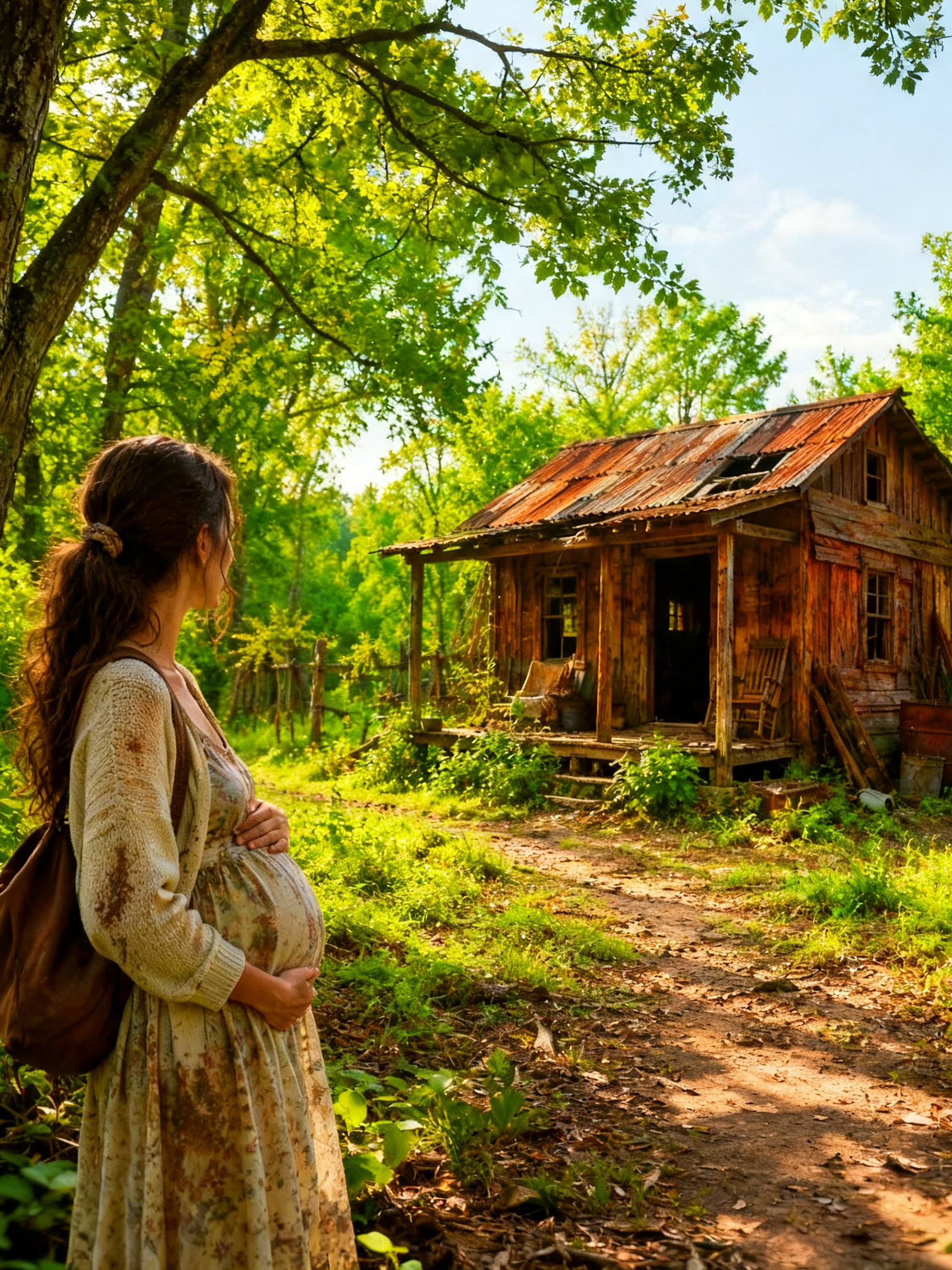
Pregnant and Betrayed, She Was Thrown Out in Days—Then Grandma’s Forgotten Shack Revealed Who Really Owned Everything
“Put your things on the porch before dinner,” my mother said. “Your brother’s buyer wants the house empty.”
I was seven months pregnant.
My husband had been dead for eleven weeks.
And the house my mother was ordering me out of had belonged to my grandmother.
I looked across the kitchen table at the three people who had apparently decided I no longer qualified as family.
My mother, Diane Harper, sat at one end with a cup of coffee she wasn’t drinking.
My younger brother, Caleb, leaned against the marble counter, scrolling through his phone.
Beside him sat Aunt Marlene, my grandmother’s younger sister, wearing the same narrow smile she used whenever she was about to say something cruel and call it practical.
A fourth person stood by the sink.
Victor Sloan.
Family attorney.
Real-estate attorney.
Occasional golf partner of my brother.
The man holding the folder that supposedly proved I had three days to disappear.
Caleb finally looked up.
“You knew Grandma was leaving the place to Mom.”
“No,” I said.
My voice was quiet.
That seemed to annoy him.
He expected tears.
He expected begging.
He expected me to say I had nowhere to go.
All of those things were true.
I simply didn’t give them to him.
My husband, Michael, had died when a delivery truck crossed the center line on Interstate 64 outside Lexington.
One moment he had been calling me from his pickup, asking whether our daughter had kicked yet.
The next, a state trooper was standing under my porch light.
Michael’s small contracting business had been overleveraged. Two clients refused to pay final invoices after his death. The business account was frozen during probate. Our apartment lease had ended thirty-six days later.
Grandma Evelyn had let me move into her guest room.
She died nine days after that.
Heart failure.
Eighty-three years old.
She had been sitting upright in a hospital bed, oxygen tube beneath her nose, her silver hair brushed the way she liked it.
Her last clear words to me had not been sentimental.
They had been strange.
“Don’t let them rush you.”
I thought she meant grief.
Now I wondered if she meant the people sitting around her kitchen table.
Victor opened the folder.
“The property at 418 Willow Creek Road passed through Evelyn’s revocable trust. Diane is successor trustee. The home is being sold, and the sale proceeds will be distributed according to the trust.”
“Which means,” Caleb said, “we’re all moving on.”
He smiled when he said all.
A family word used like a locked door.
I glanced toward the hallway.
My suitcase was still half unpacked upstairs.
Michael’s jacket still hung over the back of the bedroom chair because I hadn’t been able to put it in a closet.
Three tiny pink baby outfits were folded on Grandma’s sewing table.
An ultrasound photo sat inside the mirror frame.
Twenty-nine weeks.
A little girl.
Michael wanted to name her Grace.
Caleb stepped closer.
“Don’t make this ugly, Hannah.”
I looked at him.
“I’m not making anything.”
That was the first moment his smile weakened.
People get nervous when they have prepared themselves for your explosion and you don’t give them one.
My mother cleared her throat.
“You can stay until Friday morning.”
It was Tuesday.
“Where?” I asked.
Marlene sighed dramatically.
“You’re thirty-four years old.”
“I asked where you expect me to live.”
“Friends. A motel. One of those extended-stay places.”
My mother stared at her hands.
Caleb shrugged.
“You’ve always figured things out.”
That sentence landed harder than he understood.
I had always figured things out.
When Caleb wrecked Dad’s Ford at seventeen, I drove him to school for six weeks.
When Mom’s insurance failed to cover her surgery deductible, I emptied the savings account Michael and I had been building for our honeymoon.
When Grandma broke her hip, I rearranged my work schedule and drove ninety minutes every Tuesday and Thursday because everyone else was too busy.
When Aunt Marlene’s husband left her, I spent an entire Saturday helping her move furniture while Caleb attended a bourbon festival.
When Dad died, I handled the funeral programs.
When Mom froze, I called the cemetery.
When Caleb disappeared for half the reception, I sat with Grandma.
When Michael’s business finally began doing well, I gave my brother two roofing contracts because he said he needed a break.
When I became the one who needed a break, apparently the family had run out.
My mother pushed a manila envelope toward me.
“There’s five hundred dollars in there.”
I didn’t touch it.
“What’s that for?”
“Temporary expenses.”
Caleb rolled his eyes.
“No,” I said calmly. “I’m just trying to understand the transaction.”
Victor shifted near the sink.
He had stopped looking directly at me.
That interested me.
I reached for the envelope, opened it, and counted five one-hundred-dollar bills.
Then I placed them back on the table.
“You keep it.”
My mother blinked.
“You have a baby coming.”
“That’s why I’m keeping track of who gives me what.”
Caleb laughed.
“What does that mean?”
“Nothing yet.”
The baby pressed hard beneath my ribs.
I put one hand on the table until the pressure eased.
Caleb watched the gesture.
For half a second, something almost human crossed his face.
Then it vanished.
“Friday,” he said.
“I heard you.”
I walked upstairs.
I didn’t slam a door.
I didn’t call anyone and cry.
I didn’t confront Victor Sloan about why he wouldn’t meet my eyes.
And while I packed, I remembered something Grandma had given me six weeks earlier.
Not a house key.
It was smaller.
Heavy for its size.
She had slipped it into my palm when my mother went downstairs to argue with a nurse about parking validation.
At the time, Grandma’s hands had been cold.
She closed my fingers around the key and whispered, “Blue tin.”
“What blue tin?”
Her eyes sharpened.
“The shack.”
I smiled because I thought the medication had confused her.
Grandma had an old hunting shack at the far edge of the property, beyond the creek and behind forty acres of overgrown timber.
Nobody had used it since my grandfather died seventeen years ago.
The roof sagged.
One window was boarded.
Caleb called it the rat house.
As children, we had been forbidden to enter.
“Grandma, there’s nothing out there.”
She tightened her grip.
“If they tell you it’s worthless, go there.”
I had stared at her.
She let go of my hand.
Then she said something even stranger.
“Your grandfather made one mistake. I spent seventeen years correcting it.”
A nurse entered.
Grandma closed her eyes.
We never finished the conversation.
The brass key had been in the small zippered pocket of my purse ever since.
At the next afternoon, while my mother and Caleb were meeting the buyer’s agent, I drove Grandma’s old Subaru down the farm track toward the woods.
I didn’t tell anyone where I was going.
The October sky over eastern Kentucky was the color of dirty silver.
The gravel path disappeared beneath wet leaves.
Branches brushed the sides of the car.
When the road became too narrow, I parked and walked.
One hand under my stomach.
One hand holding Michael’s old flashlight.
The shack appeared between sycamore trees about two hundred yards past the creek.
It looked worse than I remembered.
One corner had sunk.
The porch leaned.
Green moss climbed halfway up the siding.
The chimney was cracked.
Someone had nailed a plywood sheet over the side window years ago.
The front door was secured with a rusted padlock.
The brass key didn’t fit.
I stood there in the damp leaves, staring at the lock.
Then I remembered Grandma hadn’t said door.
She had said blue tin.
I walked around the shack.
Behind it sat an old propane cage, empty except for vines.
Under the porch was a nest of broken flowerpots.
Inside the woodshed lay a pile of rotting cedar.
Nothing blue.
I almost left.
Then I saw a strip of faded paint beneath the edge of the porch.
I crouched carefully.
A square metal box was wedged between two support beams.
About the size of a loaf of bread.
I pulled it free.
The brass key fit.
Inside was another key.
A folded property map.
And a white envelope with my name on it.
Not “Hannah.”
My full legal name.
HANNAH ELISE HARPER REED.
Grandma’s handwriting.
My fingers went cold.
I opened the envelope.
There were only six lines.
If you are reading this, they moved faster than I hoped.
Do not sign anything.
Do not surrender any key.
The house is not the inheritance.
The shack is.
And remember what your grandfather always said about a survey line.
I read it twice.
Then a third time.
I looked at the collapsing building.
Rainwater dripped through one corner of the porch.
A squirrel barked somewhere in the trees.
If that was the inheritance, my family had just thrown me out of a $4,000 pile of rotten wood.
Except Grandma had written one sentence I could not ignore.
The house is not the inheritance.
The shack is.
I unfolded the map.
The property was outlined in black.
The house parcel sat near the road.
Forty-one acres.
The creek cut diagonally across the south end.
But the shack was not inside the same boundary.
A narrow strip of land extended behind it.
Then widened.
And widened again.
I followed the line with my finger.
183.7 acres.
I had lived near this land half my life.
I never knew Grandma owned 183 acres behind the woods.
At the bottom of the map, in faded pencil, someone had written:
NOT IN REVOCABLE TRUST.
I stared at the words.
Then I heard tires crunching behind me.
I folded the map fast and slid it inside my coat.
A black pickup appeared between the trees.
He got out wearing a tan jacket and work boots that had never touched actual work.
“What are you doing?”
“Out here?”
His eyes moved to the blue box in my hands.
“What’s that?”
“Something Grandma left under the porch.”
He came closer.
“What’s in it?”
I looked at him.
That was the second time his confidence flickered.
He held out his hand.
“Give it to me.”
I almost laughed.
Instead I asked, “Why?”
“Because all Grandma’s personal property belongs to the trust until inventory is complete.”
“You sound like Victor.”
“I talked to Victor.”
“I’m sure you did.”
He stepped onto the porch.
The boards complained beneath his weight.
“You need to stop acting suspicious.”
“I’m not acting suspicious.”
“What are you doing at the shack?”
“Grandma mentioned it.”
I said nothing.
His jaw tightened.
That was useful.
He wasn’t asking because he knew what was here.
He was asking because he was afraid Grandma had told me something he didn’t know.
Caleb pointed toward the Subaru.
“You mean your buyer’s home?”
“Don’t start.”
“I haven’t started anything.”
He stared at me.
The rain tapped the tin gutter.
For years, my brother had mistaken my willingness to keep peace for weakness.
He had never understood that silence can be observation.
Silence remembers.
Silence compares stories.
Silence notices which person answers too quickly.
Silence notices which lawyer looks at the floor.
Silence notices which brother follows a pregnant widow into the woods because she found a rusted box.
Just slightly.
Caleb hated that.
“You should leave,” I said.
His face hardened.
“This property is under contract.”
“Is the shack?”
“The whole place.”
“Are you sure?”
He took a step toward me.
Then stopped.
I saw the calculation behind his eyes.
If he grabbed me, the story changed.
Pregnant sister.
Dead husband.
Violent brother.
Caleb loved control more than he loved anger.
He stepped back.
“You have until Friday.”
“I remember.”
I waited until his truck disappeared.
Then I unlocked the shack with the second key.
The smell hit first.
Mouse droppings.
The room was maybe twelve feet by sixteen.
There was a broken cot against one wall, a cast-iron stove, two shelves, a wooden table, and a green filing cabinet.
The cabinet looked newer than everything else.
I tried the key.
It opened the bottom drawer.
Inside sat three document boxes wrapped in plastic.
My heart started beating faster.
I pulled the first one onto the table.
Original deeds.
Survey records.
Tax receipts.
Correspondence from a land-management company.
A conservation agreement.
Mineral-rights reservations.
I had worked as an office manager for a civil engineering firm for eight years before Michael died.
I knew enough about land records to know when I was looking at something important.
Parcel B had been purchased by my grandfather, Samuel Harper, in 1987.
One hundred eighty-three acres.
The deed had been recorded separately from the main home.
In 2003, he transferred Parcel B to Grandma alone.
Not to their joint trust.
Not to my mother.
To Evelyn Marie Harper, individually.
Ten dollars and love and affection.
Standard language.
Then I opened the second box.
Bank records.
Royalty statements.
Environmental studies.
An envelope marked DRY RIDGE LIMESTONE OPTION.
The most recent letter was dated four months earlier.
The proposed option payment was $280,000.
The purchase price, if exercised, was $6.8 million.
I sat down.
For several seconds I heard nothing but rain.
Six point eight million dollars.
For the land behind a shack everyone called worthless.
But that still wasn’t what Grandma meant.
I could feel it.
Because the third box was locked.
A small steel cash box sat inside.
The brass key opened that too.
On top was a handwritten note.
Not Grandma’s handwriting.
IF DIANE EVER TRIES TO SELL WILLOW CREEK WITHOUT HANNAH’S CONSENT, GIVE HANNAH THE ORIGINAL FILE.
DO NOT GIVE IT TO DIANE.
DO NOT GIVE IT TO MARLENE.
DO NOT GIVE IT TO ANY LAWYER WHO REPRESENTS CALEB.
I stopped breathing.
Below the note was a thick sealed envelope.
Across the front:
FOR HANNAH ONLY.
I carried the boxes to my car one by one.
Not because I was greedy.
Because somebody had followed me to the shack less than twenty minutes after I arrived.
That meant nothing left there was safe.
I photographed every room before touching anything else.
Floorboards.
Then I drove directly to the county clerk’s office.
Not to a friend.
Not to confront my mother.
The clerk behind the counter was a woman named Joanne Mills.
She had known Grandma.
Everybody in Mercer County seemed to know Grandma.
When I gave her the parcel number, she typed, frowned, then looked at me over her glasses.
“Your grandmother kept her taxes current.”
“On Parcel B?”
“Every year.”
“Whose name?”
She turned the monitor slightly.
Evelyn M. Harper.
Sole owner.
My pulse steadied.
“Any liens?”
Joanne clicked.
“Any recorded transfer after her death?”
She looked again.
“Any pending deed?”
Another click.
Her eyebrows lifted.
“There was an electronic filing attempt Monday.”
I felt the baby move.
“Rejected.”
“Grantor deceased.”
I stared at her.
“Who filed it?”
Joanne hesitated.
Public record or not, small counties come with small-town caution.
Then she printed the filing cover sheet.
Submitted by:
SLOAN & PIERCE, PLLC.
Victor Sloan.
WILLOW CREEK DEVELOPMENT HOLDINGS, LLC.
I knew that name.
Caleb had created Willow Creek Development three years ago.
He used it for flips.
The rejected deed claimed Grandma had transferred Parcel B to Caleb’s company two weeks before her death.
Except she hadn’t signed it.
At least not the Grandma I knew.
The signature looked wrong.
Too smooth.
And the notary?
Marlene Harper.
My stomach went cold.
Joanne lowered her voice.
“Hannah, do you have counsel?”
“You may want some.”
“Not Victor Sloan.”
For the first time, she smiled.
“Probably not Victor Sloan.”
I left with certified copies.
Then I drove to Danville.
There was one lawyer Grandma had mentioned over the years without ever explaining why.
Margaret Bell.
Estate litigation.
Seventy-one.
Small office above a pharmacy.
I arrived without an appointment.
Her assistant tried to stop me until I said Evelyn Harper’s name.
Five minutes later, Margaret Bell opened her office door herself.
She was short, white-haired, and wearing red glasses.
She looked at my stomach.
Then at the boxes.
Then at my face.
“Close the door,” she said.
Margaret didn’t touch the paperwork first.
She asked one question.
“Did Evelyn tell you not to sign anything?”
Margaret exhaled.
“That stubborn woman.”
“You knew?”
“I knew she was preparing.”
“For what?”
Margaret leaned back.
“For exactly this.”
The story came out slowly.
Not because Margaret was being dramatic.
Because lawyers who have spent fifty years cleaning up other people’s mistakes develop a deep hatred of guessing.
Grandpa Samuel had built a successful trucking company.
But successful enough.
When he sold it in 1998, the family suddenly had money.
Grandpa believed family wealth should remain family wealth.
Unfortunately, he also believed his oldest daughter—my mother—would protect everyone equally.
So he put most of the liquid assets and the main house into a family trust.
Diane eventually became successor trustee.
But Parcel B was different.
Grandpa had planned to develop it.
Then he discovered a limestone formation beneath the western ridge.
He became worried that future money would split the family.
So he transferred that land to Grandma individually.
Margaret opened the sealed envelope from the cash box.
Inside was a copy of a letter Grandpa had written to Grandma in 2004.
One paragraph had been underlined.
Hannah is the only one who ever comes here without asking what anything is worth.
I read it again.
Margaret said nothing.
I kept reading.
Grandpa wrote that I had spent summers helping him repair fences, stack firewood, clean the creek, and catalog birds for a conservation group.
Caleb had visited too.
Usually with friends.
Usually to ride four-wheelers.
Grandpa loved him.
But he didn’t trust his attitude toward money.
As for Mom, Grandpa had already begun noticing something I was too young to understand.
She treated family help like family debt.
Every favor became leverage.
Every gift came with invisible strings.
Grandpa wasn’t ready to disinherit anyone.
He wanted time.
Then he died of a stroke in 2009.
Grandma had spent the next seventeen years quietly protecting the land.
“And the rest?” I asked.
Margaret’s eyes narrowed.
“What rest?”
“The note said original file.”
I pushed the locked box toward her.
She examined the contents.
Then she found a flat brown envelope taped beneath the bottom liner.
My skin prickled.
Inside was a trust amendment.
Recorded with a private trust company but not yet with the county because it governed inheritance, not title.
Margaret read it once.
Then again.
Then she whispered, “Evelyn, you beautiful old fox.”
She turned the document toward me.
Grandma’s will left Parcel B to me.
That was the obvious part.
The less obvious part was a conditional provision tied to the family trust.
If any beneficiary knowingly attempted to seize, encumber, falsify transfer of, or force sale of Parcel B before estate administration was complete, that beneficiary’s share of certain trust assets would be suspended pending an accounting.
If the attempt involved fraud or a forged instrument, the trustee could be removed automatically upon court finding.
My mother was trustee.
Caleb was a beneficiary.
Aunt Marlene had notarized the rejected deed.
Victor had filed it.
I looked at Margaret.
“Grandma expected this?”
“She feared it.”
Margaret folded her hands.
“Because this wasn’t the first time.”
The room became very still.
“When was the first?”
“That,” she said, “is what we need to prove.”
My phone rang.
I let it ring.
Then a text arrived.
WHERE ARE YOU?
THE BUYER IS COMING FRIDAY AT 9. HAVE YOUR THINGS OUT.
Then Caleb.
Mom says you took documents from Grandma’s property. Those belong to estate. Bring them back tonight.
I showed Margaret.
She pushed her red glasses up her nose.
“Do not respond.”
“I wasn’t planning to.”
That earned me a glance of approval.
We spent three hours making copies.
Everything was scanned.
Every original catalogued.
Margaret called a title attorney she trusted in Louisville.
She also called a retired surveyor named Franklin Webb.
When she said his name, I remembered Grandma’s line.
Remember what your grandfather always said about a survey line.
Franklin arrived at seven that evening carrying a canvas tube and a face that looked carved from fence posts.
He knew the property.
More importantly, he had surveyed it in 2003.
“The main house sits on forty-one acres,” he said. “Parcel B wraps behind it.”
“I saw the map.”
“You saw the old map.”
He unrolled another.
This one was enormous.
And immediately, I saw something wrong with the sale.
The driveway.
The house at 418 Willow Creek Road had a long paved driveway leading from the county road.
According to Franklin’s survey, the first two hundred feet belonged to the house parcel.
Then the driveway crossed a narrow strip of Parcel B.
Then returned to the house parcel near the garage.
“What does that mean?”
Franklin tapped the paper.
“Means the house has an access easement over Parcel B.”
“Personal easement.”
Margaret smiled.
I looked between them.
“What am I missing?”
Franklin answered.
“Evelyn granted access to herself and invited guests. No assignable commercial access. No construction access. No development access.”
I stared at the map.
Caleb’s buyer wasn’t purchasing the house to live in.
I knew that much.
They were planning something bigger.
“How big is the buyer?”
Margaret asked.
I opened my phone and searched the LLC named on the sales flyer I’d seen in the kitchen.
Blue Ridge Senior Living Partners.
A regional developer.
They built luxury retirement communities.
I found a planning-board agenda from the previous month.
Proposed project:
Willow Creek Residences.
Eighty-four units.
Medical pavilion.
Estimated investment:
$28 million.
The land under contract included the house parcel.
Their planned construction route?
Grandma’s driveway.
Across my land.
Margaret leaned back slowly.
“That,” she said, “is why they needed Parcel B.”
Suddenly the attempted deed made sense.
They didn’t just want the limestone.
They needed the access strip.
Caleb had probably promised it to the developer.
And if the closing happened Friday without Parcel B, the project might collapse.
My family hadn’t thrown me out because they were impatient.
They had thrown me out because they were rushing a closing before I discovered what Grandma had done.
The pain of that realization surprised me.
Not because Caleb was capable of it.
Because my mother was.
Mom knew Michael was dead.
She knew I was carrying his daughter.
She knew I had $3,412 in my personal checking account.
She knew I had spent years helping everyone.
And somewhere between Grandma’s hospital bed and Tuesday’s kitchen table, she had decided that my vulnerability made me easier to remove.
Margaret watched my face.
“You all right?”
“You don’t have to be.”
I folded my hands over my stomach.
“What happens if I leave by Friday?”
“Nothing legally harmful by itself.”
“What happens if they close?”
“They may create a mess. But they cannot legally convey your parcel if Evelyn’s documents hold.”
“What happens if I tell them now?”
Margaret considered.
“They delay. They regroup. They may destroy evidence.”
That was the moment my strategy became very simple.
I would leave.
Not surrender.
Let them believe the quiet pregnant widow had accepted defeat.
Let them believe the shack was worthless.
Let them believe Grandma’s strange warnings died with her.
Let them believe Friday belonged to them.
On Thursday, I packed everything I owned into the Subaru and Michael’s old work van.
A friend named Rebecca let me store the van behind her dental office.
I booked four nights at a roadside hotel off Route 127.
Not glamorous.
Ground floor.
At six that evening, my mother stood in the doorway while I carried the last suitcase outside.
She had the five-hundred-dollar envelope in her hand.
“You’re being stubborn.”
“I’ve been called worse.”
“Hannah, I don’t understand why you’re turning this into some moral performance.”
The old kitchen light shone behind her.
For a second, I saw my mother as she had been when I was eight.
Laughing with Dad over burned pancakes.
I wondered when money had started translating every relationship for her.
Maybe slowly.
Maybe after Dad died.
Maybe after Grandpa’s estate made comfort feel permanent.
Maybe she had always been this way and I had spent years editing her in my memory.
“I’m not performing,” I said.
“You’re making us feel guilty.”
“I haven’t accused you of anything.”
“That’s worse.”
Interesting.
I set the suitcase in the van.
She followed me down the porch steps.
“Caleb says you went to the shack.”
“Grandma mentioned it.”
“What did she say?”
There it was again.
Not What did you find?
What did she say?
Everyone was afraid of a dead woman’s last words.
I looked at my mother.
“She said you’d probably sell the house.”
Mom’s shoulders loosened a fraction.
“She was right.”
I closed the van doors.
Mom lowered her voice.
“The shack is dangerous. The whole back acreage is useless.”
“Back acreage?”
Her face changed.
Tiny change.
But I saw it.
So she knew.
“How much acreage?” I asked.
She looked toward the house.
“I don’t know. Woods.”
“Caleb told me everything was under contract.”
“Including the woods?”
“Victor is handling it.”
That sentence had become the family religion.
Victor is handling it.
Then I took the hotel key card from my pocket.
“I’ll be gone tonight.”
My mother looked surprised.
“You don’t have to leave until morning.”
“You wanted the house empty.”
“Well… yes.”
“It’s empty.”
She stared at me.
Perhaps she expected a final plea.
A breakdown.
Some proof that she still had power over how badly this hurt.
I gave her none.
I opened the car door.
Then she said, “You know I love you.”
There are sentences people use because they’re true.
There are sentences people use because they’re afraid their actions have made them unbelievable.
I looked at her.
“I know you say that.”
Then I drove away.
Friday morning at , Caleb sent me a photograph.
Champagne bottles on Grandma’s kitchen island.
A caption beneath it:
NEW CHAPTER.
I looked at the photo for a long time.
Grandma’s yellow ceramic rooster was still on the windowsill.
Michael used to joke that it looked angry enough to collect taxes.
My brother had placed a champagne bottle beside it.
At , another text arrived.
Closing today. Buyer increased earnest money. Glad everyone can finally move forward.
I forwarded the screenshots to Margaret.
She replied with one sentence.
Good. Let him keep talking.
At 10:06, Blue Ridge Senior Living Partners wired the first installment.
At 10:21, Victor emailed closing confirmations.
At 10:33, Caleb posted a photo on social media outside the title company with my mother and Aunt Marlene.
Three smiling faces.
BIG THINGS COMING TO WILLOW CREEK.
I saved it.
At 10:41, Margaret filed an emergency petition in Mercer Circuit Court.
At 11:12, the judge issued a temporary restraining order preventing any construction traffic, conveyance, financing, or encumbrance involving Parcel B.
At 11:26, the county clerk flagged the rejected deed for suspected fraud review.
At 11:38, Margaret emailed notice to Blue Ridge.
At 11:43, Blue Ridge’s lawyer called Victor Sloan.
At 11:47, Caleb called me.
I was sitting in a diner eating scrambled eggs and dry toast.
My phone buzzed across the table.
I let it ring.
Then my mother.
Then Caleb.
Then Victor.
Then Aunt Marlene.
My waitress refilled my water.
“Popular today?”
“Apparently.”
At 11:54, I answered Caleb.
He didn’t say hello.
“What did you do?”
I cut a piece of toast.
“What do you mean?”
“Don’t play games.”
“I’m having breakfast.”
“You filed something against the property.”
“I retained counsel.”
“You retained—what the hell is wrong with you?”
“Lower your voice.”
He stopped.
Not because he suddenly became respectful.
Because my calm made him listen harder.
“The buyer is threatening to freeze closing funds.”
“That sounds inconvenient.”
“Hannah, this affects Mom.”
“I’m sure.”
“And Marlene.”
“I’m sure.”
“Yes, Caleb. That part I understood.”
He breathed hard through his nose.
“You don’t own that land.”
“Then the court should clear this up quickly.”
Then, “What did Grandma give you?”
I dipped my toast in egg.
“Why are you asking?”
“What did she give you?”
“You said I don’t own anything.”
“She was sick.”
“She wasn’t thinking clearly.”
“Was she thinking clearly when Victor filed a deed saying she transferred Parcel B two weeks before she died?”
Not a breath.
Not a curse.
That silence was worth more than any confession.
I continued.
“Because the clerk rejected it.”
He hung up.
At 12:08, Victor called.
I answered on speaker with Margaret sitting across from me.
“Hannah,” he began, “there appears to be a misunderstanding.”
Margaret covered a smile with her coffee cup.
“What misunderstanding?”
“Certain preliminary documents were filed based on estate planning instructions that may not have been fully processed before Evelyn’s passing.”
“A deed isn’t an estate-planning instruction.”
“And Aunt Marlene notarized it.”
“It is important not to jump to conclusions.”
“Then perhaps we can meet.”
“My attorney can arrange that.”
“You hired Margaret Bell.”
I looked at Margaret.
She raised one eyebrow.
Victor’s tone changed.
Only slightly.
“Margaret has a reputation for escalating situations that could be resolved privately.”
Margaret mouthed, Thank you.
I almost smiled.
“I’m comfortable with her reputation.”
“Hannah, think carefully about the stress this could cause your mother.”
I felt my daughter kick.
I placed my palm over the movement.
“My mother gave me seventy-two hours to become homeless while seven months pregnant.”
He said nothing.
“I think she can survive a court hearing.”
I ended the call.
That afternoon, Blue Ridge terminated the closing.
Not the purchase agreement.
But they refused to release additional funds until title questions were resolved.
Caleb’s celebration stopped before the champagne went flat.
Saturday morning, my hotel room phone rang at .
The front desk clerk told me someone was asking for my room number.
She had refused.
“Man. Said he was family.”
“Did he give a name?”
I called Margaret.
Then I checked my car.
Nothing obvious.
But the passenger door was unlocked.
I was certain I had locked it.
Inside, the glove compartment stood open.
The property documents weren’t there.
Those were in Margaret’s office.
But someone had searched the car.
That changed things.
I moved hotels.
Margaret arranged for a private process server to deliver preservation notices to Caleb, Mom, Marlene, Victor, and the title company.
No documents destroyed.
No devices wiped.
No estate files altered.
No trust records discarded.
Then she filed a request for forensic accounting.
Monday brought the first real fracture.
Blue Ridge’s attorneys produced emails during expedited discovery.
Caleb had told them Parcel B was “family-controlled” and would be conveyed before construction.
He had attached a draft deed.
The same deed later filed after Grandma died.
The draft metadata showed it had been created three months earlier.
While Grandma was alive.
While I was driving her to cardiology appointments.
While my mother was telling me not to worry about estate paperwork.
While Caleb was bringing Grandma grocery-store flowers and taking selfies beside her hospital bed.
One email from Caleb to Victor read:
We need this wrapped before Hannah starts asking questions. Evie talks to her too much.
Margaret printed that one.
She didn’t say anything when she handed it to me.
She didn’t need to.
I sat in her office and read the sentence until the words blurred.
Not from tears.
The kind that doesn’t make you scream.
The kind that makes you organize paper.
I opened my laptop.
“What are you doing?” Margaret asked.
“Making a timeline.”
Every hospital visit.
Every email.
Every real-estate meeting.
Every trust transfer.
Every filing attempt.
Every time someone pressured Grandma.
Every time I was told not to worry.
Every time Victor contacted my mother.
Every time Caleb contacted Blue Ridge.
Margaret watched me type.
“You’ve done litigation work?”
“You’d be good at it.”
“I’ve managed contractors.”
“Same personality types. Better shoes.”
By Tuesday, the forensic accountant found something else.
Grandma’s family trust had once held $4.3 million in investment assets.
Current value?
$1.9 million.
Some decline could be explained by withdrawals.
Living expenses.
But $740,000 had moved into companies connected to Caleb over six years.
“Loans,” Mom called them.
There were promissory notes.
Most unsigned by Caleb.
Several had no repayment schedule.
One transfer for $185,000 funded his first development project.
Another paid off a judgment after a failed restaurant investment.
Another purchased two trucks.
I had known Grandma helped him.
I had never known how much.
Then the accountant highlighted payments to me.
There were only three.
$1,200 when I graduated college.
$4,000 toward my wedding.
$9,500 when Michael and I bought our first home.
I stared at the comparison.
Caleb: $740,000.
Hannah: $14,700.
That wasn’t what hurt.
Grandma could do what she wanted with her money.
What hurt was the next page.
Trust records showed three withdrawals labeled:
HANNAH SUPPORT.
I had never received it.
One payment of $40,000 supposedly covered “Hannah home down payment.”
Michael and I had bought our first townhouse with $11,000 we saved ourselves.
Another $62,000 supposedly covered “Hannah business support.”
I had never owned a business.
Another $84,000 supposedly paid “Hannah family medical.”
Michael’s accident bills had been covered mostly by insurance.
My mother had listed money taken from the trust as money given to me.
Money I had never seen.
Margaret leaned across the conference table.
“Now we know why Evelyn amended everything.”
I felt sick.
“Mom used my name.”
“For years.”
That evening, Mom came to Margaret’s office.
No appointment.
Just my mother.
Margaret asked whether I wanted her removed.
Mom entered carrying her purse like a shield.
She looked smaller than I remembered.
Her lipstick was uneven.
“You won’t answer me.”
“I’m answering now.”
Margaret remained in the room.
Mom looked annoyed.
“This is family.”
Margaret said, “Then your family has unusually complicated financial statements.”
Mom ignored her.
“You’ve embarrassed Caleb.”
I almost admired the sentence.
Not You’re wrong.
Not I didn’t take the money.
Not The deed wasn’t forged.
You’ve embarrassed Caleb.
“What does he think I should be embarrassed about?” I asked.
“This lawsuit.”
“It’s not a lawsuit yet.”
“Whatever it is.”
“The $740,000?”
Her lips pressed together.
“He needed help.”
“The money taken in my name?”
“That was accounting.”
“No. Accounting records things that happened.”
“It was all for the family.”
“Which family?”
“Did you receive any of the money marked as mine?”
She looked toward the window.
That was enough.
I leaned back.
“Why did you tell me to leave?”
“Because the buyer needed possession.”
“They’re developing.”
“Why did you need me gone before closing?”
“You were living there temporarily.”
“Why did Caleb write that you needed the land wrapped up before I started asking questions?”
Mom’s head turned.
She hadn’t seen that email.
For one second, fear opened across her face.
Then she recovered.
“You don’t know the full situation.”
“I can’t discuss documents while lawyers are involved.”
Margaret smiled without humor.
Mom glared at her.
Then back at me.
“You have become very cold.”
That one almost worked.
Because daughters are trained from childhood to fear that word.
Ungrateful.
Words used when women stop absorbing damage politely.
I looked at my mother.
“No. I just stopped making you comfortable.”
Her eyes filled.
Real tears.
“I lost my mother too.”
“You think this is easy for me?”
“Then why are you doing this?”
I glanced at the forensic report.
“Because you put my name on money I never received.”
“You always thought you were better than us.”
“You always had to be the responsible one. The good daughter. The one Grandma trusted.”
“The one who never needed anything.”
There it was.
Not a confession.
Something sadder.
Resentment.
My independence had offended her.
Every time I solved my own problem, she had apparently heard judgment.
Every time Grandma trusted me, Mom had heard comparison.
Every time I helped without demanding repayment, Caleb had seen a resource.
Mom moved toward the door.
Then stopped.
“You have no idea how expensive it was keeping this family together after your father died.”
I said softly, “Then show me.”
She turned.
“Show you what?”
“The records.”
“All of them.”
Margaret looked at me.
I continued.
“If everything was for the family, show me.”
Mom stared at me for five long seconds.
Then she left.
She never showed me.
The court hearing was scheduled for Thursday.
By then I had moved into a furnished apartment Margaret helped me find through a client.
Second floor.
Yellow walls.
A balcony overlooking a tire shop.
Rebecca brought me a crib.
Margaret brought a smoke detector because she didn’t trust landlords.
My baby shower consisted of six people eating grocery-store cupcakes on folding chairs.
I liked it more than most expensive parties I had attended.
No one asked what I could do for them.
That mattered.
Thursday morning, I wore a navy maternity dress and Michael’s watch.
His watch was too big.
I had the band tightened three holes.
It still slid slightly on my wrist.
Before entering court, I stood outside beneath a red maple tree and touched the scratched metal face.
“You wanted her named Grace,” I whispered.
Then I went inside.
Caleb arrived in a blue suit with Victor.
Mom wore gray.
Aunt Marlene wore pearls.
Blue Ridge sent two attorneys.
The courtroom wasn’t dramatic.
No shouting.
Real court is mostly paper and waiting.
But one moment changed everything.
Margaret called the county clerk’s records custodian.
She authenticated the rejected deed.
Then she called a handwriting expert.
Grandma’s signature was likely traced.
Not copied freehand.
The underlying model appeared to be a signature from a 2021 trust document.
Marlene stared straight ahead.
Victor took notes.
Caleb kept rubbing his thumb against his index finger.
Then Margaret introduced hospital records.
Grandma had been admitted on the supposed signing date.
At p.m., she received morphine.
At , nursing notes described her as disoriented.
The forged deed claimed she signed at .
At her house.
Twelve miles away.
Notarized by Marlene.
The judge looked over his glasses.
“Ms. Harper?”
Marlene’s face lost color.
Victor rose.
“My client invokes—”
The judge lifted one hand.
“I wasn’t asking for testimony, counsel. I was confirming whether Ms. Harper is the notary identified.”
Victor sat.
“Yes, Your Honor.”
The judge looked at Marlene.
Then at the deed.
“Understood.”
The temporary restraining order became a preliminary injunction.
Parcel B was frozen from transfer.
The disputed deed was referred to the county attorney.
The trust accounting continued.
And Diane Harper—my mother—was temporarily suspended as trustee.
That was the legal twist Grandma had planted.
Not revenge.
A tripwire.
If they left the land alone, their shares remained protected.
If they tried to steal it, the trust opened.
My mother had spent years insisting Grandma was confused.
Grandma had quietly constructed a mechanism that depended on my mother doing exactly what Grandma expected.
Greed pulled the pin.
Outside the courthouse, Caleb followed me toward the parking lot.
I kept walking.
“Hannah, stop.”
He came close but not too close.
Cameras from a local reporter were twenty feet away.
“You’re destroying everything Grandpa built.”
“You think you won because you found some paperwork?”
“This project could have made all of us rich.”
“There it is.”
“All of us.”
His face tightened.
“You’d rather leave that land empty?”
“I haven’t decided.”
“It’s rock and trees.”
“Then why did you forge a deed for it?”
“I didn’t forge anything.”
“I didn’t say you did.”
He realized his mistake.
I continued.
“But somebody did.”
He looked toward Victor.
That glance lasted less than a second.
So did Margaret.
Another piece.
Victor wasn’t simply Caleb’s helpful attorney.
Caleb was afraid of him too.
That afternoon, Blue Ridge formally terminated the purchase contract.
Caleb’s $420,000 expected developer fee vanished.
The house sale collapsed with it.
My mother still owned or controlled the house only subject to the court’s trust review.
Nobody opened champagne.
Two weeks later, the limestone company renewed its interest in Parcel B.
Their new offer was higher.
$7.4 million.
I declined.
Not because I had become sentimental.
Because I read the environmental report.
The ridge contained more than limestone.
It protected the watershed feeding three farms downstream.
Grandpa had known.
Grandma had known too.
Mining it would have meant blasting half the ridge.
The family had looked at the land and seen a number.
Grandma had looked at it and seen time.
So I negotiated something different.
A conservation group agreed to purchase a permanent easement over 121 acres.
The payment was substantial.
Enough to eliminate my financial fear.
Not enough to make me careless.
The remaining acreage, including the commercial frontage, retained development value.
And the shack?
I hired one of Michael’s former crews to stabilize the foundation.
We repaired the roof.
Replaced the windows.
Saved the old floorboards.
I left Grandpa’s cast-iron stove exactly where it stood.
Every Saturday, I drove out and watched the place come back to life.
The first time I stood inside after the roof stopped leaking, I cried.
Not loudly.
Not dramatically.
I sat on the repaired porch, seven and a half months pregnant, listening to the creek, and let the tears come.
Because Michael should have been there.
Because Grandma should have been there.
Because sometimes winning doesn’t return the people who made the victory matter.
Three days later, Margaret called.
“They found another account.”
I was standing in the baby section at Target.
“What account?”
“In Evelyn’s records.”
“More trust money?”
She paused.
“Your father’s.”
I gripped the shopping cart.
Dad had died twelve years earlier.
“What do you mean?”
“A custodial account.”
I closed my eyes.
“How much?”
“That’s the problem.”
“What problem?”
“It was closed.”
“Eleven months after his death.”
“How much?”
“Originally, about three hundred twelve thousand.”
The store noise seemed to move far away.
Parents talking.
Cart wheels.
A child laughing.
“That can’t be right.”
“Your father created it when you were nineteen. Investment account. Beneficiary designation. There are records of annual contributions.”
“I never knew.”
“Where did the money go?”
“We’re tracing it.”
I looked down at the tiny white socks in my cart.
Three hundred twelve thousand dollars.
At twenty-two, I had worked two jobs.
At twenty-four, I had delayed graduate school because I couldn’t afford tuition.
At twenty-seven, Michael and I used credit cards to cover his surgery deductible.
At thirty-one, we nearly lost the townhouse during a slow winter.
All while an account my father intended for me had existed.
Then disappeared.
“Margaret.”
“Was Grandma investigating this?”
“I think so.”
That became the real inheritance.
Not the land.
Not the $7.4 million offer.
Not the conservation payment.
Proof that I had not imagined a lifetime of being asked to carry more while receiving less.
Proof that “responsible” had become another word for convenient.
Proof that every time my family told me I was lucky not to need help, they were benefiting from keeping help away from me.
The forensic accountant followed the custodial money.
$312,000 became $289,000 after taxes and liquidation.
Then it moved through three accounts.
Eventually, $168,000 went toward the purchase of a commercial building Caleb owned.
$71,000 covered my mother’s mortgage after refinancing trouble.
$50,000 moved into an account controlled by Aunt Marlene.
The rest vanished through cash withdrawals and fees.
Caleb claimed he had no idea where the original funds came from.
Mom refused to answer without counsel.
Marlene stopped returning calls.
Victor withdrew from representing the family trust due to “potential conflicts.”
Margaret laughed for almost ten seconds when she read that letter.
Then, on November 18, I went into labor.
Three weeks early.
My water broke inside the shack.
Of course it did.
I had been standing beside the green filing cabinet while a contractor installed trim.
One moment I was explaining where Grandma kept spare lanterns.
The next, warm water ran down my legs.
The contractor, a sixty-year-old man named Dale, went completely white.
“Oh, Lord.”
I looked down.
Then at him.
“Call Rebecca.”
“Hospital?”
“First Rebecca.”
“She has the bag.”
“Then call the hospital.”
Grace Evelyn Reed arrived six hours later.
Five pounds, eleven ounces.
A furious little face.
Michael’s chin.
When the nurse placed her against my chest, I understood something that had taken thirty-four years to learn.
Family is not the person who shares your blood.
Family is the person who treats your vulnerability as something to protect rather than exploit.
Rebecca slept in a chair beside my hospital bed.
Margaret brought flowers.
Dale sent a stuffed bear approximately the size of a washing machine.
My mother came the second day.
She stood outside the room until I allowed her in.
She looked at Grace from six feet away.
“She’s beautiful.”
“May I hold her?”
Mom swallowed.
I didn’t enjoy saying it.
That mattered to me.
Cruelty would have meant I was becoming like them.
A boundary was different.
For several minutes, we watched Grace sleep.
Then she said, “I made mistakes.”
“I was scared after your father died.”
“I had bills.”
“Caleb needed help.”
Finally she looked at me.
“Say something.”
“What do you want me to say?”
“That you understand.”
“I understand.”
Relief crossed her face too early.
Then I continued.
“I understand you chose.”
Her relief disappeared.
“You chose which child would be protected.”
“You chose which child could wait.”
“That’s not fair.”
“You chose which child could solve her own problems.”
“I thought you were stronger.”
That sentence hurt more than the others.
Because she meant it.
She had punished me for surviving.
I looked at Grace.
“Then you should have wanted me to stay strong.”
Mom’s eyes filled.
“I’m still your mother.”
“I love you.”
“I believe you.”
She blinked.
That surprised her.
I continued.
“But love without safety isn’t enough.”
She cried then.
Not as punishment.
Not as forgiveness.
Just consequence.
She left without holding Grace.
In December, the court removed Mom permanently as trustee.
A neutral fiduciary took control.
The accounting converted the so-called family loans into charges against Caleb’s inheritance.
Funds falsely attributed to me were restored to my share.
The custodial account became part of a separate civil action.
Marlene surrendered her notary commission before the state could revoke it.
Victor faced a disciplinary investigation.
Caleb’s development company lost financing.
Not everything ended in dramatic ruin.
Real consequences are slower.
Credit lines vanish.
Lawyers stop returning favors.
Invitations disappear.
People who once laughed at your jokes become suddenly busy.
By New Year’s, Caleb listed his lake house.
By February, he sold two trucks.
By March, my mother moved out of Grandma’s house while the trust prepared it for sale under court supervision.
I didn’t buy it.
Everyone assumed I would.
I didn’t want it.
Too many rooms held memories I no longer trusted.
Instead, I bought seventeen acres adjacent to Parcel B.
I planned a small house.
A room for Grace facing the trees.
The old shack would become something else.
I created the Evelyn Harper Land Fund.
Not a grand charity.
Not a vanity foundation.
A local legal fund for widows, single parents, and elderly property owners facing coercive sales, title fraud, or inheritance abuse.
Grandma’s shack became its office.
Two chairs.
Good coffee.
Margaret volunteered on Thursdays.
The first person we helped was a seventy-six-year-old farmer whose nephew had slipped a quitclaim deed into a stack of medical papers.
The second was a divorced mother facing an illegal lockout.
The third was a mechanic whose siblings tried to sell their father’s land without telling him he owned one-third.
I used part of the conservation payment to fund the first two years.
That was when I finally understood what Grandma meant.
The shack was the inheritance.
Not because of what was under it.
Because of what it gave me.
A way to make what happened to me useful to someone else.
In April, six months after I was thrown out, I took Grace to Grandma’s grave.
Spring grass covered the cemetery.
Dogwoods bloomed along the road.
I placed a photograph of the restored shack beside the headstone.
Grace slept against my chest.
“You were right,” I told Grandma.
I felt ridiculous talking to stone.
I did it anyway.
“The house wasn’t the inheritance.”
Wind moved through the maple branches.
Then my phone rang.
I almost ignored it.
Sunday afternoon.
She never called Sundays unless something mattered.
“Hannah, where are you?”
“Cemetery.”
“With Grace?”
“Are you alone?”
That changed my heartbeat.
“Go somewhere public.”
“We opened the final archive box from Evelyn’s safe-deposit inventory.”
“What final box?”
“The bank found a secondary drawer number in an old lease.”
I started walking toward my car.
“What was inside?”
“From Grandma?”
I buckled Grace into her car seat.
“What else?”
Margaret didn’t answer immediately.
“Margaret.”
“There’s a deposition transcript from 2009.”
“The year Grandpa died?”
“Who gave a deposition?”
“Your father.”
My hand froze on the car door.
Dad hadn’t died until 2014.
“About what?”
“Samuel Harper’s estate.”
“Why would Dad be deposed?”
“That’s what I’m trying to determine.”
I got into the car.
The cemetery suddenly felt too quiet.
“Is Mom mentioned?”
A longer pause.
My skin went cold.
Victor had claimed he didn’t begin working with the family until 2013.
Four years later.
“What does the transcript say?”
“I’m not discussing all of it over the phone.”
“Tell me one thing.”
Margaret exhaled.
“Your father believed someone was moving assets out of Samuel’s estate before probate closed.”
I stared through the windshield at Grandma’s grave.
“He names three people.”
My voice dropped.
“And Victor?”
I stopped breathing.
“Who’s the third?”
“The name is Michael Reed.”
For several seconds, I could not understand the words.
My Michael.
My dead husband.
The father of my daughter.
The man who had been twenty-one years old in 2009.
The man I had not even started dating until 2011.
“That’s impossible.”
“He didn’t know my family then.”
“That’s what you told me.”
“He was in Tennessee in 2009.”
“He was in community college.”
“So it’s another Michael Reed.”
“I hoped so.”
My hand tightened around the phone.
“You checked.”
Margaret’s voice became very careful.
“The transcript includes a Social Security number exhibit.”
The world seemed to narrow to the sound of Grace breathing behind me.
“It’s him?”
I stared ahead.
A truck passed on the distant road.
Birds lifted from a field.
I remembered Michael’s funeral.
His work boots beneath the memorial table.
His friends telling stories.
His mother holding Grace’s ultrasound image against her chest.
I remembered every night we had stayed awake talking.
Every debt.
Every sacrifice.
Every secret I thought marriage had removed between us.
Then I remembered something else.
Michael had hated Willow Creek.
Not disliked it.
Whenever Grandma asked us to visit, he found a reason to leave early.
Whenever Grandpa’s name came up, Michael became quiet.
Once, years earlier, I had asked him why.
He kissed my forehead and said, “Some families keep too many ghosts.”
At the time, I thought he meant mine.
My mouth went dry.
“What exactly did Dad say about Michael?”
Margaret hesitated.
Then she read one sentence.
“‘The Reed boy saw the transfer happen, and if Diane finds out he talked to me, I don’t know what she’ll do.’”
I closed my eyes.
Michael had known my father.
Before he knew me.
He had known something about Grandpa’s missing money.
Before he married me.
Before our first apartment.
Before our first Christmas.
Before he died on Interstate 64.
“Why didn’t he tell me?”
“I don’t know.”
“What else is in the box?”
“An envelope.”
“From Grandma?”
My pulse pounded.
“Then who?”
Margaret spoke so quietly I almost didn’t hear her.
I looked into the rearview mirror.
Grace was awake now.
Her dark eyes were open.
Watching nothing.
Watching everything.
“What does it say?”
“I haven’t opened it.”
“Because the envelope says you must open it yourself.”
I sat completely still.
Then Margaret added one more thing.
“There’s a date on the front.”
“What date?”
“The day before Michael died.”
I stopped breathing.
And for the first time since my family threw me out of Grandma’s house, I was afraid to ask the next question.
But I asked it anyway.
“Margaret… if Michael knew what they did all those years ago, why was he coming to Willow Creek the night he died?”
✓ Lynn R. Adams
Pregnant and Betrayed, She Was Thrown Out in Days—Then Grandma’s Forgotten Shack Revealed Who Really Owned Everything “Put your things on the porch before dinner,” my mother said. “Your brother’s buy…