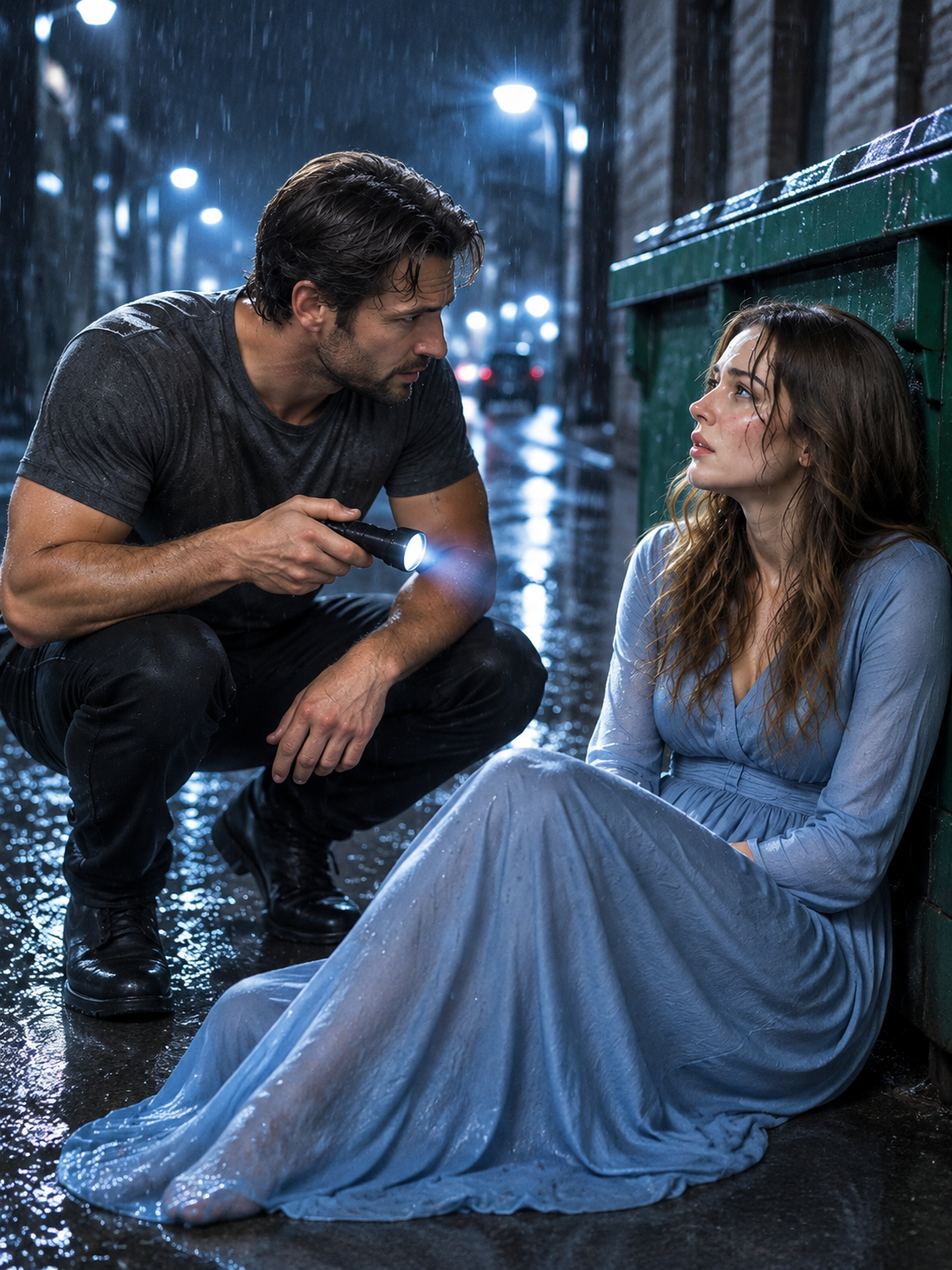
Poor Single Dad Took a Beaten Mother and Her Little Boy Into His Garage Alone on a Rainy Texas Night,
IF FACEBOOK BROUGHT YOU HERE, HERE’S THE CONTINUATION YOU’VE BEEN WAITING FOR. ENJOY! 👇
At six the next morning, Evelyn was making bacon when I told her about the SUV. Her hand stopped over the pan. “Montgomery knows,” she said. “We may have twelve hours before he comes with paperwork.” I called Tommy Reeves, my old Army friend, and told him everything.
Tommy arrived before nine. He studied Evelyn’s laptop, the photographs of her injuries, the medical reports, and the recordings of threats. He said the records could support claims of assault and unlawful detention, especially because an emergency-room report contradicted the psychiatric evaluation Montgomery had arranged. But Montgomery had already filed for emergency custody in a judge’s home county, and Tommy warned that the family had influence there.
Tommy proposed filing in federal court and taking the story public. A reporter named Martinez agreed to come. Before she arrived, two deputies appeared with an order to take Evelyn and Sam into protective custody. Tommy challenged the order’s jurisdiction and the evidence behind it. The deputies called their supervisor and eventually stood down, but warned us that Hamilton had resources ordinary people couldn’t imagine.
Then eight suited men arrived in black SUVs. Hamilton Oil’s chief counsel called and offered to make the lawsuit against me disappear if I sent Evelyn and Sam out. He reminded me that I was a single father with a failing garage. I told him no. State troopers came and ordered the men to leave, but the warning was clear: they would be back.
Martinez interviewed Evelyn that afternoon. Evelyn told her story without hiding the fear or the parts that might make her look imperfect. The article went live the next morning, and news crews filled the street. Montgomery arrived in person, silver-haired and immaculate, with lawyers and security behind him.
He accused Evelyn of being mentally ill and said she had kidnapped Sam. He handed me notice of a ten-million-dollar lawsuit, then recited details about my dead wife, my finances, and Emma’s therapy. He wanted me to understand that he could ruin my life and threaten my right to raise my daughter.
When I refused to step aside, Montgomery told his men to call the sheriff and report a hostage situation with an armed man inside. I didn’t own a gun. But the lie gave him exactly what he wanted: deputies arrived believing I might be dangerous. Sheriff Davidson knew Montgomery and had already seen the court papers.
Evelyn came downstairs and told the sheriff she was staying voluntarily, that Montgomery’s men had hurt her, and that she had evidence. The sheriff spoke with her privately, then returned with a grim expression. He said he had to enforce the orders until a court changed them. Montgomery’s men took Sam while the boy screamed for his mother and Emma.
Evelyn was ordered to a psychiatric facility for a seventy-two-hour evaluation. As deputies led her away, she gave me the old military flashlight I had lent her—the one that had belonged to Sarah. She asked me to tell the children she loved them. I held Emma while she sobbed, and Montgomery warned me that if I kept fighting, he would come after my daughter too.
For three days I did almost nothing. The garage emptied, Emma stopped talking, and I ignored Tommy’s calls. I began to wonder whether Evelyn had used me, whether Montgomery’s claims had some truth. Then Emma found me trying to throw away the broken flashlight. “We don’t throw people away when they’re broken,” she said. “Mom used to say that. We tried to help them. That’s what matters.”
Her words brought me back to myself. Tommy called with news: the independent evaluation had found Evelyn competent, with signs of trauma consistent with abuse. The facility had to release her. I told him to bring her home. I was done hiding.
Before I could make another plan, a car slipped off a jack while I was working beneath it. The weight crushed my leg. Emma heard me calling and ran downstairs, then managed to call 911 and Tommy. Paramedics freed me and rushed me into surgery. I woke in the hospital with pins in my leg, Emma beside me, and Tommy standing behind her.
Then Evelyn walked through the door. She had been released and came straight to the hospital when Emma called. She told me the bruises had come from Montgomery’s security team, not her husband. She had been preparing to expose more than a family fight: she had documents about illegal drilling, environmental violations, and bribes stretching back years. The hard drive was hidden in a Dallas storage unit.
Montgomery’s next move was already in the news. He had announced proceedings to adopt Sam, claiming Evelyn was unfit. Tommy said the independent evaluation would help, but the fight could take months. Evelyn feared every day Sam remained with Montgomery would make it easier for him to turn the boy against her.
We agreed to release the evidence and challenge the adoption. Evelyn, Tommy, and I planned to retrieve the hard drive from Dallas. I was barely out of surgery, but I refused to sit back while Sam was alone with the man who had taken him. Emma insisted on coming, too.
At the storage unit, the door rolled up on an empty space. The drive was gone. Evelyn nearly collapsed. Montgomery had found it before us. Without those files, she feared the public would see only an accusation from a woman he had already branded unstable.
I told her the missing drive proved someone was desperate to keep it hidden. Tommy cautioned that it wasn’t proof of the crimes, but the independent evaluation and the public attention still mattered. Then I suggested we go to Montgomery’s estate and demand to see Sam. Tommy called it reckless and possibly indefensible. I knew that. But Evelyn was Sam’s mother, and we couldn’t let Montgomery quietly erase her.
We drove to the estate with the news vans following us. The gates opened after Evelyn announced herself. Montgomery waited on the steps, calm as ever, and said Sam was inside adjusting to his new life. Evelyn showed him the independent evaluation and told him she would file for emergency custody. He dismissed it.
Emma stepped forward and told Montgomery that Sam had said he wanted his mother. Montgomery spoke down to her, but she didn’t back away. I moved between them and told him the cameras were recording. Evelyn sat on the steps and said she would wait there until she saw her son.
After half an hour, a housekeeper came out. Sam had seen them on the security cameras and was crying for his mother. Montgomery ordered the housekeeper to take him back upstairs. Evelyn stood and said she was going to her child. He blocked her, then realized that touching her in front of the cameras would make the story even worse. At last, he stepped aside.
Sam came running out, shouting, “Mom!” He wrapped himself around Evelyn and begged to go home with her. Montgomery insisted the boy belonged at the estate, but Sam said he wanted his mother, Emma, and me. He told his grandfather he was mean and that he hated him. The cameras caught every word.
Evelyn left with Sam. No one dragged him away this time. The four of us walked to Tommy’s truck while Montgomery stood on his steps, promising more lawsuits. The town was waiting when we returned to Milbrook. Neighbors brought food, and people who had once kept their distance came forward to support us.
The legal fight continued for months. Tommy filed counterclaims, sought emergency custody, and pursued a restraining order. The independent psychiatric evaluation, witness testimony, and the public record of Sam’s wishes all helped. Three months later, a judge awarded Evelyn full custody and limited Montgomery to supervised visitation. The court also ordered an investigation into the fraudulent psychiatric evaluation.
Montgomery appealed, but his reputation was collapsing. His lawyers began leaving, and Hamilton Oil faced investigations. The stolen hard drive never came back, but other people began speaking publicly about the company’s practices. The allegations Evelyn had tried to expose were no longer easy to bury.
My leg healed slowly. I went to physical therapy three times a week and learned to walk without leaning so heavily on the crutches. Evelyn came to every session. Emma and Sam became inseparable, doing homework together and building forts in the garage. Their nightmares didn’t disappear overnight, but the house grew quieter and safer.
Six months after the night in the rain, Evelyn told me she had regained access to her inheritance. She still planned to give much of it away, but wanted to keep enough to build something useful. Her idea was a community garage that would repair cars and train people who needed a second chance. She wanted to call it Morrison and Hamilton Community Garage.
I asked whether she was serious about going into business with a mechanic whose shop had nearly failed. She said she wanted to build something good with someone who had shown her what kindness looked like. I told her I loved her. She said she had loved me since the night I carried Sam inside. We chose each other, and the children chose each other too.
We opened the community garage three months later. The town came to the ribbon cutting, including Mrs. Chen, Mr. Peterson, Tommy, and Sheriff Davidson, who apologized for enforcing the orders without seeing the whole truth. The garage trained twenty people in its first year and later opened locations in Dallas and Houston.
Montgomery kept trying to interfere, but investigations and lawsuits consumed his empire. More witnesses came forward. The company’s misconduct was examined, and his influence shrank as people stopped being afraid to speak. The court rejected his final attempt to take Sam. He eventually left Texas, and I stopped giving him space in my thoughts.
A year after I found Evelyn and Sam, we gathered at the garage with the people who had helped us. I held up Sarah’s flashlight. Evelyn had repaired it while I was in surgery, replacing the bulb and cleaning the connections. Its beam shone steadily. I told everyone Sarah used to say that people can break without becoming worthless; sometimes they need someone to help them shine again.
Evelyn said her family had believed an empire was made of oil, money, and power. She had learned it was made of people who choose kindness and refuse to abandon one another. Emma and Sam ran outside to chase fireflies while Evelyn took my hand. I felt something I hadn’t felt since Sarah died: peace.
Montgomery made one last legal attempt to reach Sam, but the judge dismissed it and ordered him to leave the boy alone. Further investigations uncovered years of corruption, environmental violations, and bribery. The Hamilton empire continued to fall. Evelyn used her inheritance to support environmental work, education, and the growing community garages.
Two years after that rainy night, the garages had trained more than two hundred people and expanded to five locations across Texas. Emma was twelve, Sam was eight, and they called each other brother and sister. My leg still ached when storms came, but I could work and walk. Evelyn and I never married; we didn’t need a ceremony to know we were a family.
On the third anniversary, Sam held the flashlight. I told him it was his turn to carry the light. He clicked it on, and its beam stayed bright. “No one’s too broken to shine again,” he said. Emma put a hand on his shoulder. “And no one fights alone.”
That was what the night outside my garage had taught me. A family can be built from people who show up for one another, even when they are frightened and even when the odds look impossible. The best things we build aren’t empires of oil or money. They are the lives we help put back together.
Final By then, Morrison and Hamilton Community Garage had become more than a business. It gave people work, training, and another chance. Evelyn’s inheritance was helping fund causes she believed in, while the truth about Hamilton Oil was finally being examined in public.
Sam grew up knowing his mother had come back for him. Emma grew up knowing that courage did not mean never being afraid. It meant doing the right thing while your hands were shaking. The two children had become siblings by choice, and Evelyn and I had become a family by the same measure.
I still keep Sarah’s flashlight near the front desk. Sometimes a customer asks why an old, ordinary flashlight matters so much. I tell them it reminds me that broken things can be repaired, that kindness is never wasted, and that no one should have to face the dark alone.
THE END. I’ve shared the complete story, and I truly hope it touched your heart. If this story moved you, please , like, and share the post. Thank you for reading! ❤️
✓ Lynn R. Adams
IF FACEBOOK BROUGHT YOU HERE, HERE’S THE CONTINUATION YOU’VE BEEN WAITING FOR. ENJOY! 👇 At six the next morning, Evelyn was making bacon when I told her about the SUV. Her hand stopped over the pan….