PART2 I’m sleeping with Mark.”
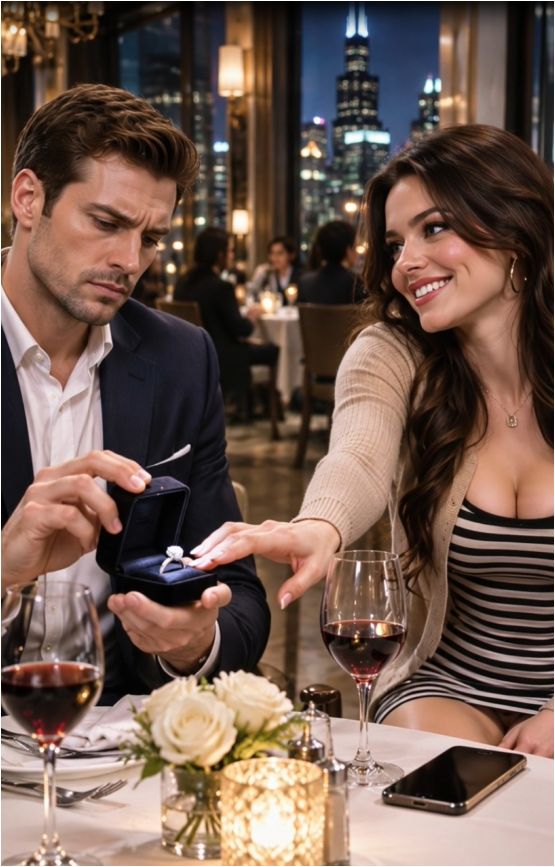
# SHE SAID, “MARRY ME TONIGHT OR I’M GOING TO MARK’S.” I CLOSED THE RING BOX—THEN DISCOVERED WHAT THEY’D PLANNED BEHIND MY BACK.
## THE FULL STORY
“Sarah, he knows about last Friday.”
Those six words were sitting on my girlfriend’s phone screen while the engagement ring I had spent eight months saving for lay inside a closed black velvet box between us.
Across the table, Sarah looked as though someone had just told her the restaurant was on fire.
“What’s Emily talking about?” I asked.
She didn’t answer.
“Sarah. What happened last Friday?”
Her eyes filled with tears.
And for one brief, ridiculous moment, I almost reached across the table to comfort her.
That was how deeply four years of loving someone had trained me.
Even when she was the person hurting me, my first instinct was to make sure she was okay.
But I kept my hands where they were.
Because ten minutes earlier, Sarah had looked me straight in the eyes and threatened to sleep with another man unless I proposed before midnight.
And now her closest friend was warning her that I knew something I hadn’t even known existed.
My name is Nathan Miller. I was thirty-two years old, working as a senior project manager for a commercial construction company in Chicago.
Sarah Collins was twenty-seven.
We had been together for four years.
Until that evening, I believed she was the woman I would grow old with.
We’d met at a friend’s birthday party in Lincoln Park. She was funny, ambitious, and the kind of person who could turn an ordinary conversation into something memorable.
I was more reserved.
Sarah liked crowded restaurants, spontaneous weekends, and being surrounded by people.
I liked quiet Sunday mornings, cooking dinner together, and making plans I could actually follow through on.
For a long time, those differences worked.
She made my life more exciting.
I made hers more stable.
At least, that was how I understood our relationship.
We moved into an apartment together after eighteen months. We split our expenses based on what we earned, although I paid a larger share because my salary was higher.
We talked about buying a house someday.
We talked about children.
We talked about getting married.
And Sarah knew I wanted to propose when I could afford a ring without putting us into unnecessary debt.
What she didn’t know was that I had already bought one.
The diamond wasn’t enormous, but it was beautiful.
A round-cut stone set in a platinum band, chosen with the help of Sarah’s closest friend, Emily Carter.
Emily knew Sarah’s ring size.
She knew Sarah preferred simple jewelry.
And she knew I planned to propose during our fourth-anniversary dinner at Le Jardin.
I had trusted Emily with something important.
That was why seeing her name on Sarah’s phone made the situation feel even worse.
“Give me a minute,” Sarah whispered.
I looked at her.
“You’ve had four years, Sarah. I’m asking about one Friday.”
A couple at a nearby table glanced in our direction.
I lowered my voice.
“I’m not going to make a scene. But I’m not leaving this restaurant without understanding what just happened.”
Sarah took a shaky breath.
“Emily shouldn’t have texted that.”
“That’s not an answer.”
She stared at her phone.
Then she whispered, “I made a mistake.”
I felt my stomach drop.
“What kind of mistake?”
She closed her eyes.
“Last Friday, I went out with Mark.”
I nodded slowly.
I already knew Mark was the sales vice president at her company.
I knew he was older than Sarah.
I knew he sent her messages at inappropriate hours.
And I knew she had spent almost a year describing him as her “work husband.”
But I had never heard her say she’d gone out with him alone on a Friday night.
“Where?”
“Downtown.”
“Where downtown?”
She hesitated.
“The Palmer House.”
I stared at her.
“The hotel?”
“The bar inside the hotel.”
The distinction sounded carefully rehearsed.
“Why didn’t you tell me?”
“Because I knew how you’d react.”
That sentence landed harder than she probably intended.
She had used it before.
Whenever I discovered something uncomfortable, the reason she had hidden it was always my reaction.
Never her decision.
Never her dishonesty.
Always my supposed inability to understand.
“What happened at the hotel?” I asked.
Sarah started crying.
And that was when I knew the answer wouldn’t be simple.
—
## THE NIGHT SHE HAD LIED ABOUT
The previous Friday, Sarah had told me she was going to Emily’s apartment for a girls’ night.
I remembered it clearly.
She had stood in our bedroom wearing black jeans and a fitted green sweater, checking her makeup in the mirror.
“Don’t wait up,” she’d said.
“Have fun.”
“Emily’s been having a rough week. She needs me.”
I had offered to drive her.
She declined.
“I’ll take a rideshare.”
Around ten that evening, she texted me a photograph of two cocktails on a table.
*Girls’ night is officially underway.*
I replied with a heart.
At eleven thirty, she sent another message.
*Staying at Emily’s. Too tired to come home.*
I told her to sleep well.
I didn’t question it.
The next morning, Sarah returned carrying coffee and pastries.
She kissed me on the cheek.
She asked how I’d slept.
And we spent the afternoon shopping for groceries like nothing unusual had happened.
Now, seven days later, I was sitting across from her in a restaurant, learning that Emily had been nothing more than an alibi.
“Did you go to his room?” I asked.
Sarah looked down.
“Nathan—”
“Did you?”
“Yes.”
There are certain moments when your mind refuses to process a sentence.
You hear the words.
You understand their meaning.
But part of you continues searching for another explanation.
Maybe she went upstairs to retrieve a forgotten bag.
Maybe there were coworkers in the room.
Maybe something innocent had happened.
I wanted one of those explanations so badly that I nearly offered them to her.
Instead, I waited.
Sarah wiped her cheeks with a napkin.
“We had drinks downstairs. We were talking about work. He said he had something he wanted to show me upstairs.”
“What?”
She swallowed.
“Some information about a possible promotion.”
I stared at her.
“And you believed that?”
“I know how it sounds.”
“Sarah, what happened in the room?”
She covered her face.
Then she said it.
“We kissed.”
I felt something inside me go completely still.
“How long?”
“It wasn’t like that.”
“How long were you in his room?”
“Maybe two hours.”
“Did you sleep with him?”
She shook her head quickly.
“No.”
I wanted to believe her.
But I had just learned that she could look me in the face on Saturday morning after spending Friday night in another man’s hotel room.
So I asked again.
“Sarah, I’m asking you to tell me the truth.”
“I am.”
“Then why did Emily think I knew?”
Sarah looked confused.
“What?”
“Emily’s message said I knew about Friday. Why would she think that?”
Sarah stared at the screen.
For a moment, she seemed to forget I was sitting there.
Then she whispered, “Because Mark told her something.”
“What did he tell her?”
“I don’t know.”
I looked at the phone.
“Then call Emily.”
Sarah shook her head.
“Not here.”
I picked up the black velvet ring box.
“Fine.”
Her eyes immediately followed it.
“Where are you going?”
“Home.”
“Nathan, please.”
I stood.
“I’ll pay for dinner. You can decide whether you’re ready to tell me the truth when you get back.”
She grabbed my wrist.
Not hard.
Just desperately.
“Please don’t leave me here.”
I looked down at her hand.
Then back at her.
“You were willing to leave me here for Mark twenty minutes ago.”
She released my wrist.
I paid the bill and walked out.
For the first time in four years, I didn’t wait for Sarah.
—
## THE MESSAGE FROM MARK
I drove home with the radio turned off.
The ring box sat in the passenger seat.
Every red light seemed to last forever.
I kept thinking about the way Sarah had smiled when she saw the diamond.
She hadn’t looked relieved that I loved her.
She had looked victorious.
As though our marriage was a contest she’d finally won.
I had imagined that moment differently hundreds of times.
I’d imagined her crying because she was happy.
I’d imagined the two of us calling our families.
I’d imagined holding her hand across the table while we talked about our future.
Instead, I’d watched her use another man’s name as a weapon.
When I reached our apartment, I set the ring box on the kitchen counter.
Then I sat in the living room and waited.
Sarah arrived forty minutes later.
Her eyes were red.
She was still wearing the black-and-white striped dress and beige cardigan from dinner.
She stood just inside the doorway.
“Can we talk?”
I nodded toward the couch.
She sat down.
I remained in the chair opposite her.
For a while, neither of us spoke.
Then I asked, “What did Mark send you?”
Sarah looked at her phone.
“I don’t want to make this worse.”
“That decision isn’t yours anymore.”
She flinched.
I hadn’t raised my voice.
I didn’t need to.
After a long pause, she unlocked her phone and opened the conversation.
Then she handed it to me.
The message from Mark read:
*Did he give you the ring yet? Because our plan only works if you get him to commit tonight. Don’t back down now.*
I read it twice.
Then a third time.
“Our plan?”
Sarah started crying again.
“Nathan, please let me explain.”
I continued looking at the phone.
There were more messages.
Earlier that afternoon, Sarah had written:
*He still hasn’t said anything about tonight. I’m getting worried.*
Mark replied:
*Then make him understand he could lose you.*
Sarah:
*What if he gets angry?*
Mark:
*He’ll give in. Men like Nathan don’t walk away from four years.*
I stopped reading.
A strange warmth spread across my face.
It wasn’t embarrassment.
It was anger.
Not the kind that makes you shout.
The quieter kind that arrives when you realize someone has been calculating how much pain you will tolerate.
“You planned the ultimatum?”
Sarah nodded.
“I didn’t think you’d actually leave.”
“That’s not what I asked.”
“Yes.”
I set the phone on the coffee table.
“You and Mark planned to threaten me with an affair so I’d propose?”
“It wasn’t supposed to go this far.”
“Which part?”
She stared at me.
“The threat? The hotel? The part where you told another man about our relationship and let him decide how to manipulate me?”
Sarah began speaking quickly.
“I was frustrated. Everyone around me was moving forward. People kept asking when you were going to propose. I felt embarrassed.”
“Embarrassed by me?”
“By waiting.”
I looked toward our kitchen.
The ring box was visible on the counter.
Eight months of saving.
Four years together.
And she’d been discussing strategies with another man to force me into marriage.
“Did Mark know about the ring?” I asked.
She shook her head.
“No.”
“Then why did he think I would propose tonight?”
“Because I told him I thought you might.”
I took a slow breath.
“Did you tell him you loved him?”
Sarah looked away.
And there it was.
Another answer hidden inside silence.
—
## EMILY’S ROLE
The next morning, Emily called me.
I almost ignored her.
Then I remembered that she had helped me choose the ring.
I answered.
“Nathan?”
“What do you want, Emily?”
She sounded exhausted.
“I owe you an apology.”
I walked onto the balcony.
“Did you know Sarah was seeing Mark?”
A long silence followed.
“I knew they were getting too close.”
“That’s not what I asked.”
“Yes.”
I closed my eyes.
“How long?”
“Several months.”
The city traffic hummed beneath the balcony.
I could hear a delivery truck backing into the loading area across the street.
Ordinary sounds.
A perfectly ordinary Saturday morning.
Meanwhile, my relationship was collapsing.
“Why did you help me buy the ring?”
Emily began crying.
“Because I thought if you proposed, she’d stop.”
I almost laughed.
Not because anything was funny.
Because the explanation was so absurd.
“You thought marrying her would solve the problem?”
“I know how stupid that sounds.”
“Did you know about the hotel?”
“Yes.”
“Did you help her lie to me?”
Another pause.
“Yes.”
I leaned against the railing.
“Then why did you send that message last night?”
Emily took a shaky breath.
“Because Mark contacted me after Sarah threatened you.”
“What did he say?”
“He said you were suspicious, and Sarah was losing control of the situation.”
I frowned.
“Why would he contact you?”
“Because I’ve been telling Sarah to end whatever this is with him. He knows I don’t trust him.”
“Then why did you think I knew about Friday?”
“Mark said you’d found out about the hotel.”
I thought back to Sarah’s face at dinner.
The panic when her phone lit up.
The way she’d grabbed it.
“What else do you know, Emily?”
She hesitated.
Then she said, “I know Friday wasn’t the first time.”
I closed my eyes.
For several seconds, I couldn’t speak.
“How many times?”
“I don’t know.”
“Don’t guess.”
“Sarah told me they had kissed before. She said it happened after a company dinner in August.”
It was now November.
Three months.
At least three months of Sarah telling me Mark was harmless while secretly crossing boundaries she knew would hurt me.
Emily continued.
“I should have told you. I kept thinking she’d come to her senses.”
“You should have told me before helping her hide it.”
“I know.”
I looked through the glass door toward the apartment.
Sarah was still asleep in our bedroom.
I had spent the night on the couch.
“Emily, I’m going to ask you one question. I need a truthful answer.”
“Okay.”
“Did Sarah ever tell you she wanted to leave me for Mark?”
Emily went quiet.
Then she said, “She told me she didn’t want to lose you.”
I waited.
“But she also said she wasn’t ready to give up Mark.”
That was the answer.
Not the one I wanted.
The one I needed.
—
## FOUR YEARS DIDN’T DISAPPEAR OVERNIGHT
People sometimes imagine betrayal as a clean break.
One shocking discovery.
One dramatic confrontation.
One person walks out and never looks back.
But it wasn’t like that for me.
I still loved Sarah.
That was the worst part.
I loved the woman who used to leave little notes in my work bag.
I loved the woman who stayed beside me when my father had surgery.
I loved the woman who knew I hated mushrooms and always ordered pizza without them.
Those memories hadn’t vanished.
They existed alongside the new reality.
Sarah had lied to me.
She had met another man in a hotel.
She had allowed him to influence the most important decision of our relationship.
And when the ring finally appeared, she reached for it as though she’d earned it through pressure.
I spent most of Saturday trying to understand when things had changed.
Sarah woke around ten.
She found me in the kitchen.
“Did Emily call you?”
“Yes.”
Her expression tightened.
“What did she say?”
“The truth.”
Sarah sat down slowly.
“I don’t know what she told you, but—”
“Don’t.”
She stopped.
“I’m not doing this again. I’m not going to listen to you explain why everyone else is responsible for your choices.”
She looked at the ring box.
“Are you still going to marry me?”
I stared at her.
That was the question she’d chosen.
Not whether I was okay.
Not whether I could trust her.
Not whether she had destroyed something important.
Whether she was still getting married.
“No,” I said.
She covered her mouth.
“Nathan—”
“I’m not proposing.”
She began sobbing.
I expected to feel satisfied.
I didn’t.
I felt exhausted.
“Please,” she whispered. “We can fix this.”
“Maybe we could have fixed problems we were honest about.”
“We still can.”
“Sarah, you didn’t tell me you were unhappy and ask us to work on it. You threatened to sleep with another man because you thought it would make me obey you.”
She looked down.
“And then I discovered you’d already crossed boundaries with him.”
“I never wanted to hurt you.”
“But you were willing to.”
Her eyes rose to mine.
I continued.
“There’s a difference between making a mistake and building a plan around someone’s fear of losing you.”
Sarah cried harder.
I let the silence remain.
For once, I wasn’t going to rescue her from the consequences of her own words.
—
## THE PROMOTION
Late Saturday afternoon, Sarah finally told me something that changed how I understood her relationship with Mark.
It began when I asked why she had continued seeing him after their first kiss.
She sat at the opposite end of the couch.
“Because things were complicated at work.”
“Complicated how?”
She rubbed her hands together.
“Mark had been talking about promoting me.”
Sarah worked in account management for a mid-sized technology services company.
She was ambitious and good at her job.
Before Mark became her supervisor, she’d earned strong performance reviews.
I had always been proud of that.
But over the previous year, Mark had become increasingly involved in her career.
He invited her to private dinners.
He gave her special assignments.
He told her she had leadership potential.
And he suggested he could help her move into a management position.
“Did he promise you a promotion?” I asked.
“Not exactly.”
“What does that mean?”
“He said I was being considered.”
“Did he connect that to your relationship?”
Sarah hesitated.
“He liked knowing I trusted him.”
I stared at her.
“Sarah, did you ever feel like you couldn’t say no to him?”
She thought about it.
Then she shook her head.
“No. I wanted his attention.”
It was the first completely direct answer she’d given me.
She swallowed.
“At first, it made me feel important. He listened to everything I said. He made me feel like I was exceptional.”
“And I didn’t?”
“You did. Just differently.”
I waited.
“With you, everything was familiar. We talked about bills and groceries and schedules. Mark made everything feel exciting.”
Her words hurt.
But I appreciated that she was finally speaking plainly.
“Did you love him?”
She wiped her eyes.
“I don’t think so.”
“Did you tell him you did?”
She nodded.
“Once.”
I looked away.
Something about that answer hurt more than the hotel.
Maybe because love was the one thing I’d believed belonged entirely to us.
“Why?”
“He asked how I felt.”
“And you told him you loved him?”
“I was confused.”
I shook my head.
“Confusion doesn’t make those words meaningless.”
Sarah stared at the floor.
Then she admitted something else.
Mark had been telling her for months that I was holding her back.
He said I was comfortable.
Predictable.
Afraid of commitment.
He told her a woman like her shouldn’t have to beg for marriage.
Eventually, she began repeating his opinions to me.
I remembered those conversations.
The sudden criticism of my job.
The comments about my clothes.
The complaints that I didn’t plan enough expensive weekends.
I had thought we were going through an ordinary rough patch.
I hadn’t realized another man was helping write her grievances.
But Sarah wasn’t simply a victim of Mark’s influence.
She had welcomed it.
She had made choices.
And she had used his attention to justify treating me with less respect.
That distinction mattered.
—
## WHAT REALLY HAPPENED AT THE HOTEL
On Sunday morning, I asked Sarah one final time about the hotel.
I told her I wasn’t going to argue.
I just needed an honest account before deciding what came next.
We sat at the kitchen table.
The same table where we’d once made plans for our first vacation.
Sarah held a mug of coffee she hadn’t touched.
“Were you physically intimate with Mark?” I asked.
She stared into the mug.
“Yes.”
My chest tightened.
“More than kissing?”
She nodded.
I didn’t speak.
She looked up.
“Nathan, I’m sorry.”
“How long have you been lying about that?”
“Since Friday.”
“Did it happen before Friday?”
She hesitated.
Then she said, “Yes.”
I looked at the clock on the microwave.
It was .
A completely meaningless detail.
But I remember it because I needed somewhere to put my eyes.
“How many times?”
“Three.”
I swallowed.
“Three times?”
She nodded.
“The first time was after the company dinner in August. The second was in September. And Friday was the third.”
I wanted to ask a hundred questions.
Where?
When?
What had she told me those nights?
Had she come home and kissed me afterward?
Had she laughed with Mark about how easily I believed her?
But I realized something important.
Even if I received every answer, none of them would change what I needed to do.
So I asked the only question that still mattered.
“Did you plan to stop?”
Sarah started crying.
“I kept telling myself I would.”
“That’s not an answer.”
“No,” she whispered.
I nodded.
The room went quiet.
And for the first time since Friday night, I stopped looking for a version of events that would allow us to return to normal.
There wasn’t one.
Sarah had maintained two relationships while telling me I was the only man she wanted to marry.
She had considered leaving me for Mark.
Then she’d decided to pressure me into proposing, partly because she was afraid of losing the stability we’d built.
That was the truth.
It was ugly.
It was painful.
But it was finally clear.
—
## MARK CALLED ME
Sunday evening, my phone rang.
Unknown number.
I almost ignored it.
Then a text appeared.
*This is Mark Reynolds. Sarah gave me your number. We should talk.*
I stared at the screen.
I had no desire to speak with him.
But I also wanted to know whether he understood what he’d helped destroy.
I called back.
He answered on the second ring.
“Nathan.”
“Mark.”
A brief silence.
Then he said, “I think there’s been a misunderstanding.”
I almost hung up.
“A misunderstanding?”
“Sarah and I got too close. I’m not denying that. But I think you’ve been given the impression that this was some elaborate plan to destroy your relationship.”
I looked toward the kitchen.
Sarah was in the bedroom.
“I saw your messages.”
He went quiet.
Then he said, “She was frustrated.”
“You told her to threaten me with sleeping with you.”
“I didn’t think she’d actually say it.”
“But you suggested it.”
He sighed.
“Look, man, people say stupid things when they’re emotional.”
I felt my jaw tighten.
“Don’t call me man like we’re friends.”
Another silence.
Then his tone changed.
“Sarah told me you were having problems for a long time.”
“I’m sure she did.”
“She said she felt ignored.”
“Then she should have talked to me.”
“Maybe you weren’t listening.”
I almost laughed.
He really believed he had the right to lecture me about my relationship.
“Mark, I’m going to make this simple. Whatever Sarah told you about me, it doesn’t change what you chose to do.”
He exhaled.
“I’m not looking for a fight.”
“Neither am I.”
“Then why are we talking?”
“Because you contacted me.”
He said nothing.
I continued.
“You don’t get to help someone lie to me, encourage her to manipulate me, and then explain that I’m responsible for her decisions.”
Mark lowered his voice.
“You don’t know everything about your own relationship.”
“Neither did I. That’s the problem.”
He paused.
Then he said something that stayed with me.
“Sarah told me she wanted to marry you.”
I closed my eyes.
“And what did she tell you she wanted from you?”
He didn’t answer.
I waited.
Finally, he said, “She said she needed someone who understood her.”
There it was.
The same story.
Two different men being told they provided something the other couldn’t.
I ended the call.
I didn’t threaten him.
I didn’t go to his workplace.
I didn’t try to embarrass him publicly.
I had no intention of turning my pain into a spectacle.
My relationship with Sarah was ending.
That was enough.
—
## THE RING SHE COULDN’T STOP LOOKING AT
On Monday, Sarah asked whether she could see the engagement ring again.
We were standing in the living room.
I’d already told her I needed space.
She had agreed to stay with Emily temporarily while we figured out our living arrangements.
Her suitcase stood beside the front door.
“Can I just see it?” she asked.
I looked at her.
“Why?”
“I never really got to look at it.”
I didn’t answer immediately.
Then I took the box from my desk drawer.
I opened it.
Sarah stepped closer.
The diamond caught the afternoon light.
She began crying.
“It’s beautiful.”
I nodded.
“I thought you’d like it.”
She stared at the ring.
“Emily told you exactly what I wanted?”
“More or less.”
Sarah covered her mouth.
“I can’t believe you did all this.”
I looked at her.
“That was the whole point, Sarah. You weren’t supposed to know.”
She looked up.
“I thought you were never going to ask.”
“I know.”
“I felt like everyone was moving forward except me.”
I closed the box.
“You were so focused on getting a proposal that you stopped asking whether we were ready to be married.”
She wiped her face.
“I was ready.”
I shook my head.
“You wanted a wedding. You wanted a ring. You wanted to tell your friends you were engaged.”
“That isn’t fair.”
“Maybe not. But marriage requires honesty, Sarah. And you were lying to me while demanding that I prove my commitment.”
She lowered her eyes.
I placed the ring box back in the drawer.
She didn’t ask to see it again.
—
## THE DECISION
Over the following two weeks, Sarah and I had several difficult conversations.
We weren’t married.
We didn’t own property together.
We didn’t have children.
But four years of shared life still required untangling.
Both our names were on the apartment lease.
We had furniture we’d purchased together.
We had shared subscriptions, a vacation fund, and photographs covering nearly every wall.
We agreed to divide the money we’d each contributed to the vacation fund.
We went through our furniture and decided what belonged to whom.
I contacted our property manager to discuss the lease.
Because both of us were legally responsible for it, neither of us could simply walk away without making arrangements.
Eventually, Sarah agreed to move out, and I took responsibility for the apartment after the necessary paperwork was completed.
It wasn’t dramatic.
It was uncomfortable.
Sometimes painfully awkward.
There were days when we argued about small things because neither of us wanted to talk about the larger problem.
A set of dishes.
A lamp.
A couch we’d bought during our second year together.
I remember staring at that couch one afternoon and realizing that it was the place where Sarah had fallen asleep on my shoulder during countless movies.
Now we were discussing whether she wanted to take it.
Relationships don’t disappear all at once.
They come apart through ordinary objects.
One cabinet at a time.
One shared account at a time.
One photograph removed from the wall.
Sarah continued asking if we could try again.
She promised to stop seeing Mark.
She said she would look for another job.
She offered to attend couples counseling.
I considered it.
I really did.
But whenever I imagined trying again, I remembered the restaurant.
Not the kiss.
Not even the hotel.
The smile.
That satisfied little smile when she thought threatening me had worked.
I couldn’t forget it.
Because it revealed something about how she had begun to see me.
Not as a partner whose feelings mattered.
But as someone who could be pressured into giving her what she wanted.
I didn’t want a marriage built on that foundation.
So one evening, I told her my decision.
We were sitting at opposite ends of the couch.
“I’m ending the relationship,” I said.
Sarah began crying immediately.
“Please don’t.”
“I’ve thought about it carefully.”
“Four years, Nathan.”
“I know.”
“You can’t throw away four years.”
I looked at her.
“I’m not throwing them away. They happened. They mattered to me.”
“Then why won’t you fight for us?”
That question hurt.
Because I’d spent months believing I was fighting for us.
Working extra hours.
Saving money.
Planning a future.
Trying to understand why she seemed increasingly unhappy.
“I was fighting for us,” I said quietly. “I just didn’t know I was the only one following the rules.”
She covered her face.
I continued.
“I don’t hate you, Sarah. I don’t want to punish you. But I can’t marry someone I no longer trust.”
She whispered, “I still love you.”
“I believe you feel something for me.”
She looked up.
“But love isn’t enough if you keep choosing things that destroy it.”
For once, she didn’t argue.
—
## THE CONSEQUENCES FOR SARAH
About a month after our breakup, Emily contacted me again.
She said Sarah had moved into a small apartment closer to her office.
She was struggling.
Not financially, at least not in any serious way.
Sarah had a good salary and could support herself.
But emotionally, she was having a difficult time.
Most of our mutual friends knew we’d separated.
I hadn’t shared intimate details publicly.
When people asked, I told them the relationship had ended because of dishonesty and broken trust.
That was enough.
Sarah apparently gave a more complicated explanation.
She told some friends that we’d grown apart.
Others heard that I had refused to commit.
Eventually, Emily confronted her about that version.
“You can’t keep saying he wouldn’t marry you,” Emily reportedly told her. “He bought the ring.”
Sarah didn’t like hearing that.
But Emily refused to help her change the story again.
Their friendship became strained.
For the first time, Sarah was facing consequences without someone immediately offering her an excuse.
She also stopped seeing Mark.
At least, that was what Emily told me.
I didn’t investigate.
I didn’t follow their social media.
I didn’t ask mutual friends to report on them.
Whatever happened between Sarah and Mark no longer belonged to me.
But several weeks later, Sarah contacted me with an update.
She had requested a transfer to another department.
She told her employer that her personal relationship with Mark had created a conflict she could no longer ignore.
The company reviewed the situation.
I never learned the full outcome, and I didn’t need to.
Sarah eventually accepted a position elsewhere.
She admitted that she’d allowed her professional ambitions and desire for approval to become tangled with her personal life.
“I thought Mark made me feel powerful,” she told me during one phone call.
I listened.
“But I let him influence things that had nothing to do with work.”
I didn’t disagree.
Then she said, “I don’t think he ever cared about me the way I thought he did.”
I looked out my apartment window.
“Maybe not.”
She hesitated.
“Does that make you feel better?”
“No.”
“Why not?”
“Because whether he cared about you doesn’t change what happened between us.”
She was quiet.
Then she said, “I understand.”
It was the first time I believed she might actually mean it.
—
## EMILY’S APOLOGY
Emily and I met for coffee about six weeks after the breakup.
I hadn’t planned to see her again.
But she asked whether we could talk, and I decided to hear her out.
We met at a small café near my office.
She looked nervous.
“I know I betrayed your trust,” she said.
I nodded.
“You did.”
“I kept thinking if Sarah got engaged, she’d stop seeing Mark. I convinced myself I was helping.”
I stirred my coffee.
“Why didn’t you tell me?”
Emily looked down.
“Because Sarah was my best friend. And I was afraid she’d hate me.”
I considered that.
It was an honest answer.
Not a good one.
But honest.
“So you let me spend thousands of dollars on a ring while you knew she was involved with someone else?”
Emily’s eyes filled with tears.
“Yes.”
I sat back.
“I trusted you because I thought you cared about both of us.”
“I did.”
“Then you should have cared enough to tell me the truth.”
She nodded.
“I know.”
We sat quietly.
Then Emily said something unexpected.
“Sarah used to talk about you differently.”
I looked at her.
“What do you mean?”
“Before Mark, she talked about how safe she felt with you. How you always showed up. How you never made promises you couldn’t keep.”
I didn’t respond.
“Then she started treating those things like they were boring.”
That sentence stayed with me.
Because it described something I’d felt but hadn’t been able to explain.
Sarah had once appreciated stability.
Then she’d begun confusing stability with a lack of passion.
She saw another man’s constant attention as proof of something special.
And my consistency became something she took for granted.
Emily wiped her eyes.
“I should have told her she was making a terrible mistake.”
“You did tell her, eventually.”
“Not strongly enough.”
I finished my coffee.
“I appreciate the apology, Emily. But I don’t think we can go back to being friends.”
She nodded slowly.
“I understand.”
We said goodbye outside the café.
I didn’t feel angry.
But forgiveness and renewed trust are different things.
I could accept that Emily regretted what she’d done.
That didn’t mean I wanted her involved in my life again.
—
## EIGHT MONTHS LATER
By the following summer, my life looked different.
I was still living in Chicago.
Still working at the same company.
Still drinking too much coffee in the mornings.
But the apartment was quieter.
At first, I hated that.
I missed hearing Sarah singing while she got ready for work.
I missed having someone ask about my day.
I missed the ridiculous conversations we used to have while grocery shopping.
For months, the smallest things reminded me of her.
A restaurant we’d visited.
A song she loved.
A particular brand of cereal.
Healing wasn’t a straight line.
Some days I felt relieved.
Other days I wondered whether I’d made the right decision.
I had to remind myself that missing someone doesn’t automatically mean you should return to them.
I started seeing a therapist.
Not because I thought there was something wrong with me.
But because I wanted to understand why I’d ignored certain warning signs.
I’d spent so long trying to avoid conflict that I’d begun accepting explanations I didn’t really believe.
Whenever Sarah dismissed my concerns about Mark, I backed away because I didn’t want to seem controlling.
Whenever she compared me to other men, I worked harder to prove myself.
Whenever she said I wasn’t doing enough, I asked what else I could do.
I had confused keeping the peace with maintaining a healthy relationship.
Therapy helped me understand that trust doesn’t require ignoring discomfort.
It requires honest conversations, boundaries, and a willingness to recognize when those boundaries aren’t respected.
I also started spending more time with friends.
I took the trip I’d canceled while saving for Sarah’s ring.
Three of us went hiking in Colorado.
One evening, we sat outside a cabin watching the sun disappear behind the mountains.
My friend Jason asked if I regretted buying the ring.
I thought about it.
“No,” I said.
He looked surprised.
“Seriously?”
“Seriously.”
“Why?”
“Because I was ready to make that commitment. I wasn’t pretending.”
Jason nodded.
“So you don’t regret wanting to marry her?”
“No. I regret not recognizing sooner that we wanted different things from each other.”
He raised his beer.
“To recognizing things sooner.”
I laughed.
It was one of the first times I’d laughed about the breakup without feeling guilty.
—
## THE LAST MESSAGE
In August, almost nine months after our anniversary dinner, Sarah sent me a long email.
I hadn’t heard from her in several weeks.
The subject line was simple.
*Something I should have said months ago.*
I nearly deleted it.
Then I decided to read it.
Sarah wrote that she had been thinking about our relationship and the choices she’d made.
She acknowledged that she’d used Mark to provoke jealousy.
She admitted she’d enjoyed having two men competing for her attention, even though I’d never agreed to be part of that competition.
She wrote about how embarrassed she’d felt watching her friends get engaged.
How she had begun measuring our relationship by what other people could see.
A ring.
A proposal.
A wedding date.
A photograph she could post online.
She said she’d spent so much time worrying about how her life looked that she’d stopped appreciating how it actually felt.
Then she addressed the night at Le Jardin.
*When you opened that ring box, I felt like I’d won.*
I stopped reading for a moment.
Those words confirmed something I’d sensed instantly.
Then I continued.
*I know how awful that sounds. But it’s true. I wasn’t thinking about the effort you made or the love behind the ring. I was thinking that I’d finally gotten what I wanted.*
She wrote that the sound of the box closing had stayed with her.
That sharp little click.
She said she heard it whenever she thought about the moment everything changed.
Then came the sentence that affected me most.
*I didn’t lose you because you refused to marry me. I lost you because I treated your love like something I could control.*
I sat quietly for a long time.
The email didn’t ask me to come back.
It didn’t promise she’d changed overnight.
It didn’t blame Mark.
For the first time, Sarah seemed willing to describe her actions without wrapping them in excuses.
At the end, she wrote:
*You deserved to be proposed to with happiness, not fear. I’m sorry I took that moment away from you.*
I read those words twice.
Then I closed my laptop.
I didn’t respond immediately.
A few days later, I sent a short reply.
*Sarah, thank you for acknowledging what happened. I hope you continue working toward the life you want. I don’t want us to get back together, but I sincerely wish you well.*
She replied with one sentence.
*I understand. Take care of yourself, Nathan.*
And that was our last conversation.
—
## WHAT HAPPENED TO THE RING
People have asked me what I did with the engagement ring.
I didn’t throw it into a river.
I didn’t smash it.
I didn’t give it to someone else to make a point.
I returned to the jewelry store where I’d purchased it.
Because several months had passed, I wasn’t eligible for a full refund.
The jeweler explained my options.
I could keep it, sell it, or exchange it under the store’s upgrade policy.
I decided to sell it.
I received less than I’d paid.
Quite a bit less.
But I wasn’t interested in keeping it as a symbol of everything that had gone wrong.
I used some of the money to take my parents on a weekend trip to Wisconsin.
My father had recovered well from his surgery, and I realized I’d spent so much time worrying about Sarah that I’d neglected some of the people who had always been there for me.
We rented a cabin near a lake.
My mother made breakfast every morning.
My father insisted on fishing even though the weather was terrible.
One evening, we sat on the porch watching the rain.
My mother asked how I was doing.
“Better,” I said.
She studied me.
“Really?”
I smiled.
“Really.”
She reached over and squeezed my hand.
“Good.”
She didn’t ask whether I missed Sarah.
She didn’t tell me I should be angry.
She simply sat beside me.
And for some reason, that quiet moment made me think about what I’d originally wanted from marriage.
Not a grand ceremony.
Not photographs.
Not the perfect ring.
I wanted a life with someone who would sit beside me when things were difficult.
Someone who understood that love wasn’t measured by how much pressure one person could put on another.
Someone who would tell me the truth even when it was uncomfortable.
I hadn’t been wrong to want those things.
I’d simply been wrong about who could give them to me.
—
## ONE YEAR AFTER THE RESTAURANT
On the anniversary of that disastrous dinner, I happened to drive past Le Jardin.
I was on my way home from a meeting.
Traffic was moving slowly.
The restaurant’s windows glowed against the evening sky.
For a moment, I remembered everything.
The candlelight.
Sarah’s smile.
The diamond.
Her hand reaching toward the box.
And the sound it made when I closed it.
I expected to feel the same sharp pain.
Instead, I felt sadness.
Not the kind that overwhelms you.
The quieter kind that comes when you remember a future you once believed was certain.
I had genuinely wanted to marry Sarah.
I had imagined our wedding.
Our home.
Our children.
Our life together.
And for a long time, losing that imagined future felt almost as painful as losing the relationship itself.
But I’d learned something during the year since we separated.
You can grieve a future that never happened.
You can miss someone who treated you badly.
You can acknowledge the good years without pretending the ending was acceptable.
And you can forgive someone without giving them another opportunity to hurt you.
I drove past the restaurant and continued home.
No dramatic music.
No sudden revelation.
No final confrontation.
Just an ordinary evening.
And the realization that I was finally comfortable with my decision.
—
## THE WOMAN I MET AFTER SARAH
Several months later, I began dating again.
I wasn’t looking for someone to replace Sarah.
I wasn’t trying to prove I’d moved on.
I simply felt ready to meet people without comparing every conversation to my old relationship.
I met a woman named Claire through a mutual friend.
She worked as a physical therapist.
She was thoughtful, funny, and direct.
On our third date, we talked about past relationships.
I told her I’d nearly proposed to someone who had been unfaithful.
Claire listened.
She didn’t ask for every painful detail.
She didn’t insult Sarah.
She simply asked, “What did that experience teach you about what you want now?”
I thought about it.
“Honesty,” I said.
She smiled slightly.
“That’s a good start.”
“And someone who understands that commitment should be a choice, not a deadline.”
Claire nodded.
“I agree.”
We continued seeing each other.
Slowly.
Without rushing toward an announcement or trying to impress anyone.
Sometimes we spent weekends doing nothing more exciting than cooking dinner and watching a movie.
Other times we went hiking or explored new places around Chicago.
I enjoyed both.
And I noticed something I hadn’t expected.
When I was with Claire, I didn’t feel like I was being evaluated.
I wasn’t constantly wondering whether I was doing enough.
We could disagree without threatening the relationship.
We could talk about difficult things without turning them into competitions.
I didn’t know where the relationship would lead.
And for the first time, I was comfortable not knowing.
I wasn’t dating to prove that I could get engaged.
I was dating because I enjoyed someone’s company and wanted to discover whether we were right for each other.
That felt healthier.
And it felt peaceful.
—
## WHAT I FINALLY UNDERSTOOD
Looking back, the most painful part of that night wasn’t discovering that Sarah had been involved with Mark.
It wasn’t even learning that Emily had helped conceal it.
It was realizing how differently Sarah and I had understood love.
I believed commitment meant choosing someone freely, every day, even when life became ordinary.
Sarah had begun treating commitment as proof of her value.
She wanted a proposal because her friends were getting engaged.
She wanted a ring because she was tired of explaining why she didn’t have one.
And when she became afraid that I wasn’t moving fast enough, she allowed another man to help her turn that fear into an ultimatum.
Mark didn’t make those decisions for her.
He encouraged them.
He benefited from them.
But Sarah still chose what she did.
That mattered because I spent weeks trying to understand whether things would have been different if Mark had never entered her life.
Maybe they would have.
Maybe Sarah and I would have had difficult conversations about our future and eventually married.
Maybe we’d have discovered that our values were no longer compatible.
I’ll never know.
But blaming Mark for everything would have prevented me from seeing the truth.
The person who owed me honesty was Sarah.
The person who had promised to build a future with me was Sarah.
And the person who decided to threaten that future was Sarah.
I wasn’t responsible for those choices.
I was responsible for how I responded to them.
I could have begged her to stay.
I could have proposed simply to prevent her from leaving with Mark.
I could have accepted her explanations because four years felt too important to lose.
For a few terrible minutes at the restaurant, part of me wanted to do exactly that.
I wanted to open the box again.
To put the ring on her finger.
To pretend the ultimatum had been a moment of anger rather than the final warning sign of a much larger problem.
But I knew that if I proposed under those circumstances, I would remember why I’d done it every time I looked at her ring.
I would remember the threat.
The fear.
The humiliation.
And I would wonder whether she had chosen me because she loved me or because she had learned how to make me comply.
That wasn’t the marriage I wanted.
So I closed the box.
It was a small action.
A hinged lid moving a few inches.
A sharp click in the middle of a restaurant.
But it was the first time in months that I stopped allowing fear to make decisions for me.
—
## THE FINAL LESSON
A year after everything happened, I found an old photograph while organizing files on my computer.
It was a picture of Sarah and me from our second anniversary.
We were standing beside Lake Michigan, laughing into the camera.
She had her arms around my waist.
I was holding her close.
We looked happy.
And I believe we were.
For a moment, I considered deleting the photograph.
Then I decided not to.
Those years were part of my life.
The memories didn’t become false just because the relationship ended badly.
Sarah had loved me in her own way.
I had loved her deeply.
But love without honesty had slowly become something neither of us could safely build a future on.
I moved the photograph into an archived folder and closed my computer.
Then I made dinner.
Claire called while I was cooking.
We talked about our days.
She told me a funny story about something that had happened at work.
I told her I’d burned the garlic bread.
She laughed.
It was ordinary.
Comfortable.
Unremarkable.
And that was exactly what made it meaningful.
I no longer wanted a relationship where every important moment felt like a test.
I wanted one where both people could be honest about their needs without using fear.
I wanted someone who would choose me without threatening to choose someone else.
I wanted a partnership, not a competition.
And I finally understood that the right proposal isn’t the one that happens before someone’s deadline.
It’s the one two people are ready to make because they trust each other enough to mean it.
That night at Le Jardin, Sarah thought she’d forced me into the biggest commitment of my life.
When she saw the diamond, she smiled because she believed she’d won.
But the moment I closed the box, something changed.
I stopped trying to prove I was worth choosing.
I began asking whether the person across from me was someone I should choose.
And once I knew the answer, I couldn’t pretend otherwise.
I never proposed to Sarah.
I never gave her the ring.
And despite how much it hurt, I don’t regret walking away.
Because sometimes the most important promise you make isn’t to another person.
It’s the promise that you won’t abandon your own boundaries just to keep someone from leaving.
**Sarah gave me until midnight to prove I loved her.**
**I needed only ten seconds to realize that love should never have been a threat.**
And in the end, the ring I didn’t give her taught me more about marriage than the proposal I’d spent eight months planning ever could.
**THE END.**
*If someone threatened to cheat unless you proposed, would you end the relationship immediately—or would you give them another chance after discovering the truth?*
✓ Lynn R. Adams
# SHE SAID, “MARRY ME TONIGHT OR I’M GOING TO MARK’S.” I CLOSED THE RING BOX—THEN DISCOVERED WHAT THEY’D PLANNED BEHIND MY BACK. ## THE FULL STORY “Sarah, he knows about last Friday.” Those six wor…