PART 6: “You want me to marry a woman I’ve never seen?” Maverick demanded, staring at the Apache chief.-062
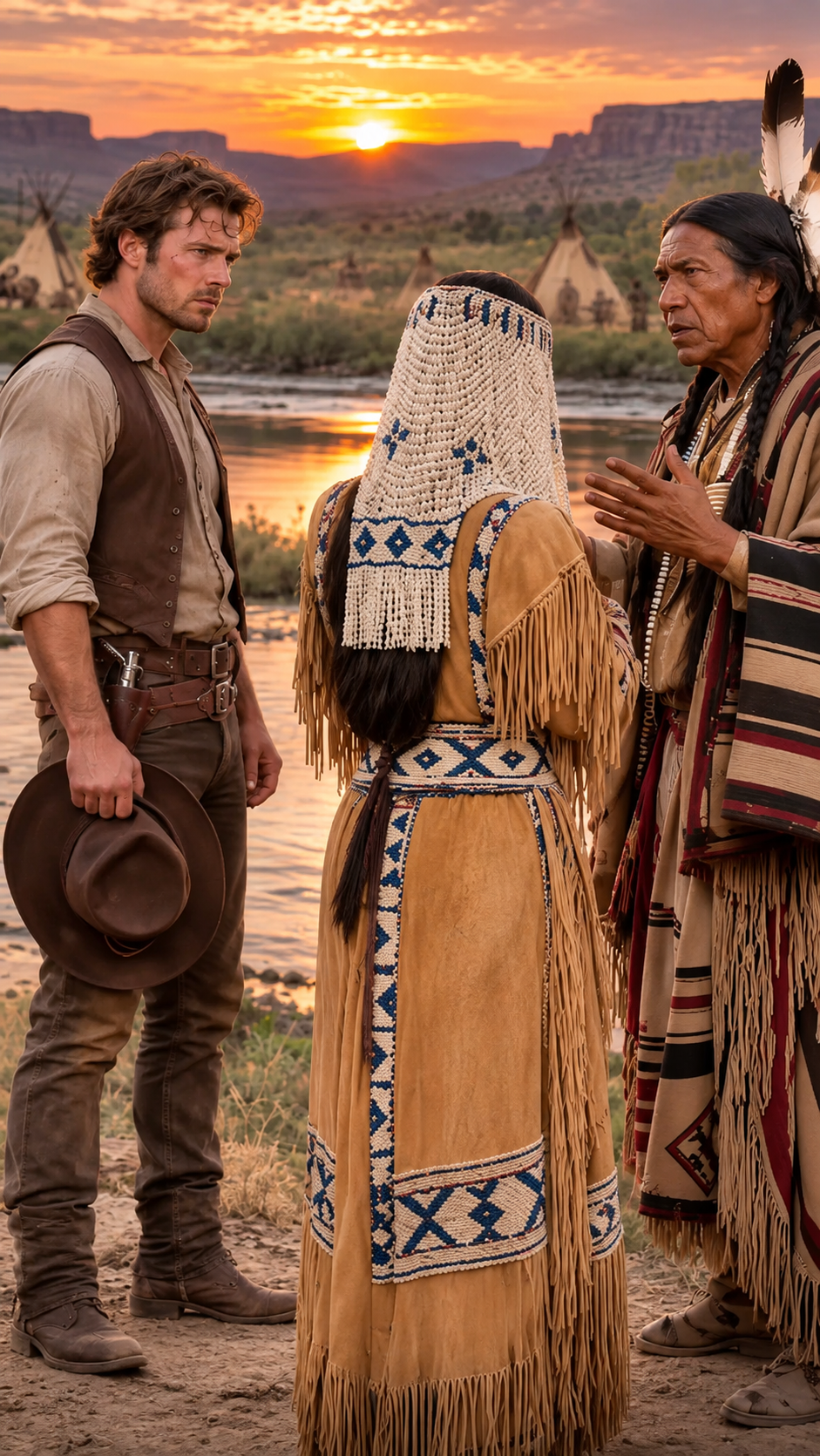
For the second time since entering the valley, Maverick found himself being told that the river land belonged to him.
The first time, the possibility had filled him with hope.
This time, it filled him with dread.
Ayasha stood beside him while the territorial notice trembled slightly between his fingers.
Nobody spoke.
The morning sun shone across the settlement with complete indifference to the confusion contained in one sheet of paper.
Finally Thomas said, “I do not believe it.”
Lobo Negro looked toward him.
“You believe the deed is false?”
“Yes.”
“How can you know?”
“Because Clara would never have sold the land to Elizabeth.”
Maverick handed him the notice.
“People change their minds.”
“Not about this.”
Thomas read the document.
His brow furrowed.
Ayasha watched Maverick.
He could feel her attention but did not look at her.
The question neither wanted to ask sat between them.
If Elizabeth had legally purchased the property, would Maverick keep it?
Three weeks earlier, the answer would have been easy.
Now it was not.
“I need to see the deed,” Maverick said.
The territorial office was two days away.
Lobo Negro immediately offered to send someone.
Maverick shook his head.
“I am going.”
Ayasha stepped forward.
“So am I.”
Maverick looked at her.
“You do not need to.”
“I know.”
The distinction mattered.
He nodded.
Thomas joined them.
This time Lobo Negro remained behind.
Before Ayasha left, he pulled her aside.
Maverick deliberately moved out of hearing.
A few minutes later, Ayasha joined him.
“What did he say?”
“He told me to be careful.”
“That seems reasonable.”
“He also gave me enough food for six people.”
“That seems even more reasonable.”
“And he told me that if you annoy me, I should take your horse.”
Maverick stared toward Lobo Negro.
The chief waved pleasantly.
“He is beginning to like me.”
“That is apparently how he shows it.”
They reached the territorial office late the following afternoon.
A clerk produced the disputed deed.
Maverick examined Elizabeth’s signature.
It looked authentic.
So did Clara’s.
Thomas leaned over it.
“Something is wrong.”
Ayasha frowned.
“What?”
Thomas pointed to the survey number.
“Clara’s original claim was Parcel 18-B.”
“This says 18-D.”
The clerk checked another ledger.
“Parcel numbers were revised.”
“When?”
The clerk searched.
“Twenty-two years ago.”
Thomas straightened.
“This deed is dated twenty-four years ago.”
Maverick understood immediately.
“Then whoever created it used a parcel number that did not exist yet.”
The clerk stared.
Ayasha exhaled slowly.
“It is forged.”
The discovery should have ended the matter.
It did not.
The clerk looked uncomfortable.
“There is a complication.”
Maverick leaned against the counter.
“I am beginning to dislike that word.”
“The deed was submitted with a sworn statement.”
“From whom?”
The clerk produced another paper.
Maverick read the signature.
He did not recognize it.
Thomas did.
“Henry Cole.”
“Who is Henry Cole?”
Thomas became pale.
“The attorney who represented Samuel Hale.”
Maverick looked at the date of the affidavit.
It had been signed six months earlier.
“Cole is alive?”
“Yes.”
“Where?”
The clerk gave them an address.
They found Henry Cole in a modest house at the edge of town.
He was eighty years old.
His hands shook.
His eyesight was failing.
Yet when Maverick introduced himself, Cole immediately asked them inside.
“I wondered when someone would come.”
Maverick sat opposite him.
“You submitted a forged deed.”
Cole nodded.
“Yes.”
Ayasha blinked.
Maverick had prepared himself for denial.
The immediate confession left him without his next question.
“Why?”
“Because I was asked to.”
“By whom?”
Cole looked at Thomas.
“Not Samuel.”
Thomas stiffened.
“Then who?”
“Elizabeth.”
Maverick stared.
“My mother asked you to submit a forged deed twenty-four years after her death?”
“No.”
Cole almost smiled.
“She asked me to prepare it twenty-four years ago.”
Ayasha frowned.
“That makes no sense.”
“It will.”
Cole opened a desk drawer.
He removed an envelope.
“Elizabeth believed Samuel intended to acquire Clara’s land.”
Maverick listened.
“She created the false deed as a shield.”
Cole explained that if Samuel attempted to transfer the river parcel into the company’s ownership, the conflicting deed would stop the transaction.
Elizabeth had instructed Cole not to file it unless the company made another claim after her death.
“So the deed was never intended to give me the land,” Maverick said.
“No.”
“It was intended to freeze the title.”
“Yes.”
“Until what?”
Cole pushed the envelope toward him.
“Until you were ready to decide what kind of man you intended to be.”
Maverick stared at the envelope.
“My mother had an irritating amount of confidence in lessons delivered from beyond the grave.”
Ayasha covered a smile.
Cole laughed.
“She said you would complain.”
“That sounds like her.”
Inside the envelope was a notarized statement from Elizabeth explaining everything.
There was also a release.
If Maverick signed it, any inherited claim created through Elizabeth would be surrendered.
Clara’s original claim would remain uncontested.
Maverick read the document once.
Then again.
Ayasha said nothing.
Thomas said nothing.
Cole placed a pen on the desk.
Maverick picked it up.
He paused.
Not because he wanted the land.
Because he suddenly understood what signing meant.
For five years he had worked toward one dream.
A place of his own.
A fence he had built.
A field he could plant.
A house no employer could order him to leave.
He had crossed a desert for that dream.
He had married a stranger for the possibility of it.
Now the land he had wanted was legally within reach.
All he had to do was remain silent.
Ayasha stood.
“I will wait outside.”
Maverick looked at her.
“You do not have to.”
“I do.”
“Why?”
“Because whatever you choose must actually be your choice.”
She left.
Maverick watched the door close.
Thomas followed.
Cole remained at his desk.
“You knew my father?”
“Yes.”
“Was he as bad as these papers make him seem?”
Cole thought about it.
“No.”
Maverick looked surprised.
Cole continued.
“He was worse in some ways.”
Maverick lowered his eyes.
“And better in others.”
That surprised him more.
“He loved your mother,” Cole said.
“Poorly, perhaps.”
He folded his hands.
“But truly.”
“Is that supposed to comfort me?”
“No.”
Cole’s voice remained gentle.
“It is supposed to remind you that human beings rarely fit neatly into the stories we tell after they are gone.”
Maverick looked at the release.
“My father wanted land.”
“Yes.”
“So do I.”
“That does not make you your father.”
“What does?”
Cole looked at the pen.
“Perhaps what you do after learning the cost.”
Maverick signed.
The decision hurt.
That surprised him.
Doing what felt right did not erase what he was giving up.
He could still imagine cattle grazing beside the river.
Still imagine a porch facing the mountains.
Still imagine waking every morning on land bearing his name.
He let the dream go anyway.
Outside, Ayasha waited beneath a cottonwood tree.
Maverick approached.
“It is yours.”
She searched his face.
“You signed?”
“Yes.”
“Are you sure?”
“No.”
Ayasha blinked.
Maverick laughed softly.
“I think people lie when they say every important decision feels certain.”
She looked at him for a long time.
Then she reached for his hand.
“Thank you.”
He shook his head.
“Do not thank me for returning something that was never mine.”
“I am not.”
“What are you thanking me for?”
“For choosing when nobody could force you.”
He understood.
Freely.
The word that had begun their marriage had followed them all the way here.
They returned to the valley carrying the corrected documents.
The territorial office recognized Clara’s original claim two weeks later.
Several disputed water records were reopened.
Not every historical wrong could be repaired.
Some boundaries had changed too many times.
Some families had lived on parcels for decades without knowing the documents beneath their homes were questionable.
Ayasha insisted that no one be displaced.
Instead, agreements were negotiated.
Water access was shared.
Long-standing residents retained their homes.
The Western Valley Agricultural Company quietly dissolved its remaining claims in the area after Thomas’s records became public.
No grand victory followed.
There was paperwork.
There were meetings.
There were disagreements.
There were long afternoons during which Maverick decided that building fences had been far easier than building consensus.
Yet something steadier emerged.
The river land became part family property, part community trust.
Ayasha reserved the northern acreage for grazing, gardens, and a school.
The southern section remained open for ranching.
One evening she found Maverick repairing a corral.
“You built that in the wrong place.”
He stopped hammering.
“I absolutely did not.”
“It is six feet east of the marker.”
“That marker moved.”
“Markers do not move.”
“This one did.”
“Did it grow legs?”
“Possibly.”
Ayasha crossed her arms.
“Maverick.”
He surrendered.
“Fine.”
She smiled.
“I have been thinking.”
“That usually creates work for me.”
“I want you to use the southern pasture.”
He became still.
“For what?”
“Your ranch.”
Maverick stared at her.
“Ayasha.”
“You wanted land.”
“I gave up the claim.”
“Yes.”
“I am not taking yours.”
“I am not giving it to you.”
He frowned.
“I am offering a lease.”
“A lease?”
“One dollar a year.”
“That is suspiciously low.”
“Two dollars.”
“Now you are exploiting me.”
Ayasha laughed.
Maverick shook his head.
“No.”
Her smile faded.
“Why?”
“Because I do not want anyone saying I stayed married to you for pasture.”
Ayasha studied him.
“Then perhaps we should settle that question.”
Maverick’s pulse changed.
“What question?”
“Our marriage.”
He set the hammer down.
Ayasha walked toward the river.
Maverick followed.
They stopped beneath the same cottonwood where they had spoken after discovering the disputed deed.
Months had passed since their wedding.
Autumn touched the leaves with gold.
The schoolhouse was nearly finished.
Thomas had decided to remain nearby but had taken a small house several miles away, wisely understanding that Ayasha needed time to decide what kind of relationship they would have.
Lobo Negro visited him occasionally.
They argued about horses.
Ayasha considered this progress.
Maverick leaned against the tree.
“We said we would decide when we knew each other.”
“Yes.”
“Do you think we do?”
“No.”
He blinked.
Ayasha smiled.
“I think knowing another person takes longer than a few months.”
“That is inconvenient.”
“Very.”
“Then what do you propose?”
“That we decide whether we want to keep learning.”
Maverick looked toward the river.
He thought of the first time he had seen her.
The veil rising.
The shock of gray eyes.
The necklace.
The mystery.
He thought of coffee arguments beneath the stars.
Of dusty roads.
Of watching her discover her mother’s photograph.
Of the way she listened before answering difficult questions.
Of the way she refused to let anyone turn gratitude into obligation.
Of how easily silence had begun to feel comfortable beside her.
“I want to keep learning,” he said.
Ayasha’s eyes softened.
“So do I.”
Maverick smiled.
“That sounds suspiciously like staying married.”
“It might.”
“Is there paperwork?”
“Probably.”
“Then perhaps we should avoid asking.”
Ayasha laughed.
Maverick became serious.
“There is one thing.”
“What?”
“The first time we married, neither of us knew what we were choosing.”
Ayasha waited.
“I would like to ask properly.”
He did not kneel.
He did not produce a ring.
He simply stood before her beside the river that had brought them together.
“Ayasha Bell, daughter of Clara, daughter of Lobo Negro in every way that matters, teacher, terrible judge of coffee, and relentless corrector of fences…”
She laughed.
“…would you choose me now?”
Ayasha looked at him for a long time.
“Yes.”
Maverick exhaled.
“But,” she added.
“There is always a but.”
“I will not cook every night.”
“Agreed.”
“The school remains.”
“Obviously.”
“My father visits whenever he wishes.”
Maverick considered.
“Within reason.”
“Maverick.”
“Fine.”
“And we make decisions together.”
“Yes.”
Ayasha stepped closer.
“No bargains.”
“No bargains.”
“No secrets meant to protect the other person from choosing.”
That one struck deeper.
Maverick nodded.
“No secrets.”
Ayasha placed her hand against his cheek.
“Then yes.”
Their second wedding was smaller than the first.
No veil covered Ayasha’s face.
No land deed waited beside the ceremony.
No bargain stood between them.
Thomas attended.
So did Lobo Negro.
The two men argued over where to stand until Ayasha threatened to place both of them behind the children.
Maverick laughed so hard he forgot the words he had practiced.
Ayasha whispered them to him.
“You were supposed to memorize those.”
“I was distracted.”
“By what?”
“You.”
She rolled her eyes.
But she smiled.
Months later, the school opened.
Its first students arrived carrying slates, books, and enough nervous energy to fill every corner of the room.
A small brass plaque hung near the entrance.
CLARA SCHOOL.
Beneath it were smaller words.
For every child who deserves to know where they came from and the freedom to decide where they are going.
Maverick built his ranch on the southern pasture.
He paid two dollars a year.
Ayasha refused to reduce the price.
Their first winter was difficult.
Their roof leaked.
Three calves escaped.
Maverick discovered that marriage did not magically improve his dancing.
Ayasha discovered that teaching twelve children simultaneously required more courage than any journey to Santa Fe.
They argued occasionally.
They apologized imperfectly.
They learned.
One spring evening, nearly a year after the veil had been lifted, Ayasha found Maverick sitting on their porch holding an envelope.
“What is that?”
“It came from Thomas.”
“He lives three miles away.”
“I know.”
“He could have walked here.”
“He says written words are sometimes easier.”
Ayasha sat beside him.
Maverick handed her the letter.
Thomas had been organizing the last of Clara’s possessions.
Inside an old book, he had discovered another note.
It had been written by Clara shortly before her death.
Ayasha unfolded it.
My little girl,
If someday you are told that you were unwanted, do not believe it.
You were wanted before I knew your face.
You were wanted when I held you for the first time.
And if circumstances take me away before you can remember me, I hope the people who raise you teach you something I learned too late.
Love is not proven by holding someone tightly enough that they cannot leave.
Love is proven by making certain they are free to stay.
Ayasha stopped reading.
Maverick looked toward the horizon.
The sun was sinking behind the mountains.
For a long time, neither spoke.
Then Ayasha rested her head against his shoulder.
“My father called me ugly.”
Maverick smiled.
“He was remarkably bad at matchmaking.”
“He thought you would refuse if you knew too much.”
“He underestimated my curiosity.”
“He underestimated many things.”
Maverick took her hand.
“Do you forgive him?”
Ayasha considered.
“Some days.”
Maverick nodded.
“That sounds reasonable.”
“And you?”
“My father?”
She nodded.
Maverick looked toward the ranch.
“I stopped trying to decide whether he deserves forgiveness.”
“What did you decide instead?”
“That I do not need to become him.”
Ayasha smiled.
“That sounds reasonable too.”
Children’s laughter traveled from the schoolhouse farther up the river.
Lobo Negro was helping Thomas repair a wagon near the cottonwoods, although from the volume of their conversation they appeared mostly to be disagreeing about how wheels worked.
Cattle moved slowly through the southern pasture.
The river continued flowing past all of them.
Maverick had once believed owning this view would make him free.
Now he understood something he could not have understood when he first crossed the desert.
The important part had never been possessing the land.
It was having somewhere he had chosen to remain.
Ayasha squeezed his hand.
“What are you thinking?”
“That I crossed three days of desert to buy a ranch.”
“And instead?”
He looked at her.
“I found a woman behind a veil who turned out to own the ranch.”
Ayasha laughed.
“That is not how the story happened.”
“It is close.”
“You forgot the forged deed.”
“I was simplifying.”
“And the missing surveyor.”
“Minor detail.”
“And your terrible coffee.”
“That has nothing to do with the story.”
“It has everything to do with the story.”
Maverick shook his head.
“Then you tell it.”
Ayasha looked toward the river.
“Perhaps someday.”
Years afterward, people would tell many versions of what happened in that valley.
Some claimed Maverick Hale had crossed the desert searching for fortune and accidentally found love.
Others insisted Ayasha had tricked him into becoming a schoolteacher’s unpaid fence repairman.
Maverick maintained that version was slanderously close to the truth.
But the people who knew them best understood that neither version was quite right.
Maverick had not rescued Ayasha.
Ayasha had not rescued Maverick.
They had simply met at a moment when both were being asked to accept lives chosen by other people.
Then, slowly and sometimes clumsily, they learned to choose for themselves.
The white veil Ayasha had worn on their first wedding day remained folded inside a cedar chest.
She never wore it again.
But she did not destroy it either.
It belonged to the story.
Years later, when her daughter once asked why she kept it, Ayasha carried the veil outside and sat with the child beside the river.
“People thought this was hiding my face,” she explained.
“Wasn’t it?”
“For a while.”
Her daughter touched the tiny blue beads.
“Then why did you keep it?”
Ayasha looked across the pasture.
Maverick was repairing a gate.
Incorrectly, she suspected.
She smiled.
“Because sometimes the thing we believe is hiding the truth is only waiting for us to become brave enough to lift it.”
Across the field, Maverick noticed them.
He waved.
Ayasha waved back.
The river caught the afternoon sunlight and scattered it into a thousand silver reflections.
Nothing about their life had unfolded the way either of them expected.
There had been secrets.
Lost letters.
Mistakes inherited from people long gone.
There had been choices no document could make for them.
Yet perhaps that was why their happiness felt real.
It had never been guaranteed.
It had never been purchased.
It had never been demanded.
It had been chosen.
Again and again.
Freely.
Share your thoughts or feedback to motivate us to create more stories ♥️
**–THE END–PLEASE
✓ Lynn R. Adams
For the second time since entering the valley, Maverick found himself being told that the river land belonged to him. The first time, the possibility had filled him with hope. This time, it filled h…