PART 6: When the Empty Chair Finally Had a Name_063
## END – The Chair We Chose to Fill
Brent agreed to meet me a week later.
Not at Alder & Stone.
Not at his house.
At a coffee shop three blocks from the waterfront.
He arrived early.
So did I.
For several seconds, we sat across from each other without speaking.
There was no pool.
No audience.
No Lauren.
No one to impress.
Brent looked smaller somehow.
Maybe we all did once the room stopped reflecting the version of ourselves we performed for other people.
“You talked to my father,” I said.
“Yes.”
“Why didn’t you tell me?”
“Because by the time I realized who you were, I had already handled everything badly.”
“That’s not an answer.”
He stared into his coffee.
“Your father came to Alder & Stone looking for preliminary financing advice. I was a senior manager then.”
“He showed you Harbor House.”
“An early version.”
“And told you Lauren was involved.”
“Yes.”
“Then months later Lauren brought you the same project.”
“Yes.”
“You knew.”
Brent didn’t pretend otherwise.
“I recognized it.”
“And removed the names anyway.”
“Yes.”
“Why?”
His answer took a long time.
“Because I wanted a project that was mine.”
I almost laughed at the simplicity of it.
“You had an entire department.”
“Departments don’t love you back.”
The sentence caught me off guard.
Brent rubbed his hands together.
“I had spent years being the person who made other people’s ideas happen. Your father’s concept was different. It was memorable.”
“It wasn’t his alone.”
“I know that.”
“You knew then.”
“Yes.”
He looked through the window toward the river.
“When Lauren brought it to me, I saw an opportunity. She wanted the director position. I wanted a flagship project.”
“And I was inconvenient.”
“You were outside the company.”
“That isn’t what I meant.”
He nodded.
“I know.”
We sat quietly.
“Did you kiss my wife?”
“Yes.”
“Why?”
Brent looked embarrassed.
Not afraid.
Embarrassed.
“I liked her.”
“Did she encourage you?”
“Not the way I wanted to believe she did.”
I appreciated that answer more than I expected.
“She stopped it?”
“Yes.”
“Then why keep pushing her?”
He looked at me.
“I wasn’t pushing her toward an affair.”
“No?”
“I was pushing her toward me.”
He gave a humorless smile.
“Those aren’t always the same thing.”
I understood.
Attention could become its own kind of destination.
“Are you staying at Alder & Stone?”
“No.”
I hadn’t heard the decision.
“The board asked me to step down from management.”
“You agreed?”
“I did.”
“What happens next?”
“I have no idea.”
For the first time since meeting him, Brent seemed almost peaceful saying those words.
“I used to think not knowing was the worst thing that could happen.”
“And now?”
“Now I think pretending you know when you don’t might be worse.”
We finished our coffee.
At the door, Brent stopped.
“Daniel.”
I turned.
“Your father liked Lauren.”
“I know.”
“He talked about her more than he talked about you.”
I smiled despite myself.
“That sounds like him.”
Brent hesitated.
“He told me she would be the reason Harbor House worked.”
That hurt in an unexpected way.
Not because I disagreed.
Because I could hear my father saying it.
“Did he say why?”
“Yes.”
“What?”
Brent looked toward the river.
“He said you knew how to design rooms.”
Then he smiled faintly.
“But Lauren knew how to notice who wasn’t in them.”
Three months passed.
Alder & Stone corrected the Harbor House attribution with the client.
My studio was contracted as lead design consultant.
Lauren did not return to the project immediately.
Instead, she transferred to a different team and accepted a role with less authority than the promotion she had once wanted.
Not as punishment.
Her choice.
She spent several months doing work she had ignored while chasing titles.
Community interviews.
Neighborhood meetings.
Research.
The things she had loved before she began worrying whether they sounded impressive.
We remained separated.
That surprised some people.
My mother thought we should reconcile immediately.
Lauren’s sister thought we should divorce immediately.
Both seemed irritated that we chose neither.
We had dinner on Thursdays.
Sometimes the dinners lasted forty minutes.
Sometimes four hours.
We talked about practical things at first.
The house.
Money.
Work.
Then harder things.
Resentment.
Loneliness.
My father.
Her fear of becoming invisible.
My tendency to disappear when I was hurting.
The pool party.
Especially the pool party.
“I still don’t understand why I said it,” Lauren told me one evening.
We were sitting on the back steps of our house.
She hadn’t moved home.
Not yet.
“I think I do,” I said.
She looked at me.
“You wanted to be someone Brent couldn’t dismiss.”
“Yes.”
“So you dismissed me first.”
Her eyes lowered.
“I hate that.”
“I know.”
“Do you?”
“Yes.”
I looked out at the yard.
“You’ve spent three months proving it.”
She nodded.
Neither of us said forgiveness.
We had stopped treating forgiveness like a ceremonial word that could reset everything.
Instead, we worked on smaller things.
Calling when we said we would.
Answering difficult questions.
Not using silence as punishment.
Not pretending everything was fine when it wasn’t.
Trust returned quietly.
Not as certainty.
As evidence.
Six months after the party, Harbor House broke ground.
The old warehouse stood beneath a clear October sky.
Half its windows were boarded.
The bricks were stained.
A crane waited nearby.
Nothing about it looked impressive yet.
That was appropriate.
Evelyn attended.
Nora attended.
Several city officials attended.
Brent did not.
Lauren stood near the edge of the crowd.
She had helped with the renewed community process but refused to place her name on the design team until I finally became annoyed with her.
“You contributed,” I told her.
“I also complicated everything.”
“Those facts can coexist.”
She looked at me.
“Your father would say that.”
“My father would have put your name on it himself.”
So the permanent project record eventually listed:
Original concept:
Daniel Mercer
Lauren Mercer
Samuel Mercer
Three people.
One table.
After the ceremony, I found Lauren inside the warehouse.
Sunlight entered through broken upper windows.
Dust moved through the beams.
She stood in the future courtyard.
“There should be trees here,” she said.
“There will be.”
“Not little decorative ones.”
“I remember.”
“Actual trees.”
“Yes, Lauren.”
“And benches that face each other.”
“I know.”
She smiled.
“Good.”
I moved beside her.
For a moment we stood without speaking.
Then she reached into her bag.
“I found something.”
“What?”
She handed me an old receipt.
Storage fees.
My father’s unit.
On the back was handwriting.
Not Dad’s.
Mine.
I frowned.
“Where did you get this?”
“In the blue folder.”
I read the sentence.
Lauren keeps asking who Harbor House is for.
That’s the question I keep forgetting to ask.
I stared at it.
“I wrote this?”
“Apparently.”
“When?”
“Two years ago.”
I laughed quietly.
Maybe memory wasn’t a locked room.
Maybe it was a house we kept renovating without realizing what was underneath.
Lauren looked across the empty warehouse.
“What happens now?”
“To Harbor House?”
“To us.”
There it was.
The question we had spent six months refusing to rush.
I looked at her.
“I don’t want the old marriage back.”
Her face tightened slightly.
Then I continued.
“I think we should build another one.”
She stared at me.
“Is that a metaphor?”
“Unfortunately.”
A laugh escaped her.
The sound echoed through the warehouse.
I had forgotten how much I missed it.
“Are you asking me to come home?”
“I’m asking if you want to.”
Lauren’s eyes filled.
“Yes.”
“Then come home.”
She covered her face for a moment.
When she lowered her hands, she was smiling.
“I need you to know I can’t promise I’ll never disappoint you again.”
“Good.”
She blinked.
“Good?”
“I can’t promise it either.”
“That’s a terrible reconciliation speech.”
“I didn’t prepare slides.”
She laughed again.
Then she stepped closer.
“I can promise I’ll tell you when I’m afraid.”
“I can promise I’ll listen.”
“I can promise I won’t decide for you.”
“I can promise I won’t disappear and call it independence.”
She nodded.
“That sounds more realistic.”
“It is.”
I held out my hand.
She took it.
No applause.
No audience.
No dramatic declaration.
Just a choice.
That was enough.
Harbor House opened eighteen months later.
My father never saw the courtyard.
But he was everywhere in it.
In the financial model that kept the community rooms affordable.
In the workshop spaces.
In the stubborn requirement that commercial rent support public programming.
Lauren designed the community engagement process.
I designed the physical spaces.
Alder & Stone helped structure the operating partnerships.
At the entrance, we installed a small plaque.
Not a memorial.
My father would have hated that.
It contained only one sentence from his letter:
**Leave room for other people.**
On opening day, hundreds came through the doors.
Children ran through the courtyard.
Local artists filled the workshop rooms.
A bakery opened on the first floor.
A retired teacher sat beneath one of Lauren’s aggressively non-decorative trees and read a newspaper for three hours.
Near sunset, I walked upstairs.
A small meeting room overlooked the water.
Inside was a wooden table.
Lauren stood beside it.
Two chairs occupied one side.
Two on the other.
One chair remained empty at the head.
I stopped.
“You did that deliberately.”
She looked innocent.
“Did what?”
“The chair.”
“What chair?”
I pointed.
She smiled.
I walked over and touched its back.
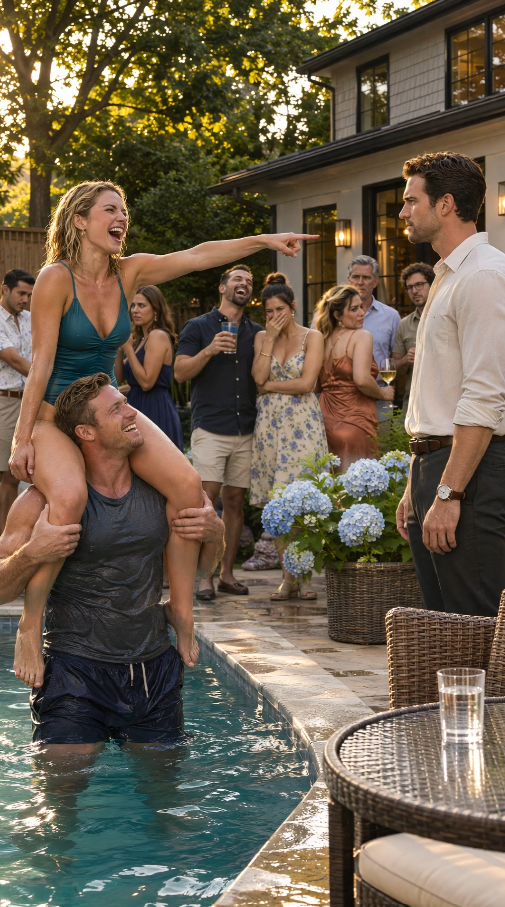
For a moment I was standing in Brent’s backyard again.
p.m.
An untouched glass of water.
Laughter dying around me.
An empty chair waiting for truth to arrive.
I had thought that chair represented control.
I had thought if I remained calm long enough, eventually the right people would walk through the gate and prove I had been right.
I understood now how little I had known.
That night had not revealed one lie.
It had revealed an entire structure of them.
Lauren’s.
Brent’s.
Mine.
Especially the lies we had told ourselves.
That ambition could replace belonging.
That silence was the same thing as peace.
That hurting someone first protected you from being hurt.
That being right could repair what being distant had damaged.
Lauren walked beside me.
“What are you thinking?”
“About that party.”
“So was I.”
“I hated you that night.”
She nodded.
“I know.”
“I don’t anymore.”
Her eyes met mine.
“I know that too.”
Outside, people moved through the courtyard.
The building was alive.
Lauren touched the empty chair.
“Should we get rid of it?”
I looked at her.
“No.”
“Why?”
“Because eventually someone will need somewhere to sit.”
She smiled.
My father would have approved.
We went downstairs.
That evening, after the last visitors left, Lauren and I remained behind.
She turned off lights while I checked windows.
Some things in marriage were grand.
Most were not.
Most were remembering which switch controlled the hallway.
Knowing where the other person had left their glasses.
Buying coffee before it ran out.
Choosing, again and again, to answer when asked what was wrong.
At the entrance, Lauren stopped beside my father’s plaque.
“Daniel.”
“Yeah?”
“Do you ever wonder what would have happened if Evelyn hadn’t knocked on the gate?”
I thought about it.
“Sometimes.”
“What do you think?”
“I think you still would have sent the email.”
She considered that.
“Maybe.”
“And I still would have found the proposal.”
“Probably.”
“We would have had the same conversation eventually.”
“Without thirty people watching me insult you?”
“That part would have been an improvement.”
She winced.
“Fair.”
I took her hand.
“The gate wasn’t what changed things.”
“What was?”
“We stopped lying after it opened.”
Lauren looked toward the dark courtyard.
Then she smiled.
“Your dad would turn that into a lecture.”
“Absolutely.”
We locked Harbor House behind us and walked toward the parking lot.
Halfway there, my phone vibrated.
A message from Evelyn.
I opened it.
There was an attachment.
An old photograph.
My father stood outside the warehouse two years before his death.
Beside him was Lauren.
And beside Lauren was me.
I stared at the picture.
I had no memory of the day.
On the back, my father had written something.
Evelyn had photographed that too.
One day they’ll think this place saved their project.
I hope they figure out it was the other way around.
Lauren read it over my shoulder.
For a long time neither of us spoke.
Then she laughed through tears.
“He knew.”
“Apparently.”
“How?”
“He was Dad.”
“That’s not an explanation.”
“It’s the only one I have.”
We stood beneath the streetlights looking back at Harbor House.
Through the tall windows I could see the meeting room upstairs.
And from where I stood, I could just make out the empty chair.
For months I had thought this story began with three knocks on a wooden gate.
It hadn’t.
It had begun years earlier around a kitchen table, when three people imagined a building none of them knew how to create yet.
My father had supplied the numbers.
I supplied the rooms.
Lauren supplied the question that mattered most.
Who are we making room for?
It had taken me years to understand the answer.
Sometimes for strangers.
Sometimes for family.
Sometimes for the person who has disappointed you.
Sometimes for the person you have disappointed.
And sometimes for whoever you and the people you love are still becoming.
Lauren slipped her hand into mine.
“Ready?”
I looked once more at the building.
Then at her.
“Yes.”
Together, we walked home.
#### Share your thoughts or feedback to motivate us to create more stories ♥️
**–THE END–PLEASE
✓ Lynn R. Adams
## END – The Chair We Chose to Fill Brent agreed to meet me a week later. Not at Alder & Stone. Not at his house. At a coffee shop three blocks from the waterfront. He arrived early. So did I. …