Part 6 – The Winter at Broken Spur-039
### END – What Waited at the Table
By April, Broken Spur was green.
Not everywhere.
Wyoming never surrendered winter gracefully.
Snow remained beneath the north-facing trees, and ice still formed on the water trough some mornings.
But the lower meadow had awakened.
Grass rose thick around the reopened channel.
Willow branches showed pale leaves.
The cattle spread across pasture instead of standing shoulder to shoulder around shrinking hay.
I rode down before breakfast one morning and found Beatrice kneeling beside the water.
She was planting stakes.
“What are those?”
“Garden markers.”
“In the meadow?”
“Near it.”
“You said you wanted a garden.”
“I do.”
“That’s a large garden.”
She stood, brushed dirt from her dress, and pointed.
“Potatoes there. Onions along the higher ground. Beans beside the fence. Squash farther down.”
“How many people are you planning to feed?”
She gave me a look.
“I married a rancher. Ranchers appear to collect hungry people.”
“That’s cattle.”
“I’ve met your neighbors.”
I laughed.
Within weeks, our plans became work.
I broke ground.
Beatrice planted.
We purchased six hens.
Not two.
Not four.
Six.
I built the coop so securely that she inspected it twice before declaring it “nearly acceptable.”
The baking business continued.
By May, Beatrice supplied bread to Mrs. Bell’s boardinghouse every Saturday.
The mercantile sold her biscuits.
I made a wooden sign for her.
**B. HAYES — BREAD & PIES**
She stared at it for a long time.
“You forgot Miller.”
I froze.
“I thought—”
“Beatrice Miller Hayes.”
I nodded.
The next day, I made another sign.
**B. MILLER HAYES — BREAD & PIES**
She hung it in the kitchen.
I never forgot again.
The ranch improved slowly.
That mattered.
There was no sack of gold beneath the springhouse.
No distant relative arrived with an inheritance.
No cattle buyer suddenly paid twice what an animal was worth.
We survived because fifteen cattle were sold before they consumed hay needed by thirty-eight.
Because Beatrice turned flour into money.
Because neighbors shared what they could spare.
Because an old spring saved labor.
Because a forty-acre deed gave us meadow.
Because pride became less important than asking for help.
And because every morning, we got up and did the next necessary thing.
In June, the bank manager visited.
Mr. Colton was a solemn man who wore a black coat even in warm weather.
I expected him to discuss my overdue note.
Instead, he rode across lower meadow twice.
“That’s good grass,” he said.
“Yes.”
“Your land?”
I looked toward Beatrice.
She stood near the springhouse.
“No.”
Colton frowned.
“My wife’s.”
Beatrice approached.
“Technically,” she said, “the cattle are tenants.”
Colton blinked.
I smiled.
He inspected our accounts.
The cattle sale.
Bread income.
Reduced feed expenses.
The spring.
Finally, he closed the ledger.
“I can extend the note another year.”
I stared.
“Without increasing interest?”
“Without increasing interest.”
“Why?”
He glanced toward the herd.
“Because last year I saw a ranch dying.”
He looked at Beatrice.
“This year I see a business.”
Beatrice corrected him.
“Two businesses.”
Mr. Colton almost smiled.
“Apparently.”
After he left, I stood beside the barn trying to understand what had happened.
“We’re not losing it,” I said.
“No.”
“Not this year.”
“No.”
Beatrice touched my arm.
“You sound disappointed.”
“I’m suspicious of good news.”
“Another Wyoming lesson?”
“No. A Caleb lesson.”
She leaned against me.
“We can revise those.”
Summer arrived.
So did people.
The guest room Beatrice wanted became a reality after I added two rooms onto the cabin.
A schoolteacher traveling toward Montana stayed one night.
Then a salesman.
Then a widow and her daughter whose wagon axle broke three miles away.
Nobody paid much.
Some paid nothing.
But everyone ate at Beatrice’s table.
I began noticing what happened there.
People talked.
Not the shallow talk exchanged at counters in town.
Real talk.
The schoolteacher confessed she was frightened to begin at a frontier school.
The salesman admitted he missed his children.
The widow told stories about her husband until she laughed hard enough to cry.
Beatrice listened.
She had a way of making silence feel like permission instead of emptiness.
One evening after our guests had gone, I said, “You would have made a good minister.”
She looked horrified.
“I prefer people awake.”
“Fair.”
She washed a plate.
I dried it.
That was another habit.
I had once thought washing dishes was women’s work.
Then I discovered that standing beside Beatrice after supper was often the best part of my day.
By August, the garden produced more potatoes than we could store.
Beatrice stood in the middle of it looking personally offended.
“I planted too many.”
I folded my arms.
“I would like that written down.”
“No.”
“Signed and witnessed.”
“Caleb.”
“Perhaps framed.”
She threw a potato at me.
I caught it.
“Violence.”
“Harvesting.”
We gave several sacks to neighbors.
Mrs. Bell bought more.
The rest went into a new root cellar.
The pantry that autumn looked nothing like the one Beatrice had found on her first morning.
Sacks of flour.
Beans.
Potatoes.
Onions.
Dried apples.
Preserves.
Salt pork.
Coffee.
Molasses.
Shelves of canned vegetables.
I stood in the doorway one evening.
Beatrice came behind me.
“What?”
“Nothing.”
“You’re staring at food.”
“I remember being afraid to feed you.”
She became quiet.
“So do I.”
“I wish I didn’t.”
“No.”
I turned.
“You don’t?”
“If you forgot who you were then, you might forget how far you’ve come.”
That was Beatrice.
She rarely offered comfort without truth attached.
Our first anniversary came in October.
One year since the Oak Haven stagecoach.
I told Beatrice we needed supplies in town.
She believed me until we passed the mercantile.
“Where are we going?”
“Depot.”
“Why?”
“Because I said so.”
“That strategy has failed every time you’ve attempted it.”
At the stage depot, I stopped beside the platform.
A coach had just arrived.
Passengers climbed down.
For a moment I saw the memory perfectly.
Beatrice in her gray dress.
The workers laughing.
My own shame.
I took her hand.
“A year ago, you stood there.”
“Yes.”
“And I thought I’d made a terrible mistake.”
She looked at me.
“I know.”
“I want to tell you what I should have thought.”
People moved around us.
Horses stamped.
A driver shouted toward the baggage clerk.
But the world seemed very small.
Just Beatrice.
Just me.
“I should have thought that you’d traveled nine hundred miles alone,” I said. “I should have wondered whether you were frightened. I should have asked if you were tired. I should have been grateful someone had trusted my miserable enough to step off a stagecoach.”
Her eyes shone.
“You could improve the .”
“I already have.”
“You have?”
I took a folded newspaper from my coat.
She opened it.
I had purchased a tiny notice in the Oak Haven Weekly.
**BROKEN SPUR RANCH — Bread, lodging, cattle, dairy goods, and honest hospitality. Operated by Caleb Hayes and Beatrice Miller Hayes. No promises of luxury.**
Beatrice began laughing.
“You kept that line?”
“It worked once.”
She laughed harder.
Then she kissed me.
In public.
Which created enough interest among nearby townspeople that I became suddenly fascinated by the horses.
On our way home, we stopped at the rise above Broken Spur.
The ranch lay below.
Fresh fencing crossed the pasture.
Smoke lifted from the chimney.
The lower meadow was gold beneath the autumn sun.
Near the cabin stood the new kitchen addition.
Beside it, the garden.
Beyond that, Beatrice’s ridiculous fortress of a chicken coop.
“This isn’t the place I arrived at,” she said.
“No.”
“Do you miss the old one?”
I considered.
“The old ranch?”
“The old Caleb.”
I looked at her.
“No.”
She smiled.
“Good.”
We rode down together.
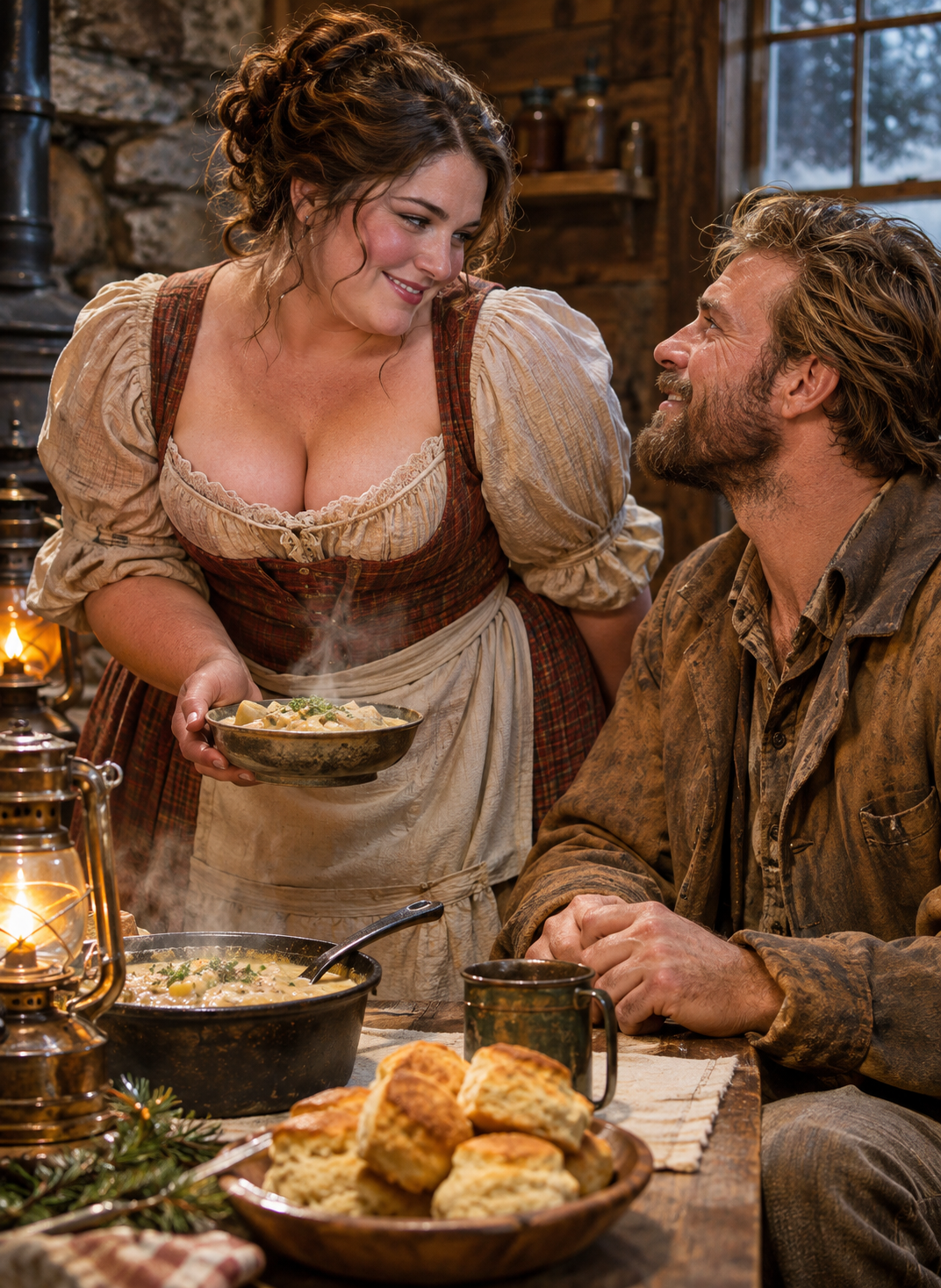
That evening, Beatrice prepared potato chowder.
The same meal she’d made four nights after arriving.
Golden biscuits sat beside it.
I entered after finishing chores and stopped in the doorway.
For one moment, time folded.
The clean kitchen.
The warm stove.
The table.
Beatrice.
“Wash your hands, Mr. Hayes,” she said.
I smiled.
“Supper is ready?”
“Supper is ready.”
I washed.
Then I took my place at the table.
Beatrice sat opposite me.
Between us stood more food than we’d had that first winter night.
But oddly, that wasn’t what made the room feel abundant.
I finally understood something my mother had known.
Something Margaret Miller had understood.
Something Beatrice had tried to show me from the beginning.
A full pantry could make a winter easier.
But it could not make a home.
A home was built from the person who noticed you were tired.
The person who asked for the truth.
The person who challenged your pride.
The person who remained after discovering your weaknesses.
The person whose dreams became important enough that you made room beside your own.
I reached across the table.
Beatrice took my hand.
“Eleven onions,” I said.
She smiled.
“Fifteen cattle.”
“One dollar rent.”
“Six chickens.”
“Too many potatoes.”
“Take that back.”
“Never.”
She laughed.
Outside, autumn wind moved through the cottonwoods.
Somewhere beyond the cabin, cattle settled beneath the darkening sky.
Broken Spur still had debts.
Fences would break again.
Winters would return.
There would be dry summers, sick calves, failed crops, burned bread, disagreements, and mornings when nothing went the way we planned.
But I no longer believed survival meant defeating every difficulty alone.
And I no longer believed worth could be measured by appearances, numbers on a scale, acres on a deed, cattle in a pasture, or dollars in a pantry.
One year earlier, I had looked at Beatrice Miller and seen a burden.
I had been wrong.
She had not come to Broken Spur to be rescued.
Neither, as it turned out, had I rescued her.
We had simply arrived in each other’s lives carrying different pieces of what a home required.
Her skill.
My land.
Her mother’s key.
My mother’s forgotten spring.
Her courage to begin again.
My willingness, eventually, to change.
And a table where neither of us had to sit alone.
Later that night, I stepped onto the porch.
The air smelled of frost.
Beatrice joined me, wrapping a shawl around her shoulders.
“Winter soon,” I said.
“Are you worried?”
I considered the stocked pantry.
The hay.
The healthy herd.
The spring flowing beneath the hill.
Then I looked at my wife.
“A little.”
“Good.”
“Good?”
“You become foolish when you’re too confident.”
“And what happens when I’m worried?”
“You listen.”
I smiled.
“Then I’ll stay a little worried.”
She slipped her hand into mine.
Across the dark pasture, moonlight caught the roof of the old springhouse.
For years, something valuable had waited beneath that hill.
Not treasure.
Not riches.
Water.
History.
A forgotten connection between two families.
All of it had been there while I struggled above it, never knowing where to look.
Perhaps people were like that too.
Perhaps the most important things about them were rarely visible from a distance.
You had to stay.
You had to listen.
You had to ask.
I squeezed Beatrice’s hand.
“What?” she asked.
“Nothing.”
“You’re doing that staring thing again.”
“I know.”
“And?”
This time I didn’t look away.
“I’m grateful you stepped off that stagecoach.”
Her expression softened.
“So am I.”
Behind us, the cabin windows glowed.
Supper dishes waited.
The stove needed banking.
Tomorrow’s work would begin before sunrise.
Ordinary things.
Beautiful things.
Home.
And when we finally went inside, Beatrice closed the door against the cold while I added another piece of wood to the fire.
The winter wind rose beyond the walls.
But this time, Broken Spur was ready.
And so were we.
Share your thoughts or feedback to motivate us to create more stories ♥️
**–THE END–PLEASE
✓ Lynn R. Adams
### END – What Waited at the Table By April, Broken Spur was green. Not everywhere. Wyoming never surrendered winter gracefully. Snow remained beneath the north-facing trees, and ice still formed …