PART 6: THE WIDOWED PRINCE LET TWELVE PRINCESSES COMPETE TO BECOME HIS DAUGHTER’S MOTHER, BUT ONE-YEAR-OLD LUCY CRAWLED STRAIGHT TO A POOR MAID AND CALLED HER “”MAMA!””-062
The letter inside the cradle was not long.
That somehow made Alexander more afraid of it.
He had learned during the previous weeks that a few sentences could alter the shape of an entire year.
Sophia stood beside the cradle.
Victoria waited near the door.
Alexander unfolded the page.
“My dearest Alexander,” he read.
“If you have found this, then Lucy has already outgrown the cradle, which means time has done the astonishing thing it always promises to do.”
“It has continued.”
Alexander stopped.
Eleanor had understood him better than he wished she had.
He continued.
“I almost sent another version of this letter through Uncle Matthew.”
“I asked him to return it because that version was filled with instructions.”
“I told you what to do with my papers, what stories to tell Lucy, whom to trust, when to forgive yourself, and several other things no dead wife has any business arranging.”
A laugh escaped Alexander.
Sophia covered her mouth.
Even Victoria smiled.
“So I destroyed it and wrote this instead.”
“I leave you no instructions.”
“I leave you permission.”
“Permission to laugh in rooms where I once laughed.”
“Permission to love our daughter without turning every resemblance to me into a reason for sadness.”
“Permission to meet people I never met and become someone I never knew.”
“And permission, someday, to love someone without asking whether doing so betrays me.”
Alexander lowered the page.
For months he had told himself he did not need permission.
He was a grown man.
A prince.
A father.
He did not need Eleanor to authorize his future.
Yet hearing the words released something he had never managed to release himself.
He continued.
“If Lucy ever calls another woman Mama, do not correct her too quickly.”
“Children do not divide love with the precision adults demand.”
“She may call someone Mama because she feels safe.”
“She may call someone Mama because she is loved.”
“She may call someone Mama because she is one year old and enjoys causing royal confusion.”
Victoria laughed aloud.
Sophia was crying.
Alexander smiled through his own tears.
“But tell her about me.”
“Not because I want to compete with the living.”
“Tell her because I loved her before I knew the sound of her voice.”
“Tell her because she should know that her life began inside love.”
“And then, Alexander, please do something difficult.”
“Let the rest of her story belong to her.”
There was one final paragraph.
Alexander read it silently first.
Then he looked toward Sophia.
“What?” she asked.
He handed her the page.
Sophia read.
“If Sophia ever returns to your life, do not make her responsible for my absence.”
“She deserves a life larger than being remembered as my friend.”
“She once told me she wanted to teach children.”
“If she still wants that, encourage her.”
“If she wants something entirely different, encourage that instead.”
“And if, by some extraordinary accident, you discover you care for her, have the decency to ask whether she cares for you before planning another ridiculous royal ceremony.”
Sophia laughed so suddenly that tears spilled down her cheeks.
Alexander stared toward the ceiling.
“I am beginning to resent how accurately she predicted me.”
Victoria looked pleased.
“I find it refreshing.”
Sophia handed back the letter.
“There is one more line.”
Alexander read it.
“P.S. Mother, if you are reading over his shoulder, stop arranging marriages.”
Victoria looked offended.
“I arranged one.”
“Nearly thirteen,” Alexander said.
Sophia laughed harder.
It was the first night since Eleanor’s death that Alexander allowed himself to remember her without ending the memory in grief.
He remembered Eleanor teasing his mother.
Eleanor hiding strawberries.
Eleanor drawing his nose too large.
Eleanor loving Lucy before Lucy could know her.
The pain did not disappear.
It simply stopped being the only thing inside the memory.
The following morning Alexander accompanied Sophia to the station.
Her luggage was modest.
Two suitcases.
A box of books.
A bundle of toys Lucy had attempted to pack without permission.
The platform smelled of coal smoke and cold autumn air.
Lucy clung to Sophia.
“Mama Fia.”
Sophia kissed her hair.
“I’ll see you next week.”
Alexander blinked.
“Next week?”
Sophia looked at him.
“The school is three hours away, Alexander.”
“I am not moving to the moon.”
“I knew that.”
“You look surprised.”
“I was preparing myself for a tragic farewell.”
“That sounds exhausting.”
“It was.”
Sophia smiled.
The train whistle sounded.
Alexander suddenly understood there was something he needed to say before she left.
Not a proposal.
Not a promise.
Not a grand speech.
“Sophia.”
She waited.
“When you come back next week, would you have dinner with me?”
She raised an eyebrow.
“We have eaten dinner together many times.”
“No Lucy.”
“Dangerous.”
“No Mother.”
“More dangerous.”
“Not as Prince Alexander and Lucy’s companion.”
Sophia’s smile slowly changed.
“As what?”
“As Alexander and Sophia.”
For several seconds she said nothing.
Then she nodded.
“Yes.”
The train carried her toward Bellmere.
Alexander returned to the palace with Lucy.
Nothing dramatic happened.
That turned out to be exactly what they needed.
Sophia began teaching.
Alexander continued his public duties.
Lucy learned several new words, most of which she used incorrectly.
On Fridays Sophia returned to the palace.
Sometimes Alexander traveled to Bellmere.
He repaired the school roof anonymously until Sophia discovered the accounts and informed him that anonymous donations were less anonymous when they came through the royal treasury.
He apologized.
She made him attend the school fundraiser instead.
Alexander discovered he was terrible at selling raffle tickets.
Lucy discovered she was excellent at it.
Queen Victoria bought twenty-seven.
Winter arrived.
Sophia’s classroom grew warmer.
So did the friendship between her and Alexander.
They argued occasionally.
Sophia believed Alexander worried too much about appearances.
Alexander believed Sophia occasionally confused independence with refusing help.
Neither argument ended with anyone storming away.
They learned to return.
They learned to listen.
Most importantly, Alexander learned not to compare Sophia with Eleanor.
Eleanor had been impulsive.
Sophia considered decisions from every direction.
Eleanor had loved enormous parties.
Sophia preferred six people around a kitchen table.
Eleanor could charm a room without trying.
Sophia rarely noticed when she had done the same.
They were different women.
Loving one did not explain loving the other.
By spring, the palace gardens bloomed again.
One afternoon Alexander found Sophia beneath the cherry trees with Lucy.
Lucy was nearly two.
She was attempting to pronounce the names of flowers.
“Rose.”
“Correct,” Sophia said.
Lucy pointed toward a tulip.
“Rose.”
“No.”
Lucy pointed toward a daisy.
“Rose.”
Sophia sighed.
“We may have reached the limits of today’s lesson.”
Alexander sat beside them.
“I have a question.”
Sophia looked at him suspiciously.
“I dislike that tone.”
“It is a very respectable tone.”
“That makes it worse.”
He smiled.
“I am not going to ask you to become Lucy’s mother.”
Sophia’s expression softened.
“She already seems to have made her own administrative decision about that.”
Lucy held up a flower.
“Rose.”
It was not a rose.
Alexander continued.
“And I am not asking because Eleanor wrote anything.”
Sophia waited.
“I am asking because every Friday morning I find myself counting hours until your train arrives.”
“Because when something ridiculous happens, you are the person I want to tell.”
“Because you make me reconsider things I thought I understood.”
“Because Lucy loves you.”
He paused.
“But also because I love you when Lucy is not in the room.”
Sophia’s eyes filled.
Alexander took her hand.
“I love the woman who wants thirty-seven children to have better books.”
“The woman who makes terrible bread.”
“The woman who told me no when everyone else was afraid to.”
“The woman who left the palace when leaving was the right choice.”
Sophia was smiling now.
“And?”
“And I have been informed I should ask what you want before arranging royal ceremonies.”
“That is excellent advice.”
“Apparently my first wife remains extremely influential.”
Sophia laughed.
Alexander drew a small ring from his pocket.
It was not enormous.
There was no crowd.
No ballroom.
No crimson carpet.
“Would you like to build a life with me?”
Sophia looked at him for a long time.
Then she did something that terrified him.
She shook her head.
Alexander stopped breathing.
Sophia squeezed his hand.
“Not that question.”
He stared.
“What?”
“I don’t want you to ask whether I would like to build a life with you.”
“Why?”
“Because I already have a life.”
Alexander slowly understood.
Sophia smiled.
“Ask whether I would like our lives to grow together.”
His eyes stung.
“Would you?”
Sophia leaned closer.
“Yes.”
Lucy applauded, although nobody had explained what was happening.
They married four months later.
Not because Lucy had chosen Sophia.
Not because Alexander had promised the ballroom.
Not because Eleanor had left letters.
They married because Alexander asked.
Sophia answered.
And both were free to choose.
The ceremony took place in the palace garden.
The twelve princesses who had once gathered for Lucy’s unusual contest were invited as guests.
Most attended.
Princess Charlotte arrived carrying the diamond bear.
“You are still trying?” Alexander asked.
“I admire persistence.”
Lucy accepted the bear at last.
Charlotte looked triumphant.
“I knew she would develop taste.”
Sophia laughed.
Queen Victoria sat beside Eleanor’s empty place of honor.
On the chair rested the ivory handkerchief embroidered with Lucy’s name.
There was no attempt to pretend Eleanor had never existed.
There was equally no suggestion that Sophia had replaced her.
During the ceremony Lucy wandered toward Eleanor’s chair.
Everyone watched.
She picked up the handkerchief.
“Mama Eleanor,” she said.
Alexander closed his eyes.
Sophia knelt beside her.
“Yes.”
Lucy then pointed toward Sophia.
“Mama Fia.”
Sophia kissed her forehead.
“Yes.”
Lucy appeared satisfied with the arrangement.
So, eventually, was everyone else.
Years passed.
The school at Bellmere expanded into three buildings.
Sophia continued teaching even after becoming a princess, although she refused to allow portraits of herself in the classrooms.
Alexander learned to bake bread well enough that it could safely be eaten.
Victoria stopped arranging marriages, although she claimed this was temporary.
Lucy grew into a curious girl who asked more questions than any tutor could comfortably answer.
She knew Eleanor.
Not as a tragedy.
Not as a portrait.
As the girl who climbed apple trees.
The woman who hated thunderstorms.
The mother who loved her before hearing her laugh.
And she knew Sophia.
The teacher who corrected her spelling.
The woman who sat beside her through fevers.
The mother who arrived not because destiny demanded it, but because affection grew slowly into family.
On Lucy’s tenth birthday, Alexander gave her Eleanor’s old writing desk.
Lucy spent the afternoon exploring every drawer.
Near sunset, she found something beneath the lowest compartment.
A tiny folded piece of paper.
“Papa?”
Alexander looked up.
“There’s another letter.”
He and Sophia exchanged a startled glance.
After all those years, Eleanor had apparently kept one final secret.
Lucy unfolded it.
The handwriting was unmistakable.
The note contained only three sentences.
“My darling Lucy, if you ever find this, you are old enough to know something important.”
“Families are not made by replacing the people we lose.”
“They are made by allowing love to keep adding new names.”
Lucy read it twice.
Then she looked toward Eleanor’s portrait.
Afterward she looked toward Sophia.
Finally she looked at Alexander.
“Did Mama Eleanor know Sophia would become my mother?”
Alexander smiled.
“No.”
Lucy frowned.
“Then how did she know what would happen?”
Sophia sat beside her.
“She didn’t.”
“Then why did she write all those letters?”
Alexander looked toward the evening light beyond the windows.
“Because your mother understood something before I did.”
“What?”
He took Lucy’s hand.
“That loving somebody means accepting that you cannot write the rest of their story for them.”
Lucy considered this.
Then she smiled.
“Good.”
“Why good?”
“Because I want to write mine myself.”
Alexander laughed.
Sophia kissed the top of Lucy’s head.
And as evening settled over the palace, the ivory handkerchief lay folded inside Eleanor’s desk, no longer a clue to some frightening mystery, but a reminder of how easily grief could make people search for what was hidden when the truth had been waiting quietly in love all along.
Alexander once believed his life had ended when Eleanor’s did.
Sophia once believed her place in the world depended upon being useful to somebody else.
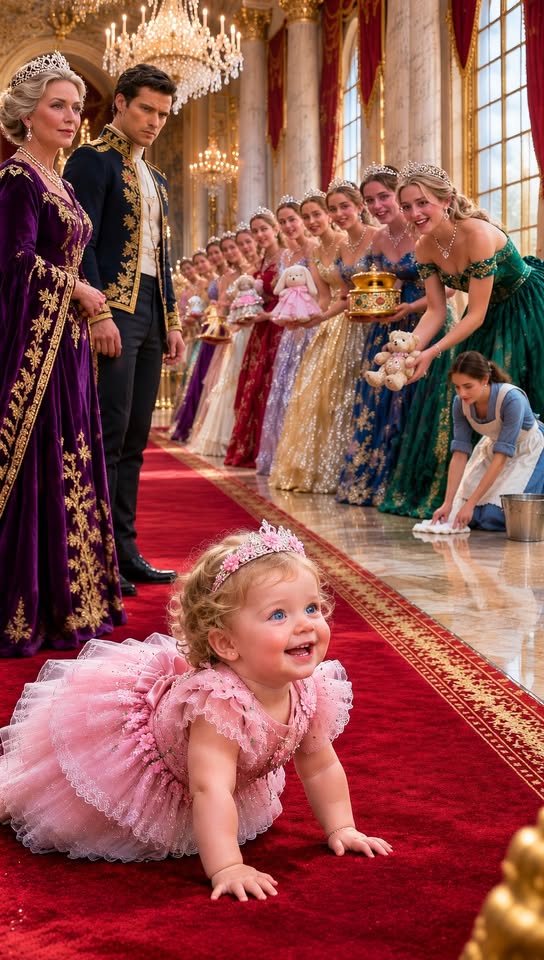
Lucy once crawled across a ballroom without understanding that every adult around her thought she was choosing a future for them.
In the end, none of them were rescued by destiny.
They were changed by something quieter.
A remembered song.
A letter finally opened.
A question asked without demanding an answer.
And the courage to let love become larger without asking it to erase anything that came before.
**–THE END–PLEASE
**Share your thoughts or feedback to motivate us to create more stories ♥️**
✓ Lynn R. Adams
The letter inside the cradle was not long. That somehow made Alexander more afraid of it. He had learned during the previous weeks that a few sentences could alter the shape of an entire year. Soph…