PART 6: “The Veiled Bride Said Nothing—Until She Whispered, ‘Your Brother Isn’t Dead’” 066
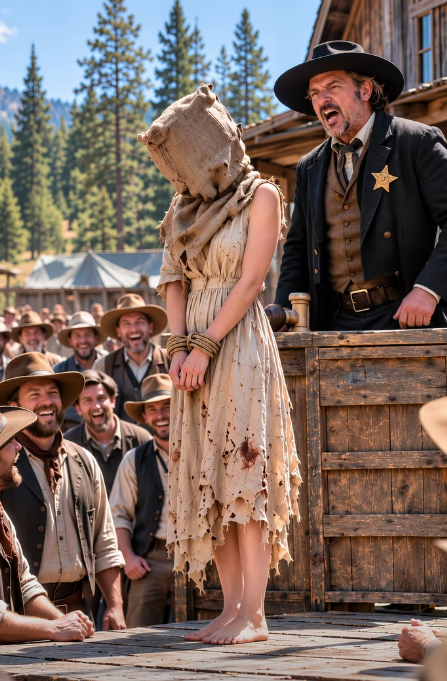
Four months later, Josephine Rourke stood outside the territorial land office in Salem and watched rain slide from the roof.
She no longer wore the sack.
She had kept it, however.
It rested at the bottom of a trunk in Caleb’s wagon.
Not because she intended to use it again.
Because sometimes evidence of who a person had been mattered almost as much as proof of who they became.
Caleb emerged from the building.
Nathan followed.
Silas Bell came last.
Nobody spoke immediately.
Josephine searched Caleb’s face.
“Well?”
Caleb held up a folded notice.
“The disputed transfers are suspended.”
Josephine exhaled.
Nathan smiled.
“Pending final review.”
“How long?”
The clerk standing in the doorway answered.
“Months, perhaps.”
Caleb looked at Josephine.
“Government.”
She almost laughed.
The investigation had moved slowly.
But it had moved.
The federal field book matched Jeremiah Whitlock’s blue ledger, Nathan’s survey, and the church copy.
Affected homesteaders would be allowed to resubmit their claims.
Pacific Crown Holdings had not disappeared overnight.
Nor had everyone involved admitted wrongdoing.
Reality proved less tidy than stories.
Some company officials insisted mistakes had been made without criminal intent.
Others quietly resigned.
Several disputed transactions were still being examined.
But the machinery that had depended on silence no longer enjoyed silence.
Silas gave sworn testimony.
Nathan provided documents.
Josephine identified her father’s handwriting.
Caleb told the truth about Jeremiah.
Not the version that protected his father completely.
The whole truth.
Jeremiah had helped redraw boundaries.
He had failed to ask questions soon enough.
Then, after discovering the deception, he had spent years trying to repair the harm.
Caleb discovered something important during those hearings.
A person could be flawed without being false.
A mistake could belong to a life without defining all of it.
That understanding changed the way he remembered his father.
It changed the way he remembered Nathan.
And eventually, it changed the way he remembered himself.
They returned to Ridge Hollow in early autumn.
The settlement looked different to Josephine.
Perhaps because nobody was laughing.
Perhaps because she was no longer looking at the world through cloth.
Clara Finch met their wagon near the post office.
She hugged Josephine before anyone could object.
“I have something for you.”
“A letter?”
“Better.”
Clara handed her an envelope bearing an eastern postmark.
Josephine recognized the handwriting instantly.
Her knees nearly failed.
Caleb caught her elbow.
“Josephine?”
She could not answer.
Nathan saw the writing.
His expression changed.
“Cormac.”
Josephine opened the letter.
My dear troublesome daughter,
If this reaches you, then my last attempt at writing did not vanish into a government office.
Josephine began laughing and crying at once.
Caleb looked away briefly, giving her privacy without leaving her side.
Cormac had indeed reached Washington.
Illness had delayed him.
Then a bureaucratic dispute had trapped the investigation among three different agencies.
By the time he regained enough strength to travel, he learned that Josephine had left Missouri searching for answers.
He had been trying to find her ever since.
At the bottom was an address in Pennsylvania.
And a promise.
I am coming west as soon as my doctor stops behaving like a prison guard.
Josephine pressed the letter against her chest.
Nathan grinned.
“Sounds like him.”
“You met him twice.”
“It was enough.”
Life did not transform in one grand moment.
It changed in ordinary ones.
Silas Bell never reclaimed his badge.
Instead, he began working with the blacksmith.
For months, some townspeople distrusted him.
He accepted it.
When apologies were appropriate, he made them.
When forgiveness did not come immediately, he did not demand it.
Nathan rented a small cabin near the river.
He and Caleb spent much of that winter rebuilding something that had no physical shape.
Brotherhood required patience.
Some conversations ended badly.
Some silences lasted days.
Then one morning Nathan appeared carrying coffee, and Caleb handed him a saw, and neither mentioned the argument.
That was progress.
Josephine remained at Caleb’s cabin.
At first for practical reasons.
Then for reasons neither of them named.
She repaired the leaking window beside the table.
Caleb built her a writing desk.
She taught him how to read survey descriptions.
He taught her how to split cedar.
She was terrible at it.
He wisely did not laugh.
She noticed anyway.
“You’re smiling.”
“No.”
“You are.”
“Wind.”
“Inside the cabin?”
“Unusual weather.”
She threw a glove at him.
One evening, Reverend Amos Vale visited.
He placed the old marriage certificate on the table.
“I have news.”
Josephine looked at Caleb.
Caleb looked at Amos.
Amos adjusted his spectacles.
“The certificate is legally questionable.”
Josephine folded her arms.
“Questionable sounds convenient.”
“Law often does.”
Caleb nodded.
“I’ve said that.”
Amos continued.
“Silas had no recognized authority when he witnessed the document. The ceremony was also irregular enough that a judge could invalidate it easily.”
Josephine was quiet.
“So we aren’t married.”
Amos smiled.
“That depends on whether either of you wishes to argue that you are.”
Caleb looked toward Josephine.
“I won’t.”
Something flickered in her eyes.
Amos gathered his hat.
“I shall leave you to discuss it.”
After he departed, silence filled the cabin.
Josephine stood near the fire.
Caleb remained by the table.
Finally she asked, “You won’t argue?”
“No.”
“Why?”
“Because you didn’t choose it freely.”
“You think I want it invalidated?”
“I think you should get to decide.”
Josephine turned toward the window.
Snow had begun falling.
Not a storm.
Just quiet flakes drifting among the pines.
“What would you decide?”
Caleb hesitated.
Josephine looked back.
“I asked.”
“I know.”
“And?”
Caleb rested both hands on the table.
“I’d rather be married to you than not.”
Josephine’s eyes widened slightly.
He continued before courage deserted him.
“But not because of two dollars.”
A smile touched her mouth.
“Good.”
“Not because of a platform.”
“Better.”
“Not because Nathan thinks I look at you strangely.”
Josephine laughed.
“He told you?”
“He is becoming tiresome.”
She crossed the room.
Caleb looked down at her.
Josephine said, “Then perhaps we should start again.”
“How?”
“With a question.”
“All right.”
She held out her hand.
“Caleb Whitlock, would you like to marry me?”
Caleb stared.
“That was supposed to be my question.”
“You were taking too long.”
He laughed.
A full laugh.
One Josephine had rarely heard.
Then he took her hand.
“Yes.”
She nodded.
“Good.”
Caleb raised an eyebrow.
“That’s all?”
“What else?”
“I expected a speech.”
“You’re the one who wanted the question.”
Caleb drew her gently closer.
“Josephine Rourke.”
“Yes?”
“Will you marry me?”
Her expression softened.
“Yes.”
This time, the word belonged entirely to her.
They married again in spring.
No auction platform.
No sack.
No ropes.
No jeering crowd.
The ceremony took place beside Willow Creek beneath tall pines.
Clara brought wildflowers.
Nathan stood beside Caleb.
Silas remained near the back, uncertain whether he should attend until Josephine personally waved him closer.
Amos performed the ceremony.
When he asked who gave Josephine away, she answered before anyone else could.
“No one.”
Amos smiled.
“Excellent.”
Josephine looked at Caleb.
“I came here myself.”
Caleb’s eyes shone.
“Yes, you did.”
They exchanged plain silver rings.
Afterward Nathan approached.
“I brought a wedding gift.”
Caleb narrowed his eyes.
“If it’s an axe, I already have one.”
Nathan handed him a small box.
Inside were two silver dollars.
Caleb stared.
Josephine laughed.
“How did you get those?”
Nathan looked pleased with himself.
“I found the auctioneer.”
Caleb’s expression darkened.
Nathan lifted a hand.
“Peacefully.”
Josephine examined the coins.
“The same ones?”
“Impossible to know.”
Nathan shrugged.
“But I told him I needed two silver dollars returned on principle.”
Caleb handed one coin to Josephine.
She handed it back.
“No.”
He frowned.
Josephine closed his fingers around both coins.
“Keep them.”
“Why?”
“So whenever you become too serious, I can remind you that you once paid more for a broken shovel.”
Nathan laughed.
Caleb looked offended.
“That shovel was repairable.”
Cormac Rourke arrived in June.
Josephine saw the wagon from the ridge.
For several seconds she could not move.
Then she ran.
Caleb remained behind.
This moment was hers.
Cormac climbed slowly from the wagon.
He had aged.
His hair was white.
He leaned on a cane.
But when Josephine reached him, he opened his arms.
She disappeared into them.
No mystery remained in that embrace.
No secret.
No map.
No unfinished promise.
Only a daughter who had spent years wondering.
And a father who had finally come home.
Later, Cormac sat beside Caleb beneath the cabin porch.
“I hear you paid two dollars for my daughter.”
Caleb closed his eyes.
“I was hoping that story would die.”
Cormac nodded solemnly.
“It will not.”
Josephine called from inside.
“Never.”
Nathan laughed from the yard.
Caleb accepted defeat.
Cormac became serious.
“You walked beside her.”
Caleb looked at him.
“Your letter said to.”
“My letters contain excellent advice.”
“So I’ve learned.”
Cormac watched Josephine through the open doorway.
“She was always braver than I wanted her to have to be.”
Caleb understood.
“I think she’s tired of being brave.”
Cormac nodded.
“Good.”
They sat without speaking.
Years later, the old auction platform disappeared.
Nobody knew who removed it.
Some claimed a storm destroyed it.
Others said the lumber was used to repair a barn.
Caleb knew the truth.
Nathan had dismantled it one quiet morning.
He built a footbridge across Willow Creek from the boards.
When Josephine discovered what he had done, she stood on that bridge for a long time.
Caleb joined her.
“Does it bother you?”
“No.”
She looked down at the water.
“I like that something ugly became useful.”
Caleb leaned against the railing.
“That sounds almost philosophical.”
“Don’t tell anyone.”
They watched leaves drift beneath the bridge.
Josephine had stopped thinking about herself as the woman beneath the sack.
That woman had existed.
She mattered.
But she was not the whole story.
Caleb had stopped thinking about himself as the man abandoned in the cave.
Nathan was no longer a ghost.
Jeremiah was no longer either a perfect father or a disgraced one.
He was simply a man who had made a mistake and tried, imperfectly, to repair it.
And the cave itself became nothing more than stone in a mountain.
The memories remained.
But memories were not chains unless people allowed them to be.
One autumn afternoon, Josephine found the old sack while sorting the trunk.
She carried it outside.
Caleb was splitting wood.
He saw the cloth.
“What are you doing?”
Josephine considered.
Then she placed it on a stump.
“Nothing dramatic.”
“Good.”
“I thought about burning it.”
“And?”
“I don’t need to.”
She folded it carefully.
Then used it to wrap a bundle of young apple trees they planned to plant near the cabin.
Caleb smiled.
Josephine noticed.
“You’re doing it again.”
“What?”
“Looking at me strangely.”
Caleb set down his axe.
“Nathan says I do that.”
“Nathan is occasionally correct.”
Caleb walked toward her.
Josephine looked at the saplings.
“Do you think they’ll grow here?”
“Yes.”
“You sound certain.”
“I know trees.”
She glanced at him.
“And people?”
Caleb considered.
“I’m learning.”
Josephine slipped her hand into his.
Together they walked toward the field.
Behind them stood the cabin built partly from Jeremiah Whitlock’s old house.
Beyond it ran the creek.
Farther still rose the mountains.
Somewhere among those peaks remained a cave that had once held fear, secrets, and three years of misunderstanding.
But the road no longer ended there.
Josephine looked toward Caleb.
“Do you ever think about that first day?”
“The auction?”
“Yes.”
“Sometimes.”
“What would you do differently?”
Caleb thought carefully.
“I’d still raise my hand.”
Josephine smiled.
“But?”
“I’d tell that fool auctioneer he couldn’t sell another human being before I gave him the money.”
“That would have been better.”
“Considerably.”
She squeezed his hand.
“And after that?”
Caleb looked at her.
“I would ask your name.”
“You already knew it.”
“No.”
He shook his head.
“I knew the name you gave them.”
Josephine waited.
Caleb continued.
“I mean I would ask who you were.”
She understood.
That had been the question beneath every other question.
Not what did you hide?
Not what happened in the cave?
Not who frightened you?
Who are you?
Josephine looked toward the saplings.
Then at the cabin.
Then at Nathan walking up the distant road with a parcel beneath one arm.
Her father sat on the porch reading.
Clara Finch approached behind Nathan, apparently carrying mail and undoubtedly carrying gossip.
Josephine smiled.
“Ask me now.”
Caleb did.
“Who are you, Josephine?”
She looked at him.
“No one’s secret.”
Caleb waited.
“No one’s debt.”
He smiled.
She continued.
“No one’s purchase.”
The afternoon wind stirred her hair.
“And?”
Josephine looked toward their home.
“Your wife.”
Caleb’s expression softened.
“By choice.”
“By choice.”
Then she took the shovel from beside the apple saplings.
“Now stop staring at me and dig.”
Caleb laughed.
“Yes, ma’am.”
Josephine raised an eyebrow.
“Careful.”
Together they planted the first tree.
Later, they would plant six more.
Years afterward, their branches would stretch above the creek bank, shading travelers who knew nothing about a winter cave, a blue ledger, a frightened deputy, an impossible letter, or a woman who once crossed half a continent with her face hidden from the world.
They would know only that apple trees grew beside the Whitlock house.
And perhaps that was enough.
Some stories did not need monuments.
Some needed ordinary mornings.
Open windows.
Brothers drinking coffee.
Letters arriving.
Trees taking root.
And two people who had first met under the strangest circumstances imaginable, discovering slowly that neither had rescued the other.
They had simply learned to walk beside one another.
Josephine glanced once toward the mountains.
Then she turned toward home.
Share your thoughts or feedback to motivate us to create more stories ♥️
**–THE END–PLEASE
✓ Lynn R. Adams
Four months later, Josephine Rourke stood outside the territorial land office in Salem and watched rain slide from the roof. She no longer wore the sack. She had kept it, however. It rested at the …