PART 6: The Truth Between Us: A Marriage, a Hidden Secret, and the Choice That Changed a Family_063
## END – The Table We Chose
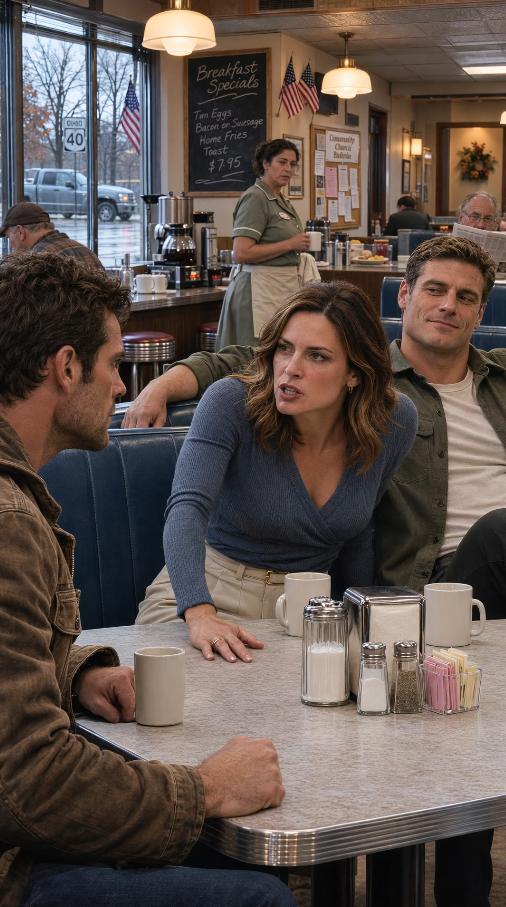
At the next morning, I walked into the diner off Route 40.
The same neon sign buzzed above the window.
The same American flags were taped inside the glass.
The same church bulletin board stood near the restroom.
Even Donna was behind the counter.
She spotted me.
Recognition crossed her face.
“Oh,” she said.
I stopped.
“Oh?”
She pointed toward the back booth.
“She’s waiting.”
I looked.
Marissa sat alone.
Not in the booth from that morning months earlier.
The one across from it.
She wore a blue sweater and had both hands wrapped around a mug of tea.
Her stomach made the table seem slightly too close.
For a moment, I remained near the door.
Memory moved faster than reality.
Nolan’s smirk.
Marissa’s folded hands.
My phone beside the sugar packets.
The words:
_I’m pregnant with his child._
I walked to her booth.
“Hi.”
She looked up.
“Hi.”
I sat.
Donna appeared.
“Coffee?”
“Yes.”
She poured it.
Then looked at both of us.
“No recordings today?”
Marissa’s eyes widened.
Donna walked away before either of us could answer.
I laughed.
Marissa covered her face.
“Oh, no.”
“She remembers.”
“Of course she remembers. We probably ruined breakfast for six counties.”
“No one remembers strangers arguing in diners.”
Donna called from the counter, “I absolutely do.”
Marissa began laughing.
So did I.
It was absurd.
Maybe healing often was.
When the laughter faded, Marissa looked around.
“Thank you for coming.”
“Elise made it sound mysterious.”
“I told her not to.”
“Elise considers instructions an artistic suggestion.”
“That is true.”
She took a breath.
“I asked you here because this is where I tried to make you responsible for my fear.”
I said nothing.
“I wanted to come back before the baby arrives.”
“Why?”
“Because I don’t want this place to belong only to the worst morning of my life.”
Something in my chest softened.
She reached into her purse.
My muscles tensed automatically.
She noticed.
“I hate that too.”
“Sorry.”
“Don’t apologize.”
She removed a folded sheet of paper.
Not legal documents.
A handwritten letter.
She placed it between us.
“What is it?”
“Something I wrote.”
“Clearly.”
She smiled faintly.
“You don’t have to read it here.”
I unfolded the page.
Clay,
I spent a long time thinking love meant preventing people from leaving.
So I controlled conversations.
Delayed truths.
Made plans before anyone else could choose.
I told myself I was protecting a family.
Mostly, I was protecting myself from uncertainty.
I cannot promise never to be afraid again.
I can promise I will stop making fear sound like certainty.
I read the next lines slowly.
If our marriage ends, I want it to end honestly.
If it survives, I want it to survive honestly.
And if we begin again, I do not want the old marriage back.
I want something new enough that both of us have to learn it.
I lowered the page.
Marissa watched me.
“That’s it?”
“There’s another side.”
I turned it over.
Three lines.
**I love you.**
**I am still sorry.**
**Neither sentence is a request.**
I folded the paper.
“What am I supposed to say?”
“Anything true.”
I considered that.
Then looked out the window.
Morning traffic moved along Route 40.
People heading to work.
School buses.
Delivery trucks.
Ordinary lives.
“I love you too.”
Marissa inhaled sharply.
“But I still don’t completely trust you.”
Her eyes filled.
“I know.”
“And sometimes I think about what happened and I get angry all over again.”
“I know.”
“And there are moments when I wonder whether staying makes me weak.”
She shook her head.
“It doesn’t.”
“You’re not allowed to answer that for me.”
She almost smiled.
“Right.”
I continued.
“And sometimes I miss you so much that I’m angry about that too.”
A tear slipped down her cheek.
She wiped it away.
“I miss you.”
“I know.”
This time, I smiled.
“So here’s my truth.”
She waited.
“I don’t want our old marriage back either.”
Her expression became very still.
“I don’t think it was as good as we pretended.”
“No.”
“But I don’t think it was fake.”
“No.”
“And I don’t think one season gets to decide the meaning of nine years.”
She looked down.
My hand moved across the table.
Stopped halfway.
Then continued.
I placed my palm upward.
An invitation.
Not a claim.
Marissa stared at it.
Then placed her hand in mine.
“I kept your ring,” I said.
She looked at me.
“I know.”
“You knew?”
“You would have mailed it back if you didn’t.”
“I considered throwing it into the garbage disposal.”
She laughed through tears.
“I’m glad you didn’t.”
“It would have damaged the disposal.”
“Very romantic.”
“I’ve grown.”
She squeezed my hand.
“What happens now?”
I thought about the question.
Months earlier, I would have wanted a plan.
Dates.
Decisions.
Certainty.
Now I understood that uncertainty was not always a threat.
Sometimes it was simply the space where honest choices had not yet been made.
“You keep the apartment.”
“For three months?”
“For now.”
She nodded.
“We keep counseling.”
“Yes.”
“We prepare for June.”
Marissa sighed.
“We are not naming her June because of one kick.”
“June has demonstrated strong leadership.”
“She has demonstrated feet.”
“Agree to disagree.”
Marissa smiled.
Then she grew serious.
“And us?”
I squeezed her hand.
“We date.”
She blinked.
“What?”
“You heard me.”
“We’re married.”
“Technically.”
“You want to date your wife?”
“I haven’t dated anyone in almost ten years. Don’t ruin this for me.”
She laughed.
“Where are you taking me?”
“Somewhere without Nolan.”
“Low bar.”
“Somewhere without pregnancy test brochures.”
“Getting better.”
“Somewhere Donna doesn’t know our history.”
From behind the counter:
“I heard that.”
We both laughed again.
Two weeks later, our first new date happened at a small Italian restaurant in Springfield.
Marissa arrived separately.
That mattered.
She wore a green dress I had never seen.
I brought flowers.
That felt ridiculous.
Which was why I did it.
We talked about books.
Travel.
Whether either of us actually liked the sectional sofa we had bought three years earlier.
Neither did.
For nine years, both of us had believed the other loved it.
That discovery somehow offended me more than half our counseling sessions.
“You picked it,” I said.
“You said it was comfortable.”
“You said the color was sophisticated.”
“I was trying to support you.”
“I was trying to support you.”
We stared at each other.
Then laughed until the waiter thought something was wrong.
We began finding small lies hidden inside politeness.
Not malicious lies.
Ordinary ones.
I hated the scented detergent she bought.
She hated the antique clock my uncle gave us.
I liked cooking.
She hated hosting Thanksgiving.
She wanted to travel more.
I wanted Sundays at home.
None of these truths broke us.
That was the surprise.
Truth, when practiced regularly, was less destructive than we had imagined.
Our daughter arrived on a snowy Tuesday morning in February.
Not June.
Which Marissa considered evidence against the name.
We named her Eleanor June Hale.
Ellie.
She had Marissa’s nose.
My ears.
An expression of permanent suspicion that both families blamed on the other side.
The first night at the hospital, I held her near the window.
Snow fell beneath the streetlights.
Marissa slept.
Ellie opened her eyes.
I had expected fatherhood to feel like certainty.
It didn’t.
It felt like responsibility without guarantees.
Love without proof of outcome.
A promise made before knowing whether you would be good at keeping it.
I looked down at her.
“I’m your dad,” I whispered.
The words nearly broke me.
Marissa spoke from the bed.
“You’ve told her four times.”
“I want to be clear.”
“She can’t understand English.”
“She seems advanced.”
“She spent twenty minutes angry at her own blanket.”
“Strong opinions.”
Marissa smiled.
Then her gaze moved to my left hand.
My wedding ring was there.
I had never removed it.
She had not put hers back on.
Not yet.
I looked at her.
She looked away.
Three months after Ellie was born, Marissa’s lease expired.
This time, neither of us spoke about it until the final week.
She came to the house on Sunday carrying Ellie.
We sat in the living room.
The hated sectional sofa remained.
“We should get rid of this thing,” I said.
“Immediately.”
“Good.”
Marissa looked around.
Then at me.
“My landlord wants an answer tomorrow.”
My stomach tightened.
“What do you want?”
“I want to come home.”
The sentence landed softly.
No demand.
No assumption.
“But,” she continued, “I don’t want to come back if you’re not ready.”
I looked toward the bassinet.
Ellie slept.
A tiny fist beside her cheek.
“I’ve been thinking about the diner.”
Marissa groaned.
“Why?”
“Because that morning you said the baby needed stability.”
“I said many stupid things that morning.”
“You did.”
“Thank you.”
“I thought stability meant keeping everything in place.”
She listened.
“Same house. Same marriage. Same people. No disruption.”
I looked at her.
“I don’t think that anymore.”
“What do you think?”
“I think stability means knowing someone will tell you the truth even when the truth might change everything.”
Marissa said nothing.
“So yes.”
Her breath caught.
“Yes?”
“Come home.”
She cried.
I immediately pointed a finger.
“No dramatic speeches.”
She laughed.
“Fine.”
“No promises about forever.”
“Fine.”
“No pretending the past didn’t happen.”
“I wouldn’t.”
“Good.”
She wiped her cheeks.
“And one more condition.”
“What?”
“We sell the sectional.”
“Done.”
She moved home the following Saturday.
Not with ceremony.
Boxes.
Diapers.
A crib.
Too many baby blankets.
Her coffee maker.
Her books.
Our daughter.
There was one final box.
Marissa carried it into the kitchen herself.
“What’s that?”
“Something I want to put away.”
She opened it.
Inside was her wedding ring.
She took it out.
Then held it toward me.
“Would you?”
I stared at her.
“Are you sure?”
“No.”
I looked up.
She smiled.
“But I’m honest about being unsure.”
That mattered more.
I took her hand.
Slid the ring onto her finger.
It fit.
Of course it did.
The strange thing was that it did not feel like restoring something old.
It felt new.
A year after the diner morning, we returned there with Ellie.
Donna took one look at us and shook her head.
“You people.”
“We’re quieter now,” Marissa said.
“I’ll believe it after breakfast.”
We took the original booth.
The booth Nolan had occupied.
The booth where my marriage had seemed to end.
Ellie sat in a high chair between us, repeatedly dropping a spoon and expressing delight when I retrieved it.
Marissa watched.
“She is training you.”
“I know.”
“You keep picking it up.”
“I know.”
“You realize she will continue.”
I looked at my daughter.
She dropped the spoon again.
I picked it up.
“She has a compelling argument.”
Marissa smiled.
Outside, the Ohio sky was blue.
Not gray.
Not dramatic.
Just blue.
Donna brought coffee.
She glanced at my phone.
“Nothing you’re planning to play for the whole diner?”
“No.”
“Good.”
Then she noticed our rings.
A small smile crossed her face.
She walked away without comment.
Marissa looked at me.
“Do you ever wish you hadn’t heard that call?”
I considered the question.
The easy answer was yes.
Without the call, there would have been less pain.
Less humiliation.
Fewer sleepless nights.
But easy answers had caused enough trouble.
“No,” I said.
She seemed surprised.
“Really?”
“I wish none of it had happened.”
“Me too.”
“But if it happened, I’m glad the truth got loud enough for us to hear it.”
Her eyes softened.
Ellie dropped the spoon.
Neither of us moved.
She stared at it.
Then at me.
Then at Marissa.
Her small face tightened in disbelief that the universe had failed to obey.
Marissa whispered, “Stay strong.”
I whispered back, “I’m trying.”
Ellie made a determined sound.
I lasted three seconds.
Then picked up the spoon.
Marissa laughed.
I looked across the table at my wife.
Not the woman I thought she was before.
Not the woman she had been at her worst.
The person she was becoming.
And I understood that she was looking at me the same way.
A marriage was not proof that people would never fail each other.
A family was not a perfectly arranged table where everyone stayed in the seat assigned to them.
Trust was not something preserved by avoiding every difficult truth.
Sometimes trust had to be rebuilt so carefully that each honest sentence became a nail, each kept promise a board, each difficult conversation another small piece of shelter.
It was slower than pretending.
Less impressive than grand forgiveness.
Much harder than walking into a diner and announcing a plan for everyone else’s life.
But it was real.
My phone buzzed beside the sugar packets.
Marissa glanced at it.
For one second, both of us froze.
Then I turned the screen over.
A weather notification.
Snow expected overnight.
Nothing more.
I smiled.
Marissa shook her head.
“Still hate that sound?”
“Maybe a little.”
“Fair.”
She reached across the table.
I took her hand.
Outside, traffic passed beneath the neon sign.
Inside, our daughter laughed for no reason either of us could understand.
And this time, nobody at the table was pretending to know exactly what came next.
We only knew we would tell each other the truth when it arrived.
That was enough.
#### Share your thoughts or feedback to motivate us to create more stories ♥️
**–THE END–PLEASE
✓ Lynn R. Adams
## END – The Table We Chose At the next morning, I walked into the diner off Route 40. The same neon sign buzzed above the window. The same American flags were taped inside the glass. The same chu…