Part 6 – The Soil Between Our Worlds 008
## Part 6 – What We Leave Growing
**Part 6**
I did not open my father’s letter at the library.
I carried it back to Riverside.
Some things, I had finally begun to understand, should be read in the place where their meaning began.
It was late afternoon when I found Elena sitting outside the community center.
Tommy was nearby doing homework beneath the apple tree.
“You look troubled,” Elena said.
“My father left me a letter.”
“Ah.”
“That’s all?”
“What would you like me to say?”
“I don’t know.”
“Then perhaps you should read it.”
I sat beside her.
“I spent half my life believing I understood him.”
“That happens with parents.”
“Did Lucia understand you?”
Elena laughed.
“Certainly not.”
That comforted me.
I opened the envelope.
The letter was short.
My father had never wasted words.
_Alexander,_
_If you are reading this, either Eleanor succeeded in making you curious, or life finally made you humble._
I laughed once.
Elena raised an eyebrow.
“My father.”
“Continue.”
I did.
_I made a mistake with Riverside._
_Actually, I made several._
_Your mother understood sooner than I did that wealth creates distance unless you work deliberately against it._
_I spent years believing I could correct my mistakes privately._
_Pay the taxes._
_Protect the cemetery._
_Preserve the clinic._
_Save your apple tree._
_Small acts performed quietly enough that I would never have to admit I had been wrong._
I stopped reading.
Elena looked toward the children playing across the street.
“Sounds familiar.”
“Yes.”
I continued.
_It was cowardice disguised as responsibility._
That sentence hurt because I understood it.
_I wanted to repair the consequences without surrendering the pride that caused them._
_Your mother would have called that nonsense._
I smiled.
She would have.
_By the time I understood that Riverside should belong to its people, the legal structure had become complicated and my health had begun to fail._
_Jonathan promised to continue the work._
_Do not blame him for my delays._
_Blame no one longer than necessary._
That sounded unlike the father I remembered.
Or perhaps I had remembered only the loudest parts of him.
_If you find this letter, I hope you do better than I did._
_Do not build a monument to us._
_Do not put our name on another wall._
_Finish the transfer._
Then:
_And Alexander—_
_learn the names of the people whose lives are affected by your decisions._
_Numbers are useful._
_Names are better._
_Dad._
I folded the letter.
Elena waited.
“Well?”
“He wants me to finish it.”
“Then finish it.”
The Riverside Community Trust officially took ownership of the cemetery, clinic and protected residential parcels three months later.
The signing took place in the community center.
No luxury hotel.
No television studio.
No oversized ceremonial check.
Residents sat on folding chairs.
Children ran through the hallway.
Someone’s coffee machine made alarming noises throughout the proceedings.
It was perfect.
Jonathan signed as corporate representative.
Elena signed as chair of the community trust.
I signed the final conveyance.
When I finished, Tommy whispered loudly from the front row:
“Is that it?”
People laughed.
“Yes,” I said.
“So we own it?”
Elena corrected him.
“We take care of it.”
Tommy frowned.
“Same thing.”
I thought of my mother’s letter.
Ownership is not the same thing as belonging.
“No,” I said. “Your grandmother is right.”
Tommy considered this.
Then nodded.
He had become surprisingly tolerant of adults speaking in riddles.
The clinic reopened the following spring.
It was named Riverside Health Center.
Not Eleanor Morgan Clinic.
Not Richard Morgan Medical Pavilion.
Not Alexander Morgan anything.
The restored scholarship program carried Lucia’s name.
I objected at first.
Elena ignored me.
“She wanted children to have choices,” she said.
The **Lucia Martinez Scholarship Fund** provided support for university, vocational programs and professional training.
Tommy complained that his mother would have hated having her photograph on the scholarship website.
Elena replied, “Correct.”
They kept the photograph anyway.
Sarah Kim joined the clinic twice a week as a family-support coordinator.
Jonathan reduced his role at Morgan Group and spent more time helping clean up old trust records.
Maria became executive vice president.
She claimed the promotion had nothing to do with the fact that she had prevented me from making twelve foolish decisions during the Riverside process.
It had everything to do with that.
Elena refused every title we offered until Maria invented one she could tolerate:
**Community Partnership Director.**
“What does that mean?” Elena asked.
“It means you tell Alexander when he is being ridiculous.”
Elena considered it.
“I already do that.”
“Now you’ll be paid.”
She accepted immediately.
As for me, Riverside changed something I had not known needed changing.
I still ran Morgan Group.
I still negotiated aggressively.
I still expected results.
I did not become a different person overnight.
Tommy once told me I was still “a little scary when talking on the phone.”
But I began visiting places before approving plans that would transform them.
Not ceremonial visits.
Real ones.
I met shop owners.
Teachers.
Tenants.
Parents.
I asked questions that could not be answered by spreadsheets.
Sometimes projects continued.
Sometimes they changed.
Sometimes we walked away.
My executives adapted.
A few complained privately that I had become sentimental.
They were wrong.
Listening was not sentimentality.
It was information.
Information we had spent years failing to collect.
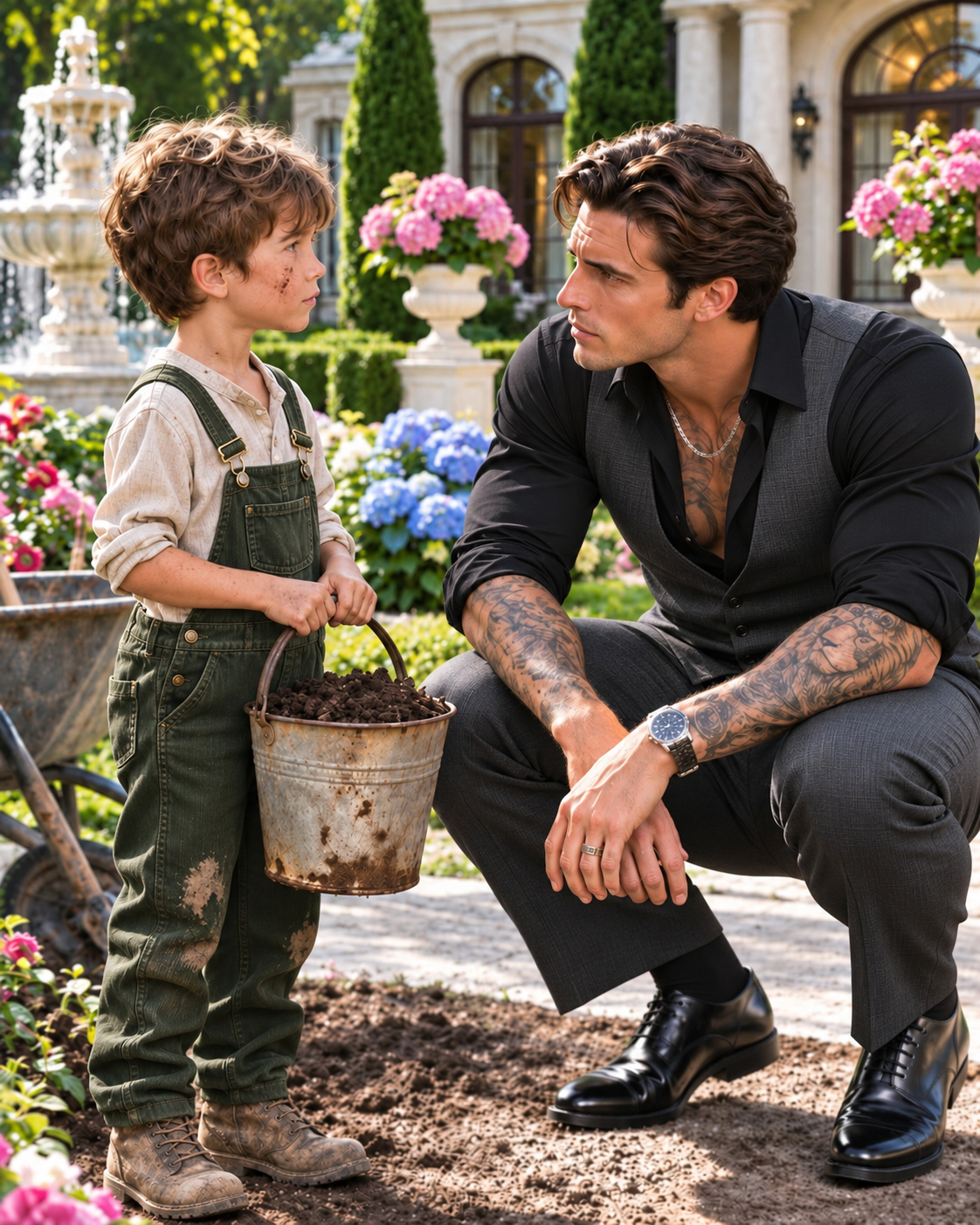
One Saturday nearly a year after I found Tommy digging through my penthouse garden, he returned to the same terrace.
This time, he used the elevator.
He carried a new bucket.
Not cracked.
“What are you stealing today?” I asked.
“Nothing.”
“Disappointing.”
He rolled his eyes.
“I brought something.”
Inside the bucket was a small apple sapling.
I stared.
“No.”
“Yes.”
“Tommy, I already have a garden.”
“Not a good one.”
“That garden cost more than your entire school.”
“Exactly.”
I stared at him.
“What does that mean?”
“It means it needs help.”
I had no response.
Elena stepped onto the terrace behind him.
“Don’t argue. I already tried.”
Maria followed carrying gardening gloves.
“You’re involved too?”
“I support the stronger side.”
Tommy pointed toward the flower bed where I had first caught him digging.
“Here.”
“That is imported landscaping.”
“So?”
“The soil conditions might not be appropriate.”
He gave me a look.
A year earlier, he would have been afraid of me.
Now he simply looked annoyed.
“Mr. Morgan.”
“Yes?”
“It’s dirt.”
Maria laughed.
I surrendered.
We planted the sapling.
Tommy packed soil around its roots.
Then he removed something from his pocket.
The small stone he had kept from the cracked bucket on the day of his mother’s funeral.
He placed it beside the tree.
“For luck,” he explained.
“I thought you were keeping that.”
“I was.”
“What changed?”
He shrugged.
“It belongs here.”
That sentence caught me unexpectedly.
Belongs.
Not owned.
Belongs.
I looked across the city.
Riverside could be seen in the distance if you knew where to look.
Once, from this height, the city had appeared orderly.
Buildings.
Roads.
Assets.
Opportunities.
Now I saw something else.
Thousands of lives overlapping.
Promises surviving the people who made them.
Mistakes passing from one generation to another until someone finally stopped long enough to notice.
And connections that could begin with something as small as a child stealing soil.
“Mr. Morgan?”
Tommy was watching me.
“Yes?”
“Why are you smiling?”
“I was thinking.”
“That’s dangerous.”
Maria laughed again.
I pointed toward the elevator.
“You can leave.”
“No.”
He sat on one of my expensive outdoor chairs and opened a bag of chips.
Apparently eviction was no longer within my authority.
Years passed.
The apple tree grew.
So did Tommy.
At fourteen, he became obsessed with astronomy.
At sixteen, he decided he wanted to study environmental engineering.
At seventeen, he changed his mind and considered law.
Elena blamed Lucia.
I secretly hoped he would become anything except a corporate executive.
At eighteen, Tommy received the Lucia Martinez Scholarship.
The ceremony took place in Riverside.
He stood behind a microphone wearing a jacket that did not quite fit.
I sat beside Elena.
“He looks terrified,” I whispered.
“He gets that from you.”
“I’m excellent at public speaking.”
“I meant the jacket.”
Tommy cleared his throat.
“My mom once told me that inheritance isn’t always money.”
The room became quiet.
“I didn’t understand that when I was little.”
He looked toward Elena.
“Sometimes you inherit people’s hopes.”
Then toward me.
“Sometimes you inherit their mistakes.”
A few people laughed.
I deserved that.
“And sometimes you inherit work that somebody else didn’t finish.”
He paused.
“I used to think Mr. Morgan changed Riverside.”
My throat tightened.
“But that’s not what happened.”
He looked around the room.
“Riverside changed him.”
Everyone laughed louder.
Especially Maria.
Tommy grinned.
“And maybe that’s what communities do. They change people because nobody belongs completely to themselves.”
I looked at Elena.
Her eyes were wet.
Tommy finished simply.
“My mom wanted me to have choices.”
“Now I do.”
“Thank you.”
The applause lasted a long time.
Afterward, Tommy found me outside.
“So?”
“So what?”
“Was the speech good?”
“It was inaccurate.”
He stared.
“You absolutely changed me.”
He smiled.
“I know.”
I handed him an envelope.
“What’s this?”
“A graduation present.”
His expression became suspicious.
“If it’s money—”
“It isn’t.”
He opened it.
Inside was a key.
Old brass.
E.M.
His face changed.
“You kept it.”
“For seven years.”
“What does it open now?”
“The old room in Morgan Tower.”
“Why are you giving it to me?”
“Because the room is being converted.”
“Into what?”
“An archive.”
“For Riverside?”
“For every community project the company participates in.”
He turned the key in his hand.
“And you want me to have access?”
“I want you to remember where the records are.”
He smiled.
“That’s very dramatic.”
“I learned from your mother.”
We walked toward the cemetery.
Lucia and Sofia’s apple tree had grown tall enough to provide shade.
Tommy stopped beside it.
“Do you think my mom knew what would happen?”
“No.”
“You think she knew I’d find you?”
“I think she hoped.”
“Why you?”
That question remained harder than all the others.
“Maybe because my mother trusted me before I had earned it.”
Tommy considered that.
“Grandma does that.”
“With you?”
“Yeah.”
“That sounds dangerous.”
“It is.”
We laughed.
Then he became quiet.
“I barely remember Sofia’s voice anymore.”
The admission was soft.
I did not try to fix it.
Some sadness does not require repair.
“I’m sorry.”
“I remember her laugh.”
“That matters.”
“And I remember Mom’s voice because of the recordings.”
He looked toward the graves.
“Sometimes I feel bad when I go a whole day without thinking about them.”
“You shouldn’t.”
“How do you know?”
“Because I used to feel the same about my mother.”
“What changed?”
I considered the apple tree.
“I realized remembering someone isn’t a job you can fail.”
Tommy said nothing for a while.
Then:
“That’s actually pretty good.”
“Thank you.”
“You should write it down.”
“I’ll have Maria do it.”
He groaned.
Some things never changed.
That evening I returned to my penthouse alone.
The apple tree Tommy planted years earlier had grown above the railing now.
Every spring, it flowered.
Every autumn, a small crop of imperfect apples appeared.
The gardener repeatedly offered to replace it with a more productive variety.
I refused.
Perfection had once mattered to me.
Perfect views.
Perfect gardens.
Perfect schedules.
Perfect control.
Then an eleven-year-old boy appeared carrying a cracked bucket, and everything I believed about the boundaries of my world began shifting.
I walked toward the tree.
Beside its trunk remained the little stone Tommy had placed there.
I picked it up.
Beneath it, something white caught my eye.
A folded piece of paper had been tucked beneath the stone.
I frowned.
I opened it.
Tommy’s handwriting.
**Mr. Morgan,**
**I forgot to tell you something at graduation.**
**Grandma found another letter from my mom.**
I smiled.
Of course she had.
Lucia Martinez seemed determined to continue organizing our lives from beyond them.
I kept reading.
**Don’t panic. There isn’t another secret company or missing trust.**
I laughed aloud.
**Mom wrote that if everything worked out, someday I should bring you back one bucket of soil from Riverside.**
Below the note was one final sentence.
**Look behind the planter.**
I walked around the apple tree.
A small bucket waited there.
This one was old.
Cracked along the side.
The same bucket.
Tommy had kept it all these years.
Inside was dark Riverside soil.
On top rested a card.
**For your garden.**
I stood there for a long time.
Then I carried the bucket toward the flower bed.
Seven years earlier, a frightened child had taken soil from this garden because he believed dignity was something his family could not afford.
Now he had returned soil from his home as a gift.
I poured it carefully around the apple tree.
Black earth mixed with black earth.
No boundary.
No distinction.
No way to separate one from the other again.
My mother had written that ownership was not the same thing as belonging.
My father had written that names mattered more than numbers.
Lucia had said Riverside did not need a rescuer.
Tommy had taught me something none of them could have explained.
Sometimes the most important changes in a life arrive without permission.
They climb through locked doors.
They dirty polished floors.
They interrupt schedules.
They ask inconvenient questions.
And sometimes they stand in your perfect garden clutching a cracked bucket, forcing you to see that the world beyond your windows was never separate from yours at all.
I placed the empty bucket beneath the apple tree.
The city lights came on one by one below me.
Somewhere in Riverside, Elena was probably correcting someone.
Maria was probably correcting me by email.
Jonathan was enjoying retirement badly.
Sarah was finishing another shift at the clinic.
And Tommy was beginning the next part of his life.
For the first time in many years, I did not feel above the city.
I felt part of it.
I touched one of the apple tree’s branches.
A small green apple hung there, not yet ready.
I left it alone.
Some things needed time.
Some promises needed generations.
And some seeds, once planted, knew exactly what to do.
**–THE END–PLEASE
✓ Lynn R. Adams
## Part 6 – What We Leave Growing **Part 6** I did not open my father’s letter at the library. I carried it back to Riverside. Some things, I had finally begun to understand, should be read in the…