PART 6: The Six Silent Hours That Forced Us to Tell the Truth About Our Marriage_063
## END – The Life We Keep Choosing
I applied.
That surprised both of us.
Not because Monica didn’t think I could get the job.
Because for years, whenever something threatened the structure of our life, I had confused reluctance with wisdom.
The consulting position involved travel.
Not constantly.
Perhaps five or six days every two months.
It also offered projects that interested me more than anything I had done in years.
When I received the interview invitation, I showed Monica before replying.
Not because I needed permission.
Because that was the point.
“Tuesday at two,” I said.
She checked her calendar.
“I’ll be in Boston.”
“That’s okay.”
“You sure?”
“Yes.”
She kissed my cheek.
“Good luck.”
The interview went well.
The second one went better.
Three weeks later, I was offered the position.
I stared at the email at my desk.
For one ridiculous second, my first instinct was to make a list.
Salary.
Travel.
Retirement contribution.
Health insurance.
Then I laughed.
I still made the list.
Growth has limits.
But I didn’t make the decision alone.
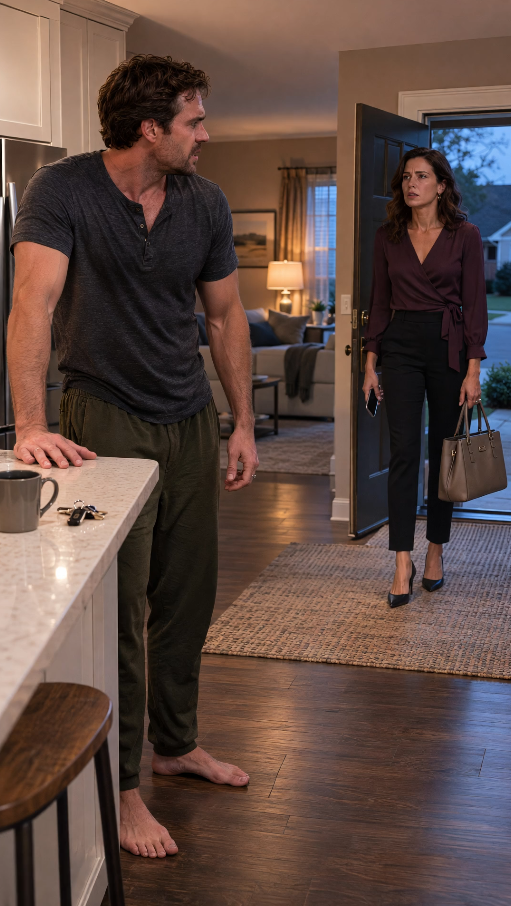
That night, Monica and I sat at the kitchen island where everything had started.
I put the offer in front of her.
She read every page.
“What are you thinking?” she asked.
“That I want it.”
“Then why do you look miserable?”
“Because I’m thinking about everything that could go wrong.”
“Of course you are.”
“Helpful.”
“I married you voluntarily.”
“So you accept some responsibility.”
“Some.”
I smiled.
Then I grew serious.
“What if both of us traveling becomes too much?”
“Then we change something.”
“What if we stop seeing each other?”
“Then we change something.”
“What if—”
“Troy.”
I stopped.
Monica reached across the counter.
“We aren’t signing a contract with the next thirty years.”
I looked at her.
“We’re choosing what makes sense now. Then we keep paying attention.”
That sentence became the closest thing our marriage ever developed to a philosophy.
Keep paying attention.
Not forever.
Not perfect.
Not guaranteed.
Just attentive.
I accepted the job.
The next year was the busiest of our marriage.
And somehow, strangely, one of the happiest.
Not because we traveled.
Not because our careers improved.
Because we stopped treating routine as something that happened to us.
Some Fridays we went out.
Some Fridays we stayed home and watched terrible movies.
We took a long weekend in Montreal.
We spent another vacation painting the guest room because the weather ruined our plans.
We learned that spontaneity didn’t require irresponsibility.
And stability didn’t require stillness.
Monica kept taking photographs.
The arts publication featured her work.
Then another small gallery invited her to submit something.
She developed a series about departures and returns.
Airports.
Doorways.
Train stations.
People waving through windows.
Shoes beside front doors.
One photograph showed an empty bed with one side turned down.
She titled it **Still Here**.
I told her it was depressing.
She told me I had no artistic soul.
We agreed to disagree.
Kayla remained in our lives.
Things with her were different too.
Better in some ways.
There were boundaries now.
Real ones.
Not dramatic declarations.
Just clarity.
One evening while the three of us were having dinner, Kayla lifted her phone.
“I am officially announcing that it has fourteen percent battery.”
Monica groaned.
“Troy has traumatized everyone.”
“I didn’t turn anyone’s phone off.”
Kayla pointed at Monica.
“That was her.”
“Fair.”
We laughed.
Eventually, even Friday night became a story we could mention without the room changing.
Not a funny story.
Not exactly.
But no longer an open wound.
There were things I never forgot.
The clock reading .
Driving downtown.
Seeing Monica in that social media video.
The cold feeling when she admitted she had used airplane mode.
But memory changed shape.
At first, it was evidence.
Then warning.
Eventually, perspective.
A year and a half after that night, Monica turned thirty-seven.
For her birthday, I gave her a photo printer.
She gave me a look.
“This is either incredibly supportive or an attempt to stop me paying printing fees.”
“Both can be true.”
Then I handed her a second gift.
A frame.
Inside was the old list.
Things I Want Before Forty.
She stared at it.
“You framed this?”
“Turn it over.”
On the back, I had attached another sheet.
Monica unfolded it.
At the top, I had written:
**Things We Want Without Deciding Them for Each Other.**
She laughed so hard she cried.
“That is the least romantic title imaginable.”
“I was aiming for precision.”
“You succeeded.”
Underneath were empty lines.
Most remained empty for weeks.
Then Monica wrote:
**Spend one month somewhere neither of us has lived.**
I added:
**Take a cooking class and finally prove I can make something besides pasta.**
She wrote:
**Photograph the ocean in winter.**
I wrote:
**Go somewhere without building an itinerary first.**
Monica circled that one.
“You?”
“Don’t make me regret it.”
“I need photographic evidence.”
“Absolutely not.”
The list grew.
Not as a bucket list.
Not as commandments.
As invitations.
Sometimes we crossed things off.
Sometimes we changed our minds.
Once Monica wrote **Buy a camper van**, and after renting one for four days we crossed it off with enormous enthusiasm.
“Some dreams,” I told her, “exist to teach us why hotels were invented.”
She agreed.
Two years after the night at the bar, Monica received an invitation to speak at the same community arts center where her first photographs had been displayed.
The topic was creative work after thirty.
She almost declined.
“Why?”
“I don’t know what I’m doing.”
“Perfect.”
“How is that perfect?”
“You can speak with authority.”
She threw a pillow at me.
The night of the event, I sat in the third row.
Monica stood behind a small lectern.
She talked about work.
Photography.
Routine.
She didn’t mention Friday night.
She didn’t mention Kevin.
She didn’t mention Boston in detail.
But near the end, she said something I recognized.
“I used to think changing your life required leaving it.”
The room became still.
“Sometimes it does. But sometimes it only requires noticing which parts you stopped choosing.”
I watched her.
She continued.
“For me, the answer wasn’t to abandon everything familiar. It was to become present inside it again.”
That was Monica.
Not the woman she had been before our marriage.
Not the woman who came home at five in the morning.
Not the woman who accepted the Boston job.
All of them.
People don’t become one final version of themselves.
That might be the strangest thing marriage asks us to understand.
You promise yourself to someone.
Then both of you keep changing.
After the talk, a young woman approached Monica.
“I loved what you said.”
“Thank you.”
“I’m twenty-six, and I’m terrified I’m already making the wrong choices.”
Monica smiled.
“You probably are.”
The woman looked startled.
Monica laughed.
“So am I. Everyone is.”
Then she added, “The goal isn’t to make one perfect choice. Just keep paying attention.”
I heard it from several feet away.
Our sentence.
I smiled.
Later, we walked home because the weather was warm.
Our neighborhood was quiet.
Porch lights glowed behind trees.
Somewhere, someone was playing music through an open window.
Monica slipped her hand into mine.
“Do you ever think about that night?” she asked.
“Yes.”
“How often?”
“Not much anymore.”
“Me neither.”
We walked another block.
“I still feel terrible about it sometimes.”
“I know.”
“You were terrified.”
“Yes.”
“I wish I could undo that.”
I squeezed her hand.
“I don’t.”
She stopped.
“What?”
“I wouldn’t want to live it again.”
“Good distinction.”
“But undoing it would mean undoing everything we learned afterward.”
Monica considered that.
“I’m not sure pain has to earn its place by teaching us something.”
I looked at her.
“That sounds annoyingly wise.”
“I’ve been giving talks.”
“Clearly.”
She smiled.
Then we started walking again.
When we reached home, I noticed a package on the porch.
Monica picked it up.
“No return name.”
“Probably something you ordered.”
“I didn’t.”
Inside was a thin book.
A photography catalog.
Monica frowned as she opened it.
Then stopped.
“What?”
She turned the book toward me.
It was an alumni collection from her college.
Several photographers had contributed work from their student years.
One page displayed a photograph taken by Monica when she was twenty-one.
The same elderly couple at the train station whose picture she had once shown me.
Beneath it was her maiden name.
**Monica Ellis.**
She sat down on the porch steps.
“I submitted this for a student exhibition.”
“Apparently it finally made the deadline.”
“Sixteen years late.”
“Art moves slowly.”
She laughed.
A note slipped from inside the catalog.
Monica opened it.
Kevin had written only two sentences.
**They found several old submissions while digitizing the archive. Thought you’d want a copy. Congratulations on finding your camera again.**
Monica read it twice.
Then handed it to me.
“You okay?” she asked.
I thought about the question.
Two years earlier, seeing Kevin’s name might have tightened every muscle in my body.
Now it was simply a name.
A person from Monica’s past who had once known a version of her I hadn’t.
That no longer frightened me.
“No problem.”
She looked relieved.
Then amused.
“What?”
“I was just thinking how weird life is.”
“Constantly.”
“If Kevin hadn’t shown up that Friday…”
I waited.
“Maybe none of this would have happened.”
“Something would have.”
“You think?”
“You were already applying for Boston.”
“True.”
“You had your list.”
“True.”
“And apparently I was busy making career decisions on your behalf.”
“That too.”
I sat beside her.
For a minute, we looked through the catalog together.
At strangers who had once been twenty.
At photographs taken before mortgages and promotions and marriages and long flights home.
Then Monica closed the book.
“Coffee?”
“It’s ten-thirty.”
“Tea?”
“Better.”
Inside, she filled the kettle.
I put two cups near the window.
Monica noticed.
“Don’t move.”
“What?”
She ran upstairs.
I heard drawers open.
Then footsteps.
She came back carrying her camera.
“Troy.”
“No.”
“Please.”
“I’m wearing sweatpants.”
“That’s why it’s perfect.”
“I refuse to become art in sweatpants.”
“You already have.”
She raised the camera.
I sighed.
“Fine.”
“Stand by the window.”
I did.
She placed one cup in my hand.
Took the other.
Then stopped.
“This isn’t working.”
“Excellent. We’re finished.”
“No.”
She walked toward me and placed the camera on a shelf.
A small red light began blinking.
“Timer.”
“Monica.”
“Ten seconds.”
She stepped beside me.
Five.
Four.
Three.
She reached for my hand.
Two.
I looked at her.
One.
The shutter clicked.
Monica immediately checked the picture.
“Oh.”
“What?”
She turned the screen.
There we were.
Not posing very well.
My eyes were slightly closed.
Monica’s hair was messy.
One coffee cup was crooked.
The kitchen behind us wasn’t perfectly clean.
Nothing about the photograph looked polished.
And somehow, I loved it.
“What are you calling this one?” I asked.
Monica thought for a moment.
“The Life We Chose?”
“Past tense?”
She looked at me.
I understood.
Our lives weren’t finished.
Neither were our choices.
She smiled and corrected herself.
“The Life We Choose.”
I nodded.
“That’s better.”
The next morning, I woke before Monica.
Sunlight entered through the curtains.
For a few minutes, I stayed still.
Then her phone buzzed on the nightstand.
Once.
Twice.
I glanced at it.
The screen lit up.
Eighty-three percent.
I smiled.
Two years ago, a phone battery had felt like evidence of everything that might be wrong between us.
Now it was simply eighty-three percent.
Monica stirred.
“What time is it?”
“Seven-fifteen.”
“Too early.”
She pulled the blanket over her head.
Her phone buzzed again.
“Your phone.”
“Who is it?”
“I don’t know.”
She lowered the blanket.
“You didn’t look?”
“No.”
Monica smiled sleepily.
“Growth.”
“Go back to sleep.”
She did.
I went downstairs.
On the refrigerator, beside grocery lists and a photograph from Montreal, hung our ridiculous shared list.
Things We Want Without Deciding Them for Each Other.
There was a new line.
I hadn’t seen it before.
Monica must have added it the previous night.
**Never become strangers just because we think we already know each other.**
I stood there for a while.
Then I found a pen.
Underneath her sentence, I wrote:
**Ask anyway.**
That afternoon, Monica found it.
She didn’t say anything.
She simply came into my office, kissed me, and left the door open behind her.
Maybe that was what marriage looked like after trust had been tested.
Not perfection.
Not forgetting.
Not pretending six missing hours had never existed.
It looked like open doors.
Questions asked before assumptions hardened.
Plans shared before decisions became secrets.
Two imperfect people refusing to believe familiarity meant there was nothing left to discover.
That evening, Monica went out with Kayla.
Before leaving, she stood in the doorway.
“Dinner, gallery opening, probably home around eleven.”
“You don’t need a curfew.”
“I know.”
She smiled.
“Phone charged?”
“Ninety-two percent.”
“Portable charger?”
She held it up.
“Ridiculous husband?”
“Present.”
Monica stepped outside.
Then turned.
“Troy?”
“Yeah?”
“I love you.”
“I love you too.”
She left.
I watched her car disappear around the corner.
Then I closed the door.
At eleven-twenty, my phone buzzed.
**Gallery ran late. Leaving now. Want anything on the way home?**
I typed:
**No. Drive safe.**
Three dots appeared.
Then:
**Actually, I’m bringing dessert.**
I smiled.
Forty minutes later, headlights swept across the front window.
For one strange second, I remembered another night.
Another set of headlights.
Another version of us.
Then the front door opened.
Monica walked inside carrying a bakery box.
“Cheesecake.”
“You’re forgiven.”
“For what?”
“Anything you might do in the next fifteen minutes.”
She laughed.
And the sound filled the house.
Our house.
Not a cage.
Not an accident.
Not something we had simply awakened inside.
A place we had stayed long enough to choose again.
And tomorrow, if we were lucky, we would have to choose it one more time.
#### Share your thoughts or feedback to motivate us to create more stories ♥️
**–THE END–PLEASE
✓ Lynn R. Adams
## END – The Life We Keep Choosing I applied. That surprised both of us. Not because Monica didn’t think I could get the job. Because for years, whenever something threatened the structure of our …