Part 6 – The Quiet Between Hoofbeats-039
### END – Where the Water Remembers
I reached the north spring before sunrise.
Cole was already there.
Naturally.
The man probably considered arriving precisely on time a personal failure.
Morning mist floated above the creek.
The cottonwoods were almost bare now, their remaining leaves flashing pale gold whenever the breeze moved them.
Cole stood beside the old springhouse.
No horse.
No ranch hands.
No attorney.
No grand preparation.
Just Cole.
He wore the same dark coat he usually wore into town.
I carried the trust deed beneath one arm and the wooden boat in my other hand.
Mrs. Avery had indeed found it in an old trunk.
Time had faded the paint, but a tiny letter C remained carved beneath the hull.
I held it up.
“Evidence.”
Cole smiled.
“You doubted me?”
“I doubted your childhood.”
“Reasonable.”
I approached.
“So why am I standing beside a creek before breakfast?”
“Because this is where we started.”
“The bathhouse would be more accurate.”
His eyebrows rose.
“Cole Bennett, if you tell anyone I said that, I will deny everything.”
“I value my life too highly.”
I laughed.
Then his expression became serious.
“The first time we started.”
He nodded toward the boat.
Memory returned.
A little girl crying beside the creek.
A boy wading into cold water.
Two mothers laughing behind them.
“I remember more now,” he said.
“You do?”
“Pieces.”
He took the boat.
“You wore a blue ribbon.”
I smiled.
“You pushed me into the mud.”
His eyes widened.
“I did not.”
“You did.”
“That seems unlikely.”
“You also cried over my kitten.”
“Mrs. Avery has corrupted the historical record.”
“Certainly.”
Cole crouched at the water’s edge.
He placed the wooden boat on the surface.
For several seconds it remained beside the bank.
Then the current caught it.
Together we watched it move downstream.
“Mother wrote that the land should bring us together,” he said.
“I doubt she meant this.”
“No.”
“Do you think they would be surprised?”
“By you?”
“By us.”
Cole considered.
“My mother apparently read terrible novels with yours.”
“Excellent novels.”
“Then no. She probably expected something ridiculous.”
I nudged his shoulder.
He smiled.
Then reached into his coat.
My heart stopped.
He produced—
A fountain pen.
I stared.
Cole looked offended.
“What?”
“I thought…”
“You thought what?”
“Nothing.”
His eyes narrowed.
“Lila.”
“Give me the pen.”
His mouth twitched.
We spread the agreement on a flat stone.
The easement was simple.
Bennett Ranch would retain reasonable agricultural water use.
The trust would guarantee free household access to neighboring families during drought.
Annual ranch contributions would maintain the road, spring, and community property.
Neither Cole nor I could sell the shared parcel without preserving those rights.
I signed first.
Lila Ruth Dawson.
Cole signed beneath me.
Coleman Edwin Bennett.
Two names our parents had placed beside each other years before.
This time we chose it ourselves.
Cole let out a long breath.
“Done.”
“Done.”
I should have felt that something ended.
Instead I felt something opening.
“What happens now?” I asked.
“We repair the cabin.”
“For what?”
“You said the children from the northern ranches still travel almost eight miles to lessons during winter.”
I stared.
“You’re suggesting a school.”
“A small one.”
“Our mothers’ school.”
“If you want.”
My eyes burned.
“I do.”
“And you mentioned books.”
“A reading room.”
“Fine.”
“And perhaps supplies.”
Cole looked suspicious.
“Supplies?”
“Paper. Thread. Coffee. Flour.”
“You’re building a general store.”
“A very small one.”
“You hated the general store.”
“I hated my employer.”
“Ah.”
“I happen to be an excellent clerk.”
“So I’ve heard.”
I folded the signed agreement.
“What about the remaining Dawson acreage?”
“Yours.”
“I want cattle.”
Cole blinked.
“How many?”
“Six.”
He stared.
“What?”
“Everyone starts somewhere.”
“Six cattle.”
“Perhaps eight.”
“You own three hundred acres.”
“Do cattle become offended if the acreage is insufficiently crowded?”
His mouth twitched.
“I’ll help you choose them.”
“No.”
“No?”
“You’ll teach me how to choose them.”
Something warm entered his expression.
“All right.”
“And I’m paying market price.”
“Lila—”
“Don’t.”
He sighed.
“Fine.”
The sky behind him had turned pink.
He looked toward the ridge.
“I’ve been thinking about the house.”
“Your house?”
“Our—”
He stopped.
I heard the word.
So did he.
Cole looked suddenly uncertain.
I rescued him.
“The ranch house.”
“Yes.”
“What about it?”
“You changed it.”
“I moved furniture.”
“No.”
He turned toward me fully.
“You changed what it feels like to walk into it.”
I didn’t know what to say.
“I spent eleven years believing the quiet was easier,” he continued. “If the house stayed the same, nothing else could be taken from it.”
“Cole.”
“I know now that’s not how it works.”
I waited.
“When you opened Mother’s sitting room…”
“You opened it.”
“Because you were beside me.”
A breeze stirred my skirt.
He glanced toward the creek.
“I don’t want that house to become silent again.”
My heart began beating faster.
“Cole…”
“And I don’t mean because I need someone cooking supper.”
“That is fortunate, considering what happened to the cornbread.”
“I ate it.”
“You could have broken a tooth.”
“It wasn’t that bad.”
“It was masonry.”
He laughed.
Then he stepped closer.
“I love you, Lila.”
“I love you too.”
“I don’t know whether I will always know the right thing to say.”
“You almost certainly won’t.”
“Thank you.”
“You’re welcome.”
“I’ll probably try to solve problems that aren’t mine.”
“Frequently.”
“And I can’t promise never to become quiet.”
I softened.
“You don’t have to.”
His eyes searched mine.
“Only don’t disappear into it.”
Something in his expression gave way.
“I’ll try.”
“That’s enough.”
He took both my hands.
I suddenly understood why we were here.
Not because of property.
Not because of water.
Not because our mothers had once dreamed of a school.
Cole had brought me to the place where two families had allowed pride to separate them because he intended to ask for something without pride.
Something that required the possibility of hearing no.
“Lila Dawson.”
“Yes?”
His hands tightened slightly.
“I don’t want you to marry Bennett Ranch.”
I blinked.
“I should hope not.”
“I don’t want you marrying land or money or a house.”
“Good.”
“And I don’t want you to say yes because I gave you work when you needed it.”
“I won’t.”
“Or because I helped with your property.”
“Cole.”
“I’ve rehearsed this better.”
I laughed through tears.
“I sincerely doubt that.”
“Will you let me finish?”
“Yes.”
He drew a breath.
“I want to build something with you.”
The teasing disappeared from my face.
“Not something inherited. Not something our parents planned. Something we choose.”
The sun reached the ridge.
Gold light moved across the creek until the water looked almost aflame.
Cole released one of my hands.
This time, when he reached inside his coat, he withdrew a small ring.
Nothing enormous.
Nothing ostentatious.
A simple gold band surrounding a tiny clear stone.
“It belonged to my mother.”
My breath caught.
“I found it inside the poetry book where she pressed those flowers.”
He looked nervous.
Cole Bennett.
Nervous.
The sight nearly undid me.
“She left a note.”
“What did it say?”
“That whoever wore it should be someone who made the house larger without adding a single room.”
Tears slipped down my cheeks.
“Cole.”
“I think she would have known you.”
“She did.”
He smiled.
“Yes. I suppose she did.”
Then he asked.
Not commanded.
Not assumed.
Asked.
“Lila, will you marry me?”
I looked at the man everyone feared.
The man I had first seen turning his horse away to preserve the dignity of a stranger.
The man who had defended me without demanding gratitude.
Who had returned land when keeping it would have been easier.
Who had carried other people’s debts because he did not know how to put them down.
Who was slowly learning that strength did not require silence.
And I thought of myself.
A store clerk who had believed survival was the highest future she could reasonably expect.
A woman who now owned land.
Who understood deeds.
Who planned to raise cattle.
Who intended to rebuild a school beside a spring her mother had loved.
Cole had never saved me.
That mattered.
He had given me room in which I discovered I could save myself.
And somewhere along the way, we had learned to walk beside each other.
“Yes,” I said.
He stared.
“Yes?”
“Yes, Cole.”
The expression that crossed his face was worth every lonely day that had brought us there.
He slipped the ring onto my finger.
Then, because we had apparently learned something from our mothers’ dreadful novels, he kissed me beneath the cottonwoods while the little wooden boat disappeared around the bend.
We married in spring.
Not at Bennett Ranch.
At the north spring.
Mrs. Avery insisted on flowers everywhere.
Mr. Mercer attended and spent most of the ceremony pretending he had dust in his eyes.
Daniel Foster brought his wife and three children.
So did ranch families I had known only as names in old documents.
The restored cabin opened two months later.
We called it Dawson-Bennett House.
I objected to Cole’s suggestion that Bennett come first alphabetically by first name.
He informed me that was not how alphabets worked.
We compromised by flipping a coin.
I won.
The front room became a school three days each week.
Another room held books.
A side counter sold basic supplies at fair prices.
No one was required to ride all the way into town for thread or paper unless they wanted to.
I bought eight cattle.
Then twelve.
Cole never once offered to purchase them for me after the first argument.
He taught me instead.
I made mistakes.
One calf escaped through a fence I had confidently declared “perfectly adequate.”
Cole found it in his vegetable garden.
He said nothing.
He merely looked at me.
“Not one word,” I warned.
“I didn’t say anything.”
“Your face did.”
“My face is innocent.”
“Your face has never been innocent.”
The calf ate three rows of beans.
My fence improved.
The Bennett ranch house changed too.
Not immediately.
Homes are like people.
They rarely transform in a single moment.
The sitting room remained open.
I learned to play three songs badly on Margaret’s piano.
Cole claimed I played beautifully.
This confirmed he possessed no musical judgment whatsoever.
Fresh flowers remained on the dining table.
Breakfast conversations remained long.
So did supper.
Some nights we sat without talking.
But the silence no longer frightened either of us.
There is a difference between emptiness and peace.
I finally learned it.
A year after our wedding, on the first cold evening of winter, a metallic crash echoed through the hallway.
I froze.
Cole looked up from his book.
We stared at each other.
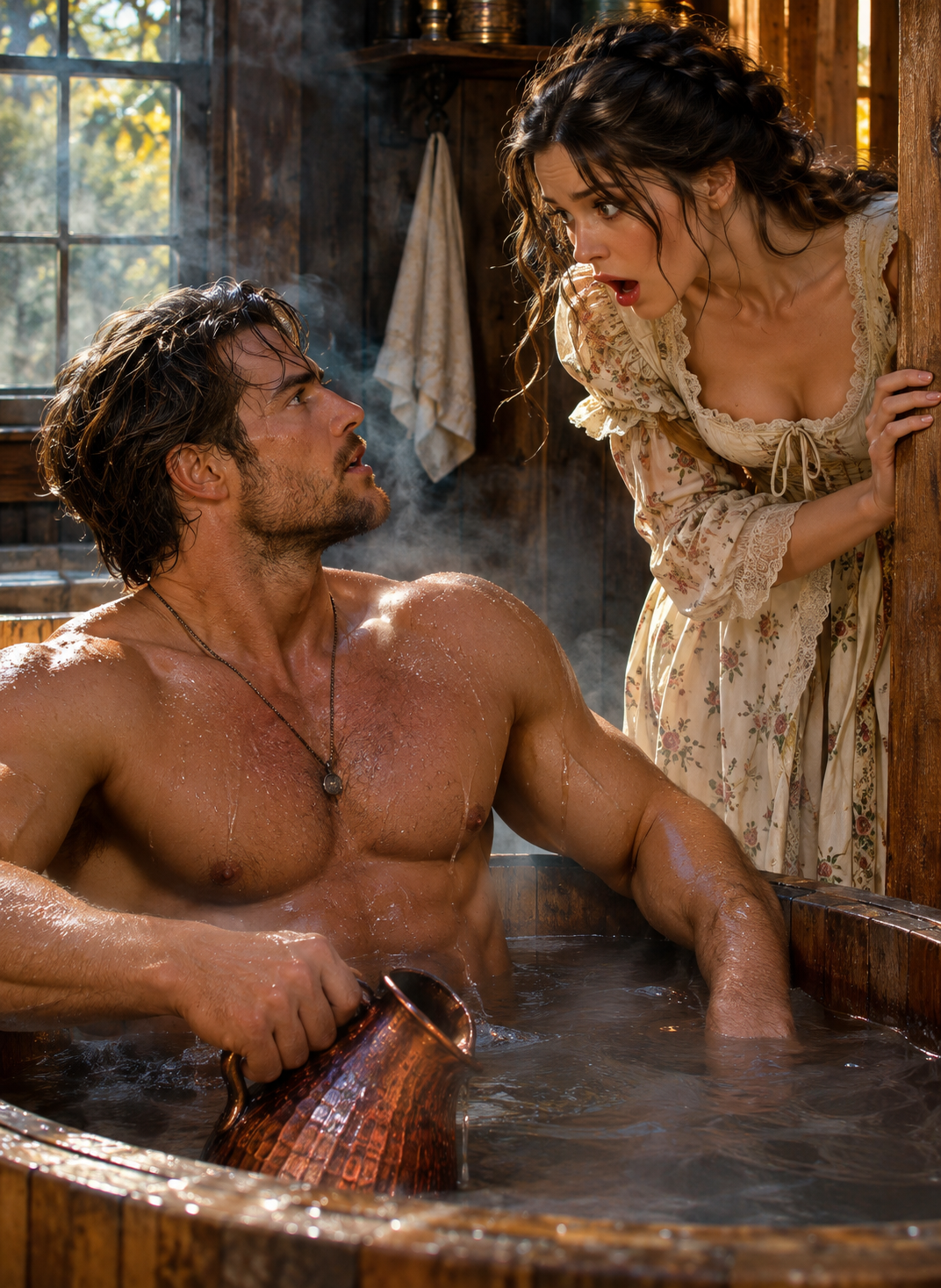
“The bathhouse,” I said.
He stood.
“Probably the pitcher.”
“You said that last time.”
“It was true.”
We walked together toward the door.
Cole opened it.
The copper pitcher lay on the floor.
A loose shelf had dropped beside it.
I laughed so hard I had to lean against the wall.
Cole folded his arms.
“What?”
“Nothing.”
“You are remembering something.”
“Possibly.”
“The worst night of my life.”
“The worst?”
“I was sitting in a bath when the woman I loved burst through the door.”
“You didn’t love me yet.”
“I absolutely did.”
I stared.
“You said you didn’t know.”
“I didn’t.”
“That’s not the same.”
“It is for a stubborn man.”
I laughed again.
He picked up the pitcher.
Then stopped.
“Lila.”
“What?”
“You know what I remember most?”
“My humiliation?”
“After that.”
“The terrible supper?”
“After that.”
I waited.
“The moment you said you were afraid something had happened to me.”
His expression softened.
“No one had been afraid of losing me in a long time.”
My laughter disappeared.
I stepped closer.
“You were worth losing.”
Cole shook his head.
“No.”
Then he touched my cheek.
“I was worth finding.”
I smiled.
“That too.”
Years later, people still told stories about Cole Bennett.
Visitors arriving from distant counties occasionally lowered their voices when mentioning his name.
Some expected a cold, ruthless cattleman.
Then they would arrive at Bennett Ranch and find him repairing a child’s wooden toy on the veranda while I argued with a supplier about seed prices.
His reputation never completely disappeared.
Cole claimed not to care.
I eventually believed him.
But sometimes, when someone called him the most feared rancher in Texas, I thought about that stormy night.
About steam filling the bathhouse.
About a copper pitcher on the floor.
About one quiet question.
Why, Lila?
Neither of us understood then what the answer would require.
It required truth.
Not merely the truth that I loved him.
The truth about our families.
The truth about land.
The truth about pride.
The truth about loneliness.
And the most difficult truth of all:
Love did not ask either of us to become smaller.
It asked us to become more honest.
One autumn afternoon, many years after our mothers’ letters were discovered, I walked to the north spring alone.
Children’s voices drifted from Dawson-Bennett House.
Someone was practicing multiplication inside.
Someone else was being told firmly not to put a frog in the water bucket.
I sat beneath the cottonwoods.
On the springhouse wall, the old initials remained.
T.D. + R.D.
L.D.
C.B.
Time had softened their edges but had not erased them.
Below them were newer marks.
Not names.
A simple date.
Our wedding day.
Cole had carved it there the morning after we married.
I heard hoofbeats.
I smiled before turning.
He dismounted and walked toward me.
Even after all those years, some part of me still recognized the sound of his horse before any other.
“Thought I’d find you here,” he said.
“How?”
“You always come here when you’re thinking.”
“You’ve become alarmingly observant.”
“I had a good teacher.”
He sat beside me.
Children laughed in the distance.
The creek moved endlessly through the rocks.
Cole reached for my hand.
I looked at the ring that had once belonged to his mother.
“Do you ever wonder what would have happened if that pitcher hadn’t fallen?”
He considered.
“I would have dropped something else eventually.”
I laughed.
“Deliberately?”
“Never.”
“You’re lying.”
“Possibly.”
I rested my head against his shoulder.
The man I had once believed frightening had become the safest silence I knew.
The enormous ranch house I had once called a beautiful prison had become a home with doors that opened constantly.
The poor clerk who had believed wealth belonged to other people discovered that the richest parts of her life could never be entered in a ledger.
And the promise our parents had broken through pride had finally become something greater than repayment.
It became a school.
A spring.
A home.
A marriage.
A second chance passed from one generation to another.
Cole squeezed my hand.
“Ready to go home?”
I looked once more at the water.
At the place where a little boy had once rescued a little girl’s wooden boat.
At the place where two adults had later discovered that finding each other was easier than admitting they wanted to stay.
“Yes,” I said.
We rose together.
And while the evening sun stretched our shadows across the grass, Cole Bennett and I walked home through the land that had once divided our families—and had finally taught us how not to divide ourselves.
Share your thoughts or feedback to motivate us to create more stories ♥️
**–THE END–PLEASE
✓ Lynn R. Adams
### END – Where the Water Remembers I reached the north spring before sunrise. Cole was already there. Naturally. The man probably considered arriving precisely on time a personal failure. Mornin…