Part 6: The Orders Beneath Thomas Reed’s Coat and the Promise He Refused to Make Blindly _064
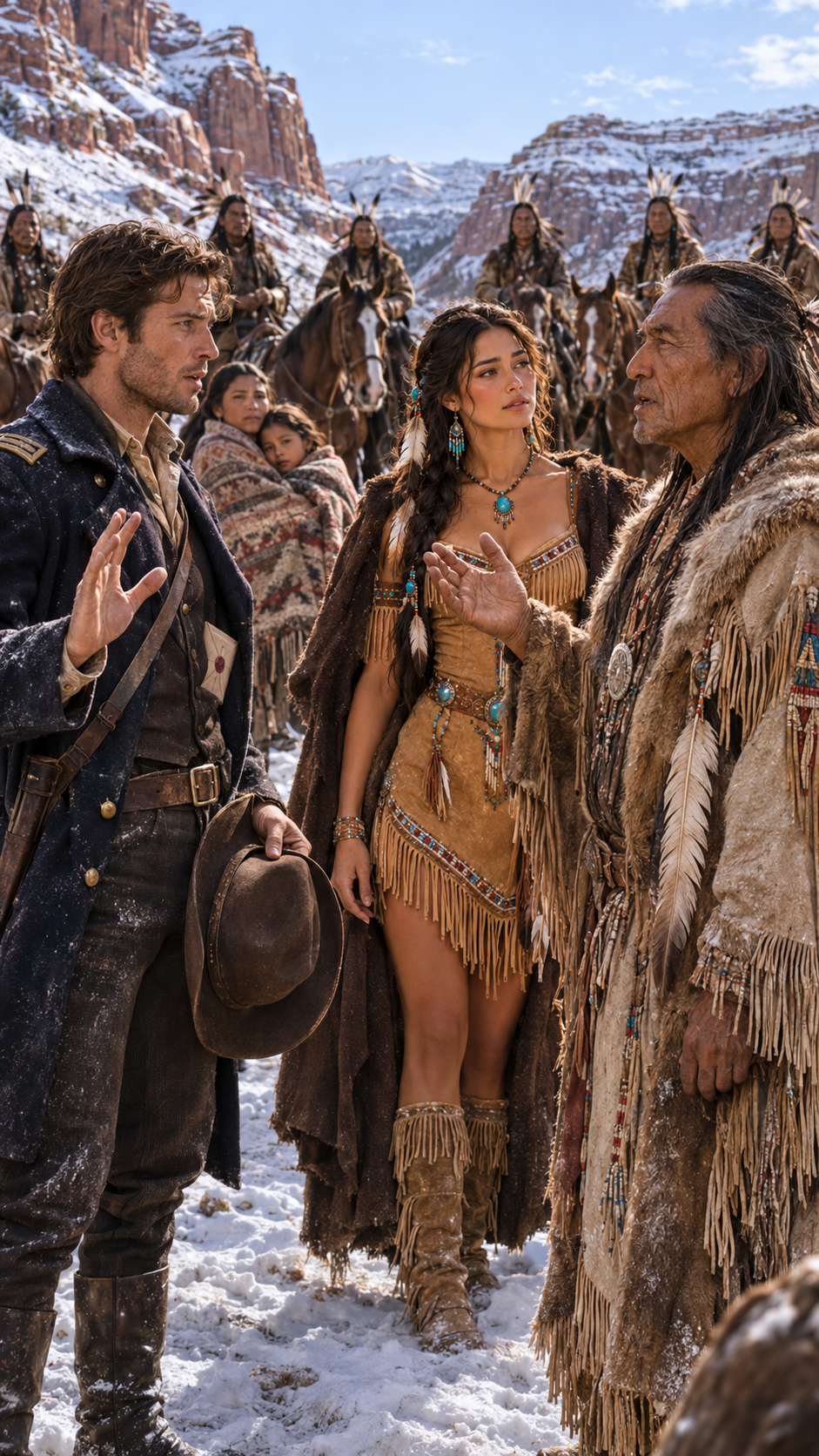
## The End – The Promise They Made After Both Were Free to Choose
Thomas accepted the liaison appointment.
He did not accept it alone.
That distinction mattered.
He and Ayana spent three evenings discussing what the work would actually require.
Travel twice each month.
Meetings at Fort Mesa.
Occasional trips farther north.
Record keeping.
Translation support, though Ayana would not automatically become his unpaid interpreter merely because she married him.
Thomas said that before she had to.
She smiled.
“Good.”
They discussed where they would live.
Thomas’s small horse property remained their primary house.
Ayana would spend regular periods with her family.
Thomas would join when work allowed.
Neither pretended marriage meant they would suddenly share every hour.
Chief Chaska listened to their plan.
Then asked Ayana privately whether she was choosing freely.
She said yes.
He asked again the next morning.
She became annoyed.
Thomas liked him even more for it.
Their wedding took place in early autumn.
The weather was clear.
No storm.
No military emergency.
No one was freezing.
Thomas considered that an excellent improvement over their first meeting.
The gathering included Ayana’s family, several people from Fort Mesa, Whitfield the trader who had taught Ayana some English years earlier, Captain Ward, Sergeant Price, and more children than Thomas could count accurately.
Sela stood beside Ayana.
Miri carried flowers for approximately four minutes before deciding flowers were more useful scattered along the ground.
Nobody stopped her.
Chief Chaska spoke first.
He did not offer Ayana to Thomas.
This time his words were carefully chosen.
“My daughter has chosen.”
Then he looked at Thomas.
“So has he.”
Simple.
Enough.
Thomas’s vows were equally direct.
“I will not ask love to make you smaller.”
Ayana’s eyes filled.
“I will tell you the truth even when I am afraid the truth may disappoint you.”
“I will remember that agreement is not the same thing as peace.”
“And I will return to the conversation.”
Ayana smiled.
Her vows promised the same in her own words.
She would not turn Thomas’s uniform, his past, or his mistakes into the whole definition of him.
She would speak before resentment became silence.
She would keep belonging to herself while building something shared.
They married as two adults who had been given every reasonable opportunity not to.
That made the yes stronger.
The first year was not effortless.
Thomas’s liaison work required patience he did not naturally possess.
Military officers wanted precise answers.
Families wanted context.
Traders wanted speed.
Thomas learned that translating facts between institutions was often harder than tracking horses through snow.
Ayana helped when she chose.
Sometimes she refused.
“You can answer this meeting without me.”
“But your English is better than Toma’s.”
“That does not make every conversation mine.”
Thomas paused.
She was right.
He found another interpreter.
Marriage survived.
Ayana made mistakes too.
Once she agreed that Thomas would guide a group through a winter pass without asking him because she assumed the work suited his schedule.
He looked at her.
“You volunteered me.”
Her face changed.
“Yes.”
“You hate when people do that to you.”
“Yes.”
Silence.
Then she sighed.
“I am wrong.”
Thomas smiled faintly.
“Painful?”
“Very.”
She apologized.
He accepted.
They became better at protecting each other’s freedom without pretending partnership required complete independence.
Sometimes Thomas said yes because Ayana needed him.
Sometimes Ayana changed plans because Thomas needed her.
Choice did not mean never sacrificing.
It meant knowing whose choice the sacrifice was.
Their horse business grew slowly.
Ayana became known among several trading communities for judging temperament better than most buyers judged appearance.
Thomas handled much of the long-distance negotiation.
She handled many of the animals.
Whitfield claimed he had created the enterprise.
No one listened.
Captain Ward served several more years before leaving military life.
Before departing, he gave Thomas the original corrected mule report.
“For your records.”
Thomas frowned.
“I don’t need it.”
Ward smiled.
“That means you probably learned something.”
Thomas kept a copy anyway.
Not as trophy.
As reminder.
Seventeen returned animals had nearly disappeared inside one careless sentence.
That fact shaped how he wrote reports for the rest of his career.
He used phrases such as **reported**, **unconfirmed**, and **witness states** with almost irritating precision.
Some officers mocked him.
Then others adopted the habit.
Small changes traveled.
Henry Sloane never returned to military contracting.
Years later Thomas saw him at a freight station.
Sloane approached first.
“I owe you an apology.”
Thomas looked toward him.
“You owe Chaska’s family more.”
“I know.”
“Did you give one?”
“Yes.”
Thomas later confirmed that he had.
Chaska had accepted the words without pretending they erased anything.
Sloane had also repaid the final disputed freight charges.
No dramatic redemption.
No lifelong friendship.
Just a man living after a serious mistake and choosing, at least sometimes, not to repeat it.
Thomas found that strangely satisfying.
Sergeant Owen Price retired and opened a small repair shop.
He became one of Miri’s favorite people because he could fix almost any metal toy.
Miri herself grew into an observant young woman who remembered only fragments of the snowstorm.
Mostly Thomas’s coat.
Mostly being thirsty.
Mostly her mother holding her.
She did not grow up carrying the rescue as a debt.
Ayana made certain of that.
When Miri was sixteen, she asked Thomas:
“Did you save my life?”
Thomas thought.
“I helped.”
“Mother says you walked beside the horse for hours.”
“Yes.”
“Why?”
“Because you needed help.”
“That is all?”
“That is enough.”
She smiled.
Good.
Sela eventually remarried a widower from a neighboring family.
Thomas liked him immediately.
Ayana distrusted this.
“You never like people immediately.”
“I am growing.”
“Suspicious.”
Sela laughed when told.
Chief Chaska aged.
His hair became almost entirely gray.
His authority changed too.
He relied more on younger family members, including Ayana and Toma.
He did not cling to being the only voice.
Thomas respected that.
One evening, years after the wedding, Chaska sat beside Thomas watching children play near the horse pens.
By then Thomas and Ayana had two children of their own.
A son named Daniel.
A daughter named Lena.
Both knew their mother’s family and their father’s.
Neither was raised to think belonging required choosing one half.
Chaska looked toward Thomas.
“First day.”
Thomas smiled.
“Yes?”
“I offered daughter.”
Thomas groaned.
“You will mention that until death.”
“Yes.”
The chief laughed.
Then his expression softened.
“Wrong way.”
Thomas looked at him.
“What?”
“To ask.”
Chaska pointed toward Ayana.
“She was always choice.”
Thomas nodded.
“Yes.”
Chaska continued.
“I knew.”
“Still father sometimes forgets knowing.”
Thomas understood more than he expected.
“Fear?”
Chaska nodded.
“Want daughter safe.”
“Wanted good man.”
“Made choice too close to mine.”
Thomas looked toward his own daughter racing beside Miri.
“I suspect I will understand that problem eventually.”
Chaska smiled.
“You will.”
He was right.
When Lena was seventeen, a young horse trader began visiting far too often.
Thomas disliked his boots.
Ayana asked what boots had to do with character.
Thomas said everything.
Ayana laughed for an unreasonable amount of time.
Eventually Thomas admitted the young man was decent.
He also remembered Chaska.
Wanting safety could quietly become wanting control.
He tried to do better.
Not perfectly.
Enough.
Thomas’s one-year liaison appointment became two years.
Then he stepped away.
Not because of crisis.
Because he had done what he wanted.
He returned to guiding part-time and expanded the horse business with Ayana.
The decision surprised several officers.
One told him he was abandoning a promising career.
Thomas smiled.
“No.”
“I am ending one.”
There was freedom in naming an ending without calling it failure.
James Reed’s old report remained in Thomas’s family papers.
So did the correction.
Thomas never preserved one without the other.
When Daniel became old enough to ask about Uncle James, Thomas told him the whole age-appropriate story.
“Was he good?”
Daniel asked.
Thomas thought.
“Yes.”
“Then why was he wrong?”
Thomas smiled sadly.
“Good people can be wrong.”
The child frowned.
“That is inconvenient.”
“Very.”
“Did he fix it?”
“He tried.”
“Did that make it okay?”
“No.”
Daniel considered.
“Then why keep correction?”
“Because trying to repair something matters even when it cannot erase the first mistake.”
Daniel nodded.
That lesson remained.
The southern winter trail stayed in use.
No grand treaty solved every conflict in the region.
There were still arguments about water.
Travel.
Livestock.
Military movement.
Traders.
Boundaries.
But the local reporting agreement created after the mule incident prevented several later misunderstandings from becoming larger disputes.
Ayana and Toma were replaced over time by younger representatives chosen by their families.
The system did not depend forever on one exceptional person.
Thomas considered that success.
Good arrangements should survive the people who started them.
Whitfield died in his seventies.
He left Ayana a stack of English books and Thomas a coffee pot so battered it looked archaeological.
The note attached read:
**For the woman who learned English despite my teaching, and the man who never learned coffee.**
Ayana laughed until she cried.
Thomas used the pot for another decade out of spite.
Their marriage grew quieter with age.
Not less loving.
Less urgent.
They no longer needed every silence filled.
Some evenings Ayana worked at the table while Thomas repaired tack.
Sometimes they disagreed without solving anything before bed.
The world did not end.
That mattered too.
One winter, decades after the storm that brought them together, snow fell unusually heavily across the mountains.
Thomas stood at the window.
Ayana joined him.
“Thinking?”
“Yes.”
“Dangerous.”
He smiled.
“Remember Sela and Miri?”
“Of course.”
“I remember removing my rifle.”
Ayana leaned against him.
“Sela remembered too.”
“I thought that was the moment everything changed.”
“Was it?”
Thomas considered.
“No.”
“When then?”
He looked toward her.
“When you asked what I would do if my orders were about your family.”
Ayana smiled.
“You disliked that question.”
“I still do.”
“Good question.”
“Yes.”
Thomas took her hand.
“It forced me to understand something.”
“What?”
“That duty is not obedience without thought.”
Ayana’s eyes softened.
“And love?”
“That too.”
She smiled.
Thomas continued.
“I used to think being honorable meant always knowing what to do.”
“And now?”
“Now I think it means telling the truth about what you know, what you do not know, and what you are responsible for choosing next.”
Ayana nodded.
“Better.”
“Almost wise?”
“Do not become proud.”
He laughed.
Chief Chaska died peacefully in old age.
Sela and Ayana were beside him.
Thomas remained nearby but did not turn himself into the center of their grief.
He had learned.
Afterward Ayana spent more time with her family.
Thomas adjusted work.
No one called that sacrifice.
It was marriage.
Years later, when Thomas’s health began failing, Ayana cared for him without pretending he had become helpless.
His heart weakened gradually.
He still walked to the horse pens until near the end.
One autumn afternoon, he sat beneath the cottonwoods watching grandchildren chase one another around the yard.
Ayana sat beside him.
Thomas smiled.
“Your father offered me twenty brides.”
Ayana stared.
“You have changed story.”
“Did he?”
“One daughter.”
“Memory improves with age.”
She laughed.
Then Thomas became serious.
“I am glad you asked me to wait.”
“For marriage?”
“Yes.”
“Why?”
“Because I was lonely enough to mistake being wanted for being ready.”
Ayana squeezed his hand.
“And later?”
“Later I knew what I was choosing.”
“Me?”
“You.”
He smiled.
“And the arguments.”
“Many.”
“Your father.”
“Dangerous answer.”
“Your sister.”
“Better.”
“Miri.”
“Yes.”
“The travel.”
“The divided seasons.”
“The work.”
“All of it.”
Ayana looked toward him.
“You were not reward either.”
Thomas’s eyes filled.
“What?”
She continued.
“I did not choose you because you saved Sela.”
“I chose you after I saw what you did when gratitude was gone and disagreement remained.”
Thomas looked down.
That may have been the finest thing anyone ever said to him.
He lived another two years.
His final illness was brief.
Daniel and Lena returned.
Sela came.
Miri, now with children of her own, sat beside him and placed the old cavalry coat across his legs.
Thomas laughed weakly.
“You kept that?”
Ayana smiled.
“Miri did.”
Miri touched the sleeve.
“You said temporary.”
Thomas closed his eyes.
“Everyone in this family remembers too much.”
“Useful trait,” Ayana said.
He died the next morning with Ayana holding his hand.
No unfinished order beneath his coat.
No unresolved accusation.
No decision left for someone else to make on his behalf.
Ayana lived eight more years.
She continued trading horses until age made long rides uncomfortable.
Then she taught younger relatives what she knew.
Not only about horses.
About contracts.
Words.
Questions.
The difference between what someone saw and what someone assumed.
The old mule report eventually entered a local archive alongside James Reed’s accusation and correction.
Ayana insisted all three be preserved together.
A later clerk asked why the incorrect report should remain.
She answered:
“Because forgetting how mistake happened makes next mistake easier.”
Thomas would have liked that.
Their descendants remembered the winter story too.
A cavalry scout found a freezing mother and child.
He removed his rifle.
Shared his food.
Walked beside his horse.
Chief Chaska offered marriage.
Thomas refused gratitude as ownership.
Ayana asked the question that mattered.
The family never told the story as though compassion purchased love.
That would have missed everything.
Thomas helped Sela and Miri because they needed help.
Nothing was owed afterward.
Ayana loved him only after she was free not to.
Thomas loved her after he learned that home was not a person handed to him as reward.
Their marriage lasted because neither person was required to surrender the purpose, family, history, or voice they had possessed before the vows.
And the military orders that once seemed destined to divide them ultimately taught Thomas the lesson he carried for the rest of his life.
A uniform could give a man responsibility.
It could not replace conscience.
A family could give a person belonging.
It could not replace choice.
And love, when it was worthy of the name, did not demand that two lives become smaller so they could fit together.
It asked whether there was enough courage to make room for both.
Thomas and Ayana spent their lives answering yes.
**–THE END– PLEASE
Share your thoughts or feedback to motivate us to create more stories ♥️
✓ Lynn R. Adams
## The End – The Promise They Made After Both Were Free to Choose Thomas accepted the liaison appointment. He did not accept it alone. That distinction mattered. He and Ayana spent three evenings …