Part 6 – The Measure of a Life 008
## Part 6 – The Stage
**Part 6**
Richard’s resignation was not announced that night.
Nor the next morning.
Ethan knew nothing about it.
I decided that was how it should remain.
This was his day.
Not Richard’s.
Not mine.
His.
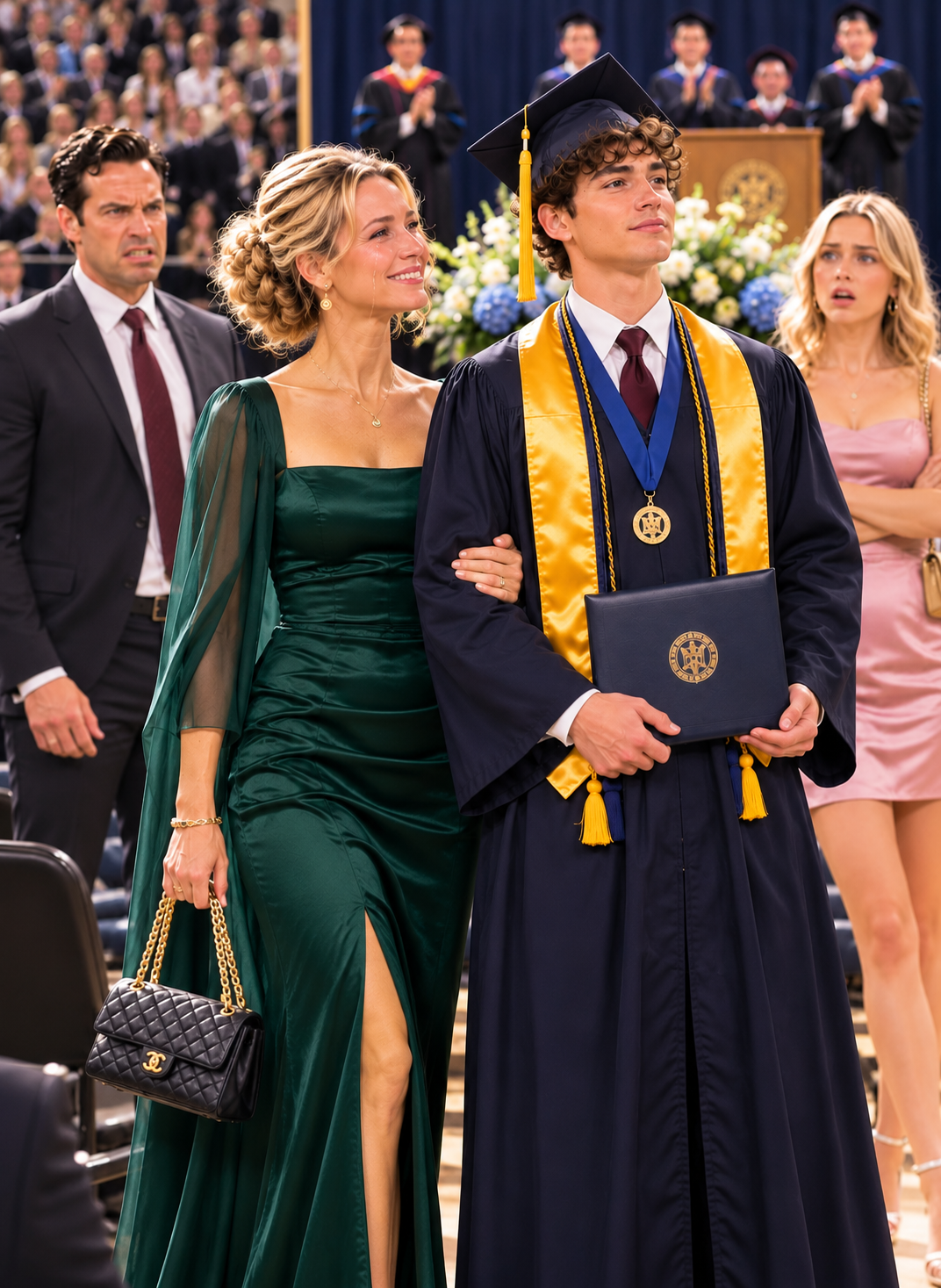
The graduation ceremony began at ten.
I sat between Nora and Maya in a crowded auditorium filled with families, flowers, cameras, restless younger siblings, and the particular electricity that accompanies endings disguised as beginnings.
Ethan stood with his classmates behind the curtain.
Fifteen years old.
Too young, perhaps, by ordinary expectations.
But there had never been anything ordinary about the route that brought us there.
My mother should have been beside me.
That thought arrived without warning.
I pictured her folding tiny onesies at the kitchen table.
Build something instead.
I swallowed hard.
Nora touched my arm.
“You okay?”
“Yes.”
I smiled.
“I’m just remembering somebody.”
The music began.
Students entered.
Then I saw Ethan.
Blue graduation gown.
Gold cord.
Hair refusing to stay flat.
He looked terrified.
Thank goodness.
A terrified fifteen-year-old still needed his mother.
I waved.
He spotted me.
His shoulders relaxed.
For one second, he was six again.
Then he walked onto the stage.
His name was called.
“Ethan Alexander Holloway.”
Applause.
I stood.
So did Nora.
Maya whistled loudly enough to embarrass three rows of people.
Ethan shook the headmaster’s hand and accepted his diploma.
Nothing collapsed.
No dramatic music played.
No justice descended from the ceiling.
Life was rarely that theatrical.
Then Ethan looked toward the far side of the auditorium.
His expression changed.
I followed his gaze.
Richard stood near the back.
Alone.
No executive entourage.
No reserved sponsor seating.
Just Richard.
He had come.
Ethan looked at him for a long moment.
Richard lifted one hand.
Ethan nodded.
That was all.
The research showcase began after lunch.
Six finalists.
Each had twelve minutes.
One had developed a low-cost water sensor.
Another had studied soil recovery after wildfires.
A sixteen-year-old girl from Oregon presented research on sleep patterns in adolescents.
Ethan was fifth.
Richard sat in the back again.
Meridian’s logo appeared among the sponsor names on the stage backdrop.
I wondered whether anyone else knew that its CEO had already submitted his resignation.
The moderator announced Ethan.
He walked to the podium.
His first slide appeared.
**THE COST OF BEING WRONG**
He looked smaller behind the lectern than he had during graduation.
Then he began.
“Prediction is useful because the future is expensive.”
The audience quieted.
“Schools decide where to place tutors. Hospitals decide where to send resources. Communities decide which programs to fund. We use data because we cannot examine every possibility forever.”
He clicked.
A graph appeared.
“But there’s a problem.”
Another slide.
“A prediction can be accurate for most people and still fail the person standing in front of you.”
I looked at Richard.
He had gone very still.
Ethan explained false positives.
False negatives.
Aggregate accuracy.
Subgroup error.
Nothing sensational.
No accusation.
No mention of Richard.
No mention of Calder.
He showed his methodology.
His datasets.
His limitations.
Maya nodded occasionally.
Then came the final slide.
Two columns.
**PREDICTION**
**DECISION**
“They aren’t the same thing,” Ethan said.
“A model can tell us what happened to people who resemble someone in certain measurable ways. It cannot tell us who that person must become.”
My eyes filled.
He continued.
“The more important a decision is, the more dangerous it becomes to confuse probability with identity.”
He paused.
“My project began because I was curious about how models handle unusual cases.”
Richard lowered his head.
“I discovered something simple. Unusual cases aren’t errors in life. They’re only errors in our expectations.”
Silence.
Then applause began.
Not thunderous.
Not cinematic.
Just genuine.
Growing.
Ethan stepped away from the podium.
And that was when Richard’s phone lit up.
I saw it because I was looking at him.
He read the message.
His face changed.
Then another message appeared.
And another.
Across the aisle, two Meridian executives stood and left quietly.
Madison had been right.
The board meeting had started.
Later I learned what happened during those minutes.
Meridian’s board voted to accept Richard’s resignation immediately rather than at the end of the quarter.
Three major clients announced independent reviews of Calder-related deployments.
One state suspended renewal discussions.
A university research consortium requested access to historical validation data.
None of those actions occurred because Ethan had humiliated Richard.
He had not.
They occurred because the internal review Richard finally authorized had confirmed what he had spent years minimizing.
Calder was useful.
Sometimes very useful.
But its risk controls had not grown as quickly as its commercial reach.
Richard had repeatedly chosen expansion first.
Review second.
For years, success had protected that choice.
Then success became the thing that magnified it.
Ethan finished his presentation without knowing any of this.
The judges asked questions.
One challenged his sample-selection criteria.
Another asked whether removing demographic variables might reduce accuracy enough to create other harms.
Ethan admitted that it could.
“Then what is your recommendation?” the judge asked.
Ethan thought.
“I don’t think the answer is to stop predicting.”
Richard looked up.
“I think the answer is to make predictions easier to question.”
The judge smiled.
“That sounds inconvenient.”
“Good systems should survive inconvenience.”
Some people laughed.
Richard did not.
But his expression changed.
Almost a smile.
Ethan did not win first place.
That surprised everyone except Maya.
He placed second.
The water-sensor project won.
Ethan shook the winner’s hand and spent twenty minutes afterward asking how the sensor calibrated for mineral-heavy groundwater.
That was Ethan.
A life-changing day occurred, and he wanted to talk about water.
Outside the auditorium, reporters gathered around the finalists.
I kept my distance.
Then I saw Richard approaching.
Ethan saw him too.
For several seconds, neither moved.
Finally Richard said, “Congratulations.”
“Thanks.”
“You were excellent.”
“Maya says my conclusion needs more replication.”
Richard smiled faintly.
“She sounds exhausting.”
“She is.”
Silence.
Ethan looked toward the sponsor banner.
“Did something happen?”
Children notice everything.
Richard nodded.
“Yes.”
“With Meridian?”
“Yes.”
“What?”
“I resigned.”
Ethan’s face changed.
“Because of me?”
“No.”
Richard answered so quickly that I believed him.
“No, Ethan.”
He stepped closer.
“You must never carry that.”
“Then why?”
Richard looked toward me.
Fifteen years seemed to pass between us.
“Because your project forced me to hear something I already knew.”
“What?”
“That being able to explain a decision isn’t the same as being able to defend it.”
Ethan stared at him.
“Did you hide the report?”
“Yes.”
“Why?”
“I told myself it was incomplete.”
“Was it?”
“Some of it.”
“That’s not why.”
Richard looked down.
“No.”
Ethan waited.
Richard finally said, “I was afraid.”
“Of losing money?”
“Of losing the company.”
“Why?”
Richard laughed softly.
“Because I thought the company proved something about me.”
“What?”
“That I mattered.”
The answer stunned me.
Perhaps Ethan too.
Richard looked at him.
“I spent most of my life believing people matter when they accomplish something visible.”
His eyes moved toward the diploma folder in Ethan’s hand.
“Businesses. Awards. Titles.”
Ethan said quietly, “You told Mom I wouldn’t accomplish much.”
Richard closed his eyes.
So Ethan had decided to say it.
“Yes.”
“Did you mean it?”
“At the time?”
“Yes.”
Richard opened his eyes.
“Yes.”
The word hurt.
Truth sometimes does.
Ethan absorbed it.
Richard continued.
“And I was wrong before you had ever had the chance to prove me wrong.”
“That sentence doesn’t make sense.”
Richard looked confused.
Ethan said, “If I’d grown up average, you’d still have been wrong.”
Something in Richard’s face broke.
Not dramatically.
No tears.
Just recognition.
Ethan continued.
“I shouldn’t have needed to do anything impressive for what you said to be wrong.”
I put my hand over my mouth.
Richard nodded slowly.
“No,” he said. “You shouldn’t have.”
That was the moment.
Not the applause.
Not the resignation.
Not the company review.
That was the moment Richard’s old worldview finally collapsed.
A child had become a young man.
And instead of defeating his father, he had simply refused his father’s measurement.
Richard looked at me.
“I’m sorry.”
Fifteen years earlier, I had imagined those words a thousand ways.
On his knees.
In regret.
Too late.
I had imagined feeling powerful when they came.
Instead I felt peaceful.
“I believe you,” I said.
Not I forgive you.
Not everything is fine.
Just truth.
I believe you are sorry.
That was enough for one afternoon.
Meridian survived.
That matters.
Reality rarely delivers clean destruction.
Companies employ innocent people.
Contracts affect schools.
Families depend on salaries.
The board appointed an interim CEO.
Calder deployments were reviewed individually.
Some were discontinued.
Others were modified.
Independent oversight was added.
Daniel Calder joined an external advisory panel after refusing three offers to return as an executive.
“I already have a job,” he told Ethan.
“Where?”
“Teaching people who think they hate math.”
Richard sold much of his remaining ownership over the following year.
The fortune he had built shrank significantly.
But he did not become poor.
He did not deserve a fairy-tale punishment.
Life offered something more difficult.
He had to live without the identity he had spent fifteen years building.
For the first time, Richard Holloway could not introduce himself by a company.
That frightened him.
Then, slowly, it changed him.
He began teaching one evening course in applied analytics.
His first class had eleven students.
He called Ethan afterward.
“Three of them fell asleep.”
Ethan laughed.
“Maybe your model predicted that.”
Richard groaned.
They began speaking more often.
Not because I arranged it.
Because Ethan chose it.
Trust returned in teaspoons.
A phone call.
A coffee.
A forgotten birthday followed by an apology instead of an excuse.
Richard came to a soccer game.
Ethan’s team lost six to one.
Afterward, Richard said, “You were terrible.”
Ethan stared at him.
Then both of them laughed.
It was the healthiest conversation they had ever had.
Two years later, Ethan enrolled in university.
He studied statistics and philosophy.
“Why philosophy?” Richard asked.
“Because statistics tells you what you can measure.”
“And philosophy?”
“What you shouldn’t pretend to.”
Maya took credit for that answer.
I took credit for feeding him for eighteen years.
Daniel took credit for teaching him to distrust impressive graphs.
Richard took credit for nothing.
That might have been the biggest change of all.
The blue blanket my mother knitted remained in a cedar box.
On the day Ethan left for college, I found him holding it.
“You kept this?”
“Of course.”
“It’s tiny.”
“You were tiny.”
He smiled.
“Were you scared?”
“When?”
“When Dad left.”
I sat beside him.
“Yes.”
“How scared?”
“Very.”
He ran his fingers over the faded yarn.
“Did you think everything was ruined?”
I thought about that night.
Fever.
Bills.
Formula.
The photograph of Richard and Madison glowing on my phone.
“Yes.”
“What changed?”
“You.”
“That’s cheesy.”
“It’s true.”
He rolled his eyes.
I nudged him.
“Not because you became brilliant.”
“I’m glad you clarified.”
“Not because you won awards.”
“Second place.”
“You’re never letting that go, are you?”
“No.”
I laughed.
“You changed things because taking care of you gave me something more useful to do than spend my life thinking about what your father had done.”
Ethan grew quiet.
“Grandma said that, right?”
“What?”
“Build something instead.”
I stared at him.
“How do you know that?”
“You tell that story all the time.”
Apparently mothers repeat themselves.
He folded the blanket.
“Did it work?”
I looked around our house.
The same house Richard once wanted sold.
The kitchen table scratched by years of homework.
The doorway where Ethan’s height had been marked in pencil.
The old cardboard drawbridge still absurdly stored in the basement.
Photographs.
Friends.
Losses.
Birthdays.
Ordinary Tuesdays.
A life.
“Yes,” I said.
“It worked.”
Years later people occasionally asked me whether I felt vindicated by what happened to Richard.
The question always seemed to misunderstand the story.
Richard losing Meridian was not my victory.
Ethan succeeding was not revenge.
My life was never a courtroom in which happiness needed to prove Richard guilty.
The real victory had happened much earlier.
It happened the first morning I woke after Richard left and fed my son.
Then the morning after that.
And the one after that.
It happened when I returned to work before I was ready.
When I kept the house.
When I learned to fix the kitchen sink.
When Ethan asked questions I could not answer and I stopped being embarrassed to say, “I don’t know.”
When grief came and we survived it.
When anger came and I refused to make it our family language.
And yes, perhaps part of it happened on that stage.
A fifteen-year-old boy in a graduation gown stood beneath bright lights and explained to a room full of adults that predictions were not identities.
His father listened from the back row.
Within minutes, the company Richard had built around certainty began changing without him.
But the sentence I remember came later.
Years later.
Richard and I were sitting in the audience at Ethan’s university graduation.
Gray-haired now.
Both of us.
Ethan crossed another stage.
Richard leaned toward me.
“Claire?”
“Yes?”
“I spent years thinking the worst thing I ever did was underestimate him.”
I looked at him.
“It wasn’t?”
He shook his head.
“The worst thing was thinking his worth had anything to do with what he accomplished.”
I watched Ethan accept his degree.
Then I smiled.
“You finally learned.”
Richard looked toward our son.
“Yes.”
Onstage, Ethan turned toward us.
For one second, despite the years, I saw the newborn I had held under a blue knitted blanket while the world outside his nursery seemed to fall apart.
Richard had once looked at that child and seen a prediction.
I had looked at him and seen a miracle.
In the end, we had both been wrong in one important way.
Ethan was neither.
He was simply a person.
A complicated, unfinished, impossible-to-predict human being.
And perhaps that had been the lesson all along.
No algorithm could measure the distance a person might travel.
No cruel sentence spoken over a crib could decide a future.
No number could tell you what someone would become.
Sometimes the most important thing we can offer another human being is not certainty.
It is room.
Room to surprise us.
Room to fail.
Room to change.
Room to become.
And fifteen years after Richard had dismissed our son’s future before it had even begun, Ethan had not destroyed him.
He had done something far more lasting.
He had taught his father how little any of us truly know about the person standing in front of us.
**–THE END–PLEASE
✓ Lynn R. Adams
## Part 6 – The Stage **Part 6** Richard’s resignation was not announced that night. Nor the next morning. Ethan knew nothing about it. I decided that was how it should remain. This was his day….