Part 6 – The Flame That Wouldn’t Lie-068
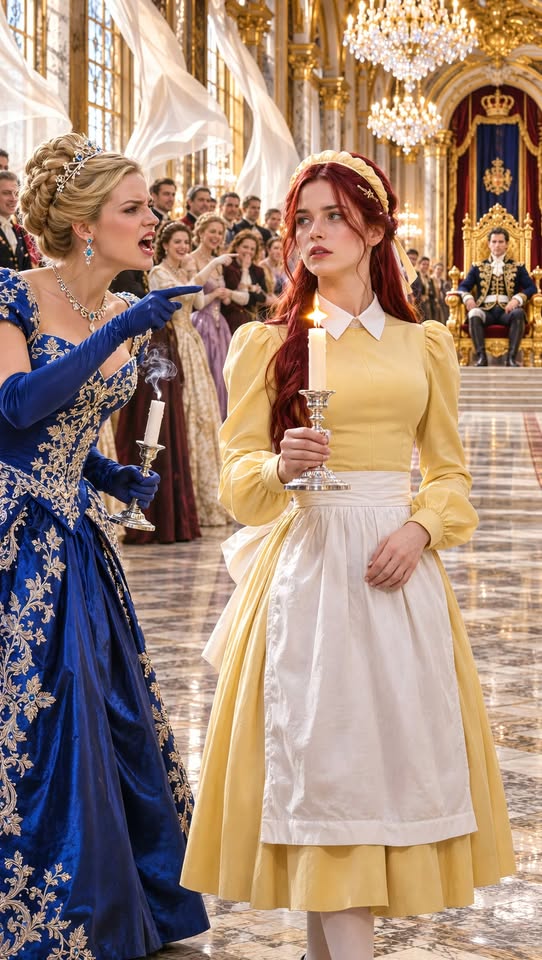
## END – The Light We Choose to Carry
**Part 6**
Three months later, the palace ballroom looked completely different.
The windows were closed.
No noble families crowded the walls.
No reporters waited outside.
No woman stood at the far end holding a candle and wondering whether marriage awaited her on the other side.
Instead, twenty-four chairs formed a circle beneath the chandeliers.
Half were occupied by palace employees.
The others held historians, teachers, foundation representatives and members of the public chosen through an open application process.
On the wall hung a simple plaque.
**THE CANDLE WALK**
**A tradition of observation, assistance and truth.**
No mention of brides.
No competition.
No winner.
Hannah stood near the same preparation table where everything had begun.
She wore no servant’s apron.
That felt strange.
For six years, the apron had been part of how she understood herself.
Now she wore a dark blue dress and a small identification badge from the palace library.
**HANNAH HART — CONSERVATION APPRENTICE**
She had not accepted charity.
She had applied.
Mrs. Bell had interviewed her alongside six other candidates.
Hannah had spent two sleepless weeks convinced she had performed terribly.
Then the letter arrived.
The palace library had created two apprenticeship positions.
One went to Hannah.
The other went to a community-college graduate named Marcus Lee, who possessed the remarkable ability to repair torn maps while talking nonstop about baseball.
Hannah adored the work.
Her first project had been the old Candle Walk ledger.
Every page had been cleaned.
Every damaged binding reinforced.
The missing fourth rule had been reproduced only on a separate insert so no one would mistake restoration for rewriting history.
“You’re staring at it again.”
Hannah turned.
Noah stood behind her.
He wore a dark suit instead of ceremonial uniform.
“I restored it. I’m allowed to admire it.”
“You’ve admired it for fourteen minutes.”
“You counted?”
“I’m a prince. We have people for counting.”
She gave him a look.
He grinned.
Their friendship had developed slowly.
Deliberately.
No secret meetings.
No dramatic declarations.
No ballroom announcement that a maid had somehow become the prince’s chosen bride because she carried a candle farther than everyone else.
They met in the library.
Sometimes they drank coffee.
Sometimes they argued about books.
Once Noah spent forty minutes insisting that a badly damaged atlas could be repaired with modern binding tape.
Hannah had nearly thrown him out.
He apologized by bringing her an eighteenth-century restoration manual.
She forgave him.
Mostly.
“Are you nervous?” Noah asked.
“No.”
“Liar.”
“Very.”
He nodded toward the circle.
“Me too.”
Today the palace would formally adopt the restored Candle Walk charter.
The ceremony would no longer be used to suggest romantic compatibility.
Instead, it would become an annual leadership exercise for the royal foundation.
Participants would face small cooperative challenges designed around the original principle:
Who protects another person’s light when there is nothing to gain?
Lady Margaret had helped draft the new charter.
That surprised everyone.
Perhaps Margaret most of all.
After the scandal, she stepped down temporarily from two foundation committees and spent several weeks with Clara away from Washington.
When they returned, something between them had changed.
Not perfectly.
Not magically.
But noticeably.
Margaret asked more questions.
Clara gave more honest answers.
Mr. Vale remained ceremony master, though his position now included an oversight committee.
He had admitted his role in manipulating the candles and accepted a formal reprimand.
Noah had explained the decision simply.
“Accountability isn’t useful if its only form is exile.”
James Whitmore resigned from his foundation position.
He also sent Hannah a handwritten apology.
She had not answered.
Not because she hated him.
She simply did not yet know what answer she wanted to give.
That too was a choice.
Emily entered the ballroom carrying a tray of candles.
She saw Hannah and sighed dramatically.
“Do you know how heavy these are?”
Hannah looked at the tray.
“Twelve candles?”
“Extremely.”
“Your poor hands.”
Emily stared at her.
Then laughed.
Their relationship had become an unlikely one.
Emily volunteered twice a month at the royal foundation’s literacy program.
The first time, Hannah suspected it was a public-relations decision.
By the fourth visit, Emily was sitting cross-legged on the library floor reading adventure stories to eight-year-olds while wearing shoes worth more than Hannah’s monthly salary.
People could surprise you.
Clara arrived last.
She wore a pale green dress and no family diamonds.
Margaret entered beside her.
Not ahead.
Beside.
Clara embraced Hannah.
“I have news.”
“Good?”
“I think so.”
She had been accepted into an architecture program in Boston.
Margaret looked as though she were still practicing the art of not immediately planning housing, professors and future internships.
“My mother has asked only seven questions.”
“Nine,” Margaret corrected.
“Seven were questions. Two were disguised instructions.”
Margaret sighed.
“I’m improving.”
“You are.”
Noah called the meeting to order.
There was no throne.
He sat in the circle with everyone else.
Mr. Vale read the history of the ceremony.
Not the polished version.
The real one.
He spoke of Queen Miriam.
Of Anna Hart.
Of Margaret Whitmore.
Of the promise three young women once made.
When he reached the part about how the ceremony had been distorted, Margaret herself stood.
“I was part of that distortion.”
No excuses.
No theatrical confession.
Simply truth.
“I believed security could be created by controlling outcomes. I was wrong.”
Clara looked at her mother.
Margaret met her eyes.
That was enough.
Then Noah stood.
“My mother wrote that a crown should notice who shields another person’s light.”
He paused.
“For a long time, I thought leadership meant making good decisions for other people.”
His eyes found Hannah.
“I am beginning to understand that sometimes it means creating room for people to make their own.”
Hannah looked down, suddenly self-conscious.
Emily leaned toward her.
“He’s looking at you.”
“I noticed.”
“Should I laugh?”
“Please don’t.”
Emily smiled wickedly.
“I’ve matured, not transformed.”
After the charter was signed, Mr. Vale brought out a tray.
Twenty-four candles.
Everyone took one.
Noah explained the restored ceremony.
“You will cross the ballroom in pairs.”
Several people smiled.
“The goal is not to keep your candle burning.”
That surprised them.
“The goal is to notice your partner.”
Hannah remembered her first walk.
How desperately she had protected her own flame.
How everyone had watched only the candles.
The participants began.
At the first window, hidden fans created a mild artificial breeze.
One woman’s candle leaned sharply.
Her partner immediately protected it.
Across the ballroom, another participant stopped to relight someone else’s wick.
A third gave up his own flame to shield his partner’s.
There was laughter.
No competition.
Nobody kept score.
Margaret and Clara walked together.
Halfway across, Clara’s flame died.
Margaret instinctively reached toward it.
Then stopped.
She looked at her daughter.
“Do you want help?”
Clara smiled.
“Yes.”
Margaret relit the candle from her own.
Hannah felt tears sting unexpectedly.
Beside her, Noah pretended not to notice.
“Thank you,” she whispered.
“For what?”
“For pretending.”
“I have no idea what you’re talking about.”
“You’re terrible at it.”
“So I’ve been told.”
When the ceremony ended, the guests moved into the garden for supper.
Hannah remained behind.
She gathered the unused candles.
Old habits survived promotions.
She found one remaining candle on the table.
A crescent had been scratched underneath.
Hannah froze.
“Mr. Vale?”
He turned from the doorway.
She showed him.
He smiled.
“Not me.”
Hannah’s heart gave a ridiculous jump.
“Then who?”
Mr. Vale nodded toward Noah.
The prince looked suddenly interested in a painting.
Hannah walked over.
“You marked this.”
“Possibly.”
“Why?”
“I thought the ceremony should retain one crescent candle.”
“For staff?”
“No.”
“For demonstrations?”
“No.”
She waited.
Noah finally looked at her.
“For questions.”
Hannah smiled.
“What kind of questions?”
“The sort without predetermined answers.”
He took the candle.
Then he gestured toward the far side of the ballroom.
“Walk with me?”
Hannah crossed her arms.
“This isn’t another marriage challenge, is it?”
“Absolutely not.”
“Good.”
“I’ve become strongly opposed to candle-based courtship.”
“Wise policy.”
They each lit a candle.
Then they started walking.
Side by side.
No audience.
No throne waiting at the end.
Halfway across the ballroom, Noah’s flame went out.
Hannah laughed.
He stared at the smoke.
“This feels unfair.”
“Ask why.”
“Why did my candle go out?”
Hannah examined it.
“Bad wick.”
“Sabotage?”
“Manufacturing inconsistency.”
“Less exciting.”
“Most truth is.”
He looked at her candle.
Still burning.
“Yours survived.”
“Apparently.”
“So you win.”
Hannah shook her head.
“We’ve discussed this.”
“Right.”
They reached the far end.
Noah looked through the tall windows toward the garden.
Music drifted in from outside.
“Clara leaves for Boston next month.”
“I know.”
“Emily has asked to join the literacy committee.”
“That seems dangerous.”
“Extremely.”
They laughed.
Then Noah grew thoughtful.
“Do you ever think about that first day?”
“Sometimes.”
“What do you remember most?”
Hannah expected herself to say the parchment.
Or the false accusation.
Or her mother’s letters.
Instead she said, “The silence.”
“What silence?”
“When my candle went out.”
She looked at the little flame still burning between them.
“The whole ballroom became quiet because something happened that didn’t fit the story everyone expected.”
Noah nodded.
“And then you changed the story.”
“No.”
She smiled.
“I asked why.”
They stood quietly for a moment.
Then Noah said, “Can I ask another question?”
“Depends.”
“Would you have dinner with me Friday?”
Hannah studied him.
“We’ve had dinner before.”
“Yes.”
“Many times.”
“Yes.”
“Why are you suddenly nervous?”
“Because the previous dinners were between friends.”
Hannah felt her heartbeat change.
“And this one?”
“I hoped it might be a date.”
There it was.
No trumpets.
No public proposal.
No throne.
No challenge in which one woman defeated twelve others.
Only a question.
And room for an answer.
Hannah looked toward the candle in her hand.
“You’re not going to decide my future for me?”
“I have received extensive training on that subject.”
“Good.”
She let him wait a moment longer.
Then she smiled.
“Friday.”
Noah’s answering smile was so ordinary and delighted that for a moment he looked nothing like a prince.
“Friday.”
“But somewhere without ceremonial candles.”
“Agreed.”
“And no royal seal.”
“Definitely.”
“No competition.”
“I promise.”
Hannah lifted an eyebrow.
“People around here have complicated histories with promises.”
“Then I will simply say I intend to try.”
“Better.”
They walked toward the garden.
At the ballroom doors, Hannah glanced back.
Rows of candles glowed along the walls.
Some burned strongly.
Some flickered.
One went out near an open window.
Nobody rushed to relight it.
Nobody declared anyone a winner.
Nobody blamed the wind.
It was simply a flame.
Beautiful while it lasted.
And beside the restored ledger in the palace library, Anna Hart’s final note would remain preserved beneath glass.
Not because her daughter had obeyed it.
But because she had understood it.
**I will not choose your path. I only want you to know a path exists.**
Years later, historians would write about the strange Candle Walk that changed one of America’s most famous royal traditions.
Newspapers would focus on Prince Noah.
Society magazines would eventually write about Hannah too.
Some would turn their friendship and later courtship into a fairy tale.
They would say the servant girl won the prince because she carried a candle farther than wealthy women could.
Hannah would always laugh when she read that version.
Because she had not won the challenge.
Her candle had gone out.
That was the whole point.
Had it continued burning, she might never have questioned it.
Had she accepted the ceremony master’s explanation, she might never have found the cedar box.
Had Clara remained silent, Margaret might never have faced the fear beneath her plans.
Had Noah treated authority as certainty, the original ledger might have disappeared again.
No single person had saved the day.
They had done something much less dramatic and far more difficult.
They had listened when the story stopped making sense.
The following spring, Hannah completed her first major restoration project.
It was not a royal charter.
It was an ordinary children’s book donated to the palace library by a retired schoolteacher.
The cover had nearly separated.
Several pages were torn.
Someone had drawn a blue star on page seventeen.
Marcus thought the star should be removed.
Hannah disagreed.
“It’s part of the book’s history.”
“It’s crayon.”
“History can be crayon.”
Mrs. Bell sided with Hannah.
Marcus complained for a week.
On the day the repaired book returned to the shelf, Noah visited the conservation room.
He carried coffee.
“No candles?”
Hannah asked.
“None.”
“You’re improving.”
“Apparently.”
He looked at the restored children’s book.
“You saved it.”
“No.”
Hannah ran a finger gently along the repaired spine.
“I gave it enough support to keep being what it already was.”
Noah smiled.
“That sounds familiar.”
Outside, bells rang from the palace courtyard.
Life moved forward.
Clara sent photographs from Boston.
Emily continued arriving late to literacy meetings and staying long after everyone else left.
Margaret began funding scholarships without attaching family expectations to them.
Mr. Vale retired from ceremonies the following year and became a consultant to the palace archives, where Hannah frequently argued with him about labeling systems.
James never returned to public foundation work.
Two years after the Candle Walk, Hannah finally answered his apology.
Her letter contained four sentences.
No forgiveness announced.
No condemnation.
Only acknowledgment.
That was enough.
And Noah?
He kept asking questions.
So did Hannah.
Sometimes their answers matched.
Sometimes they didn’t.
That became one of the things Hannah valued most.
Their relationship was never built around the idea that one person completed the other.
They were two people who had learned, in very different ways, that love without freedom could easily become another form of planning.
When Noah eventually asked Hannah to marry him, he did not do it in the ballroom.
There were no candles.
No audience.
No royal photographer.
They were sitting at an old wooden table in the conservation workshop, arguing about whether a handwritten grocery list discovered inside a nineteenth-century novel should remain in the archive.
Noah said yes.
Hannah said obviously yes.
Then he said, “While we’re agreeing on things, would you consider marrying me?”
Hannah stared at him.
“That is the worst proposal in royal history.”
“Is that a no?”
“No.”
His face fell.
She laughed.
“No, it isn’t a no.”
Understanding arrived.
He smiled.
Hannah made him ask properly anyway.
Years afterward, visitors touring the palace would still see the crescent candleholder displayed beside the old ceremony ledger.
The plaque underneath did not mention romance.
It did not mention scandal.
It did not say a servant girl defeated noblewomen.
It simply read:
**THE CRESCENT CANDLE**
**Its flame was designed to fail so that someone would ask why.**
And below that, in smaller letters, were Queen Miriam’s words:
**A crown should notice who shields another person’s light.**
Children on school tours often asked Hannah which candle had really been the most important.
The one that survived longest?
The one Clara deliberately allowed to extinguish?
The crescent candle?
Hannah always gave the same answer.
“None of them.”
The children would look disappointed.
Then she would smile.
“The important part wasn’t the flame.”
“What was it?” they would ask.
Hannah would point toward the people around them.
“The person standing beside it.”
And every time she said those words, she remembered a ballroom filled with wealth, expectation and carefully arranged appearances.
She remembered rough hands around a trembling flame.
She remembered a wick going dark when there was no wind.
She remembered speaking when remaining silent would have been easier.
Most of all, she remembered that the extinguished candle had never marked the end of anything.
It had illuminated the first question.
And sometimes one honest question was enough to change an entire room.
**–THE END–PLEASE
**Share your thoughts or feedback to motivate us to create more stories ♥️**
✓ Lynn R. Adams
## END – The Light We Choose to Carry **Part 6** Three months later, the palace ballroom looked completely different. The windows were closed. No noble families crowded the walls. No reporters wa…