PART 6 (THE END): What the Velvet Box Held 053
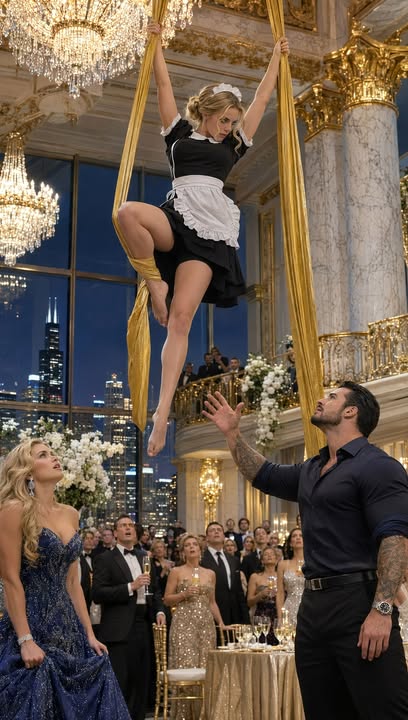
Part 6 – Where the Air Opens
Emily stared at the false clearance, the inked promise that the cable had been replaced, and felt the last uncertainty in her settle into a quiet, unmistakable anger.
Not anger at the fall itself, which had already taken years from her, but at the knowledge that someone had written down a reassurance and left her to trust it.
“Can we compare the date with the original inspection log?” she asked.
The trustees’ chairwoman passed the page to Clara, who had been invited to attend as the keeper of the surviving copy.
Clara studied it beneath the conference room lights, then laid it beside her sleeve-protected record.
“The acknowledgment is dated two days after the replacement was deferred,” she said.
“But the log still says the cable was in use,” Emily replied.
“Yes,” Clara said. “And the initials beside the daily checks are different from those on the earlier entries.”
The attorney leaned over the documents.
“That doesn’t prove who altered either record,” he said. “It does establish that the records conflict.”
Emily kept her eyes on the page.
“Was there a second file?”
The attorney folded his hands.
“Mrs. Moretti’s papers refer to a sealed packet delivered to the independent inspectors. It may contain correspondence or a copy of the report they received.”
“Where is it?”
“The archive catalogue lists it as transferred to the Whitmore family records.”
Vanessa looked down at her hands.
“My father said the records were destroyed.”
“Perhaps he believed that,” the attorney replied. “We should not assume otherwise without asking.”
The chairwoman nodded.
“The trust review can continue while we locate the packet. The question of the altered record is separate from the question of how the money should be used.”
Emily looked at the proposal she had brought.
“I don’t want the trust held up while we search for someone to blame.”
“No one is asking you to do that,” the chairwoman said. “But the trustees do have a duty to preserve the records and understand the history attached to the fund.”
“Then preserve them,” Emily said. “Find out what happened. But the program should not depend on proving who failed me.”
The words surprised her with their certainty.
For years, she had believed the truth might be the one thing that could make the past feel complete.
Now she understood that accountability mattered, but her life could not be made to wait for every answer.
The chairwoman nodded.
“That is a reasonable distinction.”
The meeting continued for another hour, with careful questions about the proposal, the independent safety reviews, and the way scholarship recipients would be chosen.
Emily answered what she could and wrote down what required more thought.
Vanessa stayed quiet until the trustees asked her whether the Whitmore family would authorize a search of its archive.
“Yes,” she said. “I’ll ask my father to approve it, and I’ll request that the records be kept intact.”
“Will he agree?” Emily asked when the meeting ended.
“I don’t know,” Vanessa said. “But I’ll ask him plainly, and I won’t pretend the documents have disappeared.”
Emily believed she meant it.
That did not erase the ballroom, or make Vanessa’s apology a substitute for changed behavior.
It did allow Emily to see that a person could begin to change without being owed forgiveness.
A week later, the Whitmore attorney contacted the trustees with news.
Vanessa’s father had authorized a search of the family’s stored records, and the sealed packet had been found in a cabinet of documents from the old hospital foundation.
It contained Lucia’s original letter, a copy of the manager’s acknowledgment, and the inspectors’ own findings.
The cable had not been replaced.
A second inspection had been carried out after the rehearsal, and the equipment had been marked unsafe.
The circus manager had signed the clearance before that inspection took place.
The independent inquiry concluded that the company had failed to follow its own maintenance procedures and had relied on an inaccurate certification.
It could not establish who had changed the paperwork, or whether the manager had knowingly signed a false statement.
The report did establish that the equipment should not have been used.
Emily read the findings in the arts center office, with Clara seated beside her and Marisol across the table.
She had expected to feel a rush of vindication.
Instead, grief arrived first, then a deep, weary relief.
“I wasn’t careless,” she whispered.
Clara reached for her hand, stopping just short until Emily turned her palm upward.
“You trusted the people responsible for the equipment,” Clara said.
Emily let Clara hold her hand.
“I keep thinking about how close it was to being prevented.”
“I know.”
“Lucia tried.”
“Yes.”
“And you kept the log.”
“I did.”
“Thank you.”
Clara’s eyes glistened.
“I’m sorry I didn’t show it to you sooner.”
“I’m sorry I stopped answering your letters.”
They sat with the two apologies between them, neither one demanding that the other be enough.
At last, Clara gave a small, unsteady smile.
“Would you like to begin again?”
“Not as if nothing happened.”
“No.”
“Just from here.”
“From here is good.”
The trustees completed their review the following month.
They approved the program under Lucia Moretti’s original purpose, with the arts center as its first partner and an independent committee overseeing safety, scholarships, and finances.
Emily accepted the role of director, but only after the trustees agreed that she would be paid for her work and that the program would never require students or injured performers to share personal stories as a condition of receiving help.
She did not take the ten-million-dollar trust as a personal award.
She kept the bank draft in the velvet box for a little while longer, not as an offer she was tempted by, but as a reminder that refusing to be bought and choosing to build something could come from the same strength.
The money did not erase her medical debt overnight.
She continued paying it down, one bill at a time, and found other work at the arts center as its director.
The difference was that her labor now helped create something she believed in, and no one mistook her purpose for a reason she should work for free.
Vanessa made a public statement about the ballroom wager.
She acknowledged that she had made the offer, that it was wrong to turn Emily into a spectacle, and that the money had never been hers to promise.
She apologized without asking Emily to appear beside her.
Her family’s disapproval was immediate, but Vanessa did not withdraw the statement or ask Emily to soften it.
Emily read it once, then set the newspaper aside.
She did not feel triumphant.
She felt that the truth had been spoken in the place where the lie had first taken shape.
When Vanessa later visited the center, she brought no flowers and no explanation.
She asked Marisol whether there was a practical way to help with the children’s reading program.
Marisol gave her a list of tasks and made it clear she would be expected to follow the center’s rules like any other volunteer.
Vanessa agreed.
Emily watched her carry a box of donated books down the hallway, then turned back to the schedule on her desk.
Forgiveness, she was learning, did not need to be a door flung open all at once.
Sometimes it was simply the choice not to lock it forever.
The new program began with one movement room, a borrowed set of mats, and an aerial rig purchased only after an independent engineer inspected the space and approved its installation.
Clara helped write the inspection routine.
Every check was recorded, every concern addressed before the equipment was used, and every instructor was empowered to stop a class without fear of being called difficult.
The children learned how to notice their balance, how to warm up, how to listen to their bodies, and how to ask questions when something felt wrong.
The first scholarship went to a young performer named Luis, who had injured his wrist while working with a small touring company.
The fund covered his rehabilitation and helped him train for a different kind of work while he healed.
He did not owe the program a performance, a photograph, or a speech.
He owed it nothing.
Emily made certain the language appeared in every scholarship letter.
The program grew slowly, the way trustworthy things often did.
The arts center found a more stable lease, and the trustees approved funding for additional movement classes and rehabilitation support.
No one promised that every problem could be solved.
They promised to keep the equipment inspected, the accounts transparent, and the people at the center of the program.
Emily was still cautious around Vincent.
She did not become less herself because she had learned to trust him.
She still told him when she wanted space.
She still made her own decisions about work, money, and the future.
And Vincent, who had once thought that protection meant arranging the world before someone else could be hurt by it, learned to ask what support looked like before offering it.
He attended the program’s planning meetings when invited, and otherwise stayed away from decisions that belonged to Emily and the staff.
He did not use his name to secure favors.
He did not turn the program into a Moretti family project.
When reporters came asking about the wager, Emily answered only what she wanted to answer.
Vincent stood nearby, never stepping in front of her or speaking over her.
The first time she climbed the new aerial silks, she did it after the children had gone home.
The rig had passed inspection that morning, and Clara had checked it again before Emily took hold.
Marisol waited beside the mat, while Vincent stood at the edge of the room.
Emily wrapped the silk around her hand and felt the fabric settle against her palm.
Her shoulder twinged.
She lowered her arm, breathed slowly, and waited until the sensation eased.
No one urged her to continue.
No one asked whether she could still do the things she had done years ago.
She climbed only a few feet, then stopped.
The old fear came with her, but so did the knowledge that she could climb down whenever she chose.
After a moment, she descended and stepped onto the mat.
“That was enough for today,” she said.
“It was,” Clara replied.
Vincent gave no applause.
He simply met Emily’s eyes and smiled.
The next week, she climbed higher.
The week after, she practiced a gentle turn.
She did not train toward a return to the stage, and no one treated each small achievement as a promise of what she would do next.
She was learning the air again, not as a place she had to conquer, but as a place she could enter by choice.
Months passed.
The movement room filled with children, visiting teachers, recovering performers, and the sound of feet brushing across the floor.
The first anniversary of the program arrived on a bright spring afternoon.
A handful of guests gathered near the edge of the room, among them Marisol, Clara, Vanessa, the trustees, and Vincent.
There were no chandeliers or champagne towers.
There was a paper banner painted by the children, a table of fruit and warm bread, and a row of carefully inspected silks hanging from the ceiling.
Emily stood before the group and spoke about Lucia’s note.
She did not describe the trust as a prize or herself as a symbol.
She spoke of the freedom to choose what came next, and the importance of giving people help without asking them to turn their pain into a performance.
When she finished, Ana came forward and handed her a small drawing.
It showed a person on a silk, arms spread wide beneath a bright blue sky.
At the bottom, in careful letters, Ana had written: YOU CAN COME DOWN WHENEVER YOU WANT.
Emily laughed softly, then felt her eyes fill.
“That’s exactly right,” she told her.
The children took their places on the floor.
They began with the balance exercise Emily had taught them in her first class, lifting their arms slowly and finding the middle of their bodies.
She joined them, then looked toward the silks.
For a heartbeat, the old memory and the present occupied the same space: the fall, the hospital, the letter Lucia had written, the years of debt and doubt, the bright room built from a purpose that had almost been forgotten.
Vincent watched from the side, not reaching for her, not asking her to prove anything.
Emily went to the mat.
Clara checked the rigging once more, then nodded.
Emily climbed.
She moved with care, pausing when her shoulder asked her to pause, and continuing only when she wanted to.
At a safe height, she wrapped the silk around her waist and leaned back into a gentle shape she had once thought belonged to someone she used to be.
The children watched in quiet wonder.
Emily let the fabric hold her.
She breathed.
Then she opened her arms.
The applause began softly, led by Ana and the other children, and grew into something warm and unhurried.
Emily descended when she was ready.
At the mat, she looked up at the silks, then toward Vincent.
He did not reach for her.
He waited.
After the guests had gone, he walked with her beneath the paper banner and into the small courtyard behind the center.
The evening light rested on the brick walls, and somewhere beyond them the city carried on with its restless music.
“I have something to ask you,” he said.
“Is it a practical introduction?”
“No.”
“Then I’m listening.”
Vincent drew a small, plain ring from his coat pocket.
There were no cameras, no guests waiting for a cue, and no grand arrangement meant to make refusal difficult.
“I love the way you choose your life,” he said. “I love your honesty, even when it leaves me with no answer except to listen. I don’t want to own your future or decide where it should go.”
Emily’s eyes shone.
“I want to share mine with you, if that’s what you want too.”
He held the ring between them, not yet offering it into her hand.
“Will you marry me?”
Emily looked at him and saw the man who had once stood beneath her in a ballroom, then the man who had learned to leave space around a question.
She thought of the life she had rebuilt, of the work that mattered to her, and of the love that had grown without asking her to become smaller.
“Yes,” she said.
His relief came as a quiet smile, not a shout or a display.
He slid the ring onto her finger, and she rested her forehead against his.
Behind them, the room held its silence beneath the hanging silks.
They married in a small garden ceremony months later, surrounded by the people who had become part of their life: Marisol, Clara, the children from the center, and even Vanessa, who sat quietly in the second row and did not ask to be included in the photographs.
Emily kept her name.
She kept directing the program.
She kept earning her own living and making choices that belonged to her.
Vincent stood beside her, not ahead of her, and when the program grew, he helped only where she invited him.
At the next opening, the children gathered beneath the inspected rig, their faces turned upward.
Emily stood at the edge of the mat and looked once toward the silks.
Then she looked at Vincent.
He smiled, and she smiled back.
She stepped into the air because she wanted to, held by equipment that had been checked and by people who understood that trust was something built, not demanded.
And when it was time to come down, Emily chose where she would land.
**–THE END–PLEASE
Share your thoughts or feedback to motivate us to create more stories ♥️
* * *
[PREVIOUS: PART 5](https://storyly.idolsgift.com/blog/part-5-what-the-velvet-box-held-053)
✓ Lynn R. Adams
Part 6 – Where the Air Opens Emily stared at the false clearance, the inked promise that the cable had been replaced, and felt the last uncertainty in her settle into a quiet, unmistakable anger. No…