PART 6 (THE END): What Chelsea Had Been Afraid to Tell Me 070
Part 6 – A Promise Made Slowly
The photograph of Madison’s note stayed on my screen long after the message arrived.
I recognized the paper, the faded blue lines, the small ink smudge where I had rested my hand before the words dried.
I remembered writing the promise on a warm afternoon when the future had seemed less like a place we would have to choose and more like somewhere we were already headed.
*If we lose the life we planned, we can still choose what comes next.*
I had written it after we’d spent a day looking at houses we couldn’t afford, laughing at kitchens too small for the table we wanted.
Madison had added her sentence sometime after, when I wasn’t looking.
*If we lose the life we planned, we can still choose what comes next.*
I had read it then as optimism.
Now, months after we had lost the life we planned, I heard something more difficult in it: permission to begin without pretending nothing had been broken.
I typed, *Bring it, if you want to.*
She answered, *I do.*
The day she returned, the city was bright with the kind of late-summer sun that made every storefront look freshly painted.
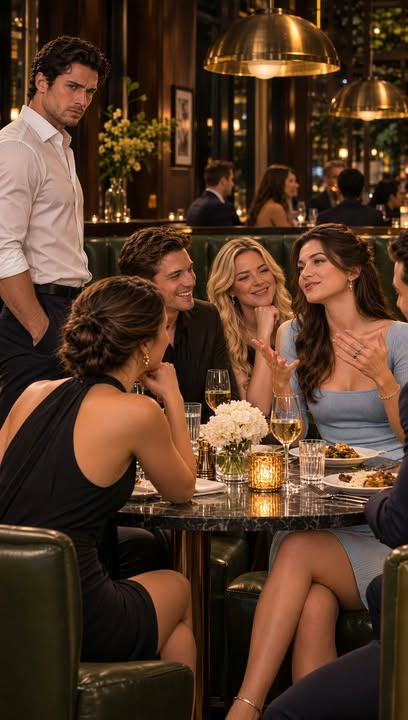
Madison had suggested Marlow & Finch.
I read her message twice before replying, then agreed.
It had been the place where our engagement ended, and I wondered whether meeting there was her way of returning to the moment without asking either of us to pretend it had never happened.
When I arrived, she was already outside, standing beneath the awning with a small envelope in her hand.
She wore a pale green jacket I had never seen before and carried herself with a settled ease that was new to me.
Not a confidence meant to make an impression, but the quieter kind that comes from having made choices and learned to live inside them.
“Hi,” she said.
“Hi.”
For a moment we simply looked at each other.
Then she smiled, careful but real, and we went inside.
The bar was quieter in the afternoon than it had been that night.
We chose a table near the window, away from the center of the room, and ordered coffee instead of the drinks our friends had once gathered around.
Madison set the envelope between us.
“I’m glad you came,” she said.
“I’m glad you’re here.”
Her eyes softened, but she didn’t mistake the words for anything more than they were.
“I’ve been thinking about what I wanted to say,” she told me.
“Have you found the words?”
“Some of them.”
She placed both hands around her cup.
“The job is going well,” she said. “Better than I expected, actually.”
“I’m glad.”
“I’m managing a project that matters to me, and my colleagues don’t treat asking questions like a weakness.”
“That sounds like a good place to work.”
“It is. I’ve made friends, too. I found a little apartment near the park, and I finally know which grocery store has the best bread.”
I smiled.
“An important discovery.”
“More important than I expected.”
Her voice held warmth when she spoke of Bellweather, and I was glad to hear it.
She had built a life there, not a temporary shelter while waiting for me to decide what I wanted.
That mattered.
“I’ve also stopped making you the punchline when I talk about us,” she said.
The words were gentle, but her expression was serious.
“I’m glad.”
“I used to think that if I made a joke first, I could control what people noticed. I thought I was keeping things light.”
She looked down into her coffee.
“But mostly I was teaching people that it was fine to laugh at something I knew mattered to you.”
I didn’t interrupt.
“I’m not telling you that to show you I’ve changed enough to deserve another chance,” she continued. “I’m telling you because I want you to know I understand the difference now.”
“What difference?”
“Between speaking honestly about something that hurt me and making you small so I won’t have to admit I’m hurt.”
She lifted her eyes.
“I can talk about our problems without turning your work, or your steadiness, or the way you care for people into a joke.”
I let her words settle.
The room around us carried on in low conversation, cups set down softly, the front door opening and closing behind a couple who had come in from the sun.
“I’ve noticed the difference,” I said.
Madison’s hands relaxed around her cup.
“Thank you.”
“That doesn’t mean the old things are gone.”
“I know.”
“Sometimes I still hear those jokes when someone mentions my job.”
“I’m sorry.”
“Sometimes I wonder if you respected me before you knew what the work had meant to your family.”
She didn’t look away.
“I can’t give you a perfect answer,” she said. “I respected how hard you worked, but I let myself dismiss the work because it was easier than admitting I didn’t understand it.”
She paused.
“Then Noah’s treatment made it impossible for me to keep pretending it was just spreadsheets.”
I remembered that night’s call, the old delivery record, and Noah’s careful voice telling me what his family had been waiting for.
The storm had left no grand story behind, no single person to credit.
It had left a family who had been frightened, a hospital team doing what they could, and a group of people on the road helping necessary supplies reach their destination.
“Do you think you told me because you wanted me to know what the work meant,” I asked, “or because you were afraid I’d never believe you respected it?”
“Both, at different times,” she said. “But that isn’t why I’m telling you today.”
“Why today?”
“Because I want to speak about you truthfully, even when I’m not trying to get anything from you.”
I looked at her across the small table.
The answer was not a grand gesture.
It was better than one.
“What have you decided to do with the note?” I asked.
She opened the envelope and slid the folded paper toward me.
“You wrote the first line,” she said. “I wrote underneath it because I thought I might need to remember it someday.”
“You kept it all this time?”
“I found it in the box with the photographs. I almost threw it away when I moved, but I couldn’t.”
I unfolded the paper.
My handwriting looked younger, more hurried.
Beneath it, Madison’s sentence curved across the page in dark blue ink.
*If we lose the life we planned, we can still choose what comes next.*
“I don’t want this to become a promise that we have to get back together,” she said. “I don’t want an old note to decide for us.”
“I don’t either.”
“I wanted you to have it because it belongs to both of us, even if we choose different things next.”
I traced the edge of the paper with one finger.
For a long time, I had thought that if she returned to town, I would need to decide whether to offer her the future we had once planned.
But the words on the page did not demand that.
They only left us room.
“What do you want now?” I asked.
Madison drew a slow breath.
“I want to see whether we can know each other again.”
“Not pick up where we left off?”
“No. I don’t think we can.”
She glanced toward the window.
“I’m not the same person who left, and I don’t want to ask you to pretend you’re the same person who watched me go.”
“I don’t think I am.”
“What do you want?”
I considered the question before answering.
“I want to spend time with you without calling it a promise.”
“Okay.”
“I want us to be able to say difficult things before they turn into hurtful ones.”
“Me too.”
“I want us to keep our lives separate enough that neither of us mistakes dependence for love.”
She nodded.
“I agree.”
“And I don’t want to hear that you respect me only when I’ve done something useful.”
Her eyes filled, but she stayed with me.
“You shouldn’t have to earn my respect by saving anyone,” she said. “I’m sorry I made you feel that way.”
“I know.”
“I respect the way you pay attention. I respect that you do careful work without needing people to praise you for it. I respect that you can be gentle and still hold a boundary.”
The words came quietly, without flourish.
They did not erase the old ones.
They gave the present something honest to stand on.
“Thank you,” I said.
She nodded, then looked at her bare hand.
“I’m not wearing the ring anymore,” she said.
“I noticed.”
“I took it off before I moved. Not because I stopped loving what it meant, but because I didn’t want it to mean we were still engaged when we weren’t.”
“That was the right thing to do.”
“I kept it in its box.”
She opened her bag and took out the small sapphire ring box.
My breath caught before I could hide it.
Madison placed it on the table between us, but did not open it.
“I thought I should return it,” she said.
“You don’t have to.”
“I know.”
The same words, spoken with the same care, held a different meaning now.
“I’m not bringing it back as a way to ask you to propose again,” she said. “I’m bringing it because it was yours to choose, and I don’t want to keep something that belongs to a promise we didn’t make.”
I rested my palm on the closed box.
The sapphire inside had once seemed like a question I already knew how she would answer.
Now it felt like a beautiful object from a life we had not known how to build.
“I don’t want to sell it,” I said.
“Neither do I.”
“I don’t want it to become a symbol that we have to return to the old plan.”
“Then let’s not make it one.”
I opened the box.
The oval sapphire held the light, deep blue and quiet, framed by two small diamonds that caught the brightness at its edges.
For a moment, I remembered the months I had spent searching for it, the careful notes, the questions to jewelers, my fear that I would choose something that felt like everyone else’s idea of a ring instead of hers.
Madison watched me without asking what I felt.
“I’d like you to keep it,” I said.
She blinked.
“Why?”
“Because it was chosen for you, and it was part of a real moment in our lives. I don’t want you to wear it now, and I don’t want it to mean we’re engaged.”
“I understand.”
“I’d like you to keep it as a keepsake. You can decide what to do with it later.”
She looked at the ring, then at me.
“You’re sure?”
“Yes.”
“I don’t want you to give it to me because you think it will make me stay.”
“I’m not asking you to stay.”
“I know.”
“Keep it because it mattered. Not because it decides what happens next.”
Madison reached for the box, then stopped just before touching it.
“I can do that.”
I closed the lid and slid it to her.
She took it with both hands.
“Thank you,” she whispered.
We stayed at Marlow & Finch until our coffee was gone.
We talked about Bellweather, about Noah’s plans for the autumn, about the work I had been doing since the storm archives came up again.
Madison asked questions that showed she wanted to understand the work itself, not merely what it had once meant to her family.
When I explained how our system tracked changing road conditions and helped dispatchers adjust routes, she listened without glancing toward the door or trying to turn the explanation into a joke.
Then she told me about a problem she had solved at her new job, describing the doubt she had felt before she finally spoke up in a meeting.
I listened, proud of her.
Not because she had proven she could manage without me, but because she had learned to trust her own voice.
When we left, the afternoon light had begun to soften.
We stood outside beneath the familiar awning.
“Would you like to walk?” she asked.
“Yes.”
We walked toward the park, keeping a little space between us at first.
The air smelled of warm pavement and the first dry leaves of the season.
At the entrance, we found a bench beneath a row of trees and sat down.
Madison took the sapphire box from her bag and held it in her palm.
“I don’t want to wear it yet,” she said.
“I understand.”
“Maybe I never will.”
“That’s your decision.”
She turned the box once, considering the shape of it.
“I used to think that if I didn’t wear a ring, it meant I had failed to become the person I was supposed to be.”
“I never thought that.”
“I know now.”
She placed the box back in her bag.
“I want to ask you something, and I don’t want you to answer because you think it’s what I need to hear.”
“Okay.”
“Would you be willing to see me again while I’m here?”
“Yes.”
“Not because we’re promising to get back together?”
“Not because of that.”
“Just to find out whether we still like being together when we aren’t trying to solve our whole future at once?”
I looked at her, at the hope she was allowing herself to show without trying to turn it into certainty.
“Yes,” I said. “I’d like that.”
Her breath left her in a quiet, relieved laugh.
“Then I’d like that too.”
We met the next day for lunch, and the day after that for a walk through the neighborhood where we had once looked at houses.
We didn’t talk about moving back in together.
We didn’t talk about wedding dates.
We talked about the things we had failed to ask each other before.
What made us feel cared for.
What made us feel dismissed.
How each of us wanted to handle money, work, family, and fear.
When Madison started to reach for a joke at her own expense, she stopped and tried again.
When I caught myself hiding behind “I’m fine,” I told her I was actually nervous.
The changes were small, and sometimes awkward.
They were also real.
On the last evening of her visit, Madison stood beside me outside the station.
Her train back to Bellweather would leave in twenty minutes.
“I’m glad we didn’t try to decide everything this week,” she said.
“So am I.”
“I still love you.”
The words were quiet, offered without a question attached.
“I still love you too,” I said.
She closed her eyes briefly, letting the truth be what it was without asking it to guarantee anything.
“I don’t know what we’ll become,” she said.
“Neither do I.”
“But I know I want to keep talking.”
“So do I.”
She hugged me then, and this time the embrace was warmer, less like a goodbye and more like a beginning we had not yet named.
When she pulled away, she rested her forehead briefly against mine.
“I’ll call when I get home.”
“I’ll answer.”
She smiled.
“Not because you owe me?”
“Because I want to.”
The train carried her back to Bellweather that night.
Over the next months, we learned the difference between missing someone and asking them to return.
We called on Sundays when the timing worked and wrote when it didn’t.
I visited Bellweather twice, staying in a small guest room rather than assuming there was space for me in her home.
Madison came back for another weekend, and we cooked dinner in my apartment, each of us taking responsibility for different parts of the meal.
We did not treat an imperfect evening as proof that we should stop trying.
We did not treat a good one as proof that we were ready to promise forever.
When we disagreed, we practiced staying in the conversation.
When a joke landed badly, Madison listened instead of insisting I had misunderstood.
When I began to retreat into silence, she asked whether I needed a moment or wanted her to stay.
The distance between our cities did not make everything easier.
It did make us choose our time together with care.
After nearly a year, Madison accepted a position in the city again, but not because I asked her to come back.
Her Bellweather team had helped her grow, and she had found a role in the same field closer to home.
She visited before making her decision.
We talked about what moving would mean, including the possibility that we would be together and the possibility that we would not.
She chose the position because it was right for her work and her future.
I told her I was glad she was coming back.
She told me she was glad too.
Even then, we waited.
We dated again, slowly enough that our friends sometimes asked whether we were making things more complicated than they needed to be.
Perhaps we were.
But we were no longer mistaking speed for certainty.
We built a new relationship around ordinary choices.
Madison opened her own accounts and kept them.
I let her handle her own paperwork and asked before offering to help.
She asked about my work and spoke of it with respect whether I was present or not.
I learned to tell her when her teasing hurt instead of laughing and carrying the injury home with me.
She learned to ask the difficult question before fear turned it into a performance.
There were days when the old hurt returned.
On those days, we did not pretend the past had vanished simply because the present was kinder.
We named what we remembered, and we spoke about what we were doing differently now.
Trust came back less like a sudden sunrise than like morning arriving through a row of clear, ordinary hours.
One year after Madison returned, we sat together at Marlow & Finch again.
We had asked no friends to gather and made no announcement.
The sapphire ring rested in its box on the table between us.
Madison had kept it safe all that time.
She opened the lid and looked at the stone.
“I’ve been thinking about what it means to me now,” she said.
“What does it mean?”
“That we loved each other before we knew how to treat that love carefully.”
She glanced at me.
“I don’t want to pretend we can go back to the proposal.”
“We can’t.”
“I don’t want to ask you to give me the old engagement again.”
“I don’t want to offer it that way.”
She nodded, as if the words settled something she had needed to hear.
“I want to ask you a different question,” she said.
I waited.
“Would you like to build a life with me now, knowing what we’ve learned and knowing we’ll still have to keep choosing how we treat each other?”
The question was not hidden inside a joke.
It did not ask me to soothe her fear or reward her growth.
It left room for an honest answer.
I looked at Madison, at the woman who had left for a life of her own and returned without asking me to pretend that leaving had been a mistake.
At the woman who had learned to speak about me with respect when I was not there to hear it.
At the woman who had listened when I said the old relationship could not simply resume.
“Yes,” I said. “But only if we keep talking when it’s hard.”
“I will.”
“And only if we remember that being reliable doesn’t mean I’m unbreakable.”
“I will remember.”
“And I’ll remember that being afraid doesn’t make you dishonest, but hiding behind a joke can.”
She nodded.
“I want that too.”
I took the ring from its box.
The sapphire caught the bar’s warm light, blue and steady, no longer a symbol of a future already decided but an object we could choose to make part of a new promise.
“Would you like to wear it?” I asked.
“Not yet,” she said.
I smiled.
“Good.”
She reached across the table, and I took her hand.
We did not put the ring on her finger that night.
We left it in its box and went home together, not to the same apartment but to a new one we had chosen only after talking through what sharing a home would mean.
A few months later, we held a small wedding in a garden behind Madison’s parents’ house.
No grand hall, no elaborate spectacle, no attempt to make the day prove that we had overcome everything.
Noah stood beside his sister, healthy and smiling.
Chelsea sat in the front row with her hands folded tightly in her lap, and when it was time to speak, she told us how glad she was that we had learned to listen before laughter took over.
Madison wore the sapphire ring, not because it restored the engagement we had lost, but because she had chosen it again.
Before we exchanged vows, we stood together beneath the trees with our families close by and the late afternoon sun filtering through the leaves.
Madison took my hands.
“I promise not to make your love, your work, or your quiet kindness the punchline,” she said.
“I promise not to mistake silence for peace,” I replied. “And I promise to tell you when something hurts before I let it become a wall.”
She smiled through tears.
“I promise to ask instead of guessing.”
“I promise to answer honestly.”
We married with the understanding that a promise could not protect us from every fear, but it could give us a way to meet those fears together.
That evening, when the music had quieted and the last of our friends had gone, Madison and I walked through the garden beneath the small lights strung between the trees.
She tucked her hand into mine.
“Are you happy?” she asked.
I thought of the bar, the apartment, the storm, the long road between our cities, and every difficult conversation that had brought us to that moment.
“Yes,” I said. “And I’m not afraid to tell you why.”
She leaned her head against my shoulder.
Above us, the lights glowed softly in the branches, and the sapphire on her hand held a small piece of evening sky.
We had not returned to the life we once planned.
We had chosen what came next.
And this time, neither of us had to make love the punchline to say what we meant.
**–THE END–PLEASE
Share your thoughts or feedback to motivate us to create more stories ♥️
* * *
[PREVIOUS: PART 5](https://storyly.idolsgift.com/blog/part-5-what-chelsea-had-been-afraid-to-tell-me-070-1)
✓ Lynn R. Adams
Part 6 – A Promise Made Slowly The photograph of Madison’s note stayed on my screen long after the message arrived. I recognized the paper, the faded blue lines, the small ink smudge where I had res…