PART 6 ( THE END) : THE WRONG WOMAN TO BETRAY -058
## Part 6 – The Choice That Was Mine
The Moretti family council did not resemble anything I had imagined.
There was no dark chamber.
No circle of intimidating men making secret decisions beneath portraits of dead ancestors.
The meeting room occupied the fourth floor of an old Moretti building near the river.
It had windows.
Coffee.
A long walnut table.
And twelve people who looked considerably more ordinary than the legends surrounding them.
I was not invited.
Neither was Serena.
That was Nikolai’s idea.
More importantly, it was mine.
For once, neither sister would stand beside a Moretti brother as proof of his value.
The men would have to speak for themselves.
Before that happened, however, Antonio insisted on meeting privately with both sons.
Nikolai told me what happened only afterward.
Antonio placed Julian’s file on the table.
Inside were records of eighteen months of business decisions.
There was no shocking crime.
No hidden scandal.
Nothing dramatic enough to become tomorrow’s headline.
The truth was quieter.
Julian had repeatedly made choices that prioritized immediate advantage over trust.
He had promised business terms without full authorization.
He had pushed senior advisors aside when they questioned him.
He had structured my father’s refinancing agreement around his own council ambitions.
He had treated the Halston transfer as proof of leadership rather than asking whether the people involved had been given genuine choices.
Antonio had watched.
And waited.
Julian had stared at the documents for several minutes.
Then he had asked one question.
“Did you know about Serena?”
Antonio answered truthfully.
Not initially.
Later, he suspected.
Julian looked at him.
“And you did nothing.”
Antonio admitted it.
“I wanted to know what you would choose.”
According to Nikolai, Julian laughed.
Not angrily.
Sadly.
“Then perhaps I learned from you better than either of us realized.”
That sentence silenced the room.
Antonio’s test had revealed Julian’s flaws.
It had also revealed his own.
Nikolai told his father exactly that.
“You turned people into evidence.”
Antonio did not defend himself.
“No.”
He closed the file.
“I did.”
Then Julian looked at his older brother.
“You knew about Evelyn and Serena four days before the engagement dinner.”
Nikolai answered.
“Yes.”
“You could have warned her.”
“Yes.”
“Why didn’t you?”
Nikolai looked at his father’s file.
“Because I wanted proof too.”
The admission hurt even when Nikolai repeated it to me later.
Perhaps especially because he did not soften it.
He had known enough to suspect Julian intended to publicly change his engagement.
He had believed intervening too early would allow Julian to deny his motives.
So he waited.
He had watched me walk into that ballroom unprepared because strategy mattered more to him in that moment than my right to know.
When he finished telling me, we sat in my apartment.
The room was quiet.
He did not reach for me.
“I’m sorry,” he said.
I looked at him.
“I know.”
“No.”
He shook his head.
“I don’t want you to make this easy because I admitted it.”
That surprised me.
“I told myself I was waiting for certainty.”
He looked down.
“But part of me was angry with Julian.”
“Because of me?”
“Yes.”
“And part of you wanted me to see who he really was.”
“Yes.”
I swallowed.
“So you let me discover it in the worst possible way.”
“Yes.”
There was no excuse after the word.
No but.
No explanation designed to reduce his responsibility.
“I may not forgive you quickly.”
“I know.”
“I may never forget it.”
“I hope you don’t.”
I frowned.
“Why?”
“Because forgetting and forgiving are not the same thing.”
He looked at me.
“If I want your trust, I should have to earn it without asking you to erase the reason it was difficult to give.”
Something in my chest tightened.
It would have been easier if he were perfect.
Perfect men required no judgment.
Real people did.
That was more frightening.
“What happens with the council?”
“They postponed the vote.”
“Why?”
“Because Julian asked them to.”
I stared.
“Julian?”
“Yes.”
“What did he say?”
“That he wanted the chance to speak without relying on the hotel arrangement.”
That surprised me.
The council reconvened one week later.
During those seven days, my family changed in ways both enormous and ordinary.
My father stepped down temporarily from Hart Development.
There was no dramatic press conference.
He simply told the board that personal decisions had interfered with professional judgment and asked them to appoint an interim executive.
For the first time in my life, I saw him voluntarily release control.
My mother moved into the apartment she had owned before marriage.
When I asked why she had never sold it, she smiled sadly.
“I suppose some part of me wanted one place that was mine.”
She did not file for divorce.
She did not move home either.
She and my father began meeting with a counselor.
Their marriage, Mom told me, would not be saved or ended by their daughters.
That decision belonged to them.
Serena stayed with Mom for three nights.
By the fourth, they were arguing over closet space.
I found that strangely reassuring.
Growth did not require everyone to become saintly.
Sometimes healing looked like being irritated with someone and staying anyway.
Penny arrived at my apartment carrying bagels and opinions.
“I have three questions.”
“No.”
“I haven’t asked any.”
“Experience has prepared me.”
She sat across from me.
“Are you marrying Nikolai?”
“I don’t know.”
“Are you dating Nikolai?”
“I don’t know.”
“Are you in love with Nikolai?”
I nearly dropped my coffee.
Penny pointed at me.
“That reaction was highly informative.”
“I have known him for approximately one chaotic week.”
“Technically, three years.”
“I did not know I knew him.”
“Your subconscious did.”
“My subconscious does not have legal standing.”
“It should.”
I threw a napkin at her.
She caught it.
Then she became serious.
“Do you trust him?”
The question lingered.
“Not completely.”
“Good.”
I frowned.
“You approve of that?”
“I approve of you not confusing attraction with trust.”
She leaned back.
“Trust should take longer.”
I smiled.
“When did you become wise?”
“I contain multitudes.”
“That is Nikolai’s line.”
“See?”
“You’re already sharing vocabulary.”
The night before the council vote, Nikolai came to my apartment.
No flowers.
No dramatic gesture.
Just him.
I made coffee.
He sat at my kitchen table.
“I corrected the council.”
“About what?”
“They assumed we were engaged.”
I froze.
“And?”
“I told them we weren’t.”
Something strange happened inside my chest.
“You could have used the assumption.”
“Yes.”
“It would have helped you.”
“Possibly.”
“But you corrected them.”
“Yes.”
“Why?”
He looked genuinely puzzled.
“Because you never said yes.”
Basic respect should not have felt romantic.
Perhaps after years of receiving too little, ordinary consideration could feel extraordinary.
“What exactly did you tell them?”
“That I proposed impulsively and that you are considering whether I possess enough good judgment to deserve an answer.”
I laughed.
“You told the Moretti council that?”
“Yes.”
“That must have been devastating for your reputation.”
“I may never recover.”
I smiled.
Then he grew serious.
“If they choose Julian tomorrow, I will accept it.”
“Really?”
“Yes.”
“Even after everything?”
“If he convinces them he understands what he did wrong.”
I studied him.
“You want the position.”
“Yes.”
“But not at any cost.”
“No.”
Perhaps that was the moment trust shifted.
Not into certainty.
Into possibility.
The next afternoon, the council voted.
Nikolai won by one vote.
I learned that from Antonio.
Nikolai did not call immediately because he was still in the meeting.
Antonio did.
“There is something you should know.”
I nearly laughed.
“I have developed a reflexive fear of that sentence.”
He chuckled.
“The deciding vote was Julian’s.”
I stopped.
“What?”
“Julian voted for his brother.”
“Why?”
Antonio was silent for a moment.
“Because before withdrawing his own name, he said leadership should belong to the person who wanted the responsibility more than the victory.”
I sat down.
“And then?”
“He resigned from Moretti Capital temporarily.”
“To do what?”
“He doesn’t know yet.”
That answer felt right.
Not everyone needed a perfectly designed redemption.
Sometimes the first honest step was admitting you did not know where you were going.
Serena met Julian two weeks later.
Not because he demanded it.
Not because either family arranged it.
He sent one message.
I owe you an apology that does not ask for anything in return.
She agreed to meet him for coffee.
When she came home afterward, I asked how it went.
She looked out the window.
“He apologized.”
“And?”
“I believed him.”
“Are you getting back together?”
“No.”
I nodded.
She looked at me.
“You’re not going to ask why?”
“No.”
“Why not?”
“Because it’s your life.”
Her expression changed.
Then she smiled.
“Thank you.”
Hart Development eventually sold part of its Halston interest.
The old reversion clause survived review by three independent legal firms.
Twenty-one percent transferred to me.
Personally.
My father recommended two attorneys.
I hired someone else.
Six months earlier, that would have created an argument.
This time he simply said, “Send me her card if she’s good.”
Progress was occasionally very boring.
It was still progress.
My mother and Antonio eventually had coffee.
Once.
When Serena asked what happened, Mom smiled.
“We finished a conversation thirty years late.”
“Is that all?”
“That is enough.”
Antonio had loved again after my mother.
My mother had built a life with my father, however complicated its foundation.
Neither needed to rewrite everything that followed in order to acknowledge what had been lost.
I liked that.
It felt more honest than pretending old love automatically deserved a new ending.
Julian returned to Chicago in spring.
He came to my office.
Alone.
“I owe you an apology.”
I looked at him.
“I’ve heard.”
He almost smiled.
“I loved the idea of being chosen.”
Something about the sentence sounded familiar.
“So did I.”
He looked surprised.
“Maybe that’s why we stayed together.”
“Maybe.”
“I thought being chairman would prove something.”
“To whom?”
He considered it.
“Everyone.”
“And Serena?”
His expression softened.
“I love her.”
I waited.
“But that didn’t stop me from using the situation.”
“No.”
“I thought if my feelings were real, my choices were automatically honorable.”
“That is a dangerous assumption.”
“I know.”
He looked at me.
“I’m sorry.”
This time, I believed him.
“I forgive you.”
Relief crossed his face.
“That does not mean I want to have Sunday dinner with you every week.”
He laughed.
“Understood.”
Serena and Julian did not immediately reunite.
Perhaps they never would.
That part of the story belonged to them.
Mine changed in May.
Nikolai invited me to the Halston.
I almost refused.
Then curiosity won.
The ballroom looked different.
The decorations from that November night were long gone.
No white roses.
No reporters.
No crowd waiting to see which sister had been chosen.
Only the chandeliers remained.
Nikolai stood beside the windows overlooking the river.
I stopped inside the doorway.
“If there is a family council hiding behind those curtains, I am leaving.”
“There isn’t.”
“Penny?”
“No.”
“Mrs. Bellini?”
“She attempted to come.”
“That sounds accurate.”
He smiled.
I approached him.
“Why are we here?”
He reached inside his jacket.
I immediately raised a hand.
“Be careful.”
His eyebrows lifted.
“I am retrieving paper.”
“Paper has caused considerable damage in our relationship.”
“Fair.”
He removed an envelope.
I opened it.
Inside were two plane tickets.
Florence.
I looked at him.
“What is this?”
“A vacation.”
“With you?”
“That was my optimistic interpretation.”
I laughed.
“No marriage contract?”
“No.”
“No hotel agreement?”
“No.”
“No council strategy?”
“No.”
“Why Florence?”
He looked suddenly uncertain.
That alone interested me.
“You once told Penny you wanted to see the Uffizi.”
“When?”
“Two years ago.”
I stared.
“You remember deeply alarming amounts of information.”
“I am attempting to make it charming.”
“You have work to do.”
He nodded solemnly.
“I accept the challenge.”
I walked toward the windows.
The river below caught the evening lights.
Months earlier, standing in this same ballroom had felt like standing inside the ruins of my future.
Now the room was simply a room.
That surprised me.
We imagine places permanently absorb our worst memories.
Often, they do not.
We bring the memories.
And sometimes, when we return changed, the place changes with us.
“Do you regret that night?” Nikolai asked.
I considered it.
“I regret what happened.”
“That was not my question.”
“No.”
I turned toward him.
“I don’t regret leaving.”
His expression softened.
“Neither do I.”
I held out the tickets.
“Yes.”
He took them.
Then froze.
“Yes to Florence?”
“No.”
Understanding moved across his face.
“Evelyn.”
“You proposed to me months ago.”
“That proposal was extremely poor.”
“It was.”
“Strategically irresponsible.”
“Definitely.”
“Delivered in a service corridor.”
“Your geography was weak.”
“I have reflected on that.”
I smiled.
“I’m still saying yes.”
He did not move.
It was one of the few times I had ever seen Nikolai Moretti truly speechless.
I enjoyed it for several seconds.
Then he spoke carefully.
“To marriage?”
“To considering marriage under revised conditions.”
He exhaled.
“You are terrifying.”
“I learned from the better Moretti.”
His laugh surprised both of us.
Then he stepped closer.
“What conditions?”
“I keep my name professionally.”
“Yes.”
“My work.”
“Yes.”
“My property.”
“Obviously.”
“My decisions.”
“Always.”
“Serena comes to Christmas even if she irritates you.”
“That clause requires negotiation.”
I raised an eyebrow.
“Accepted.”
He smiled.
“And you stop assuming silence means agreement.”
His smile faded.
“Yes.”
“When you are wrong, you say it.”
“Yes.”
“And if you ever make a decision about my life because you think you know what is best for me…”
“You leave.”
The answer came before I could finish.
I looked at him.
He continued.
“And I will deserve it.”
Something in my throat tightened.
“That was the correct answer.”
“I studied.”
“I can tell.”
Then he reached into his jacket again.
I stared.
“You said no ring.”
“I said no marriage contract.”
He opened a small box.
The ring was simple.
Elegant.
Nothing like the large diamond Julian had once given me.
Nikolai did not kneel.
I was glad.
He stood in front of me as an equal.
“Evelyn Hart.”
“Yes?”
“I proposed the first time because I was angry, ambitious, and foolishly convinced strategy could protect me from admitting what I actually wanted.”
I swallowed.
“And now?”
“Now I’m still ambitious.”
I laughed.
“Encouraging.”
“Possibly still foolish.”
“Definitely.”
“But I know what I want.”
His eyes held mine.
“I want to build a life with you that neither of us has to disappear inside.”
My eyes burned.
He continued.
“I want you to argue with me.”
“That seems likely.”
“To disagree with me.”
“Guaranteed.”
“To leave rooms when you need to leave them.”
I thought of the ballroom.
“And?”
“To come back only when you choose to.”
My throat tightened.
“Evelyn, will you marry me?”
This time there was no strategy.
No council.
No sister.
No brother.
No hotel.
No family watching.
Only a question.
And my answer.
“Yes.”
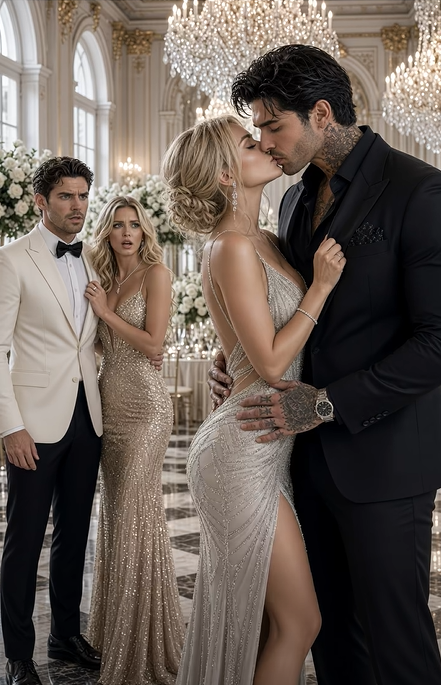
He kissed me beneath the same chandeliers that had once illuminated the worst evening of my life.
Six months later, we married beside Antonio’s lake.
Penny cried before the ceremony began.
Mrs. Bellini insisted she was not crying and blamed pollen despite it being October.
Serena stood beside me as my maid of honor.
Julian attended quietly.
He and Serena were speaking again.
Nothing more.
Perhaps someday there would be.
Perhaps not.
For once, neither family tried to decide.
My father and mother arrived together but not holding hands.
They were still in counseling.
Still married.
Still uncertain.
Oddly, uncertainty no longer frightened Mom the way it once had.
Before the ceremony, she walked with me toward the aisle.
Halfway there, she stopped.
I looked at her.
“Aren’t you coming?”
She smiled.
“The rest is yours.”
My eyes filled.
For most of my life, my mother had taught me how to stand correctly.
Speak correctly.
Smile correctly.
Endure correctly.
Now, finally, she was teaching me something else.
How to walk alone.
I kissed her cheek.
Then I continued.
Nikolai waited beneath the trees.
He did not extend his hand immediately.
He waited until I reached him.
Then he asked quietly, “May I?”
I smiled.
“You may.”
I placed my hand in his.
During the reception, Serena found me near the lake.
Music drifted behind us.
Nikolai was being lectured by Mrs. Bellini about cutting the cake incorrectly.
My father and Antonio stood several yards apart discussing something that appeared surprisingly civil.
Mom watched them with mild amusement.
Serena looked toward the guests.
“You know what’s strange?”
“What?”
“We spent our entire childhood believing one of us had to win.”
I looked at her.
“Yes.”
“I thought you were better.”
“I thought you were loved more.”
She smiled sadly.
“And all that time…”
“We wanted different things.”
She nodded.
“We just didn’t know we were allowed to.”
I looked across the lawn.
Nikolai saw me.
Even from a distance, something in his face changed.
Recognition.
That quiet awareness still moved me.
I had once believed love meant being chosen above everyone else.
Perhaps because my family had turned affection into a competition.
Serena or Evelyn.
Julian or Nikolai.
Successor or failure.
Winner or loser.
But love, I had learned, was not the same as victory.
Neither was forgiveness.
Neither was family.
My father’s mistakes did not disappear because I understood them.
My mother’s apology did not erase every year I had felt unseen.
Serena’s regret did not magically repair our trust.
Nikolai’s honesty after the fact did not make his earlier silence harmless.
Growth was not a clean page.
It was writing something better over lines that could still be seen underneath.
Sometimes people changed.
Sometimes they did not.
Sometimes relationships survived.
Sometimes the most loving decision was distance.
There were no grand punishments.
No humiliating revenge.
No perfect victory.
There were only people finally forced to live with the truth and decide what to do next.
Nikolai crossed the lawn toward me.
Serena smiled.
“I’ll leave you two alone.”
She walked away.
Nikolai stopped beside me.
“You disappeared.”
“I walked twenty yards.”
“Devastating.”
I smiled.
He looked toward the lake.
“Happy?”
The question was simple.
Once, I would have searched his face to determine which answer he wanted.
I would have evaluated the room.
The guests.
The expectations.
I would have chosen the response that made everyone comfortable.
Instead, I asked myself.
“Yes.”
He looked at me.
“Good.”
“And terrified.”
“Also reasonable.”
“And still occasionally angry.”
“At me?”
“Frequently.”
He nodded.
“Excellent.”
I laughed.
Then his hand opened beside mine.
He did not take.
He offered.
The same gesture he had made in a dim service corridor almost a year earlier.
Back then, I had taken his hand because I wanted to turn humiliation into something powerful.
I had thought choosing Nikolai might prove everyone had underestimated me.
I had been wrong.
The most important choice had never been between two brothers.
It had never been between marriage and abandonment.
It had never even been between my family and myself.
The real choice had been whether I would continue measuring my worth by the people willing to select me.
Julian had once chosen me.
Then he chose Serena.
My father had chosen business.
My mother had chosen appearances.
Serena had chosen her own longing.
Nikolai had chosen strategy before he learned to choose honesty.
For years, I had treated every choice as a verdict on my value.
Now I understood.
Other people’s choices revealed who they were.
They did not determine who I was.
I looked at Nikolai’s waiting hand.
Then at the man beside it.
He had changed.
So had I.
Neither of us perfectly.
Neither without scars.
But honestly enough to begin.
I placed my hand in his.
“Where are we going?”
He looked toward the reception.
“Mrs. Bellini says we have three minutes before she cuts the cake without us.”
“She wouldn’t.”
“She has a knife.”
“Then we should hurry.”
We started walking.
Halfway across the lawn, I stopped.
Nikolai looked at me.
“What?”
I glanced back at the lake.
At Serena laughing with Penny.
At my mother talking to Antonio without fear of what the conversation might mean.
At my father standing slightly apart, learning perhaps for the first time that loving people did not entitle him to arrange their lives.
At Julian speaking quietly with one of his cousins, no longer wearing the confidence of someone who believed leadership was owed to him.
Then I looked at Nikolai.
“Nothing.”
He studied me.
“You’re smiling.”
“I know.”
“Why?”
Once, I might have said because I finally got the better brother.
Once, I might have said because everyone who underestimated me had been proven wrong.
Once, I might have needed the answer to contain victory.
Now I shook my head.
“Because I spent most of my life waiting for someone to choose me.”
Nikolai’s expression softened.
“And?”
I squeezed his hand.
“It turns out I was waiting for the wrong person.”
He understood.
Of course he did.
The person I had needed to choose me had never been Julian.
It had never been my parents.
It had never been Nikolai.
It had always been me.
We walked toward the lights together.
Not because I needed him to lead me.
Not because he needed me to strengthen him.
Not because our marriage repaired our families or erased what had happened.
We walked together because every day after that first disastrous night, we had learned how to make the same choice again.
Freely.
Honestly.
Side by side.
And when Nikolai opened the ballroom door for me, I stopped beside him.
Almost exactly as I had stopped in that service corridor nearly a year earlier.
He raised an eyebrow.
“Second thoughts?”
I looked inside.
Our families were waiting.
So were all the imperfect, unfinished relationships we had chosen not to abandon and not to idealize.
Then I smiled.
“No.”
I walked through the doorway.
This time, I did not enter a room wondering who would choose me.
I already knew.
Share your thoughts or feedback to motivate us to create more stories ♥️
**–THE END–PLEASE
✓ Lynn R. Adams
## Part 6 – The Choice That Was Mine The Moretti family council did not resemble anything I had imagined. There was no dark chamber. No circle of intimidating men making secret decisions beneath po…