PART 6 (THE END): The Words Emma Left Behind 034
Part 6 – The Love That Stayed
Celeste held Emma’s letter as though the paper might break beneath her fingers.
“I’m not sure I can read the rest,” she whispered.
“You don’t have to read it aloud,” I said.
She lowered her eyes to the page again, and the tears that had gathered there finally slipped down her cheeks.
Emma’s words were private, but I could see the way they changed Celeste’s face: first with hurt, then with something quieter and more difficult to name.
When she finished, she folded the letter along its old crease and pressed it gently between her palms.
“She said she hoped I would become someone her son could safely know,” Celeste said. “Not because I was owed a place in his life, but because people can choose to do better than they did before.”
I looked at her, careful not to offer comfort too quickly.
“Did she say why she chose you?”
“She said she knew I had helped hurt her,” Celeste replied. “She also said she had once seen me tell the truth when it would have been easier to hide behind Evan.”
I thought of Emma’s quiet attention, the way she noticed things other people missed.
“She saw something in you,” I said.
“I don’t know if it was enough.”
“Maybe she wasn’t asking you to prove you were worthy. Maybe she was leaving room for you to become more honest.”
Celeste nodded, her gaze fixed on the letter.
“I don’t want to use this as a way to get close to the baby,” she said. “I don’t want Emma’s kindness to become permission I haven’t earned.”
“That’s a good place to begin.”
“I’ll tell the court what I know. I’ll tell the truth about Evan and about my part in it. After that, I’ll step back unless the people responsible for the child’s care ask me to do something.”
I believed her intention, though I knew intentions would have to prove themselves over time.
“You should speak with Mr. Halden,” I said. “He can explain what the court expects and what is appropriate.”
“I will.”
She stood, still holding the letter.
At the door, she turned back.
“Margaret, I am sorry for what I said at the funeral.”
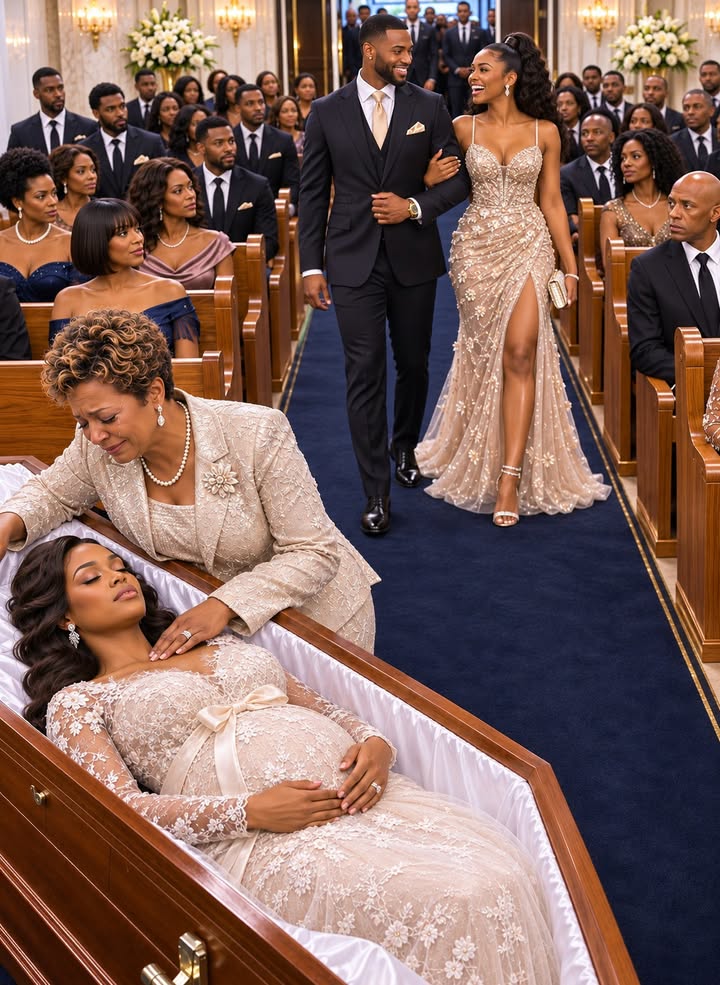
The memory came back in a rush: her perfume, her whisper, the confidence in her voice as she leaned near me beside Emma’s coffin.
“I know,” I said.
“I thought I had won something,” she continued. “Now I understand there was nothing to win. I was standing beside the woman Evan loved and the child she was carrying, while she was grieving the life she had hoped for.”
The words hurt, but they were not an excuse.
“I can’t make that moment disappear,” I said.
“I know.”
“But I hope you keep telling the truth, even when it costs you.”
“I will.”
She left without asking me to forgive her, and I was grateful she understood that forgiveness could not be hurried simply because remorse had arrived.
In the weeks that followed, the legal questions began to settle.
Evan withdrew his challenge to Emma’s will after his lawyer reviewed the records, the declaration she had asked Mr. Halden to read, and the evidence of her careful planning.
The agreement preserved the estate as Emma had chosen it, with the child’s funds held in an independent trust.
An appointed trustee would manage the money for the baby’s needs and future, with clear records and no unchecked access for any one adult.
Evan could request support for the child, but he could not draw on the trust at will or alter its purpose.
The house and the rest of Emma’s estate remained with me, not as a prize, but as a responsibility she had entrusted to the person she believed would put her son first.
The court also approved a plan for Evan to build a relationship with the baby.
At first, visits would take place with a family support worker present, with the schedule guided by the child’s medical team and adjusted as he grew stronger.
Evan accepted the arrangement without asking for special treatment.
That mattered to me.
It did not erase his absence during Emma’s final months, but it showed that he could begin by listening instead of insisting.
The first time I brought him to the hospital’s family room, he stood just inside the doorway, his hands clasped as if he were afraid to reach for anything.
The baby was awake in my arms, his dark eyes following the pale light above us.
“Would you like to hold him?” I asked.
Evan looked from the child to me.
“If it’s all right.”
I waited for the nurse’s nod, then passed the baby into his arms.
Evan settled him carefully against his chest, supporting his head the way the nurse had shown us.
The child made a small, restless sound and curled one hand around the edge of Evan’s shirt.
Evan stared down at him.
“Hello,” he whispered. “I’m your dad.”
The baby blinked slowly.
Evan’s face crumpled, and he turned toward the window as though he needed a moment to keep his composure.
“I’m sorry I wasn’t there when your mother needed me,” he said. “I can’t change that, but I can try to be here for you.”
The support worker watched quietly.
I stood beside them, my hand near the back of the chair, and felt no triumph in the moment, only the solemn hope that a promise might become a pattern of choices.
When the baby began to fuss, Evan did not hand him back at once.
He listened to the nurse’s guidance, rocked him slowly, and hummed an uncertain tune that sounded like a song Emma used to sing in my kitchen.
The baby quieted.
“You remembered that song,” I said.
“Emma sang it when she couldn’t sleep,” Evan replied. “I used to tease her because she changed the words.”
“You should tell him that.”
“I will.”
He looked down at the baby again.
“I want him to know her as she was,” he said. “Not only as the person we lost.”
“That’s what she asked of us.”
For the first time, I felt we were standing on the same side of something, though not yet close enough to call it peace.
Celeste kept her word.
When asked to provide a statement, she gave a clear account of what Evan had told her about his separation from Emma and his doubts about the baby’s paternity.
She did not soften her own choices or place all the blame on him.
She admitted that she had learned the truth about the marriage and stayed anyway.
Her statement was not a performance of regret.
It was simply honest, and it helped the people responsible for the child’s care understand the history around him.
Afterward, Celeste did not seek me out.
She kept her distance, and I let her.
Months passed.
The baby grew steadier, gaining strength in small increments that became precious milestones: a stronger cry, a longer stretch of sleep, fingers that began to curl around mine with surprising purpose.
The hospital team approved his discharge once they were confident he could be cared for safely at home.
A caseworker reviewed the plan with me, Evan, and Mr. Halden.
The independent trust was in place, the medical instructions had been copied and secured, and the visitation schedule was written down so that no one had to rely on uncertain promises.
When the day came for him to leave the hospital, I brought the blue blankets from the nursery.
They had been washed and folded carefully, their soft edges worn from the times Emma and I had handled them together.
The nurse helped me tuck the baby into the carrier while Evan stood close by, watching each step.
“Is he warm enough?” I asked.
“He is,” the nurse said.
“Are you sure?”
She smiled.
“I’m sure.”
Evan laughed softly, the first unguarded laugh I had heard from him in a long time.
Emma’s son came home to my house on a pale afternoon, with a light rain tapping the car windows.
My sister had prepared a simple meal and left a vase of late-blooming flowers on the kitchen table.
The nursery looked different with the blue blankets in the crib and a small breathing baby beneath them.
I stood in the doorway, afraid to move, afraid that if I blinked the room would become empty again.
Then the baby opened his eyes and made a quiet, indignant sound.
My sister laughed through her tears.
“Well,” she said, “he certainly has an opinion.”
I bent over the crib and touched his tiny hand.
“Your mother did too,” I whispered.
Evan visited according to the plan.
At first, he seemed unsure of every movement, pausing before lifting the baby and asking the nurse or me whether he was doing it correctly.
I answered when I could and let the professionals answer when I could not.
He learned how to warm a bottle, how to recognize the baby’s sleepy sounds, and how to sit with him in the garden when the weather was mild.
He did not always know what to say.
Sometimes he simply sat beneath the old maple tree with his son tucked against him and told him about ordinary things: the rain, the birds at the fence, the yellow car they had passed on the drive.
One afternoon, I found him in the nursery reading one of Emma’s old picture books.
He had reached the page where the little bear wandered away from its mother and was trying to make the story sound cheerful.
“Emma used to read that with all the voices,” I said from the doorway.
“I remember.”
“Her bear voice was terrible.”
A smile appeared at the corner of his mouth.
“It was.”
He looked down at the baby, who was asleep against his shoulder.
“I don’t want him to think his mother only lived through the sadness,” Evan said.
“Then don’t let him.”
“I won’t.”
His voice held no grand promise now, only a willingness to begin with the next small thing.
That was more useful than any speech.
The following spring, I planted beans along the garden fence.
I left one row crooked, just as Emma and I had done when she was a girl.
The baby was too young to understand what I was doing, but I carried him outside in his pram and told him the story anyway.
“Your mother and I planted them like this,” I said. “She insisted the crooked row would make the beans grow in a more interesting direction.”
Evan stood by the gate, listening.
“She cheered every time the first green shoot appeared,” I continued. “She said the plants could hear us.”
The baby stirred beneath his blanket.
“Perhaps they could,” Evan said.
I looked at him, and for a moment neither of us tried to fill the quiet.
We were not the family Emma had imagined when she decorated the nursery, but we were still a family being made, slowly, by people who had to learn how to stand beside one another without pretending the past had been harmless.
Celeste wrote to me once.
Her letter contained no request for contact and no suggestion that I should reply.
She said she had ended her relationship with Evan and had begun counseling to understand why she had accepted a version of the truth that allowed her to avoid responsibility.
She apologized again for the funeral and for the pain she had helped bring into Emma’s life.
Most simply, she wrote that she hoped the child would grow up surrounded by honest people.
I put the letter in a drawer with Emma’s papers.
Some apologies were not doors.
Some were only a person’s quiet attempt to place the truth where it belonged.
A year after Emma’s funeral, we held a small gathering in the garden.
There were no speeches about the estate or the court, only family and a few friends who had known Emma well.
Mr. Halden came with a box of Emma’s photographs.
He placed them on the table, and we spent the afternoon telling stories: how she once tried to teach herself piano from a book, how she would bring home wilted flowers from the market because she was convinced they could be saved, how she had laughed until she cried when my old dog stole an entire loaf of bread.
Evan listened.
Sometimes he added a memory of his own.
The child sat in my lap, one hand gripping my necklace and the other reaching for the bright leaves above us.
When people asked his name, I answered with the name Emma had chosen.
He was old enough to turn toward my voice, but not yet old enough to understand why the grown-ups went quiet whenever we said his mother’s name.
So I told him in the simplest way I could.
“Your mother loved gardens,” I said. “She loved blue blankets, warm biscuits, and making people laugh when they thought they had no reason to.”
Evan sat beside us.
“She also loved changing the words to songs,” he added.
“And she was very bad at keeping a straight row of beans,” I said.
He smiled.
The baby made a soft sound, as if the story had pleased him.
I carried him into the nursery that evening and held him beneath the blue blankets.
The room no longer seemed to be waiting for someone who would never return.
It held the life Emma had loved before she could see his face, and the life we were learning to give him now.
I pressed my cheek to his hair and remembered the final line of her letter: grief would not take all the love with it.
She had been right.
The sorrow remained, but it no longer filled every corner.
It lived beside the laughter, beside the garden and the stories, beside the small trusting weight of her child in my arms.
I had thought Emma’s death would be the last word in our family’s story.
Instead, her love had become the way we carried the story forward.
Under the soft blue blankets, with the baby breathing steadily against my chest, I felt my daughter near—not as a ghost, and not as an ache alone, but in every careful thing we chose to do for the child she had left in our keeping.
**–THE END–PLEASE
Share your thoughts or feedback to motivate us to create more stories ♥️
* * *
[PREVIOUS: PART 5](https://puretales.idolsgift.com/blog/part-5-the-words-emma-left-behind-034)
✓ Lynn R. Adams
Part 6 – The Love That Stayed Celeste held Emma’s letter as though the paper might break beneath her fingers. “I’m not sure I can read the rest,” she whispered. “You don’t have to read it aloud,” I…