PART 6 (THE END): The Words Beneath the Rose 069
Part 6 – A Story of Her Own
Rose read the final line again, certain that the words might change if she gave them another moment.
“Your mother did not leave you, Rose.
“She was hidden among the palace staff, and she has been here with you all along.”
The corridor seemed to grow very still.
Adrian stood beside her without touching her, and Celestine watched with her hands clasped tightly before her.
“Who?” Rose managed.
The chamberlain lowered his eyes.
“I’m afraid the letter gives no name, Miss Rose.”
Rose pressed the paper flat against her palm.
Then a voice sounded from the open council chamber behind them.
“Rose.”
She turned.
The king’s chief attendant stood in the doorway, her silver-threaded hair neatly pinned beneath a plain cap.
Mistress Anwen had worked in the palace kitchens for as long as Rose could remember, overseeing the morning bread and the stores of dried herbs.
She was a quiet woman, known for her steady hands and for humming old garden songs while she worked.
Now she looked at Rose with a tenderness that seemed to have been waiting years for permission.
“I am sorry,” Anwen said. “I hoped you might learn the truth in a gentler way.”
Rose stared at her.
“You knew?”
“Not at first.” Anwen drew a careful breath. “I was a girl then, an apprentice in the nursery. Mistress Bell told me only that a child needed to be loved without questions. Years later, when the queen’s letter came into her keeping, she told me who you were.”
The corridor blurred at its edges.
“Why didn’t you tell me?”
“Because Mistress Bell had promised the queen that the choice would be yours, and because I had promised Mistress Bell I would keep you safe until you were ready.” Anwen’s voice faltered. “I thought silence was the kindest thing I could give you. I see now that kindness can leave a person with questions they deserved to ask.”
Rose looked down at the letter.
“Are you my mother?”
Anwen’s face crumpled with feeling, though she did not step closer.
“No, my dear. I was the one who helped carry you to the nursery that morning. I knew your mother, and I have loved you since before you could walk, but I am not your birth mother.”
Rose’s breath caught.
“Then who is?”
Anwen looked toward the council chamber.
“There is someone who has waited a long time to answer you herself.”
Behind her, a woman stepped into the doorway.
She wore a modest gray-blue dress, the uniform of a senior palace seamstress, and held a wooden box against her chest.
Her hair was threaded with silver, and her eyes were the same warm brown as Rose’s.
For a long moment, neither of them spoke.
The woman’s gaze moved to Rose’s face, then to the rose-shaped mark visible at the edge of her collar where the neckline had slipped.
A soft, astonished smile came to her lips.
“Rose,” she whispered.
Rose knew her.
Not as a mother.
Not yet.
She knew her as Mara, the seamstress who had repaired Rose’s first work apron, who had taught her to mend a torn hem without puckering the cloth, who had once left a warm roll beside Rose’s sewing basket when she had stayed late to help Mistress Bell.
Mara had always been kind.
She had never asked Rose about the birthmark.
“I am your mother,” Mara said. “My name is Mara Vale.”
Rose could not move.
Mara set the wooden box down on a nearby table, then kept her hands folded before her.
“I did not know whether I would be allowed to tell you,” she continued. “Mistress Bell said she would speak when the time was right, but she died before I could ask what she had planned. I have waited for this day without knowing whether it would ever come.”
Rose’s fingers tightened around the letter.
“You were in the palace all this time?”
“Yes.”
“Why didn’t you come to me?”
Mara’s eyes shone.
“Because Queen Elara asked that you be raised without the danger of being identified as her daughter, and because your safety depended on no one knowing where you had gone. When Mistress Bell brought you to the nursery, I was told that I could watch over you from a distance, but I could not claim you.”
The answer hurt, though Rose could hear the care inside it.
“How could you bear that?”
“I did not bear it gracefully every day.” Mara gave a small, unsteady laugh. “I learned which corridor you liked best because it caught the morning sun. I made sure your shoes were mended before you noticed the soles were thin. When you were ill, I found reasons to work near the nursery door.”
Rose remembered the scent of lavender that had lingered over her childhood blankets.
She remembered a pair of soft blue mittens that had appeared one winter, too carefully knitted to be a palace purchase.
She remembered Mara kneeling beside her when she had fallen in the courtyard, asking whether the scrape hurt more than her pride.
“You were there,” Rose whispered.
“Whenever I could be without putting you at risk.”
“Did you want to tell me?”
“Every day.” Mara’s voice broke, then steadied. “But wanting was not the same as having the right. You had a mother in Mistress Bell, and I would not take that from you, even in my own heart.”
Rose’s eyes filled.
She had spent years imagining a mother as an empty place, a person who had chosen to leave her behind.
Mara had not left.
She had been near enough to mend a sleeve and far enough to keep a promise.
“I don’t know how to feel,” Rose said.
“You don’t have to know today.” Mara’s hands trembled, but she kept them still. “You don’t owe me affection because I gave birth to you, and you don’t have to forgive the years we lost. I only wanted you to know that you were loved before you had a name.”
Rose looked at the wooden box.
“What is that?”
“Things I kept for you.” Mara glanced toward it. “Not as proof you must accept, but as a record of the years I could not speak.”
Rose stepped closer.
Inside the box lay a small green quilt, carefully folded; a child’s wooden rattle; a handful of letters tied with blue thread; and a tiny scrap of cloth embroidered with a single rose.
Rose recognized the green quilt from the journal.
Her hands shook as she touched its worn edge.
“Was I wrapped in this when I was carried out of the palace?”
“Yes,” Mara said. “Eveline Celestine took you through the passage, and I met her in the old nursery. Mistress Bell was waiting there. The queen had arranged for you to be placed in the palace nursery as an abandoned child, where no one would think to search for a royal infant.”
“Why did you stay?”
“The queen believed it was safer for me to remain where I was. If I disappeared with you, the court might follow. If I lived quietly among the staff, I could help protect you without drawing attention.”
Rose looked at the letters.
“Did you write these?”
“I did. I never expected you to read them.” Mara glanced down. “They are mostly small things. Your first tooth, the first time you laughed, the day you walked from Mistress Bell’s chair to the window.”
Rose lifted one of the letters.
It was dated years before she could read.
She did not open it yet.
Adrian stood a little apart, his face composed but his eyes bright with feeling.
The council chamber had emptied around them, though the king remained at its doorway.
He did not call Rose back inside or ask her to make a decision.
The court, for once, had allowed the truth to belong to the people living it.
Celestine stepped nearer to Mara.
“My ancestor carried Rose through the passage,” she said. “I am sorry that my family kept the story in fragments for so long.”
Mara touched her arm.
“Eveline did what the queen asked. She carried a child through a fire and a palace full of secrets. She kept the promise as best she could.”
Celestine lowered her eyes.
“I hope my family can help repair the record.”
“You already have,” Rose said.
She turned back to Mara.
“Did Mistress Bell know you were my mother?”
“Yes. She knew from the beginning.” Mara’s expression softened. “She let me visit you when I could, but she made me promise not to speak until you were ready to ask. She said she would not have your life arranged around a truth you had not chosen to hear.”
Rose thought of the note in the green household book.
The child be loved first and questioned only when she is old enough to choose.
She had been loved in more ways than she knew.
“I wish Mistress Bell were here,” Rose said.
“So do I,” Mara replied. “She loved you fiercely.”
Rose felt the words settle inside her.
For the first time, the absence of her mother did not seem like a door forever closed.
It was a door that had been kept shut, for reasons that had once seemed necessary, and now stood open without anyone insisting she walk through it at once.
“May I call you Mother?” Rose asked.
Mara’s tears fell then, quiet and unhidden.
“If you wish,” she said. “Whenever you wish.”
Rose reached for her hand.
Mara took it as gently as if it were a small bird.
The council reconvened the next day.
The king sat at the head of the table, with Adrian beside him and the archivist’s records arranged in neat, orderly stacks.
Rose entered with Mara at her side.
Celestine followed with Eveline’s letters, while Anwen carried Mistress Bell’s household book.
The council members rose, not because Rose wore a title, but because the king had asked them to receive the witnesses whose lives had preserved the truth.
The archivist presented the completed record.
It traced Rose’s descent from Queen Elara through a branch omitted from the public family histories, establishing her as a distant cousin of the present royal line rather than a close relative of Adrian.
He also explained how the succession statutes treated the dormant title attached to that branch.
The title could be recognized without requiring Rose to take a seat on the council or surrender her independent life.
The senior councillor looked over the final page.
“The records are persuasive,” he said. “But the council must decide how to announce them.”
“Announce the truth plainly,” Rose replied. “Queen Elara’s daughter survived, and her descendant was raised here. Do not turn it into a tale that I was secretly waiting to rule.”
The councillor inclined his head.
“And the title?”
“I will accept the family title as part of the record, but I will not take a public office or let it decide my work.”
The council murmured among itself.
The king listened, then gave a small nod.
“That is a fair distinction.”
The council voted to recognize Rose’s lineage and restore Queen Elara’s daughter to the royal family record.
They also accepted Rose’s choice to hold the dormant title without taking political office.
No marriage arrangement, court appointment, or claim to the succession would be made in her name.
The decision was not unanimous at first.
A few councillors worried that the precedent would be difficult to explain.
But the king reminded them that the purpose of a record was to tell the truth, not to make a convenient use of the people named in it.
When the vote was complete, he stood.
“Let the record honor Queen Elara, who protected her child; Eveline Celestine, who carried that child to safety; Mistress Bell, who gave her a home; and Mara Vale, who loved her from a distance until the truth could be safely told.”
The chamber grew quiet.
Then Celestine bowed her head, and Anwen quietly wiped her eyes.
Mara held Rose’s hand.
Rose felt no sudden transformation when the council recognized her.
She was still Rose, with the same rounded cheeks, the same quick hands, the same love of warm bread and sunlit corridors.
The title did not put a crown on her head.
It put a name back in the record, where it belonged.
In the months that followed, the palace changed in small but lasting ways.
The archivist opened a new collection devoted to the lives of ordinary people who had worked in the palace: cooks, seamstresses, gardeners, guards, nurses, and housekeepers.
Rose helped him gather their letters, recipes, songs, and household books.
She began with Mistress Bell’s green ledger and Mara’s bundle of letters.
The new collection was called the People’s Archive.
Rose insisted that every account be preserved in the writer’s own words whenever possible.
“History is not only what kings decided,” she told the council. “It is also who carried the coal, who planted the gardens, who mended the sleeves, and who kept the children safe.”
The council agreed to fund a school beside the archive, where palace servants and children from the nearby town could learn to read old records and write their own stories.
Rose helped choose the first teachers.
Mara came with her to inspect the classrooms, offering practical advice about benches, windows, and the best place to keep the ink away from curious little fingers.
Celestine’s family contributed its private papers and paid for the repair of several damaged ledgers.
She also took on the difficult work of correcting her family’s records, adding Eveline’s name to the public account of the palace fire.
The task did not erase the years of silence, but it gave the silence a truthful ending.
Celestine and Rose grew into a friendship slowly.
They were not alike in every way, and neither pretended that the ballroom’s first insult had never happened.
But Celestine learned to ask rather than assume, and Rose learned that accepting an apology did not require becoming careless with her trust.
One spring morning, Rose found a tray of fresh seedlings waiting outside the archive.
A blue bellflower had opened among them.
She carried the plant to the winter garden and set it beside the old clay pots.
The flowers had spread gently across the beds, their small blue bells catching the light beneath the glass.
The sleeping bellflower had bloomed, though there had been no magic in it.
Only time, care, and a promise kept long enough to be understood.
Adrian began courting Rose without asking the council to arrange a single meeting.
He brought her books he thought she might enjoy, and she returned them with notes in the margins.
They walked through the garden after work, sometimes talking about the archive and sometimes about nothing more important than the weather.
He learned when to ask questions and when to let a silence rest.
She learned that his humor was quieter than his public manner, and that he, too, grew tired of being treated as a symbol before he was treated as a person.
Their affection did not arrive like a command or a grand declaration.
It grew in the ordinary spaces between them.
A shared cup of tea.
A laugh over a misplaced catalogue.
The comfort of being understood without being interpreted.
One evening, a year after the truth was first uncovered, Adrian came to the archive after its doors had closed.
Rose was arranging a box of letters written by palace gardeners.
He stood at the entrance, waiting until she looked up.
“I have something I would like to ask,” he said.
Rose set down the letter in her hand.
“Is it a royal matter?”
“No.”
“Is it a council matter?”
“Definitely not.”
“Then I’m listening.”
Adrian stepped closer, holding no ring or written contract.
“I love you, Rose,” he said. “I would like to marry you, if that is something you want too. But I don’t want you to answer because of the court, or because our names would make a convenient story.”
Rose felt her heart begin to beat faster.
“What would you want our life to be?”
“Partnership,” he said. “A home where we both have work that matters to us, and where neither of us has to disappear into the other’s title.”
“And if I want to keep working here?”
“Then the archive will have a very devoted patron and an even more devoted co-director.”
Rose smiled.
“And if I disagree with you?”
“I expect you to.”
“That sounds less like a royal bargain.”
“It is the only kind of bargain I know how to offer.”
Rose looked at the letters on the table, then at the man waiting for her answer without trying to hurry it.
“Yes,” she said. “I would like to marry you.”
Adrian’s face brightened, but he did not reach for her until she stepped into his arms.
Their wedding took place in the garden beside the People’s Archive, where the bellflowers had opened beneath the glass.
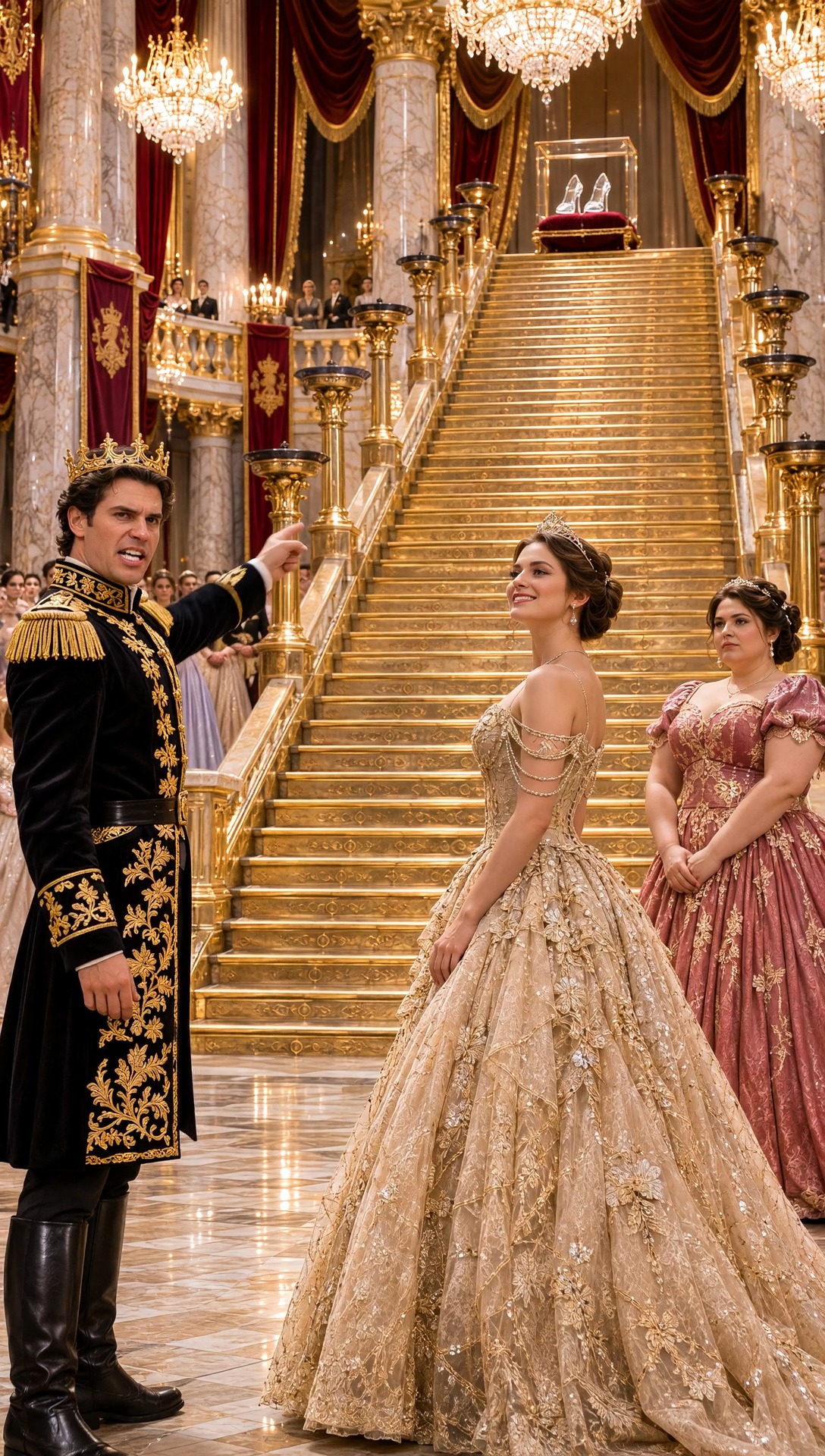
There were no towering golden steps, no trial, and no demand that Rose prove she belonged.
The people who had helped shape her life gathered around them: the king, the archivist, Celestine, the palace staff, the gardeners, and the children from the new school.
Mara sat in the front row with Anwen beside her.
On the chair between them lay Mistress Bell’s green household book, its cover worn smooth from the years Rose had carried it.
When Rose came to the garden, she wore the crystal slippers.
They caught the morning light and scattered it across the stone path.
The tiny rose engraved beneath one heel was still there.
Rose had once thought the slippers would tell her whether she belonged.
Now she knew they had only helped her find the story she had a right to choose.
She wore them for Queen Elara, who had loved her before she could know her.
She wore them for Eveline, who had carried her through the hidden passage.
She wore them for Mistress Bell, who had raised her as her own.
She wore them for Mara, who had stayed near enough to love her and far enough to keep her safe.
And she wore them for herself.
Adrian took her hands beneath the flowering branches.
Rose looked around at the people gathered there, at the school windows shining in the distance, and at the archive where so many quiet lives had finally found a place on the page.
The court had given her a title.
Her family had given her a history.
The palace had given her a home.
But the life she stood in that morning was her own, freely chosen and full of room for everyone she loved.
When Adrian kissed her, the bellflowers trembled in the breeze, and the crystal slippers flashed softly beneath the sunlight.
Beyond the garden, the palace bells began to ring—not to announce a princess returned, but to celebrate Rose, exactly as she was.
**–THE END–PLEASE
Share your thoughts or feedback to motivate us to create more stories ♥️
* * *
[PREVIOUS: PART 5](https://storyly.idolsgift.com/blog/part-5-the-words-beneath-the-rose-069)
✓ Lynn R. Adams
Part 6 – A Story of Her Own Rose read the final line again, certain that the words might change if she gave them another moment. “Your mother did not leave you, Rose. “She was hidden among the pala…