PART 6 (THE END): The Word That Changed Everything 027
Part 6 – An Ordinary Kind of Sunshine
The sound came again, no louder than a breath passing through a narrow space, but this time the word was clear.
“Mother.”
Rosalind pressed one hand to her mouth.
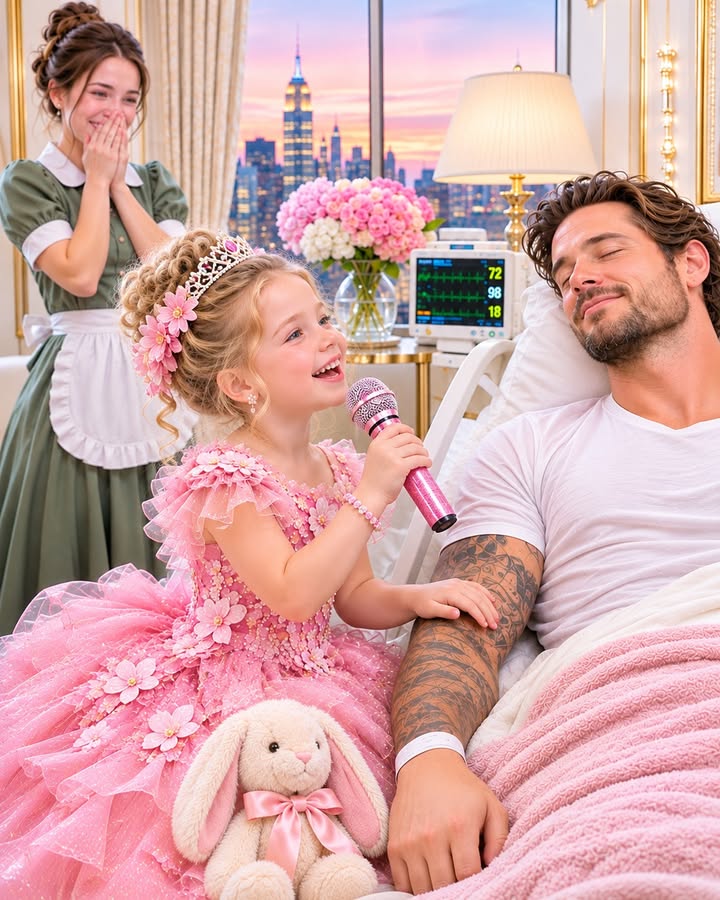
Poppy leaned against my side, clutching Bunny by the repaired ear, while I felt the floor beneath me go strangely unsteady.
Dr. Sen appeared in the doorway and raised a hand, asking us to wait before coming closer.
“Matthew has made a sound,” he said gently. “We’re assessing him now. It may be a meaningful response, but we need to be careful about what we conclude.”
Rosalind nodded, though tears had already begun to shine in her eyes.
“I understand.”
The doctor returned to the bedside.
A nurse checked Matthew’s breathing and pulse while Dr. Sen spoke to him in a calm, practiced voice, asking him to open his eyes and then to move his fingers.
For a long moment, nothing happened.
The room seemed to hold its breath with us.
Then Matthew’s right hand shifted against the sheet.
Dr. Sen waited, gave the instruction again, and watched closely.
Matthew’s fingers moved once more, small but distinct.
The doctor turned to Gwen.
“Document the time and the sequence.”
Gwen wrote it down without looking up, her face composed by years of training and softened by feeling she did not try to hide.
Rosalind stood at the foot of the bed, trembling.
“Can I speak to him?”
“Yes,” Dr. Sen said. “Just quietly, and give him time.”
She moved closer, but this time she did not ask him to say anything.
She only placed her hand beside his and said, “I’m here, Matthew.”
His eyelids fluttered.
Poppy gripped my hand.
The movement came again, faint and uncertain, like a curtain stirred by a distant breeze.
Then Matthew opened his eyes.
They did not focus at once.
His gaze wandered over the pale ceiling, the monitor, the figures gathered around him, until at last it found Rosalind.
She made a small, broken sound.
“Hello, darling.”
Matthew’s lips parted.
The sound that emerged was rough and unsteady, but it was a word.
“Mother.”
Rosalind bent over him, careful not to disturb the wires or the medical staff.
“I’m here.”
His gaze moved slowly past her and settled on Poppy.
She stood beside me, too overwhelmed to sing.
Matthew blinked, then gave the faintest lift of his fingers.
Poppy leaned forward only when Dr. Sen nodded that she could come closer.
“Hello, mister,” she whispered.
Matthew’s eyes stayed on her.
“You… sang.”
Poppy’s mouth opened in surprise.
“I did.”
He tried to speak again, but the effort tired him, and Dr. Sen gently told him to rest.
Rosalind wiped her cheek with the back of her hand.
“You don’t need to say anything else right now.”
Matthew looked at her, then closed his eyes.
This time, the room understood the difference between sleep and leaving.
The doctor and nurses took charge of the next hours, checking Matthew’s condition, adjusting his care, and speaking with the specialist facility about delaying the transfer until he could be reassessed.
No one called his waking a miracle that made medicine unnecessary.
Dr. Sen was clear that Matthew remained seriously ill and would need intensive care and rehabilitation.
His eyes opening was a beginning, not an ending.
But when he woke again later that afternoon and recognized Rosalind, the beginning felt real.
Over the following days, his awareness came and went.
Sometimes he answered a question with a word.
Sometimes he managed only a movement of his fingers or the faintest turn of his head.
The doctors kept careful records, and Matthew slept often.
When he was alert, he asked for water, then apologized for how difficult it was to speak.
Rosalind told him he had nothing to apologize for.
She stayed beside him as much as the medical team allowed, no longer waiting in the doorway or inventing reasons to leave.
One afternoon, when the room was quiet and Matthew seemed clear enough to follow a conversation, she finally told him what she had been carrying.
“I listened to your message,” she said. “The one you left before the crash.”
His eyes rested on her.
“I should have answered.”
He tried to move his hand toward hers.
Rosalind met him halfway, holding his fingers gently.
“I was angry, and I assumed the call was about work,” she continued. “I told myself I could speak to you later. I’m sorry.”
Matthew’s voice was little more than a rasp.
“Not… your fault.”
“I should have listened.”
“You’re listening now.”
The words were slow, but unmistakable.
Rosalind lowered her forehead to their joined hands.
For a while, neither of them spoke.
When she lifted her head, Matthew was watching her.
“I’m glad you’re here,” he whispered.
“So am I.”
That was the first of many conversations they would have to build again, word by word.
The investigation continued in parallel with Matthew’s recovery.
The police examined the recovered messages, the company records, the security logs, and the damaged cufflink found in Matthew’s car.
Victor was asked to step away from his duties while the review proceeded.
He did so without argument, though the distance between him and Rosalind remained painful.
For several weeks, the evidence was incomplete.
Then the investigators found a set of payment instructions in the company’s old records, approved through a security contractor and concealed among routine invoices.
The instructions had been arranged by Victor.
The same records showed that he had learned Matthew was gathering copies and knew Matthew planned to speak with Rosalind.
The damaged recording from the medical wing placed Victor near Matthew’s room after the crash.
The cufflink in the car matched the pair he wore, and a second recovered fragment of the audio supplied the last piece.
The voice could not be identified from sound alone, but a message on Victor’s own phone contained the same words Matthew had recorded: You shouldn’t have kept the copies.
The investigator explained that Victor had arranged the collision to stop Matthew from exposing the illegal dealings.
When the facts were presented, Victor did not try to shift blame onto Nell, Poppy, or anyone else.
He admitted that he had used his position to move money and had been afraid of what Matthew would reveal.
He also admitted entering the medical wing after the crash, though he denied causing any additional harm there.
The authorities handled the case, and Victor was arrested after a formal interview.
Rosalind received the news in her office.
For a long time, she sat with her hands resting on the desk, looking at the empty chair where Victor had once discussed schedules and security with her.
“I trusted him,” she said when I came in.
“Yes.”
“I still remember the person I trusted.”
“You don’t have to erase those memories to accept what he did.”
She looked up, and something in her face eased.
“I’m learning that trust doesn’t require me to ignore the truth.”
“No,” I said. “It doesn’t.”
She closed the folder the investigator had left.
“Matthew will have to learn it, too.”
“He’ll have time.”
That evening, Matthew asked to speak with me.
When I entered his room, Rosalind was beside him and Gwen stood near the window.
Matthew looked tired, but awake.
“Nell,” he said.
I sat in the chair beside his bed.
“Hello, Matthew.”
“Thank you.”
His voice was still rough, and each phrase came with effort.
“You don’t have to thank me.”
“For… Poppy. For being careful.”
I glanced at Rosalind.
“We did what we promised her.”
“I know.”
He took a breath.
“You didn’t save me.”
The words startled me.
Matthew gave a small, weary smile.
“The doctors… they did the work. You gave me something kind to hear.”
His gaze shifted toward Poppy’s drawing of the sailboat, still framed on the shelf.
“That mattered.”
I felt my eyes sting.
“Then I’m glad you heard it.”
“So am I.”
Poppy had not come that day.
I had told her Matthew was resting, and she had accepted it, then asked whether his boat was near him.
When I told him, his smile grew.
“Tell her… Bunny can visit whenever he wants.”
“I’ll tell her.”
Matthew closed his eyes, tired from the effort of talking.
Gwen checked his monitor, and Rosalind adjusted the blanket near his shoulder.
Before I left, Matthew opened his eyes again.
“I’m sorry I frightened you.”
“You didn’t frighten me,” I said. “The whole house did.”
A soft, almost silent laugh escaped him.
“I can understand that.”
It was the first time I had heard him sound like a man who might one day laugh easily.
As the weeks passed, Matthew grew stronger by degrees.
He was transferred to the specialist facility when the doctors agreed he was ready.
The visits were limited at first, just as they had warned us, and Rosalind learned to leave the room when the staff asked her to so Matthew could rest.
She went every day she was permitted, but she no longer treated every visit as a test of whether he would respond.
Sometimes they spoke.
Sometimes she read aloud from an old book he had liked as a boy.
Sometimes she sat quietly beside him while he slept.
Matthew’s recovery was slow, and there were setbacks that frightened all of us.
But the doctors continued their work, and Matthew continued his.
He learned to sit upright, then to stand with support.
He practiced forming words until his voice grew stronger.
He became frustrated when progress was slower than he wanted, and Rosalind learned not to rush in with answers.
Once, when he told her he wanted to make his own decision about the next stage of rehabilitation, she listened without turning his request into a family meeting.
That was a small change, but I recognized its importance.
Rosalind was learning to love him without trying to control every uncertainty around him.
Matthew, in turn, began to speak about his life before the crash.
He told me he had spent too long believing that every problem could be solved by having the right person handle it.
“Sometimes I confused being feared with being respected,” he said during one visit. “They’re not the same.”
I did not ask him to explain the things he was not ready to discuss.
He had stepped away from the illegal business dealings and cooperated with the investigators.
As he recovered, he made arrangements to separate himself from the criminal network that had surrounded his family and to live by lawful means.
It was not a grand transformation completed in one conversation.
It was a series of ordinary decisions, each one made with care.
He hired new advisers, submitted records for review, and accepted that the consequences of his old choices would take time to resolve.
Rosalind helped with practical matters but did not make the decisions for him.
She was learning that support could mean standing nearby instead of taking over.
The promise she had made me about housing also became something real and separate from Matthew’s care.
Her staff coordinator connected me with a stable housekeeping position near the city, and Rosalind offered a written reference without conditions.
I found a modest apartment within walking distance of a preschool Poppy could attend.
The first time we carried our boxes inside, Poppy walked from room to room with Bunny tucked under her arm.
“This is our home?” she asked.
“It is.”
She chose a place for Bunny on the small shelf beside her bed.
Then she ran back to hug my waist.
Rosalind helped with the first month’s deposit only after I agreed to take it as a loan, with a repayment plan we both understood.
She put nothing in writing that connected it to Poppy’s visits or Matthew’s recovery.
When I paid back the final amount months later, she accepted the envelope with a quiet smile.
“You never had to do that,” she said.
“I wanted to.”
“I know.”
By then, our friendship had become something neither of us had expected when she locked me in her office.
We spoke often, sometimes about Matthew and sometimes about small things that had nothing to do with loss.
Rosalind came to our apartment for tea.
Poppy showed her the drawings taped beside the refrigerator.
Nell, she would correct herself with a laugh when she accidentally called me Mrs. Sterling, as if the old rules of the mansion had followed her to our little kitchen.
“You can call me Rosalind,” I told her.
“I know,” she said. “I’m trying to remember that.”
Matthew visited once the doctors allowed him to leave the facility for a few hours.
He came with Rosalind and Gwen, walking slowly with a cane and resting whenever he tired.
Poppy ran to the door, then stopped herself just before throwing her arms around him.
“Can I hug you?”
Matthew’s face softened.
“If you don’t mind that I’m a little wobbly.”
She hugged him carefully around the middle.
Bunny was pressed between them.
“I missed you,” Poppy said.
“I missed hearing you talk about him.”
She held the rabbit out.
“This is Bunny.”
“I’ve heard a great deal about him.”
“He helps when I miss my daddy.”
Matthew’s expression grew gentle.
“I understand.”
Poppy studied his face.
“Do you still remember the song?”
“I do.”
“Can you sing it?”
“I’m not sure my voice is ready.”
“That’s okay,” she said. “You can listen.”
She sang the first verse, quiet and unhurried.
Matthew listened with his eyes closed, while Rosalind sat beside me at the small kitchen table.
When Poppy finished, he opened his eyes.
“Thank you,” he said.
“You’re welcome.”
There was no monitor in the room, no nurse taking notes, and no one waiting for a sign.
There was only a child who had offered a song because she wished to, and a man who was able to hear it.
Months later, Matthew came to our apartment again, this time without the cane.
He had regained most of his strength, though he still had appointments and exercises he kept even when he would rather have spent the afternoon at home.
His life was quieter than it had been before the crash.
He had chosen to leave the life of fear and secrecy behind him, and he was building something more ordinary in its place.
Rosalind had learned to let him make his choices.
Matthew had learned to tell her when he needed help.
Nell had kept her independence without having to close herself off from people who cared about her.
And Poppy had never been asked to carry anyone’s recovery on her small shoulders.
On a bright afternoon near the end of summer, she stood in our living room with Bunny tucked under one arm and sang “You Are My Sunshine” while I folded laundry.
When she reached the second verse, Matthew joined in.
His voice was still lower and rougher than he remembered, but it held steady.
Poppy turned toward him, delighted.
“Your turn,” she said.
He sang the next line.
Rosalind watched them from the doorway, her face warm with an emotion that no longer needed to hide behind a locked door.
When the song ended, Matthew looked at his mother.
“Thank you for listening now.”
Rosalind crossed the room and took his hand.
“Thank you for calling again.”
Poppy pressed Bunny between them, making them laugh.
Outside, the afternoon light fell across the ordinary rooms we had fought to build—over the small table, the picture on the refrigerator, and the home Poppy could trust would still be hers tomorrow.
The song had not promised that no one would be afraid or that grief would disappear.
It had simply given them something gentle to find one another by.
And now, in the quiet warmth of an ordinary day, they sang it together.
**–THE END–PLEASE
Share your thoughts or feedback to motivate us to create more stories ♥️
* * *
[PREVIOUS: PART 5](https://puretales.idolsgift.com/blog/part-5-the-word-that-changed-everything-027)
✓ Lynn R. Adams
Part 6 – An Ordinary Kind of Sunshine The sound came again, no louder than a breath passing through a narrow space, but this time the word was clear. “Mother.” Rosalind pressed one hand to her mout…