PART 6 (THE END): The Woman Who Was Supposed to Be Dead 047
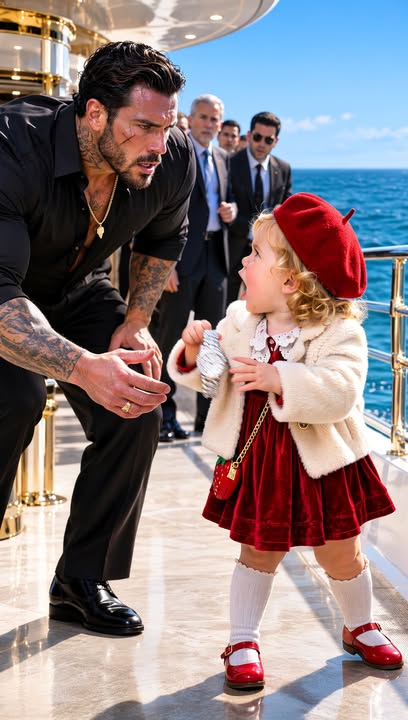
Part 6 – The Good Tick-Tock
The stranger outside the car held his photograph steady against the window.
Elena stared at the silver bracelet on the newborn’s wrist, then looked down at the matching band around Poppy’s tiny arm.
For one suspended moment, the harbor seemed to fall away.
“Alexander,” she said into the phone, “the baby in this picture has your bracelet.”
“I’m coming to you.”
Across the customs office, Michael had gone pale.
Alexander kept his eyes on his brother. “You said you saw a second identification bracelet.”
“I did.”
“Did you see the photograph?”
“No.”
“Did you know about it?”
Michael’s silence stretched just long enough to answer.
“I suspected there might have been a child,” he said. “I was told there wasn’t.”
“By whom?”
“I can’t remember the name.”
“Try.”
Michael pressed a hand to his brow. “The hospital administrator called me after the crash. He said Elena had been taken to a separate ward, that the records had to be kept private because people were asking questions.”
“You let him decide what I was allowed to know.”
“I was afraid the people who caused the crash would come back.”
“So you hid the records.”
“I thought I was keeping them safe.”
“Were you?”
Michael did not answer.
Alexander left the folder with his lawyer and crossed the room, his brother following him.
Outside, the stranger lowered the photograph and turned as they approached.
He was an older man with a weathered face and a careful way of standing, as if he had spent years trying not to attract notice.
Sofia remained beside the car, alert but calm.
Elena had one arm around Poppy, who watched the man with a solemn expression.
“Who are you?” Alexander asked.
“My name is Daniel Vale,” the stranger said. “I was a nurse at St. Agnes Hospital the night of the crash.”
Elena tightened her hold on Poppy. “You treated me?”
“I helped move you from the emergency room to a private recovery ward.”
“I don’t remember you.”
“I wouldn’t expect you to.” His voice softened. “You were injured, frightened, and confused. You asked for Alexander more than once.”
Alexander felt the old ache return, sharper now because it had a voice.
“What happened to the baby?”
Daniel glanced at the photograph in his hand.
“He was born several hours after you arrived.”
Elena’s breath caught.
Alexander looked at her, but she could only stare at the image.
“A boy?” she whispered.
“A girl,” Daniel said. “Your daughter.”
The word seemed to loosen something in Elena’s face, though it brought no relief yet.
“Why were we told she was born eighteen months ago?” Alexander asked.
“Because the hospital file was altered,” Daniel replied. “The people who arranged it claimed the child had been transferred. I was told not to speak of her again.”
“Who told you?”
“A physician from the private ward. He said it was for your protection.”
“Did you believe him?”
“I wanted to. I had a young family of my own, and I was afraid of being dismissed, or worse.” Daniel lowered his eyes. “I kept the photograph anyway.”
Michael stood behind Alexander, silent.
“You kept it for six years?” Elena asked.
“I kept the photograph and a copy of the original birth record. I didn’t know where to take them. I didn’t know who was safe to trust.” Daniel’s gaze moved to Alexander. “When I saw the news about the yacht, I recognized the family. Then I heard that Elena was alive.”
“You could have come forward earlier,” Alexander said.
“Yes.” Daniel did not look away. “I should have. I’m sorry.”
There was no dramatic defense in his voice, only the regret of a man who understood that fear could preserve a person and still cost someone else dearly.
Elena looked down at Poppy.
“Do you remember anything from the hospital?” Alexander asked her.
She closed her eyes.
At first, there was only the faint sound of traffic and the quiet breathing of the child against her shoulder.
Then her face changed.
“I remember the room,” she whispered. “The white walls. A window with rain on it.”
Daniel nodded. “You were awake for a little while after the birth.”
“I heard someone say she was safe.”
“I told you that,” he said. “You kept asking whether Alexander knew.”
Alexander’s throat tightened.
“What did you tell her?”
“That you were alive, but they wouldn’t let you see each other yet.” Daniel paused. “You were very weak. Later, when you woke again, your memory was worse. The doctor said the shock had left gaps.”
Elena opened her eyes.
“I thought Poppy was born eighteen months ago.”
“You gave birth to her six years ago,” Daniel said. “But the papers you received later were false.”
The pink bracelet in Poppy’s purse, the false certificate, the hidden photograph—all of them shifted into a crueler, clearer shape.
The child Elena had raised and named Poppy had been the baby from the crash all along.
“Why did I find her only eighteen months ago?” Elena asked.
Daniel took a breath. “The hospital’s records show that she was moved out of the private ward under another name. I don’t know who arranged it. I only know she disappeared from the official system.”
“And then?” Alexander asked.
“She was cared for by a family at a small clinic outside the city. The woman who worked there recognized Elena when she later came seeking help. She brought the two of them together.”
Elena’s eyes shone.
“That was the doctor who helped me.”
“Possibly,” Daniel said. “The woman who contacted me last week was searching for you both. She had the original clinic records. She told me Poppy had been returned to Elena when she was eighteen months old, but she didn’t know why anyone had changed the dates.”
The months after the hospital, the lost memories, the unexplained records, and the child who had called Alexander Big Dada began to form a story they could finally hold without having to pretend it made sense.
Alexander looked at Poppy.
She was listening with the solemn patience of a child who understood more through the warmth of a voice than through its words.
“Can you show us the original file?” he asked Daniel.
“I brought a certified copy. The rest is with the authorities.”
Michael’s gaze lowered.
“You took the file to them?”
“I did,” Daniel said. “After I saw the evidence from the bracelet, I realized this was no longer something I could keep to myself.”
Alexander turned toward the customs office, where his lawyer waited with the papers he had chosen to hand over.
“Good,” he said.
Michael looked at him. “You’re still going to do it?”
“Yes.”
“Even now that you know the child is yours?”
“Especially now.”
The answer came without anger.
That surprised Alexander.
For so long, he had imagined that the truth would arrive with a demand for punishment, that the past would only open so they could decide who deserved to suffer for it.
But Elena was beside him.
Poppy was in her arms.
And the choice in front of him was simpler than revenge and harder than silence.
He could protect the family name, or he could stop protecting the lies that had harmed his family.
Michael looked toward Elena.
“I’m sorry,” he said.
She held his gaze for a long moment.
“I believe you’re sorry,” she replied. “I don’t know what that will mean for us.”
“It may not mean anything.”
“No,” she said. “It may not.”
Michael accepted the answer without asking her to soften it.
Alexander returned to the office and gave his lawyer the remaining evidence, including the message hidden in the watch and the records Daniel had brought.
The lawyer explained what would follow: interviews, investigations, the freezing of assets, and the possibility that Alexander would face consequences for the organization he had led.
Alexander listened without interrupting.
He did not ask what could be concealed or which parts might be made to disappear.
When he signed the statement, his hand trembled only once.
It was not the signature of a man certain he would keep everything.
It was the signature of a man who had finally understood that keeping everything was not the same as saving anything.
Elena came to stand beside him.
“You don’t have to decide this for me,” he said quietly.
“I’m not.”
“I know what it could cost you.”
“I know what silence has already cost.”
She rested her hand on the table, close to his.
“I’m not asking you to be forgiven today,” he said.
“Good.”
“I’m asking you to let me show you who I can become.”
Elena studied his face, the scar on his cheek, the tiredness in his eyes, and the man she had once promised to find when the tide turned.
“Then show me,” she said.
It was not a promise that everything would be easy.
It was better than that.
It was a beginning neither of them had been forced to pretend was an ending.
Michael gave his account to the investigators and answered what he could about the people who had altered the hospital records and arranged the crash.
He did not ask Alexander to protect him.
He did not ask Elena to understand.
The evidence was examined, the medical file was confirmed, and the people responsible for the crash and the falsified records were brought before the authorities.
Michael was arrested for his part in concealing the truth and for his role in the organization’s crimes.
Alexander cooperated fully.
When investigators asked him about his own part in the empire, he did not hide behind his brother or claim ignorance of what he had chosen not to see.
The process was long, and the consequences were real.
His businesses were dismantled or placed under independent oversight.
The accounts that could not be separated from the criminal operation were surrendered.
He spent months answering questions, attending hearings, and helping the people whose lives had been shaped by the organization find safer ways forward.
The outcome did not restore the years he had lost with Elena and Poppy.
It did not erase the fear that had shaped Elena’s choices or the loneliness Alexander had mistaken for strength.
But it gave them something the lies had denied them: time in which their decisions belonged to them.
The first months were not a reunion wrapped in easy forgiveness.
They were mornings spent learning Poppy’s routines, afternoons divided between visits with doctors and lawyers, and evenings in which Alexander and Elena tried to speak plainly even when the truth was uncomfortable.
Sometimes Elena needed space.
Sometimes Alexander mistook that need for rejection and had to learn not to retreat into silence.
Sometimes he asked questions too quickly, and Elena reminded him that remembering was not the same as being ready to explain.
They learned to stop when the other asked them to stop.
They learned to return to difficult conversations after rest.
Poppy, meanwhile, treated the careful rebuilding of their lives as a matter of simple common sense.
She wanted Alexander to sit beside her while she ate.
She wanted Elena nearby when she woke.
If either of them left the room, she called until both voices answered.
“Big Dada,” she would say, stretching her arms toward him.
At first, he worried that the name was only a sound she had carried from the past.
Then one evening, as he read her a picture book, she patted his cheek and said, “Dada.”
He looked up at Elena.
She was standing in the doorway, one hand pressed to her heart.
Neither of them corrected Poppy.
Neither of them asked her to say it again.
They simply let the word rest where she had placed it.
A year passed.
Then another.
The investigation ended, though its consequences continued.
Alexander gave up any attempt to rebuild the old empire.
Instead, he worked with the people overseeing the dissolution of its legitimate businesses, helping workers find new jobs and making sure the organization could not return under another name.
The life that replaced it was smaller, quieter, and often more demanding than the one he had left.
He discovered that ordinary problems required more patience than commands ever had.
A broken kettle did not respond to a title.
A child’s question could not be postponed indefinitely.
And trust, once damaged, did not return because someone had suffered enough.
It returned through repetition: honest answers, kept promises, apologies without excuses, and the humility to ask before deciding what was best for someone else.
Elena took time to recover her memories in her own way.
Some returned as sounds or images.
Others remained missing.
She did not force herself to fill every blank.
Instead, she made new memories with Poppy: planting herbs on a sunny windowsill, choosing library books, and walking the quiet paths near the shore.
Alexander joined them when he could.
At first, Elena’s hand would stiffen if he reached for it without warning.
So he learned to ask.
“May I?”
And when she said yes, he held her hand without assuming the gesture meant the hurt was gone.
Years after the night of the yacht, they returned to the coast on a clear spring morning.
The beach was broad and quiet, the tide rolling in with a soft, unhurried hush.
Poppy ran ahead in a yellow raincoat, carrying a toy watch in one pocket and the wooden rabbit in the other.
She was no longer a toddler, though she still walked with the determined speed of someone convinced that the world would wait for her.
“Stay where we can see you,” Elena called.
“I can see you!” Poppy shouted back.
Alexander laughed.
“She has a point.”
“She has your confidence.”
“She has your sense of direction.”
“She once led us to the wrong side of the park.”
“She knew where she was going. The park was wrong.”
Elena gave him a look, and he smiled.
The old silver bracelets rested at their wrists.
Alexander’s had been cleaned and repaired, the hidden compartment sealed beneath a new clasp.
Elena wore the original matching bracelet again, recovered from the nurse who had kept it safe.
They had left the old watch in a secure evidence archive, where it belonged.
The last message hidden inside it had helped confirm the truth: Michael had arranged the route on the night of the crash, intending to separate Elena from Alexander and seize control of the family’s operations.
He had not known the baby would survive.
He had not known the child would be hidden and later returned to Elena.
But he had chosen silence when he could have chosen courage.
That truth did not make what he had done harmless.
It did make the story complete.
Poppy stopped at the edge of the wet sand and bent over her toy watch.
“Dada!”
Alexander went to her.
The watch was bright blue plastic, with a yellow face and two painted hands that never moved.
A label had been carefully stuck across the back.
GOOD TICK-TOCK.
Poppy held it up to him with a proud smile.
“I fixed it.”
“You did?”
“It’s safe.”
“That’s very important.”
“It doesn’t go boom.”
Elena joined them, smiling.
“No, it doesn’t.”
Poppy fastened the toy watch around Alexander’s wrist, just above his silver bracelet.
The two pieces looked absurd together.
He loved them both.
Poppy patted the watch, then looked up at him.
“Good tick-tock.”
“Good tick-tock,” he agreed.
She reached for his hand.
The gesture was small, familiar, and entirely her own.
Alexander took it.
Poppy held Elena’s hand with the other, and together they walked a little way along the shore.
The sea turned silver beneath the pale morning light.
For years, Alexander had believed that what he had lost could only be recovered by finding the person responsible and forcing the past to answer for itself.
He had been wrong.
The answers mattered.
So did the truth.
But the life waiting for him was not in the old watch or the missing years.
It was in Elena’s hand beside his, in Poppy’s small fingers tucked into his palm, and in the quiet work of becoming someone they could trust.
Elena glanced at the bracelets on their wrists.
“Do you remember what we wrote inside them?”
“When the tide turns, find me.”
“I thought I had.”
“You did.”
She looked at him.
“So did you.”
Ahead of them, Poppy turned and waved for them to hurry.
They followed her toward the brighter edge of the water, not as the people they had been before the crash, but as the family they had chosen to become.
And when Poppy’s toy watch tapped lightly against Alexander’s wrist, its safe plastic face shining in the sun, he heard only a gentle little tick.
A good tick-tock, at last.
**–THE END–PLEASE
Share your thoughts or feedback to motivate us to create more stories ♥️
* * *
[PREVIOUS: PART 5](https://echoesofstories.idolsgift.com/blog/part-5-the-woman-who-was-supposed-to-be-dead-047)
✓ Lynn R. Adams
Part 6 – The Good Tick-Tock The stranger outside the car held his photograph steady against the window. Elena stared at the silver bracelet on the newborn’s wrist, then looked down at the matching b…