PART 6 (THE END): The Woman Who Came Back 041
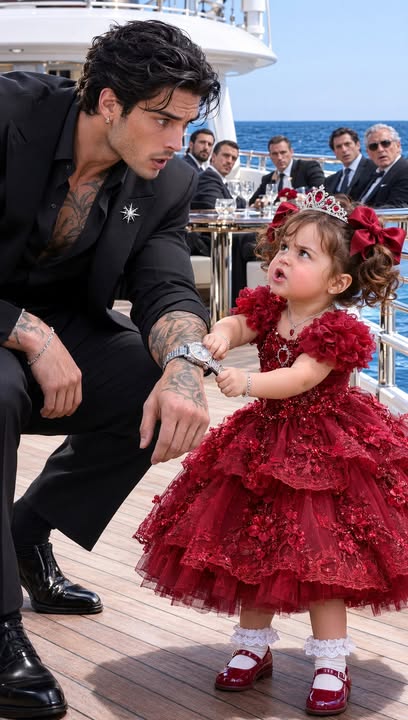
Part 6 – The Life We Choose
The message remained bright on the screen.
**Michael wasn’t the one who ordered the yacht attack. Ask who signed for the child.**
No one spoke for a moment.
Rosie held Elena’s hand, looking from one adult to another with the solemn attention of a child who knew the room had changed, even if she could not understand why.
I turned the phone over, as if the words might lose their weight in the dark.
“Who signed for the child?” Elena asked.
Elias looked toward the documents spread across the table.
“The note on Michael’s phone said he wanted Rosie kept away from Alexander,” he said. “It didn’t say he brought her aboard.”
“Could the message mean someone signed for her at the yacht?” I asked.
“Or when she was moved,” Elena said. “We still don’t know who brought her there.”
Dr. Vale lowered his eyes.
“I can tell you what I know,” he said. “Michael asked me to keep Elena’s records concealed. He never mentioned a child until much later.”
“Did you meet Rosie?” I asked.
“No.”
“Did you tell anyone where Elena was living?”
“I gave Michael no address. I didn’t know where she had gone after the recovery house.”
Elias examined the message details.
“It came through the same account as the hospital photograph,” he said. “The account is routing through an archive server.”
“Can you identify its owner?” Elena asked.
“Not yet, but the server is connected to the old Romano office.”
The old office.
The thought brought back the document bearing my signature, dated the morning after Elena’s supposed death.
“I signed for something six years ago,” I said. “I just don’t remember what.”
“Could it have been a family document?” Elias asked.
“Possibly.”
“Could someone have used your signature?”
“I don’t know.”
Elena’s hand tightened around Rosie’s.
“Then we find the original record,” she said. “No guesses.”
I looked at her, grateful for the steadiness in her voice.
“All right.”
Elias called the independent administrator handling the released files.
The administrator had access to the old office archive and agreed to search the records, but warned us that the process would take time.
We waited in the guesthouse sitting room while Rosie colored at a small table, drawing a large blue boat with a yellow sun above it.
Every few minutes, she held up the picture for one of us to admire.
When she showed it to me, I bent close to inspect the uneven waves.
“Is that the yacht?” I asked.
“No,” Rosie said. “That boat is safe.”
Elena looked up from her coffee.
Rosie added two stick figures to the deck, then a smaller one between them.
“Who’s that?” I asked.
“Mommy, Dada, and me.”
The words were simple, but they settled in my heart with the quiet force of a promise beginning.
I did not tell her that I would keep her safe forever.
I had learned that love was not made trustworthy by grand declarations.
Instead, I sat beside her and helped her draw another person at the stern.
“Who’s that?” Rosie asked.
“Elias,” I said. “He helped us get off the yacht.”
She chose a green crayon and gave the figure a very large hat.
Elias, standing near the window, saw the drawing and smiled.
“I’ve never looked so distinguished,” he said.
“You look like a duck,” Rosie replied.
Her laughter filled the room, light as the morning that had finally arrived.
For a little while, we let it be enough.
The call came just after noon.
The administrator had found a document in the archived yacht records, filed under the private transfer of guests and household staff.
The name on the form was not Michael’s.
It was Frank’s.
The same Frank who had tried to take Rosie from me.
“He signed her onto the yacht as a temporary guest,” Elias said after reading the record. “The authorization was issued through Alexander’s office.”
“Was it my signature?” I asked.
The administrator sent a scan.
My name was printed beneath the authorization, but the signature looked wrong.
Not obviously wrong.
It carried the same slant, the same long stroke through the final letter, yet the pressure was too uniform, and the ink had been copied from a document I remembered signing years earlier.
“I didn’t sign this,” I said.
Elena leaned closer to the screen.
“Can you prove it?”
“The office has my original signature on hundreds of records,” Elias said. “A handwriting analyst can compare them.”
“Why would Frank bring Rosie aboard?” I asked.
“Maybe he was following orders from the person who arranged the attack,” Elena said. “Maybe he thought he was moving her somewhere safe.”
“His jacket had the photograph and the transmitter.”
“Those could have been planted there.”
I looked at the document again.
The authorization was dated the day before the yacht negotiation.
Someone had used my name to bring my daughter into the one place where I would be surrounded by people, distractions, and danger.
The signature did not tell us who had ordered the bomb.
It did tell us that someone had reached into my office, taken my authority, and used it to place Rosie in the path of a plan.
“What happened to Frank after the explosion?” Elena asked.
“He was taken to the coast guard station with the injured crew,” Elias replied. “He gave a statement, but he hasn’t been charged with anything.”
“Can we speak to him?”
“Not without the investigators present.”
“That’s reasonable,” I said.
The old version of me would have demanded answers alone.
The man I was trying to become understood that patience could be stronger than control.
The administrator agreed to preserve the original document and compare it with my verified signatures.
We delivered the records, the phone, Dr. Vale’s archive, and the yacht authorization to investigators who had no ties to the Romano family.
Over the following days, facts began to emerge in careful, unhurried pieces.
The signature had been forged.
Frank had been paid through an account belonging to a company that Michael had secretly controlled, but the transfer had not come directly from him.
The bomb had been placed on my watch by a technician hired through a false contract, a man who later admitted he had been told the device was intended to disable the yacht’s communications, not cause an explosion.
He had not known Rosie would be on board.
The person who arranged her transfer had expected me to be there and had used the watch as part of a plan to create confusion, separate me from my staff, and keep me from discovering the family records hidden on Michael’s phone.
The plan had been set in motion by a former family adviser named Victor Hale.
For years, he had managed the family’s private accounts and had quietly built a network of shell companies to divert money from the legitimate businesses.
Michael had believed Hale was helping him secure control of the family holdings.
Instead, Hale had been using Michael’s ambition as cover for a separate scheme.
The supposed transfer would have placed several businesses under a trust controlled by Hale.
Michael had hidden Elena and Rosie because he thought their appearance would threaten the transfer.
Hale had arranged the yacht attack because the phone contained records that could expose his accounts, and because my presence at the negotiation offered a chance to remove the phone and discredit anyone who found it.
He had used my forged signature to place Rosie aboard, expecting Frank to take her away after the blast.
The note on Frank’s jacket had not been a message from Michael.
It had been written by Hale’s assistant, who was later found cooperating with investigators.
Frank had carried the phone because he had been told it held the emergency override.
The device had been placed in his jacket after he left the navigation console, making him look responsible for the attack and keeping attention away from the people who had arranged it.
Elias had been helping Elena for months.
He had found her after she sent a cautious message through an old contact, and he had quietly arranged safe passage for her and Rosie whenever he could.
He had never told me because Elena had feared that anyone connected to my organization might expose her location.
The message I had received aboard the speedboat, the one warning me not to trust the man holding Michael’s phone, had been sent by Elias through an encrypted account.
He had not known whether I would believe him.
He had only known that Michael’s phone was important, that the yacht had become dangerous, and that Elena had asked him not to let me mistake the evidence for certainty.
When I learned the truth, I found him in the small courtyard behind the guesthouse.
“You could have told me,” I said.
“I tried,” Elias replied. “At first, I didn’t know what I could safely say without exposing Elena.”
“Then you let me think you might have helped set the attack in motion.”
“I know.”
“Why didn’t you tell me you were helping her?”
“Because she asked me not to.”
The answer stung, but I understood it.
“You trusted her more than you trusted me.”
“I trusted her fear,” he said. “And I knew you were surrounded by people who expected you to react before you listened.”
I could have argued.
Instead, I thought of the man I had been when Elena left, the man who had mistaken authority for protection and silence for strength.
“I’m sorry I doubted you,” I said.
“I would have doubted me, too.”
We stood in the courtyard, the early evening light resting on the stone walls.
The world beyond the guesthouse was moving again, but not back to what it had been.
The family businesses were under review.
My accounts had been frozen.
The organization I had spent years managing was being dismantled, piece by piece, by investigators and by the people who had once relied on it.
I had expected to feel only loss.
Instead, the more the old structure fell away, the more clearly I could see the people beneath it.
Frank was cleared of the central accusations after the evidence showed that the transmitter had been planted in his jacket.
He still had to answer for taking orders without questioning them, but he chose to cooperate fully with investigators and explain how the family’s security system had been used.
The rescued crew confirmed Elias’s account of the evacuation.
The technician admitted to placing the device on my watch.
His testimony, combined with the forged authorization and financial records, helped investigators trace the plot to Hale.
Michael was arrested after the families whose money had been diverted agreed to share their own records.
The evidence against him was serious, but not every accusation held.
He had concealed Elena’s survival and helped Dr. Vale falsify the records.
He had also knowingly kept Rosie hidden from me.
But investigators could not prove that he had ordered the yacht attack.
He had believed Hale was arranging a transfer of control, not an attempt to sink the vessel.
That did not excuse his choices.
It did make them human, and therefore more difficult to dismiss.
When Michael asked to see me, I agreed to meet him with a mediator present.
We sat across from each other in a plain office, far from the family boardroom where we had once spoken in the language of shares, influence, and succession.
He looked tired.
I looked older than I had the day the yacht went down.
“Did you know Rosie was aboard?” I asked.
“No.”
“Did you know the bomb was on my watch?”
“No.”
“Did you know Hale meant to use my signature to get her onto the yacht?”
“No.”
“Why did you keep Elena from me?”
His eyes lowered.
“I thought if she came back, the transfer would fall apart.”
“You were protecting your position.”
“I was protecting what I believed was the family’s future.”
“You let me mourn her.”
“I thought it was safer.”
“For whom?”
He did not answer.
I had asked myself the same question for years, though in different forms.
Michael rubbed the edge of the table with his thumb.
“I was afraid,” he said. “Afraid you would find her, afraid the company would unravel, afraid I’d spend my life being the brother who never measured up.”
I remembered the boy he had been before our father taught us to compete for every scrap of approval.
We had once shared a room and made up stories about the city outside our window.
Then the stories had become plans, and the plans had become weapons no one had meant to draw.
“I’m not asking you to forgive me,” Michael said.
“I don’t know if I can.”
“I know.”
“But I’m not going to pretend you were only a monster in my story.”
He looked up, surprised.
“You made choices,” I continued. “You hurt Elena and me. You helped bury the truth. You will have to answer for that.”
“I know.”
“If you want a life after this, you’ll have to build it without controlling the people around you.”
He nodded slowly.
“I don’t know how.”
“Neither do I.”
It was the first honest conversation we had shared in a long time.
It did not restore what had been lost.
It did not erase what he had done.
But I left the office without the need to make him suffer for it, and that felt like a beginning.
The months that followed were not simple.
I cooperated with investigators and turned over every record I could find.
Some of the former family businesses were shut down.
Others were sold, their employees protected by independent administrators and fair severance.
I gave up my formal authority over the old network and accepted the legal consequences of decisions I had made while running it.
The headlines called me a fallen heir, a reformed power broker, and a man whose empire had collapsed.
I stopped reading them.
My days became smaller and more honest.
I found work advising a legal aid foundation that helped former employees untangle themselves from the family’s complicated contracts.
I learned how to make dinner without scheduling every step.
I learned that a promise to be home by six mattered more than a promise to change the world by morning.
Most importantly, I learned to ask before I acted.
Elena did not move back in with me.
She said she wanted to build trust at a pace that belonged to her, not to my guilt.
I did not argue.
At first, we met in public places, where Rosie could play and Elena could leave whenever she wanted.
We spoke about the past only when both of us had the strength for it.
Some conversations ended in silence.
Some ended in tears.
A few ended with laughter, surprising both of us.
I told her what I had done after I believed she was dead: the work I used to fill the empty hours, the anger I had carried, the ways I had mistaken being feared for being safe.
She told me about the years she had spent moving from one quiet place to another, about the terror of hearing a car slow outside at night, and about the first moment she heard Rosie laugh without checking the door.
Neither of us asked the other to turn pain into gratitude.
We let the past be what it was.
Rosie, meanwhile, made her own plans.
She insisted that I learn the names of every stuffed animal in her collection, then quizzed me on them whenever I visited.
She taught me to draw a crown with exactly seven points.
She also decided that my bracelet needed a bright red ribbon tied around the clasp.
“Now it’s fixed,” she declared.
The scratch remained beneath the ribbon, but I no longer wanted to hide it.
One Sunday, after a long afternoon at the botanical gardens, Elena walked me to the gate.
Rosie was asleep in the stroller, her curls spread across the blanket, her tiara resting beside her.
“You’ve been patient,” Elena said.
“I’ve been trying to listen.”
“You do more of that now.”
“I should have learned sooner.”
“Maybe.”
She looked toward the garden, where the last of the sunlight was catching in the glass roof.
“I’m not ready to go back to who we were,” she said.
“I don’t want us to.”
Her eyes returned to mine.
“What do you want?”
I took a breath.
“To know who we can become.”
She considered the answer.
Then she reached for my hand.
It was not a promise of forever.
It was not forgiveness for everything.
It was a choice in the present, and I held it with care.
A year after the night of the yacht, we returned to the harbor on a clear spring morning.
Not to the place where the damaged vessel had gone down, but to a public pier where families watched sailboats cross the bay.
Rosie ran ahead, her red shoes flashing against the weathered boards.
She had grown taller, and her curls were still tied in two side ponytails, though now she chose the ribbons herself.
Elena walked beside me with her hand in mine.
The matching bracelets rested against our wrists.
The scratch on hers and the scratch on mine caught the sun at different angles.
Rosie came back carrying a small paper boat she had folded with Elena.
“Can we send it sailing?” she asked.
We walked to the edge of the pier and lowered the boat into the water.
It wobbled, then found its balance.
Rosie watched it drift.
“Is it going far away?”
“Not too far,” Elena said. “The tide will bring it back toward the shore.”
Rosie looked at me.
“Like people?”
I glanced at Elena.
“Sometimes,” I said.
She smiled, then tucked herself between us, one hand in each of ours.
I used to think the bracelet was a relic of the life I had lost.
Now I understood that it was a promise measured not by how long it survived untouched, but by whether I could choose to stay when the truth became difficult.
The silver still carried its tiny scratch.
The harbor still held the memory of the night everything changed.
But Rosie’s laughter moved freely over the water, and Elena’s hand rested warm in mine.
For the first time, the future did not feel like something I needed to control.
It felt like something we could build together, one honest day at a time.
**–THE END–PLEASE
Share your thoughts or feedback to motivate us to create more stories ♥️
* * *
[PREVIOUS: PART 5](https://echoesofstories.idolsgift.com/blog/part-5-the-woman-who-came-back-041)
✓ Lynn R. Adams
Part 6 – The Life We Choose The message remained bright on the screen. **Michael wasn’t the one who ordered the yacht attack. Ask who signed for the child.** No one spoke for a moment. Rosie held …