PART 6 (THE END): The Woman Wearing the Buried Necklace 041
Part 6 – A Life in the Daylight
For one suspended moment, the old depot held every fear Alessandro had carried there.
The woman stood beneath the dim platform lights, her hands trembling around the recorder, while familiar faces watched from the high windows.
Marco remained near the entrance with Elena, and Raffaele stood a few paces behind them, his expression unreadable.
Alessandro could feel the old response rising in him: name the guilty, give the order, make uncertainty disappear.
Instead, he looked at the woman.
“What is your name?”
“Clara,” she said. “I work in the archive office.”
“Did Raffaele give you that recording?”
She glanced toward the underboss, then lowered the recorder.
“He gave it to me as a precaution. He said someone might try to use his voice to make the family turn on itself.”
Raffaele’s eyes closed briefly.
“Clara, I should have told Alessandro what I knew before tonight.”
“Why didn’t you?” Alessandro asked.
“Because I was afraid the wrong person would hear it and move the evidence before we could protect it.”
“That fear has made a mess of things.”
“Yes,” Raffaele said. “It has.”
Alessandro turned to the figures in the windows.
“Everyone inside, please. No weapons. No one leaves until we understand why we were called here, but no one is being accused or punished for showing up.”
The people exchanged uncertain looks.
Then Marco stepped forward from the entrance.
“You heard him,” he said. “We’re going to talk.”
His calm voice gave the others something to follow.
One by one, they came down from the upper level and gathered on the platform, leaving space between themselves and the three men at its center.
Alessandro recognized the head of the transport office, a records clerk, two security supervisors, and several people who had served the family for years.
Each looked unsettled, not dangerous.
They had been given different messages, Clara explained: one claiming Alessandro had asked them to bring evidence against Raffaele, another claiming Marco had stolen family records, and a third warning that Elena was in danger.
The messages had been sent from accounts that belonged to people who had not written them.
No one had known which story was true.
“Whoever did this wanted us to arrive suspicious of one another,” Marco said.
“And they nearly succeeded,” Alessandro replied.
He looked at the people gathered under the depot lights.
“You are not required to give me answers in front of everyone. If you saw something, tell Marco or the investigators tomorrow. No one here will be blamed for a message they didn’t send.”
A security supervisor raised his hand.
“I received a call from a number that looked like the office line. It said you wanted me to bring the archive key.”
“Did you bring it?”
The supervisor held up a small keycard.
“I thought I was helping.”
“You were responding to what looked like an order,” Alessandro said. “Thank you for telling us.”
The supervisor’s shoulders eased.
Marco took the card and handed it to the technician who had come with them.
“Can you check whether it was used tonight?”
“I can.”
The technician walked to a small service terminal near the platform.
As the others watched, he compared the access record with the messages on Clara’s recorder.
“The calls all came through the same routing service,” he said. “They were set up with different numbers, but the account was created using credentials from the internal communications office.”
“Whose credentials?” Raffaele asked.
The technician paused over the screen.
“An account assigned to Stefan Bell.”
A man near the back lowered his gaze.
Alessandro knew him as the deputy director of family operations, a quiet administrator who had handled schedules and records for years.
Stefan did not run.
He did not reach for anything.
He only looked at the evidence on the terminal and then at the people around him.
“I thought the organization was coming apart,” he said. “I believed Raffaele intended to take control, and I wanted to force the truth into the open before he did.”
“You created the messages?” Marco asked.
“I created some of them.”
“And the footage of Marco?”
Stefan swallowed.
“I gave someone the file and asked them to make it convincing.”
Alessandro felt his attention narrow, but he kept his hands at his sides.
“You knew it would make me believe Marco had betrayed me.”
“I thought you would question it.”
“You thought I might execute him?”
Stefan looked stricken.
“No. I thought you would confront him.”
There was no excuse in the answer, only the frightened logic of someone who had believed he could manage the consequences of a lie.
Alessandro glanced at Marco.
The false footage had been meant to divide them, but it had also revealed how close he had come to letting suspicion choose for him.
“Why?” he asked Stefan.
“Because I found records showing Raffaele requested changes to the nursery schedule, and I thought he was preparing to use Mimi to pressure you.”
Raffaele’s face tightened.
“I never intended to involve the child.”
“How could I know that?” Stefan said. “You kept secrets. Elena kept secrets. Alessandro signed changes without reading them. Everyone said they were protecting the family.”
He looked around the depot, his voice weary rather than angry.
“I thought if I made the threat obvious, someone would finally act.”
Alessandro heard the familiar trap in those words: the belief that fear justified deciding for everyone else.
“Did you alter the hospital records?” Elena asked.
“No. I never had access to Isabella’s medical account.”
“Did you create the second approval under her name?”
“I don’t know anything about that.”
The technician examined the terminal again.
“The messages and the footage were made through the same office account, but the hospital authorization came from a separate source.”
Raffaele took the folded paper from his pocket.
“I believe I know where that authorization came from.”
He unfolded a narrow sheet bearing the name of a former hospital contractor and a date.
“When Isabella became ill, she asked me to help secure a backup of her records,” he said. “She believed someone had accessed the hospital terminal while she was asleep. I arranged for a private audit.”
“Why was her name used to approve the nursery route change?” Alessandro asked.
“The audit found that the route change was authorized through a shared terminal. The system copied the name of the account holder automatically.”
“So the record made it look as if she approved it.”
“Yes.”
“Did she?”
“I don’t know. She may have agreed in conversation, but I cannot prove that she signed the change.”
Alessandro studied the paper.
The second approval had seemed like a message from his mother beyond the grave.
It was only an imperfect record, made confusing by a system that had recorded an account name without preserving who had used the terminal.
The mystery had not been solved by a secret command or hidden accusation, but by the patient work of people willing to check what they did not know.
“Why didn’t you show me the audit?” he asked Raffaele.
“I should have.”
“That is not an answer.”
“I believed the person making the changes was still inside the hospital. I wanted to know who before I gave you a suspicion you might act on.”
Alessandro looked at the ring on Raffaele’s hand.
“And the reflection?”
“I was at the archive door that night because I saw a security alert. I did not know the false footage had been planted until I reviewed the logs.”
“Why was your ring visible beside it?”
“I opened the door.”
“And left?”
“Yes.”
“Without telling anyone?”
“Yes.”
For once, Raffaele’s answer offered no shelter behind careful phrasing.
“I thought I was keeping the situation contained,” he said. “Instead, my silence made me look like the person behind it.”
Alessandro nodded slowly.
“Your silence helped the person who was.”
“I know.”
Stefan’s head remained lowered.
“I’m sorry, Marco,” he said. “I thought the footage would create enough doubt to force a review. I did not expect Alessandro to order your execution.”
Marco’s expression was grave.
“You don’t get to decide what danger another person can survive.”
“I know.”
Alessandro looked from Stefan to Raffaele, then to the people who had gathered because they feared the family was splitting around them.
“I won’t settle every consequence here tonight,” he said. “The investigators will review the records. The people responsible will answer for what they did, and anyone who was caught in the middle will be treated fairly.”
He paused, looking at Marco.
“I should have said that sooner.”
Marco met his gaze.
“Yes,” he said. “You should have.”
The honesty hurt, but Alessandro did not turn away from it.
By dawn, the depot had emptied.
Clara gave her statement.
The technician preserved the message records.
Stefan agreed to cooperate with the investigators, and Raffaele handed over the audit documents he had kept outside the organization.
Elena’s evidence, the archive copies, and the letter were placed in separate secure locations, with each chain of access recorded and witnessed.
No one was asked to trust a single person with the whole truth.
The final review took weeks.
The records showed that Isabella had died naturally, as her medical team had said.
Her illness had followed the course they expected, and no one had harmed her or altered her care.
The hospital authorization had been misattributed through a shared system, while the nursery route change had been approved by Alessandro after Raffaele raised a security concern.
Isabella had known about the concern and had asked Elena to keep Mimi’s routines quiet.
She had not been trying to make her son a suspect.
She had been trying to buy time to discover who was listening.
The planted footage had been assembled later, using fragments from legitimate recordings and Marco’s stolen credentials.
Stefan had commissioned it because he wanted the family to confront the growing distrust, though he had refused to admit how easily that plan could have ended in tragedy.
Raffaele had not planned a coup.
He had concealed his investigation from Alessandro, hoping to keep the family calm until he had proof, and his secrecy had made him look guilty.
The transfer record connected Marco to the file because someone had used his credentials after the footage had already been inserted.
Marco’s own secret meeting with Raffaele turned out to be what he had said it was: an attempt to get proof that someone was manipulating the archive before Mimi or Alessandro became a target.
He had hidden the meeting because he feared Alessandro would mistake it for betrayal.
When the review was complete, Marco’s name was cleared in front of the same people who had once watched him be accused.
Alessandro stood beside him in the family’s main office, beneath the tall windows that looked out over a city bright with morning.
“I was wrong,” Alessandro said. “I mistook fear for certainty, and I nearly let it cost me my oldest friend.”
The room was quiet.
Marco’s expression softened, but he did not make the apology easier than it was.
“You can’t give back the moment,” he said.
“I know.”
“But you can decide what you do next.”
Alessandro nodded.
“That’s what I’m trying to learn.”
Marco extended his hand.
Alessandro took it, and the clasp between them held for a few seconds longer than business required.
Then Marco pulled him into an embrace.
The room’s tension loosened.
Raffaele waited nearby, his green-stone ring turned inward against his palm.
“I should have trusted you enough to tell you I was afraid,” he said.
“And I should have listened before deciding I knew what your silence meant.”
They did not pretend that the weeks of suspicion had left no mark.
They only agreed to stop letting old habits decide what the future would be.
The most difficult decision came after that.
Alessandro had built his life around an organization that rewarded secrecy, loyalty, and fear.
For years, he had told himself that the power he carried protected the people he loved.
Now he could see what it had cost them: the rooms that stayed closed, the truths spoken to everyone but him, and the daughter who had learned to know him mostly by the sound of his steps passing her nursery door.
He began cooperating with authorities, turning over the records and helping dismantle the parts of the organization that depended on intimidation and hidden violence.
Some people left.
Some faced charges.
Others chose to help build a legal business from what could be salvaged.
There were difficult meetings and long days, but Alessandro stopped treating every loss as an attack he had to answer.
He took responsibility for the damage his power had made possible.
And, slowly, he began to build a different life.
He moved with Mimi into a smaller home where the windows stayed open to the morning air.
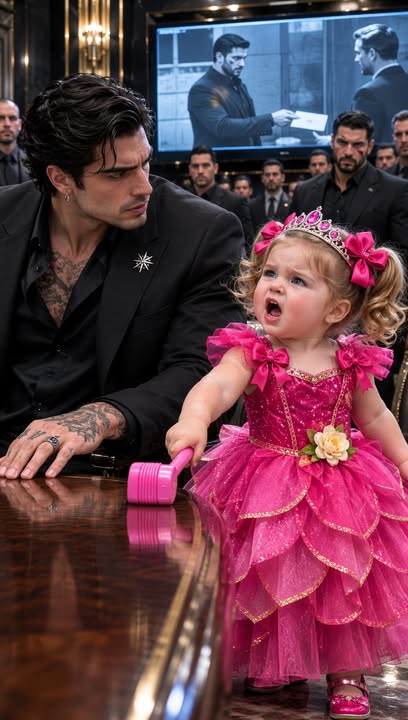
The first week, she insisted on sleeping in the nursery she already knew, and Alessandro sat beside her bed until she fell asleep, reading the same picture book three times because she kept tapping the page with her toy hammer.
When he tried to leave, she caught his finger.
“Stay,” she murmured.
“I’m staying,” he promised.
This time, he did.
He learned which breakfast she liked, how she wanted her curls brushed, and that her favorite flowers were the yellow ones Elena brought from the market.
He learned that Mimi laughed hardest when Marco pretended the toy hammer had made his shoes too heavy to lift.
He learned that being present was not a grand gesture but a thousand small returns: coming back after a meeting, sitting through a messy lunch, listening when a toddler repeated the same story until every detail felt important.
One afternoon, he carried Mimi into the old sitting room.
The curtains were open, and sunlight lay across Isabella’s ceramic bowl.
For the first time since the funeral, he moved it from the table to the windowsill.
Mimi watched him carefully.
“Grandma’s,” he told her.
She touched the bowl with one finger.
“Love Nana.”
Alessandro crouched beside her.
“Me too.”
Elena arrived later that day carrying a small envelope.
“I found something else among Isabella’s things,” she said.
Alessandro’s expression shifted.
“Another record?”
“No. A letter she wrote when she was still well enough to be annoyed with everyone.”
That drew a faint smile from him.
“Then I recognize the handwriting.”
He waited until Mimi was settled beside Marco on the rug before opening it.
The paper was a little yellow at the folds, but Isabella’s words were clear.
My dear Alessandro,
If you are reading this, then Elena has finally stopped waiting for the perfect moment and trusted you with something unfinished.
I hope you have learned that love does not always arrive in a grand speech or a flawless decision.
Sometimes it is the person who stays when you are tired, the friend who tells you that you were wrong, and the child who taps her toy hammer against the table until you look up.
You do not owe Mimi a powerful name.
You owe her your time, your gentleness, and the freedom to become someone who does not have to be afraid of the people who love her.
My greatest hope is not that she inherit what I built.
It is that she grow up free, and that you grow beside her.
I love you, my son.
Alessandro lowered the letter.
He did not try to hide the tears in his eyes.
Elena sat beside him, her shoulder warm against his.
“I should have asked her more questions,” he whispered.
“She knew you loved her.”
“I still wish I had.”
“So do I,” Elena said. “But wishing is not the same as losing the chance to love the people who are here.”
Marco looked up from the rug.
“Mimi’s about to make a speech.”
The little girl had arranged wooden blocks in a crooked line, with the toy hammer planted in the center like a flag.
She struck the table once.
“Play!”
Then she looked at Alessandro, at Marco, and at Elena, and lifted both arms.
Alessandro put the letter safely away and sat on the floor beside her.
Marco joined them.
Elena followed, laughing as Mimi handed each adult a block and insisted they build something together.
Outside, morning light filled the room.
There were still conversations ahead, and grief that would return without warning, and a city that would take time to forget the old name.
But the doors stood open, the people he loved were within reach, and Mimi’s hand rested on his.
When she tapped her toy hammer against the floor, Alessandro looked up at once.
“Here I am, princess,” he said.
And this time, he was there.
**–THE END–PLEASE
Share your thoughts or feedback to motivate us to create more stories ♥️
* * *
[PREVIOUS: PART 5](https://echoesofstories.idolsgift.com/blog/part-5-the-woman-wearing-the-buried-necklace-041)
✓ Lynn R. Adams
Part 6 – A Life in the Daylight For one suspended moment, the old depot held every fear Alessandro had carried there. The woman stood beneath the dim platform lights, her hands trembling around the …