PART 6 (THE END): The Woman in Silver 046
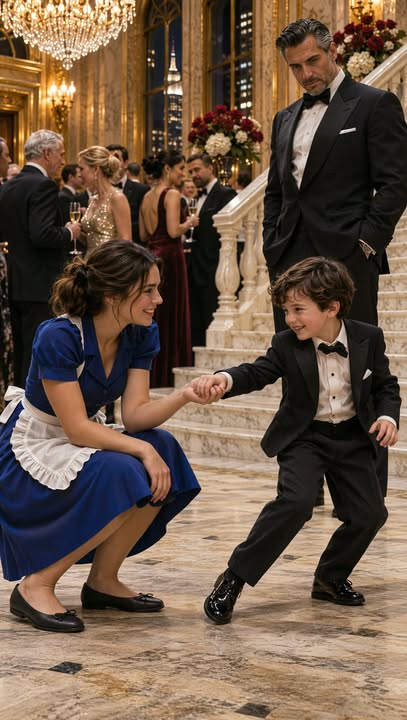
Part 6 – The Beat We Kept
“I’m grateful you gave the evidence to the investigators,” Dominic said.
I sat across from him on the rug, with Matteo tucked against his shoulder and Noah’s notebook resting inside my bag.
“I gave them the evidence that could help,” I said. “The rest of Noah’s life isn’t theirs to own.”
Dominic nodded, slowly and without argument.
“I understand.”
Matteo’s cheek pressed against his father’s sleeve.
“Are they going to find out who made the loud sounds?” he asked.
“They’re trying,” I said.
“Will the room be loud again?”
“No,” Dominic answered. “Not when I can help it.”
Matteo considered this, then reached for the loose end of his bow tie.
“Can we go home?”
“Yes,” Dominic said. “Whenever you’re ready.”
The investigators kept Graham at the hotel for several hours, asking questions while the recording and board log were copied and examined.
He did not ask again to see the file.
Before leaving, he sent word that he would cooperate fully and provide the name of the event contractor who had told him the sound changes were routine.
Dominic’s first instinct was to remain at the Pierre and oversee every conversation himself.
Instead, he went home with Matteo.
He left the investigators to do their work, and he left me with the choice of whether to follow.
I went home too, carrying Noah’s notebook and the music box.
For the next few days, my life returned to its old shape only on the surface.
I went back to the hotel for my shifts, polished silver, carried trays, and tried not to glance toward the east sitting room each time I passed its door.
At night, I read through Noah’s notes, slowly, without trying to turn every sentence into a clue.
Some pages were practical lists of cables and equipment.
Others held small observations I had forgotten he used to make: a song playing in the wrong key, the name of a stranger who had helped him carry a speaker, the time a little boy had fallen asleep under the table during a rehearsal.
Near the back, I found a short line about Matteo.
“He knows the room before the room knows him.”
I understood it as soon as I read it.
Noah had always noticed how much people heard without listening.
The police contacted me the following week.
The original board log matched the notes in Noah’s notebook, including several sound changes that had been removed from the version submitted to the hotel.
The restored recording also became clearer when the sound engineer compared it with the log.
The voices belonged to Graham Pike and a contractor hired to manage the gala’s technical equipment.
Graham had not arranged the deliberate noise himself, but he had known the contractor was altering the sound cues and had allowed it to continue.
He told investigators he had been under pressure to finish a private agreement concerning control of the family foundation.
The contractor had promised the changes would be brief, harmless, and unnoticeable to anyone except Dominic, who would be made uncomfortable enough to reconsider the transfer.
But the effects had not been harmless to Matteo.
And Noah had understood that before the people with the power to stop it did.
Graham admitted he had seen Noah make notes after the event.
He had asked him to hand them over, saying the event’s technical records belonged to the company.
Noah had refused.
He told Graham he would share the evidence once Matteo was safe and the people responsible were no longer in a position to pressure the family.
Graham said he had not known Noah would die.
The investigators found no proof that he had arranged or ordered the crash that killed him.
They did, however, uncover evidence that the contractor had altered his own records after the gala and that Graham had helped keep those changes from being examined.
That led investigators to reopen the review of Noah’s death and look again at the circumstances surrounding the crash.
The truth did not arrive all at once, or in a form that could make three lost years feel fair.
It came through careful interviews, records, and people finally being willing to say what they had once chosen not to say.
Graham was charged for his part in concealing the altered event records and for the related financial scheme.
He agreed to cooperate with investigators and the foundation’s independent review.
The contractor faced separate charges connected to the falsified records.
Noah’s death was formally reexamined, and the case was no longer described simply as a settled accident.
Dominic could have demanded that everyone involved answer to him.
Instead, he gave investigators access to the family’s records and asked his lawyers to cooperate with the independent review.
He did not ask the police to hurry, and he did not ask them to make an example of anyone.
When I asked why, he said, “Because the truth doesn’t become more useful just because I control who hears it.”
It was the first time I believed he had learned something he could not simply order the world to obey.
He asked me to meet him at a small café near the hotel after the first round of interviews had concluded.
I expected a businesslike conversation.
Dominic arrived alone, in a dark coat, and set no envelope of money on the table.
“I owe you an apology,” he said.
“You owe me several.”
“I know.”
He did not look away when I reminded him of the ballroom, the guards, or the way he had ordered the exits closed before he knew whether Lena was a danger.
“I was frightened for Matteo,” he said. “I used that fear to justify making everyone do what I wanted.”
“You did.”
“I’m sorry.”
The apology held no excuse inside it.
He told me he was rebuilding the family foundation’s oversight so that people outside his household would review its decisions.
He also told me the foundation would fund a program for children who needed quieter spaces at public events, but he would not announce it as a tribute to Noah without asking me.
That question mattered more than the offer.
“I don’t want his name used as a symbol,” I said. “I want what he noticed to matter.”
“Then that’s what we’ll build around,” Dominic replied.
“‘We’?”
“Only if you want to be part of it.”
He offered me no payment for staying quiet.
He offered no promise that my life would become easier because he had influence.
Instead, he asked whether I would consider working with Matteo, using rhythm and movement to help him express what felt difficult to say.
“You can refuse,” he said. “And if you accept, you can leave whenever the work stops being right for you.”
I looked through the café window at the street, where people hurried beneath the gray sky with their collars turned up.
My rent would still be due.
My shifts at the hotel would still be long.
Grief would still find me in ordinary places, sometimes in a song or a familiar way of tapping my fingers.
But the thought of helping Matteo find a way to be understood felt less like an escape from my life than a continuation of something Noah had begun.
“I’ll meet with him,” I said. “Then I’ll decide.”
Dominic smiled, not as a man who had won something, but as someone relieved not to have taken it.
Lena remained part of Matteo’s care.
She apologized to me again once the interviews were over, and this time I told her I was still angry but willing to begin again.
She accepted that without asking me to move faster.
The message she had kept from Dominic did not disappear from the story of what happened.
It became part of what they both had to understand: protecting someone could become another way of deciding for them.
Lena promised to ask more and assume less.
Dominic promised to listen before making a plan.
Neither promise repaired everything, but they were a place to start.
The months that followed were not dramatic.
They were better than dramatic.
Matteo and I met in a small room with a rug, a window that looked out on a garden, and soft panels along the walls to keep sudden sounds from echoing.
We began with four beats.
Sometimes he answered by stepping sideways.
Sometimes he answered with a tap of his fingers against the floor.
Sometimes he said he wanted no rhythm at all, and we sat together without trying to fill the quiet.
Dominic was there for the first few sessions, but he learned not to hover at the door.
When Matteo wanted him to join, he did.
When Matteo wanted him to wait outside, he waited.
The first time Dominic tried the four-beat pattern, he was stiff enough to make Matteo laugh.
“You have to bend,” Matteo told him.
“I am bending.”
“More.”
Dominic bent lower.
Matteo smiled, satisfied, and continued the pattern.
I kept the notebook at home, in a drawer beside the music box.
The investigators asked for copies of the relevant pages and honored my request to keep the rest private.
Noah’s work was entered into the case file, but no one published his unfinished notes or turned them into a spectacle.
I gave a statement about what I had learned and what I remembered.
When the review of Noah’s death was formally reopened, I sat beside Lena in the waiting room.
Dominic waited down the hall, keeping his distance until I asked him to join us.
He did not offer certainty.
He offered to sit.
I found that I could accept the difference.
As the months passed, the worst of the unanswered questions did not vanish, but they no longer filled every room I entered.
I learned that grief could leave space for other things without asking permission from the past.
I could miss Noah and laugh with Matteo in the same afternoon.
I could remember the way he heard the world and still be grateful for the music that remained.
The first warm evening of summer, Dominic invited us to a family gathering at his home.
He called it small.
It was small by his standards, which meant there were only a handful of relatives, a few close friends, and no orchestra.
The garden lights glowed softly among the leaves.
A string quartet played in the far room, quiet enough that the notes seemed to breathe rather than fill the space.
Matteo wore no bow tie.
He had chosen a soft blue shirt and shoes that gave him room to move.
Near the garden doors, he stopped and watched the adults talking.
I saw his fingers begin to tap against his leg.
Four beats.
A pause.
Two more.
I answered on my knee.
Matteo looked at me and grinned.
He stepped sideways.
I followed.
He dipped his knees, turned in a wobbly half-circle, and laughed.
The people nearby made space without being asked.
No one clapped too loudly or called attention to him.
They simply let the dance belong to him.
Dominic stood at the garden threshold, watching.
I held out my hand.
He looked at Matteo first.
“Would you like me to join?” he asked.
Matteo nodded.
Dominic stepped into the pattern, his shoulders still a little stiff and his timing a little late.
Matteo corrected him with a serious look.
“Four beats,” he said. “You have to wait.”
“I’m waiting.”
“You’re not.”
Dominic slowed down.
This time, he let the pause stay empty until Matteo filled it.
The three of us moved together beneath the warm garden lights.
A step to the side.
A dip.
A turn.
A breath of quiet between one pattern and the next.
I thought of Noah, not as he had been in the last days of his life, nor as the name at the center of a file, but as my brother at the dashboard, tapping out a way to tell me he needed help.
His rhythm had reached me then.
It had reached Matteo now.
And as Dominic learned to wait for the last count, I felt Noah’s memory settle beside us—not an open wound asking to be explained, but a love that had found another way to keep time.
**–THE END–PLEASE
Share your thoughts or feedback to motivate us to create more stories ♥️
* * *
[PREVIOUS: PART 5](https://echoesofstories.idolsgift.com/blog/part-5-the-woman-in-silver-046)
✓ Lynn R. Adams
Part 6 – The Beat We Kept “I’m grateful you gave the evidence to the investigators,” Dominic said. I sat across from him on the rug, with Matteo tucked against his shoulder and Noah’s notebook resti…