PART 6 (THE END): The Woman at the Door 046
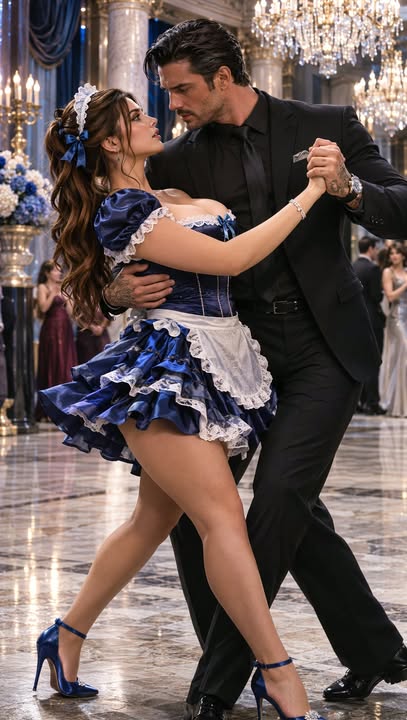
Part 6 – The Dance We Chose
“The identity in the file may not match the name your father left you.”
For one suspended moment, I could hear only the faint rush of traffic beyond the windows.
Then I asked, “What does that mean?”
“The records contain a protected identity that doesn’t correspond to Victoria Sterling,” the investigator replied. “We’re confirming the information before contacting anyone. Until then, please don’t attempt to locate the witness yourself.”
“I understand.”
“I know this is difficult, Ms. Bennett. Mr. Hale is safe, and he’ll be able to speak with you soon.”
I thanked her and ended the call.
Elena had risen from her chair.
“What did she say?”
“They found a sealed file. Someone tried to access it, but the investigators have secured it.”
“Is the witness in danger?”
“They don’t know yet.”
I stood in the middle of the room, my father’s letter still open on the table.
For weeks, every discovery had brought us closer to an answer, only to reveal another question waiting beneath it.
Now the person my father had protected was no longer a name on a card, but someone with a life and a face, someone who might still be living with the consequences of a choice made long ago.
“I need to go,” I said.
Elena reached for her coat.
“I’ll come with you.”
“I’m not sure they’ll let us see him.”
“Then we’ll wait until they do.”
She did not insist that she knew what was best for me.
She simply offered to stand beside me, and I was grateful.
At the federal office, an investigator met us in the lobby and explained that Vincent was being interviewed as a witness to the discovery of the second ledger.
He had not been accused of wrongdoing.
The file had been moved to a secure location, and no identifying details would be shared until investigators confirmed the witness was safe.
“Is the person in Chicago?” I asked.
“We can’t answer that yet.”
“Does Victoria know?”
“Not at this stage.”
Elena’s hand found mine.
The waiting room was modest, with soft gray chairs and a glass of water on a small table.
I thought of how little it resembled the places I had imagined when I was young and heard adults speak of justice.
There were no grand rooms or dramatic declarations.
There were forms, patient questions, and people taking care not to turn a life into a story before they understood it.
After almost an hour, Vincent came through the inner door.
His tie was loosened, his face tired, but when he saw me, his shoulders eased.
I crossed the room to him.
“Are you all right?”
“Yes.”
He took my hands, then stopped, leaving me the choice of whether to stay close.
I stepped into his embrace.
For a few quiet seconds, I let the steady warmth of him remind me that we were here, in the present, not in a ledger or a memory.
“What did they find?” I asked.
“The second ledger showed that the network continued using a few accounts after my father believed it had been contained. The investigators are tracing the final transfers now.”
“And the witness?”
“The sealed file contains a different name from the one in your father’s note. They believe he may have used a protected identity for many years.”
“Do they know if he’s alive?”
“They’re trying to confirm that carefully.”
“Why would my father write Victoria’s name?”
Vincent glanced toward the investigator, who had given us a little privacy but remained nearby.
“We don’t know yet,” he said. “The file may explain it.”
The investigator came forward and introduced herself as Agent Raines.
She explained that the identity in the file appeared to belong to a man who had once worked in the company’s accounting department.
He had helped Daniel identify the false accounts, then agreed to testify when the investigation began.
Victoria had been the person who verified several of the records, but she had not been the protected witness.
“Is he safe?” I asked.
“We have reason to believe he is alive and living under a protected identity,” Agent Raines replied. “We’re taking steps to contact him through the proper channels.”
My breath left me in a slow, shaky exhale.
“He may be able to explain why my father wrote Victoria’s name.”
“That’s possible,” she said. “But we’ll need to speak with him before drawing conclusions.”
Vincent looked toward the sealed case on the table.
“Who tried to access the file?”
“We are still investigating that. At this point, we have no reason to believe it was a direct attempt to reach the witness. It may have been an effort to locate records before they were transferred.”
“Could it have been one of the surviving members of the network?” I asked.
“It could have been,” Agent Raines said. “We’re examining access logs and the company’s internal records. We don’t want to speculate until we know more.”
I appreciated the carefulness.
Too many years had been spent treating fragments as if they were complete answers.
This time, we would let the truth arrive in its proper order.
The weeks that followed were long, but they were not empty.
The investigators reviewed the ledgers, traced the false payments, and separated the names of employees who had knowingly participated from those who had been used without their knowledge.
Several former executives were charged with financial crimes and conspiracy.
Others cooperated, providing records that helped investigators understand how the network had operated and where its remaining funds had gone.
The protected witness was found alive.
He had been living under another name in a quiet town several states away, working as a bookkeeper for a small family-owned business.
When investigators contacted him, he agreed to speak with them and confirmed that Daniel had helped him escape a dangerous situation after he provided evidence.
He also confirmed that Daniel had been working with federal investigators long before the photograph at the gala was taken.
The truth in my father’s records was real, but it was not quite the truth I had first imagined.
The witness explained that Victoria had been the person who reviewed the charitable accounts, while he had been the one who helped Daniel trace the hidden transfers.
My father had written Victoria’s name on the card because he believed she was the person most likely to connect us with the witness without exposing him.
She had not been the witness herself.
She had been the bridge.
When Victoria learned the details, she sat with me in the garden at Vincent’s home, her hands wrapped around a cup of tea.
“I wish I had remembered sooner,” she said.
“You were asked to protect someone’s identity,” I replied. “It makes sense that you didn’t connect an old name to a file you had never seen.”
“I thought the case had ended.”
“So did my father, for a while.”
She looked toward the house.
“Vincent is doing what his father should have done years earlier.”
“He’s doing what he believes is right now.”
“That’s different.”
“Yes,” I said. “It is.”
The records did not prove that every person in the Hale businesses had known about the network.
They showed that some had helped it, some had looked away, and many had simply done their jobs without understanding what the numbers concealed.
The investigators made that distinction public when the time came.
The innocent employees were not named as criminals, and the witness’s protected identity remained sealed.
Daniel’s role was made clear in the official findings: he had been an undercover accountant who gathered evidence, cooperated with investigators, and helped bring the network to light.
For the first time, his work was no longer hidden behind rumors or incomplete records.
His name was cleared.
I read the statement alone in my apartment.
Then I read it again with Elena beside me.
She reached for my hand, and I let her take it.
“I wish he could have heard this,” I said.
“So do I.”
“I wish he had been able to come back.”
“I know.”
Elena’s eyes shone.
“I can’t return the years I kept quiet.”
“No.”
“I won’t ask you to forgive me all at once.”
I studied her face, seeing the woman who had come through Vincent’s doors with fear in her eyes, and the sister my father had once trusted with the most important thing in his life.
“I don’t know how to make the lost years disappear,” I said. “But I don’t want to spend the rest of my life pretending they’re all we have.”
Elena’s lips trembled.
“Neither do I.”
I leaned across the small table and embraced her.
It was not a cure.
It was a beginning.
After the legal review, Vincent stepped aside from the company’s board while the independent investigation continued.
Several of the family’s legitimate businesses were separated from the accounts and managers connected to the criminal network.
Others had to be sold or closed.
Some employees left because they could not trust the company again.
Others stayed, choosing to help rebuild its work under new oversight.
Vincent did not try to preserve the family empire as it had been.
He accepted that the name itself could not be separated from the choices made beneath it, and he let the investigation proceed even when it cost him control, money, and years of work.
When I asked him whether he regretted it, he answered without hesitation.
“I regret what people did with the businesses,” he said. “I regret what my father kept from me, and what his silence cost you. I don’t regret telling the truth once I knew it.”
It was not the answer of a man untouched by loss.
It was the answer of a man willing to live with it.
He began rebuilding the remaining legitimate companies with a smaller group of partners, a transparent board, and strict independent oversight.
He sold the grand house where I had worked as a maid.
At first, I thought he was leaving because everything that had happened there had become too difficult to carry.
But he explained that the house had belonged to his father’s generation, and he did not want to confuse inheritance with identity.
“I don’t need the rooms to remember him,” he said. “And I don’t want a house that makes other people feel they must belong to me.”
The new place he chose was smaller, full of windows, and close enough to the river that evening light touched the walls in a soft blue shimmer.
He asked me to come there only when I wanted to.
I came often.
We learned how to be together without an audience, without a gala, without anyone we needed to convince.
There were quiet breakfasts and walks along the river.
There were difficult conversations when I missed my father so suddenly that the grief felt new again.
There were evenings when Vincent returned from a meeting weighed down by the cost of rebuilding and did not pretend that it was easy.
He never used tenderness to hurry me past sorrow.
I never used his love as a reason to stop asking hard questions.
We made room for both.
One evening, nearly a year after Elena had burst through the doors of his old home, I found the diamond ring in its velvet box on a shelf in Vincent’s study.
He had never asked me about it again.
I picked up the box and carried it to him.
He was reviewing a stack of documents at the kitchen table, his sleeves rolled to his forearms.
“I wondered when I’d see that again,” he said.
“You never brought it up.”
“I didn’t want the ring to become another thing you had to answer for.”
“I’m glad you didn’t.”
I sat opposite him and opened the box.
The diamond caught the light, bright but no longer dazzling enough to make me forget everything around it.
“I loved that you asked me,” I said. “I was frightened because I didn’t know whether I was saying yes to you or to the life you were offering me.”
“That was fair.”
“I know more now.”
He laid down the papers.
“What do you know?”
“I know you when no one is watching. I know you when you’re tired, when you’re wrong, when you’re trying to do better than the people who came before you.”
His face softened.
“And I know you don’t need me to prove that you can choose your own life.”
“No,” he said. “I don’t.”
“I also know I love you.”
For a moment, he did not speak.
Then he stood, came around the table, and knelt in front of me.
He did not produce another ring.
He simply rested his hands over mine.
“Clara Bennett,” he said, his voice low and steady, “will you marry me?”
I looked at the man who had once asked me to pretend beside him, then had learned to let me choose my place without fear of what the answer would cost.
“Yes,” I said.
His eyes closed briefly, and when they opened, their gray seemed bright with relief.
“Yes?” he asked, as if he needed to hear it once more.
“Yes.”
He kissed me gently, and I set the ring on my finger myself.
We chose a small wedding in a garden beside the river, with white flowers and blue ribbons tied around the chairs.
Elena stood with me while I dressed, her hands shaking as she fastened the last small buttons at my back.
“I can’t believe I get to be here,” she whispered.
“I’m glad you are.”
She held me for a long moment.
“I loved your father,” she said. “I loved the little girl you were, too, even when I was too afraid to tell you.”
“I know.”
And I did.
Not because the years of silence had disappeared, but because love had finally been allowed to speak in the present tense.
Victoria came early and helped arrange the flowers.
She had left the world of family engagements and business expectations behind, and she seemed lighter for it.
When she saw Vincent, she smiled.
“You look more nervous than you did at the gala.”
“I was pretending then.”
“And now?”
“Now there’s no one to distract me.”
She turned toward me.
“Good,” she said. “That means you can both be yourselves.”
The ceremony was intimate.
A few friends stood among the guests, along with people who had supported us through the investigation and the long work of beginning again.
Vincent wore a dark suit without a family crest.
I wore a simple ivory dress with a deep-blue sash, the color a quiet tribute to the evening our story began.
When I reached him, he took my hands and waited until I was ready.
No one told me where to stand.
No one told me what my answer should mean.
We spoke our vows plainly, with our voices sometimes unsteady and our promises chosen rather than inherited.
When the ceremony ended, sunlight moved through the leaves above us, laying warm patterns across the path.
Elena cried openly.
Victoria laughed and wiped at her eyes when she thought no one was looking.
Vincent leaned close to me.
“Do you remember our first dance?” he asked.
“I remember stepping on your shoes.”
“You did it twice.”
“Three times.”
“Three?”
“I was nervous.”
He held out his hand.
The musicians began the same slow melody the orchestra had played at the gala, though now the notes seemed softer, less like a performance and more like a welcome.
I placed my hand in his.
For a moment, I waited for him to lead.
Then I smiled and stepped forward.
Vincent followed me.
I turned beneath his raised hand, my dress moving over the garden stones, and saw him watching me with the same wonder he had shown beneath the ballroom chandeliers.
Only this time there was no borrowed ring, no family plan, and no pretense to protect us from what we felt.
When the music ended, I rested my forehead against his.
“Do you wish tonight didn’t have to end?” I whispered.
“I do,” he said.
I took his hand.
“Then don’t let it.”
We walked back toward our family and friends together, not as a story we had been asked to perform, but as two people who had chosen the truth and chosen each other.
Behind us, the river carried the last of the afternoon light toward the city.
Ahead of us waited a life we would build one honest day at a time.
**–THE END–PLEASE
Share your thoughts or feedback to motivate us to create more stories ♥️
* * *
[PREVIOUS: PART 5](https://echoesofstories.idolsgift.com/blog/part-5-the-woman-at-the-door-046)
✓ Lynn R. Adams
Part 6 – The Dance We Chose “The identity in the file may not match the name your father left you.” For one suspended moment, I could hear only the faint rush of traffic beyond the windows. Then I …