PART 6 (THE END): The Warning Beneath the Water 053
Part 6 – Beside Her, in the Daylight
“Who said your name?”
Elena’s question remained in the library after the recorder fell silent.
Victoria looked at the small machine, then at the sealed evidence sleeves on the table.
She recognized the voice that had spoken her name, but recognition did not bring relief.
It brought the memory of a winter evening two years earlier, her father on the telephone, his voice lowered as he told her not to assume the report told her everything.
“That sounded like my father,” she said.
The archivist nodded.
“The recording is damaged, but the voice behind his is clearer than the first section.”
“Can you isolate it?” Ruth asked.
“I’ll send it to the technician tonight.”
Julian kept his gaze on Victoria.
“Did your father know he was being recorded?”
“I don’t know.”
“Did he say anything like that to you before he died?”
Victoria searched the memory.
“He told me not to assume the report told me everything. He said he’d found something he needed to show you.” She swallowed. “He didn’t say he was trying to protect me.”
Elena drew a chair closer to Victoria, leaving space between them.
“Perhaps he meant that the truth would reach you eventually.”
“Or that someone would use me to get to him,” Victoria said.
No one offered a comforting guess as fact.
That, she realized, was one of the things that had changed.
For years, she had been surrounded by explanations that arrived already polished, their rough edges smoothed away before anyone could ask what lay underneath.
Now there was uncertainty, and everyone in the room was willing to let it remain uncertainty until they had evidence.
Ruth arranged for the recorder and the remaining files to be transferred to her office for secure examination.
She asked Victoria to return the following morning to give a full statement, and she told Julian the inquiry would continue independently.
When the last of the investigators left, the library fell quiet.
Elena sat with her hands folded on the table.
Julian watched the dark windows, his reflection faint in the glass.
Victoria stood between them, no longer wearing her black-and-white maid uniform, but still feeling the weight of the role she had entered the estate under.
“I should go home,” she said.
Julian turned from the window.
“If that’s what you want.”
“It is, for tonight.”
He nodded, and did not ask her to stay.
That mattered more than she expected.
The next morning, Victoria sat across from Ruth and told the story from the beginning.
She explained how she had applied for the secretary position, what she had learned in the office, and what she had kept to herself.
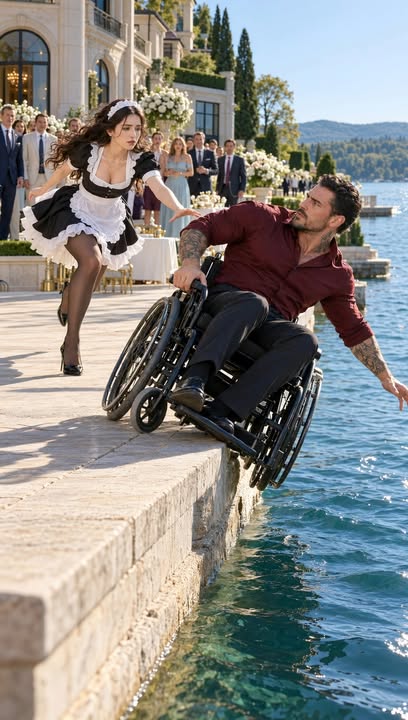
She described the fall at the lake, the whisper behind her, and the people who had watched until Julian went beneath the surface.
Then she told Ruth about her father’s last call, the old reports, and the moment she had found his handwriting tucked into a file Julian himself had never seen.
Ruth listened carefully, asking for dates where Victoria could remember them and making a distinction between what she had witnessed and what she had inferred.
When the statement was finished, Victoria signed each page.
The inquiry took months.
Ruth’s team traced the missing access records, compared the surviving camera footage with the estate’s renovation files, and examined the damage to Julian’s wheelchair.
The altered wheel lock had been changed before the gathering, not damaged during the fall.
The loose stonework at the terrace had also been worked on recently, though investigators found no evidence it had been loosened to cause Julian’s fall.
Its condition had made the area more dangerous, but the direct mechanism had been the chair.
A service log from the day of the incident had been amended after the fact.
The original entry placed Elena in the west wing when Julian’s chair was tampered with.
The later version, created from a copy of the log, placed her near the terrace.
That altered page was the source of the photograph’s apparent certainty.
The photograph itself proved only that Elena had been near the rose display earlier, before the service record put her elsewhere.
It did not show her giving the order.
It did not show her near Julian when the chair moved.
The order had been given by one of the event guards, a man who reported to Marco and had received his instructions through a private earpiece.
He had been told to keep guests away from the terrace until the security team had “cleared the area.”
He claimed he believed there might be a second threat.
He did not know the chair had been altered, but he admitted that he had repeated the instruction not to touch Julian after he heard a voice through his earpiece.
That voice belonged to Marco.
The guard had frozen when he saw Julian in the water.
He had followed an instruction at first, then failed to act even when it was clear the danger had become immediate.
He gave a statement and surrendered the earpiece and its service records.
Marco’s own messages showed that he had arranged for the wheelchair to be altered and had directed the guard to hold the guests and other security staff back.
He had expected the fall to leave Julian isolated long enough for the lake to finish what he had planned.
He had not expected Victoria to jump.
The investigation also established that Marco had arranged the attack two years earlier that left Julian paralyzed.
Daniel Hayes had discovered the original access route and learned enough about the altered security records to understand what had happened.
He had tried to reach Julian before the attack, but the warning had been intercepted and hidden by an employee in Julian’s office, acting under Marco’s direction.
Julian had never received the letter.
He had not known Daniel had found the passage, had not known the report was being altered, and had not ordered anyone to silence him.
The evidence could not answer every question about the night Daniel died.
There had been no witness to the moment of his fall, and the final stretch of the passage had been too badly damaged to recover every trace.
But the restored recording, the service corridor footage, the falsified report, and Marco’s own messages established that Daniel had died while trying to carry the warning to Julian.
The coroner reviewed the case and amended the original finding.
Daniel Hayes’s death was no longer listed as an accidental fall.
The revised report stated that he had been killed after discovering a planned attack and attempting to alert the intended victim.
The inquiry could not establish every hand involved in that final act, but it showed that Daniel had not been careless, confused, or alone in the matter that mattered.
He had been trying to protect someone.
He had been trying to get the truth through.
When Ruth delivered the amended report, Victoria read it at her small kitchen table with both hands around a mug of tea she had not tasted.
The words did not give her father back.
They did not make the two years of unanswered questions disappear.
They did not make the phone call from that rainy night any less painful.
But they gave the silence a shape.
Her father had not forgotten her.
He had not left her with a meaningless mystery.
He had been doing the work he believed was right, even when it frightened him.
When Victoria finished reading, she covered her eyes with one hand.
The tears came quietly.
They were not the sharp, bewildered tears she had cried after his death, when every memory seemed to end in a question.
These carried grief, but they carried recognition too.
Ruth waited with her, saying nothing until Victoria looked up.
“Thank you,” Victoria said.
Ruth nodded.
“I’m sorry it took this long.”
“So am I.”
The weeks that followed brought more hearings, more documents, and difficult decisions for everyone connected to the estate.
Marco was charged after the investigation was completed.
He did not deny the messages or the orders attributed to him.
He disputed the meaning of some of the records, but he did not claim the evidence had been invented.
Elena testified about the missing plans, the guard who stopped her from reaching the terrace, and her own decision to keep parts of her investigation to herself.
She spoke plainly, including the things she wished she had done differently.
Julian provided the full security files and gave his statement without asking Ruth to separate the family from the organization.
He also turned over records that implicated people who had worked for him for years.
Some had acted under Marco’s direction.
Others had chosen to preserve their own positions by looking away.
The inquiry distinguished between them as carefully as it could.
Julian could not make the consequences gentle.
He could only refuse to make them disappear.
The criminal operation that had once surrounded the Vescari family began to come apart, piece by piece.
Several people cooperated with investigators.
Others were charged.
Contracts were reviewed, properties were examined, and accounts that had once been managed through layers of private authority were transferred to outside trustees.
Julian stepped back from the parts of the organization that had relied on intimidation and secrecy.
He cooperated with the authorities, even when it meant seeing his own name printed beside questions he could not answer with a simple defense.
He did not claim that being deceived made him innocent of every consequence.
“I trusted Marco,” he told Victoria one evening, months after the lake incident.
They were in the library, where the recovered records had once covered the table.
Most of the files had been returned to investigators, and the room looked almost ordinary again.
“I trusted him because he had been family since we were children,” Julian continued. “Then I trusted him because I was injured and he was useful. After that, I trusted him because admitting I had handed him too much power would have meant admitting I had helped create the situation.”
Victoria sat across from him.
“That sounds like a hard thing to admit.”
“It was easier to think he had become someone else.”
“And now?”
“Now I understand that what he did was his choice, but what I allowed around him was mine.”
She watched him absorb the weight of it without turning it into a punishment for himself.
“Understanding responsibility doesn’t mean you have to take responsibility for everything,” she said.
“I’m learning the difference.”
“So am I.”
For a while, they sat without speaking.
The trust between them had not returned in a single moment.
It had been built slowly, through disclosed records, difficult answers, and Julian’s growing willingness to let Victoria make choices without trying to direct them.
She had not moved back into the estate.
She had returned to her own apartment after giving her statement, and she had refused the position Julian offered her when the investigation began.
“I don’t want to be your secretary,” she had told him.
He had nodded.
“I understand.”
“I don’t want to be hired because I saved you.”
“I understand that too.”
“And I don’t want to have to ask your permission to leave.”
“You won’t.”
He had not tried to bargain with her or turn her refusal into an insult.
Instead, he had asked what she wanted to do.
Victoria had told him about the sketches she used to make of old buildings, the way she had always noticed the lines of a house before its furniture, the quiet satisfaction she felt when something worn could be repaired without being made to look new.
She had once imagined studying architecture, but money and family responsibilities had led her toward whatever work she could find.
“I want to learn estate restoration,” she said. “Not for your estate. Just the work itself.”
Julian had listened.
Then he had given her the name of a restoration program and offered to connect her with a conservator who worked with historic properties.
He had not offered to pay for it.
He had asked whether she wanted the introduction.
She did.
Victoria applied on her own, completed the interviews, and earned a place in the program.
By the time the next spring came, she was spending her days studying old stonework, window frames, roof beams, and the delicate work of bringing a damaged building back into use without erasing the hands that had built it.
She liked the patience of the work.
She liked that restoration required listening before repair.
A wall could carry a record of everyone who had touched it.
The old estate plans, she had learned, were not just lines and measurements.
They were the memory of a place.
Elena visited the estate’s eastern grounds less often after the investigation, but when she did, she and Julian took tea in the sunroom.
Their reconciliation was not a sudden return to the closeness they had once shared.
It was more honest than that.
They spoke about the years in which they had both mistaken silence for protection.
Elena admitted that she had kept her investigation from Julian because she feared he would dismiss it or act before she understood what it meant.
Julian admitted that he had made it easy for her to believe he would.
They did not ask each other to forget.
They began asking each other questions sooner.
One afternoon, Victoria joined them in the sunroom after a class on historic masonry.
Elena had brought a small box from her old room.
Inside lay Daniel’s gardening gloves, carefully mended at the palms.
“I found these after the report was amended,” she said. “I thought you should have them.”
Victoria ran her fingers over the worn leather.
“My father used to keep them beside the back door.”
“He was meticulous with the garden.”
“He said plants told you what they needed if you stopped trying to make them behave.”
Elena smiled faintly.
“I think he said something like that to me once.”
Julian looked at the gloves.
“He used to tell me the eastern wall needed more attention than I gave it.”
“Did you listen?” Victoria asked.
“I told him I was busy.”
“And was he right?”
“He usually was.”
The three of them sat in the late-afternoon light, the old hurt still present, but no longer the only thing between them.
When summer arrived, Ruth confirmed that the evidence had cleared Victoria’s father’s name and established that Julian had not known his warning had been concealed.
Julian sent Victoria a copy of the final findings.
He did not write a long letter.
He wrote only that Daniel had been brave, that the record now reflected it, and that Victoria had been right to keep asking.
She kept the letter beside the amended report.
She did not need it to tell her what her father had meant to her.
But she was glad Julian had written it.
A year after the incident at the lake, Victoria returned to the estate for the first time since the investigation had ended.
The invitation came without pressure.
Julian asked whether she would like to visit the grounds in daylight and see the work the restoration team had completed near the eastern terrace.
Victoria answered that she would, as long as the visit was about the stonework and not a public ceremony.
He agreed.
She arrived in the late morning wearing a pale blue blouse, dark trousers, and sturdy shoes.
Her long brown hair fell loose down her back, moved gently by the breeze.
No one had asked her to wear a uniform.
No one had asked her to wait outside the main entrance.
Julian was already on the terrace, seated in his wheelchair with Elena beside him.
The lakeside was quiet.
The repaired stone edge gleamed in the sunlight, its mortar matched to the old work so closely that the new section could be recognized only by someone who knew where to look.
Victoria crouched beside it, examining the finished joints.
“The mason did a thoughtful job,” she said.
“He had good guidance,” Julian replied.
“He had good measurements.”
“Those too.”
Elena smiled.
“Are you going to spend the entire visit discussing stonework?”
“That was the invitation,” Victoria said.
“It was,” Julian agreed.
“And yet,” Elena said, “I suspect he hoped you might stay for lunch.”
Julian did not deny it.
Victoria looked up at him.
“Did you?”
“Yes.”
She straightened.
“Then you could have asked.”
“I’m asking now.”
It was a small exchange.
Nothing about it resembled the order that had once sent guards moving across the terrace.
Victoria let herself hear the difference.
“I’d like that,” she said.
After lunch, Elena left them to return a call, giving the two of them more space without making a ceremony of it.
Julian asked whether Victoria wanted to see the boathouse.
She looked toward the path, then back at the lake.
“Not today.”
“All right.”
No disappointment crossed his face.
He turned his chair toward the water, and she walked beside him.
They stopped at the place where the terrace met the stone steps.
The lake was bright beneath the afternoon sun, its surface broken by the breeze.
Victoria remembered the cold that had closed over her head, the weight of her skirt and apron, the wrenching effort of pulling Julian free.
She also remembered the people on the shore, the lowered eyes, and the fear that had settled in her when she understood that someone had meant for him to die.
Julian looked out across the water.
“I still remember the first thing I saw when I came up.”
“The sky?”
“Your face.”
She glanced at him.
“I was probably terrified.”
“You looked determined.”
“I was terrified and determined.”
“That sounds more like you.”
They watched the sunlight shift across the lake.
After a while, Julian said, “I never thanked you properly.”
“You thanked me in the library.”
“I thanked you for saving my life.”
“You did.”
“I don’t think that’s what I’m thanking you for now.”
Victoria waited.
He turned toward her.
“You gave me a reason to look at what had happened instead of accepting the easiest answer.”
“I didn’t do that for you.”
“I know.”
“I did it because my father deserved to be heard.”
“I know that too.”
She rested one hand on the stone railing.
“My father would have wanted the truth even if it cost him.”
“He would have wanted you safe.”
“He wanted me to be able to choose.”
Julian lowered his eyes briefly.
“That is what I’m trying to do now.”
“You are.”
It was not a promise that he would never make a mistake.
It was recognition that he had learned to question the authority he once believed he had to preserve.
He glanced toward the sunroom, where Elena stood at the open door, talking on her phone.
“She thinks we should have lunch in the garden next time.”
“There will be a next time?”
“If you want there to be.”
Victoria considered the question, not because she doubted what she wanted, but because she had grown to value being asked.
“Yes,” she said. “There can be.”
Julian’s expression softened.
“I’d like that.”
She took his hand.
The gesture was simple, and it belonged to neither of them more than the other.
No one was watching to see what they would do.
No one had given an order.
The lake moved quietly below the terrace, holding the reflection of the open sky.
Julian looked at their joined hands.
“Thank you for saving my life, Victoria.”
She gave his hand a gentle squeeze.
“You’re welcome.”
Then she met his eyes.
“But you’re the one who finally chose how to live it.”
He held her gaze, accepting the words rather than trying to turn them into something easier.
Beside her, not above her, Julian turned his chair toward the garden.
Victoria walked with him into the daylight.
**–THE END–PLEASE
Share your thoughts or feedback to motivate us to create more stories ♥️
* * *
[PREVIOUS: PART 5](https://storyly.idolsgift.com/blog/part-5-the-warning-beneath-the-water-053)
✓ Lynn R. Adams
Part 6 – Beside Her, in the Daylight “Who said your name?” Elena’s question remained in the library after the recorder fell silent. Victoria looked at the small machine, then at the sealed evidence…