PART 6 (THE END): The Warning Behind the Smile 047
Part 6 – A Home Built on Truth
“Elena,” Alessandro said, turning the scrap toward the others.
Lucia leaned over the desk, her face changing as she read the name.
“I remember her,” she whispered.
Genevieve glanced between them. “The older sister from the fire?”
“Yes,” Lucia said. “Elena and Paolo. They were the children your mother visited.”
Alessandro studied the different handwriting beneath his mother’s note.
“Who wrote this?”
Lucia looked closely, then shook her head.
“I don’t recognize it.”
“Could Elena have written it?”
“Possibly. She would have been a child then, but this paper is newer than your mother’s letter.”
Luca eased the scrap into a clear sleeve.
“We should compare it with the archive documents, but we shouldn’t assume what it means yet.”
Alessandro looked at his mother’s words again.
If Alessandro asks why the charter was never signed, tell him I chose the lodge, not the company.
“What company?” he asked.
Lucia was quiet for a moment.
“Your father wanted to sell the lodge to a development company,” she said. “Your mother refused. She said it belonged to the children, even if the charter had not yet been signed.”
“Did she ever explain why she chose not to sign?”
“She may have wanted the trustees to review the full plan before she committed the foundation. She was careful about making promises that other people would have to carry out.”
Alessandro rested his hand beside the sleeve.
“So she didn’t abandon the home.”
“No,” Lucia said. “She protected the place while she tried to make the promise sustainable.”
“And afterward?”
“Afterward, the papers were scattered. Your father made different choices. I should have kept asking.”
The admission held no plea for forgiveness, only regret.
Alessandro turned to Genevieve.
“You could have told me about the lodge and the company.”
“I could have,” she said. “But I didn’t know this note existed. I only knew Lucia believed your mother had wanted a home for the children.”
“I understand that now.”
“I’m glad.”
The feeling between them was still tender in places and sore in others, but it no longer seemed to require either of them to hide what hurt.
Luca closed the sleeve around the scrap.
“I’ll trace Elena through the records from the fire. If she’s still in the area, she may be able to tell us whether she wrote this.”
“And if we find her,” Alessandro said, “we ask what she wants. We don’t ask her to prove our family’s story for us.”
Luca nodded.
Lucia’s eyes filled, and she looked down at the old letters.
“Your mother would have liked hearing you say that.”
The next weeks were filled with work that could not be settled by one meeting or one signature.
Luca located the surviving records of the fire and found that Elena and her brothers had been placed with relatives after several months in temporary housing.
The family had rebuilt their lives in another town.
Elena, now a grandmother, still lived there.
She agreed to meet them, but only after Luca explained that the Rienzi family was trying to understand the old promise, not asking her to support a plan already decided.
She arrived at the estate on a bright morning in early spring, carrying a small photograph in a brown envelope.
Alessandro met her in the library with Genevieve, Lucia, and Luca beside him.
Elena had silver hair and a warm, direct gaze.
She studied the family portraits on the wall, then let her eyes settle on Alessandro.
“You look like your mother,” she said.
“I’m told that often.”
“She listened more than she spoke. I remember that.”
Elena opened the envelope and laid the photograph on the table.
In it, a younger woman stood beside three children in front of a plain building with wide windows.
Alessandro recognized his mother.
The smallest child sat on her hip, while Elena and her brother Paolo stood close together, their hands clasped.
“She visited us after the fire,” Elena said. “She brought books and asked what we needed. We told her we wanted to stay together.”
“Did she promise you a home?” Alessandro asked.
“She promised she would try to make sure no child who had lost their home would have to face that alone.”
Elena touched the photograph’s edge.
“She never promised us a perfect place or a grand house. She promised she would keep trying.”
Alessandro felt the carefulness of that promise settle in his chest.
“Did you write this name?” he asked, showing her the copy of the scrap.
Elena looked at it for a long time.
“No,” she said. “But I think I know who did.”
She explained that the name had been written by a former housekeeper who had stayed in touch with the children after they moved.
The woman had tried to send news to Alessandro’s mother, but the letters had stopped after his mother became ill.
“She may have brought the note to the estate years later,” Elena said. “She told me she wanted someone to remember that we had been there.”
The mystery did not end with a dramatic discovery.
It ended with a name in an old hand, a photograph kept safe for decades, and the realization that people had tried, in small ways, to preserve a promise no one could carry alone.
Alessandro thanked Elena for coming.
Before she left, she looked at the east lodge through the library windows.
“If you make it a home, make sure the children who live there have a say in what home means.”
“We will,” Alessandro said.
He meant it.
The review took months.
The foundation’s trustees examined the letters and charter, consulted independent legal advisers, and met with people who worked with displaced children.
Some grants were protected by reorganizing the foundation’s investments.
Others had to be reduced for a time, and the decision brought hard conversations with the groups that relied on them.
Alessandro met with each one himself.
He listened when people challenged the plan and changed parts of it when their concerns were right.
The estate contributed the east lodge and the surrounding gardens under a long-term agreement.
The foundation committed income to the home, while outside partners helped fund the restoration.
The old building was repaired without erasing its character.
Its stone walls were cleaned, its windows renewed, and its broad rooms made bright enough for children to read, play, and gather together.
Alessandro did not put his family’s name over the entrance.
The home was called the Hearth House.
When the final plans were approved, Genevieve stood with him in the garden as workers carried the last of the old furniture out of the lodge.
“I’m proud of you,” she said.
He looked at the open windows, where pale curtains stirred in the breeze.
“I’m proud of the people who kept asking what the promise was for.”
“Your mother.”
“And Lucia.”
“And Elena.”
He turned toward her.
“And you.”
Genevieve did not reach for his hand.
She had learned not to treat affection as permission to skip the hard part.
Alessandro took her hand himself.
“I’m still learning how to trust you again,” he said.
“I know.”
“But I don’t want to learn alone.”
Her eyes brightened.
“I don’t want to make you do it alone.”
They began again without trying to pretend they had never been hurt.
They spoke more plainly than before, especially when the truth was inconvenient.
Genevieve told him when she was afraid he would dismiss her.
Alessandro told her when silence made him retreat into old habits.
They did not resolve everything in a single conversation, but they stopped letting small doubts grow into private stories neither could question.
Lucia visited often during the restoration.
She brought the letters to be copied and carefully catalogued, then watched as the originals were placed in an archive where they could not disappear again.
She and Alessandro did not recover all the lost years between them.
But they began sharing meals, and then memories, and sometimes laughter.
Sofia was asked to lead the care team at Hearth House.
She accepted only after meeting with the foundation’s advisers and reviewing what the role would demand of her.
“I want the children to feel they belong here,” she told Alessandro. “Not that they’re guests in someone else’s grand house.”
“Then you should help shape it from the beginning,” he replied.
She did.
Sofia chose the staff with care, helped design the daily routines, and made sure there were quiet corners for children who needed time before joining a room full of people.
Amara visited the lodge throughout the work, first holding her mother’s hand, then walking from room to room as if she were inspecting a house she already considered hers.
On the morning Hearth House opened, she wore a pale yellow dress and a ribbon in her curls.
The garden was full of children, families, foundation workers, and neighbors who had come to see the restored home.
Sofia stood by the entrance, trying to keep her eyes dry.
Alessandro waited beside her.
“You made this possible,” he said.
“We made it possible,” she replied. “That matters.”
He understood what she meant.
The home could not rest on one person’s good intention, nor on a family’s name.
It had to be held by the people who lived in it and cared for it.
Amara carried the ribbon to the front steps.
She looked up at Alessandro.
“Do I get to cut it?”
“If you want to.”
She gripped the small pair of scissors with both hands.
Genevieve stood beside him, close enough that their shoulders touched.
Lucia waited behind them, holding the photograph Elena had given the family.
As Amara cut the ribbon, the gathered crowd applauded.
The sound rose into the spring air, but Alessandro heard something quieter beneath it: the unsteady, hopeful laughter of children discovering rooms that belonged to them.
Amara ran to Sofia, who gathered her into a joyful embrace.
Alessandro looked at Genevieve.
Her eyes were wet, and this time she did not turn away from him.
He took her hand.
“I love you,” he said.
“I love you too.”
“I don’t want to ask you to marry me because we’ve come this far.”
“You don’t have to.”
“I want to ask because I know more of the truth now, and I still choose you.”
Genevieve’s hand tightened around his.
“Then I choose you too.”
They waited until the work at Hearth House had settled into its first season.
There were still difficult days.
There were still meetings, budgets, and decisions that asked more of the foundation than anyone had expected.
But the home remained open.
The children stayed together.
Sofia led its care with a steadiness that made the rooms feel welcoming rather than grand.
Alessandro and Genevieve did not return to the wedding they had postponed.
They planned a smaller one, in the garden at the estate, with only the people closest to them.
On the morning of the ceremony, the sky was clear.
The garden smelled of lavender and warm earth.
There were no towering arrangements of flowers, only small bunches gathered in glass jars along the path.
Luca stood with the witnesses.
Lucia held the old photograph close to her heart.
Sofia sat in the front row, dressed in deep blue.
Amara stood between Alessandro and Genevieve, holding each of their hands.
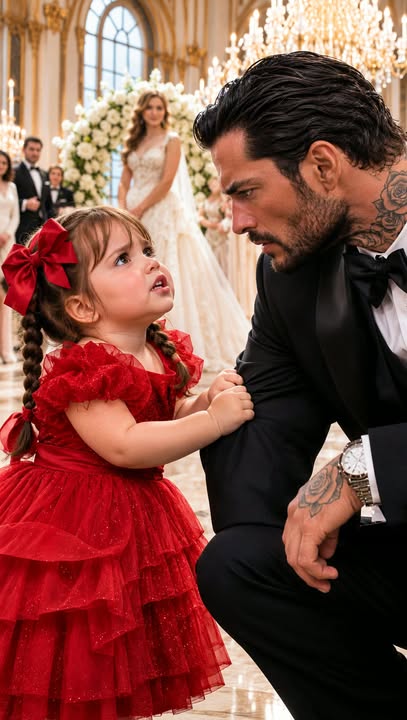
The little girl looked from one to the other with an expression of solemn importance.
“Are you both sure?” she asked.
Alessandro knelt so they were eye to eye.
“Yes,” he said. “We’re sure because we talked about it honestly.”
Genevieve knelt beside him.
“And because we want to keep choosing each other, even when things are difficult.”
Amara considered this, then smiled.
“Good.”
She stepped back but did not let go of their hands until the ceremony began.
When Alessandro and Genevieve exchanged their vows, they did not promise never to misunderstand one another or never to be afraid.
They promised to speak before fear became a secret.
They promised to listen, even when the truth came in a form they had not expected.
And they promised to make room in their life for people beyond themselves.
When they were pronounced married, Amara clapped with the whole of her small heart.
Alessandro kissed Genevieve beneath the garden trees while Sofia wiped her eyes and Lucia laughed softly through her own tears.
Later, as the guests gathered in the sunlight, Amara stood with them at the edge of the path.
She was no longer holding anyone back.
She was not carrying a warning alone.
She was simply a child who had been brave enough to say what frightened her and loved enough to help the people around her choose truth.
Alessandro looked at Genevieve, then at Sofia, Lucia, and Amara.
The future had not arrived as a perfect certainty.
It had arrived as an open door, a home with light in its windows, and the people he loved choosing to walk through it together.
**–THE END–PLEASE
Share your thoughts or feedback to motivate us to create more stories ♥️
* * *
[PREVIOUS: PART 5](https://echoesofstories.idolsgift.com/blog/part-5-the-warning-behind-the-smile-047)
✓ Lynn R. Adams
Part 6 – A Home Built on Truth “Elena,” Alessandro said, turning the scrap toward the others. Lucia leaned over the desk, her face changing as she read the name. “I remember her,” she whispered. G…