PART 6 (THE END): The Waltz That Changed the Room 046
Part 6 – The Dream She Chose
The orchestra began the waltz, and the first notes traveled through the ballroom like a hand reaching for mine.
I looked once at the foundation page in Alexander’s grasp, then toward Dad, who had settled into a chair near the front with Marta beside him.
“Go,” Dad called softly, not urging me to hurry, only reminding me that he was there.
Victoria squeezed my fingers.
“We’ll look for the answer,” she said. “But it doesn’t have to happen before you dance.”
I drew a breath and stepped onto the floor.
The chandeliers shone above us, their light scattered across the polished wood and the faces of the guests.
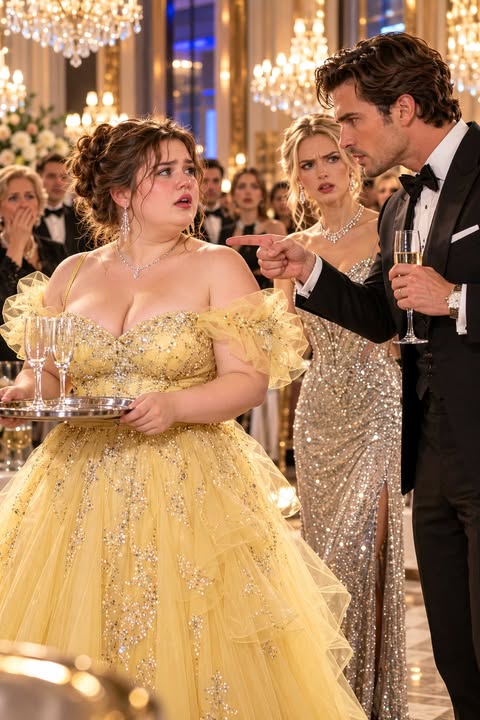
For a heartbeat, I was back in the night of Alexander’s joke, with laughter in the room and a silver tray trembling in my hands.
Then Victoria took her place beside me, and the memory loosened its hold.
We had chosen this dance together.
The orchestra lifted the melody, and I began.
My first steps were measured, each one placed with care.
Victoria joined me at the second phrase, her shoulders settling as the music carried her forward.
She did not look like the girl her family had trained, or the woman who had once set dancing aside to meet other people’s expectations.
She looked like Victoria, uncertain and brave, making a choice in the present.
We crossed the floor in a slow, graceful arc.
The guests watched without laughter or whispers, but their attention did not feel like a demand.
It felt like space.
At the far side of the room, Dad held Mama’s old letter in both hands.
I had given it to him before the performance, unable to decide whether it belonged in my bag or in his.
He had tucked it into the inside pocket of his jacket, close to his heart.
When I reached the center of the floor, the music turned toward the passage Victoria and I had rehearsed.
She offered me her hand.
I accepted, and we moved together through the final phrase.
Her step faltered once, then found the rhythm again.
I smiled at her, and she smiled back.
The last notes rang beneath the chandeliers.
We came to rest side by side, our hands joined and our breathing unsteady.
For one suspended moment, the ballroom was quiet.
Then Dad rose.
His applause began alone, warm and deliberate.
Marta joined him, then Mr. Harris, then the guests, until the sound filled the room.
I looked at Dad and saw pride in his face, but no expectation that I should become anything other than the woman standing before him.
Victoria lowered her head, laughing through tears.
I squeezed her hand before we parted.
The applause continued, but I let it belong to the dance rather than to the story people might make of me.
When I came down from the floor, Dad stood carefully, and I went to him.
“You did it,” he said.
“We did.”
He held me for a moment, mindful of the letter in his pocket.
“I wish your mother could have seen you.”
“So do I.”
“I think she did, in her way.”
I rested my cheek against his shoulder.
For years, I had imagined Mama’s absence as an empty place where a voice ought to be.
Tonight, I felt her in the stitching of the dress, in the old words I remembered, and in the quiet permission she had left me: we’ll decide together.
When I stepped back, Victoria was waiting nearby.
“Are you all right?” she asked.
“I am.”
“Would you like to sit down?”
“In a minute.”
Alexander stood a few paces away, giving us room.
He had set the foundation page on a side table.
When I approached, he did not reach for it or ask me to reassure him.
“The board’s condition still needs an answer,” I said.
“Yes.”
“I don’t want them using my mother’s name unless we know she agreed.”
“I understand.”
“Did they give us a deadline?”
“They asked for a response before the scholarship announcement next month.”
“Then we have time.”
He nodded.
“I’ll ask the archivist to search the correspondence records again.”
“Not just the foundation box.”
“Every archive I can access.”
“And if nothing turns up?”
“Then we tell the board exactly what we know, and let them decide whether a new scholarship can honor her without claiming she accepted the original one.”
I considered that.
It was careful, and it did not promise an answer he could not give.
“All right,” I said. “Keep looking.”
“I will.”
He paused, then faced me fully.
“Lena, I’m sorry for what I said the first night, and for making your work and your body part of a joke.”
The ballroom moved around us, guests talking quietly, musicians setting down their instruments.
Alexander’s apology did not try to make the moment grand.
“I should have treated you as a person before you danced,” he continued. “You didn’t owe me a performance to earn respect.”
I held his gaze.
“No,” I said. “I didn’t.”
“I know.”
“I’m not ready to say everything is forgiven.”
“I understand.”
“I do believe you’re trying to change how you act, though.”
“I am.”
“Then keep doing that, even when no one is watching.”
“I will.”
He looked down briefly, taking in the answer without asking it to become more than it was.
I left him there and returned to Victoria.
For the rest of the evening, I spoke with the children’s arts program organizers and answered questions about the dance.
A few guests mentioned the scholarship, but I told them the proposal was still being finalized and that its rules mattered as much as its name.
No one asked me to tell a story about being rescued.
That was the first time in a long while that I felt seen without being turned into a lesson.
After the gala, Dad and I went home together.
Victoria had offered to drive us, but Dad wanted the short walk to the car and the quiet ride across town.
He seemed tired, though happy, and I kept my hand near his elbow as we crossed the lobby.
“You don’t have to hover,” he said gently.
“I know.”
“You’ve been watching me all evening.”
“I know that too.”
He glanced at me, amused.
“I’ll tell you if I need help.”
“I’m practicing believing that.”
“Good.”
The next morning, Victoria met us at the clinic for the care coordinator’s appointment.
She had offered practical help, not a solution, and kept that promise by bringing a notebook and asking the questions Dad and I had written down.
The coordinator explained the options available through the clinic and the neighborhood support program.
Some required forms, and none would be arranged overnight, but there were clear steps to begin.
Dad chose the appointment times that worked best for him.
I added my work schedule and the dates of my audition.
We left with a plan that had his handwriting beside mine.
On the subway home, Dad rested his folded appointment sheet on his knee.
“I don’t feel abandoned,” he said.
I looked at him.
“I was afraid you might.”
“I was afraid too, for a while.”
“Are you still?”
“A little.”
“So am I.”
He placed his hand over mine.
“But being afraid doesn’t mean we have to stay where we are.”
The audition took place the following morning.
Victoria offered to drive me, but I chose the subway, carrying Mama’s sewing scissors in my bag and the blue ribbon from my childhood medal tied around the handle.
Before I entered the studio, I called Dad.
“I’m outside,” I told him.
“Then you’re where you need to be.”
“What if I forget something?”
“Then you’ll keep going.”
“What if they say no?”
“Then you’ll decide what comes next.”
I closed my eyes and heard Mama’s voice beneath his.
The music already knows who you are.
I thanked him and ended the call.
The assessment was not a grand stage or a room full of chandeliers.
It was a bright studio with a wooden floor, a piano, and three instructors who introduced themselves by name.
They asked about my training, my time away, and why I wanted to return.
I told them the truth.
I had danced as a child, stopped when my mother died and our circumstances changed, and found my way back years later.
I was not asking them to return my past.
I wanted the chance to build a future with the skill I still had and the work I was ready to do.
When they asked me to dance, I did.
My legs were not twenty-nine-year-old legs in the way I had once imagined they would be.
They carried the memory of long shifts and years without training.
But they also carried me across the floor.
I made a mistake during one sequence, corrected it, and continued.
By the end, my breath was uneven and my cheeks warm.
The instructors thanked me and explained when I could expect a decision.
I left the studio without knowing whether I had earned a place.
For the rest of the day, I returned to work, checked on Dad, and tried not to make the wait mean more than it did.
Three days later, an envelope arrived at the apartment.
I opened it standing beside the kitchen table, with Dad watching from his chair.
The program had offered me a place.
The letter described the schedule, the training requirements, and the financial assistance available.
It was not a promise that everything would be easy.
It was a door, offered with a real set of steps beyond it.
My fingers trembled against the page.
Dad rose slowly.
“Is it good news?”
I handed him the letter.
He read the first line, then looked up at me with shining eyes.
“They want you.”
“They do.”
He drew me into his arms.
I held him tightly, crying against his shoulder, while the old sewing box sat open on the table beside us.
The acceptance letter went into it beside Mama’s letter and the worn ribbon from my medal.
I did not take the place that same day.
I called the program and asked to speak with the student coordinator about the schedule and support options.
I called the clinic to confirm the care plan.
I spoke with Marta about adjusting my shifts.
Every answer changed the shape of the decision a little, making it more possible and more real.
Dad listened while I wrote everything down.
When I finally told him I planned to accept, he nodded.
“Then accept it.”
“What if you have a difficult day when I’m in class?”
“I will call you, and we’ll follow the plan.”
“What if the plan doesn’t work?”
“We’ll make another one.”
I searched his face for the old fear that he might ask me to stay.
It was there, but beside it was something stronger.
“I don’t want my health to be the reason you stop living,” he said.
“You’re not the reason.”
“I know. I’m trying to remember that.”
I sent the acceptance the following morning.
The scholarship proposal moved more slowly.
Alexander brought the board’s revised terms to me and Victoria, and we read them line by line.
The application would be open to students from any neighborhood, with help available for families who could not apply online.
The selection panel would include independent arts educators, a community representative, and a youth-program coordinator, with no Blake family member permitted to decide alone.
The fund would publish its annual spending and explain decisions to applicants.
There would be a process for questions and appeals.
We asked the board to add one more safeguard: the committee had to contact every applicant directly, so no child would be left waiting for news that never came.
The board agreed.
Alexander did not present the decision as his achievement.
He forwarded me the final documents and asked whether the language was clear.
“It is,” I said.
“Is there anything you want changed?”
“No. The rules are strong.”
He let out a careful breath.
“Thank you for reviewing them.”
“I was paid for my time.”
“You were.”
“And I’m glad I did it.”
The board approved the scholarship under the name of the Brooks Community Arts Award, in honor of my mother.
They did not claim that Mama had accepted the original award.
Instead, the announcement explained that Richard Blake had intended to help a young dancer, that the original paperwork had failed to reach the family, and that the renewed fund would operate with public safeguards.
The truth was included without turning my family into a display.
At the first meeting, Dad came with me.
He sat beside the window while I read the scholarship’s purpose aloud to the small group gathered in the club’s rehearsal room.
When I finished, he tapped the folded copy of the original letter in his pocket.
“Your mother would have liked the part about no one owing the fund anything,” he said.
“She would have liked the part about telling families what happens too.”
He smiled.
“So would I.”
The scholarships would support dance, music, theater, and visual arts, with awards small enough to reach more students and flexible enough to meet the costs that often went unnoticed.
A child might need lessons.
Another might need the bus fare to reach them.
The application included room for families to describe what would help, without asking them to prove they were worthy of an opportunity.
I watched the committee members listen to one another and ask practical questions.
For the first time, the old offer felt less like a promise trapped in a file and more like something set in motion.
The following months were full.
I worked at the Copacabana Club and attended classes at the program.
Some evenings, my feet ached so badly that I sat on the edge of my bed with an ice pack and the lesson notes open beside me.
Some mornings, I doubted whether I could keep up with the younger dancers.
Then I would hear the count in my head, one, two, three, and begin again.
Dad kept his appointments.
The clinic arranged regular check-ins, and two neighbors agreed to stop by on the afternoons when I was in class.
Marta adjusted my shifts when she could, and when she could not, we made another plan.
There were days when the arrangements felt fragile.
There were also days when Dad called to tell me he had handled something on his own and sounded proud of it.
“Your mother would have wanted to hear that,” I told him once.
“She would have asked whether I remembered to write it on the calendar.”
“Did you?”
“I did.”
Victoria returned to dancing in small steps of her own.
She joined me for rehearsals when our schedules allowed, and the gala became an annual performance rather than a single return.
She did not leave her life behind or pretend her family had not shaped her choices.
She simply began making more of the choices herself.
Sometimes she danced beside me.
Sometimes she watched from the edge of the floor with her shoes in her hand, smiling as if she could feel the music anyway.
Alexander continued to work with the foundation.
He stopped offering grand solutions and began showing up for the unglamorous meetings where people discussed budgets, applications, and whether every student had actually received a reply.
His apology did not make us close at once.
Trust grew more slowly.
When we spoke, he listened without assuming that the conversation was about him.
When I disagreed with a proposal, he asked what I thought would work better.
Some evenings, after a foundation meeting, we walked to the subway together.
We talked about the program, the city, and ordinary things that had nothing to do with the family name on the paperwork.
I did not mistake kindness for romance, and he did not ask me to.
One afternoon, I found him waiting outside the rehearsal room with two cups of coffee.
“I thought you might need one,” he said.
“Is that an apology?”
“No. It’s coffee.”
I took the cup.
“Good. I already have an apology.”
He smiled, then grew serious.
“I hope I can become someone you trust.”
“I hope you keep becoming someone who deserves trust.”
He accepted the correction with a quiet nod.
For a while, that was enough.
A year after the first gala, the club held another benefit for the community arts award.
The ballroom was familiar now, though I still noticed how the chandeliers scattered their light over the floor.
Marta had moved from supervising the evening staff to coordinating events, and she had helped make sure the performers received clear contracts and proper rehearsal time.
Mr. Harris welcomed the students and their families as guests rather than treating them like a backdrop for donors.
Dad sat near the front, his medication schedule tucked into his jacket and his coat buttoned neatly.
Victoria stood beside him in a dark green dress, her hair swept back from her face.
She had chosen to dance again, this time without needing me to ask.
Before the performance, she squeezed my hand.
“I’m nervous,” she said.
“So am I.”
“Are we still allowed to dance if we’re nervous?”
“I think that’s when it matters most.”
The orchestra began.
We stepped onto the floor together.
At first, I heard only the music and the measure of my breath.
Then I heard the other things too: the soft scrape of our shoes, the warmth of Victoria’s hand, and Dad’s steady applause when the dance ended.
A boy from the youth program approached us afterward.
He was about twelve, with his hair combed flat and his hands tucked nervously into the pockets of his jacket.
“Are you the person the scholarship is named after?” he asked.
“My mother is,” I said.
“Did she dance?”
“She did, and she helped me learn.”
He glanced toward the floor.
“I want to dance, but my family doesn’t have much money for lessons.”
I knelt so I could meet his eyes.
“You can apply to the award,” I said. “There’s help if the forms are confusing, and you don’t need to know anyone here.”
He studied my face, as if checking whether that could truly be the whole rule.
“Anyone can apply?”
“Anyone.”
“Even if they’ve never done competitions?”
“Especially if they’re still finding out what they can do.”
He nodded, and his shoulders eased.
A volunteer from the program came over to give him the application information.
I watched him return to his family, holding the paper carefully in both hands.
The scholarship could not give him back a year of lessons he had missed.
It could make sure his family received an answer.
That mattered.
Later, when the guests had begun to leave, I stood for a moment alone beneath the chandeliers.
The ballroom was nearly empty.
The floor gleamed under the lights, and the last notes of the orchestra lingered in the high ceiling.
I thought of the little girl in the blue dress, clutching her medal while Mama stood beside her.
I thought of the woman who had stopped dancing because grief and bills had left no room for anything else.
I thought of the scholarship letter hidden in a sewing box, and the words my mother had written before either of us knew what the future would ask.
We’ll decide together.
For a long time, I had believed the dream belonged to the girl who had won the medal.
Now I understood that it belonged to me, too.
Not because a wealthy family had offered it, or because a committee had approved it, or because an audience had finally gone quiet.
It belonged to me because I had chosen it again, with my eyes open, and built a life around it without pretending love required me to abandon everyone I cared about.
Victoria came to stand beside me.
“Ready?” she asked.
I looked toward the floor, then at her.
“Yes.”
We began with a simple waltz, moving slowly beneath the chandeliers.
Dad watched from his chair.
Alexander stood a little farther back, not at the center of the room, but present.
The music carried us through the turn.
And this time, when I danced beneath the lights, I was not trying to return to who I had been.
I was becoming who I had chosen to be.
**–THE END–PLEASE
Share your thoughts or feedback to motivate us to create more stories ♥️
* * *
[PREVIOUS: PART 5](https://echoesofstories.idolsgift.com/blog/part-5-the-waltz-that-changed-the-room-046-4)
✓ Lynn R. Adams
Part 6 – The Dream She Chose The orchestra began the waltz, and the first notes traveled through the ballroom like a hand reaching for mine. I looked once at the foundation page in Alexander’s grasp…