PART 6 (THE END): The Waltz He Could Not Command 052
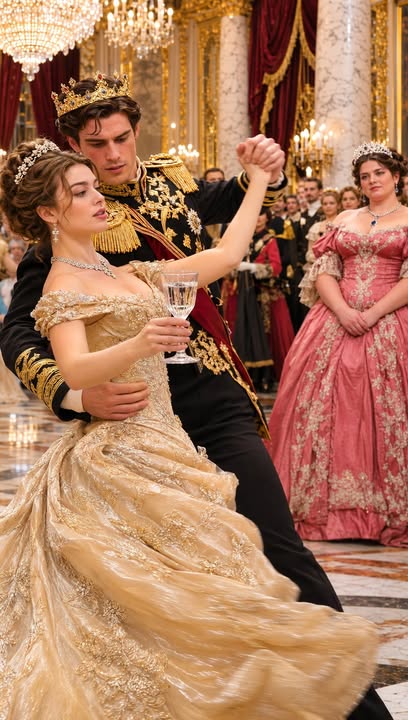
Part 6 – A Dance Chosen Freely
Alexander glanced at the empty council chamber, then at Lord Harrow.
“The name belongs to someone who is still at court.”
Isabella watched his grip tighten around the letter.
“Who is it?” she asked.
“Please,” Lord Harrow said gently. “Read the rest before you decide what the name means.”
Alexander lowered his eyes to the page.
The handwriting was his mother’s, but the words that followed were less a confession than a careful explanation, written for someone she might never meet.
“Lady Mirabel Ashcombe,” he read.
The name meant nothing to Isabella at first.
Then Lord Harrow drew in a quiet breath.
“She is the Dowager Countess of Wexford,” he said. “She served on Queen Helena’s household committee.”
“She is here?” Victoria asked.
“Her family attended tonight’s gathering,” Lord Harrow replied. “She left before the announcement.”
Alexander read on.
“‘Lady Mirabel was not my enemy,’” he said. “‘She believed the court would never accept a queen who openly refused a royal trial. She arranged for the music to change so that I would fail in a way the court could understand, and leave without having to explain that I had chosen to go.’”
The paper trembled once in his hands.
Then he steadied it.
The room seemed to hold its breath around them.
“So she meant to help your mother?” Isabella asked.
“She thought she was protecting her,” Lord Harrow said.
“By making her appear to fail,” Victoria murmured.
“By giving the court a reason to accept her departure,” Alexander said. “A reason that did not require anyone to question the trial itself.”
Isabella looked at the letter.
“And Queen Helena knew?”
Alexander read the final lines.
“‘I understood what Mirabel had done only afterward. I did not ask her to confess. I knew she had acted from fear, and I did not want the court to make her a symbol of its own blame.’”
He stopped reading.
For a moment, the palace seemed to recede, leaving only the four of them and the folded page.
“So the altered music was real,” Victoria said.
“Yes,” Alexander replied.
“And the person responsible was trying to spare the Queen from a public argument,” Isabella said.
“Though in doing so, she helped preserve the lie that the Queen had failed.”
Lord Harrow lowered his head.
“A kind intention can still help a harmful story survive.”
Alexander’s gaze moved to him.
“Do you know whether Lady Mirabel is still in the palace?”
“She may be at the Wexford residence,” Lord Harrow said. “But I can send word.”
“No,” Alexander replied. “I will speak with her myself.”
Isabella heard no anger in his voice, only a careful resolve.
“What will you say?”
“I will ask her what happened.”
“And if her account differs from your mother’s letter?”
“Then I will listen before I decide.”
He folded the pages with great care.
The decision was small, but Isabella recognized the effort it required.
Once, he might have used the name as an answer, turning the mystery into a convenient villain.
Now he was willing to let the truth remain complicated.
“Will you tell the court?” Victoria asked.
“Yes,” Alexander said. “But not tonight, and not as an accusation.”
“Good,” Isabella said. “The letter explains what Helena understood. It does not tell us every part of Lady Mirabel’s story.”
Alexander nodded.
“Then we will ask her.”
The next morning, the palace sent a respectful invitation to Lady Mirabel.
She arrived in the archive shortly before noon, carrying no escort beyond a quiet-footed maid who waited outside.
She was in her late sixties, dressed in a dove-gray gown with a narrow pearl brooch at her collar.
Her silver hair was pinned neatly at the nape of her neck, and her expression held the reserve of someone accustomed to rooms where every word might be repeated.
When Alexander showed her the letter, she did not deny her name.
She read the passage once, then returned the page to the table.
“I wondered whether Queen Helena had kept it,” she said.
“You knew she had written about you?” Alexander asked.
“I knew she had understood what I was trying to do.”
“Why did you arrange the irregular measures?”
Lady Mirabel looked at the old records rather than at him.
“Because the committee would not let her simply refuse,” she said. “They thought a queen must finish whatever test was set before her, or be judged unfit.”
“Did you ask the music master to make her fail?”
“I asked him to make the dance impossible to complete gracefully,” she replied. “I thought that if the court saw a clear failure, they would let her leave without demanding a public explanation.”
“That was your plan?”
“It was the only one I could imagine at the time.”
“Did the prince know?”
“No,” she said at once. “He believed the music was ordinary.”
“And Queen Helena?”
“I did not tell her beforehand. I thought I was protecting her.”
Lady Mirabel’s eyes lowered.
“I see now that I made the decision for her, just as the committee had.”
The words were quiet, and they carried no request for absolution.
Alexander sat opposite her.
“Why did you let the failure story stand?”
“Because the Queen asked me not to tell anyone what I had done.”
“Did she ask you to support the story that she had failed?”
“No,” Lady Mirabel said. “She never asked that. I chose silence because I was afraid the truth would make the court accuse her of rejecting the crown.”
“And because it might expose you?”
“Yes.”
The answer cost her something, but she did not turn away from it.
“I told myself silence was kindness,” she continued. “After a while, it was simply easier than admitting I had helped the palace keep the wrong story.”
Isabella listened, thinking of the many ways fear could disguise itself as loyalty.
Lady Mirabel had not set out to harm Helena.
She had still acted without asking what Helena wanted, and then allowed the consequences to settle around her for decades.
“Why tell us now?” Victoria asked.
“Because I have spent too long hoping the truth would remain harmless if no one said it aloud.”
She looked toward Isabella.
“And because I heard what happened at the gathering last night.”
“Then you know Alexander has ended the competition,” Isabella said.
“I do.”
“Will you tell the court what you told us?”
“If the prince asks me to, I will.”
“I am asking,” Alexander said. “Not so that the court can blame you, but so that the record is complete.”
Lady Mirabel nodded.
“I will give my account, and I will accept that it may change how people remember me.”
“It may also change how they remember Queen Helena,” Isabella said.
“I hope it does,” Lady Mirabel replied. “She deserved to be remembered as someone who chose for herself.”
Her testimony was recorded alongside the letters and ledger copies.
At Alexander’s request, the archivists made a clear, complete catalogue entry, connecting the payment to Matteo Bellini, the altered music, Helena’s refusal, and her later request that the trial be stopped.
No one was dismissed from the palace.
No family was publicly condemned.
The court instead had to reckon with a quieter, more difficult truth: that a custom could outlive the reasons that created it, and that good intentions did not erase the cost of letting it continue.
In the weeks that followed, Alexander met with the council and the families who had entered the competition.
He apologized to the women personally, without asking them to reassure him.
Some accepted.
Some remained disappointed.
A few told him plainly that the palace had wasted their time.
He listened to each of them, and when he could not repair what had been lost, he did not pretend otherwise.
The royal selection custom was formally ended.
In its place, the palace created an advisory council that included people from outside the royal household, and it opened its historical records for review.
The new process did not promise a bride, a queen, or a perfect answer.
It promised only that no one would be asked to prove her worth through a test whose rules were hidden from her.
Victoria returned to her family’s estate, where she persuaded her aunt to donate a copy of the ledger to the royal archive.
She did not become Isabella’s attendant or her rival.
She became her friend, a relationship built slowly through honest letters, lively arguments, and the occasional shared joke about how badly the palace understood its own paperwork.
Isabella remained at court for several weeks.
She helped review the new council’s plans, but she did not let the palace mistake her presence for an agreement to marry the prince.
Alexander never asked her to decide quickly.
When they met, he asked what she thought and waited for the answer.
When they disagreed, he did not turn disagreement into a test.
And when she asked him to explain a decision, he did not tell her that the crown made it too complicated for her to understand.
She noticed these changes, but she did not call them proof.
Trust, she knew, was not a prize someone won in one evening.
It was a habit, built in ordinary moments.
As the spring thaw came to the palace gardens, Alexander invited Isabella to walk with him among the budding trees.
He brought no guards close enough to overhear, though two remained visible along the path.
The evening air smelled of damp earth and the first sweet flowers of the season.
“I have been thinking about what you said on the night of the trial,” he began.
“Which part?”
“That you wanted your voice to matter before decisions were made.”
“It still does.”
“I know.”
“Do you?”
“I am trying to make certain the palace knows it too.”
“That is a different answer.”
“It is the answer I can stand behind.”
They stopped beside the fountain.
The water moved in a steady stream over the stone, untroubled by sudden turns or hidden instructions.
Alexander looked down at it.
“I want to ask you something,” he said.
“You may ask.”
“Would you consider building a future with me?”
Isabella did not answer at once.
He waited, his hands resting loosely at his sides.
“I do not mean an answer tonight,” he added. “I do not mean a promise made because the court expects one. I would like to know whether you might choose to explore the possibility with me, at your own pace.”
“And what would that future look like?”
“I cannot give you a finished picture.”
“Good,” she said. “I would distrust one.”
A smile touched his face.
“I can promise that the council will hear you before decisions affecting the kingdom are settled.”
“Not just hear me speak?”
“Consider what you say, answer you honestly, and allow you to disagree without calling it disloyalty.”
“And if I disagree with you?”
“Then we will have to talk about why.”
“That sounds like work.”
“It is.”
“Not a very romantic answer, Your Highness.”
“No,” he said. “But it may be an honest one.”
Isabella watched him in the fading light.
She remembered the ballroom, the water lifting in the glass, and the prince who had expected everyone else to adapt to his pace.
She remembered the apology he had offered without asking to be comforted.
She remembered the council chamber, where he had chosen the truth even though it cost him the simpler ending.
None of those moments guaranteed what came next.
But together, they gave her something worth considering.
“I will not promise to be agreeable,” she said.
“I would not want you to be.”
“I will not accept praise in place of influence.”
“Understood.”
“And I will need time to decide whether I love you.”
His expression softened.
“I would rather have an honest answer later than an easy one now.”
“Then I will consider your invitation.”
“That is enough.”
“For now.”
“For now,” he agreed.
Their courtship began without a timetable.
They met in the palace library and argued about histories.
They walked through the gardens and spoke about their families, the people they had disappointed, and the habits they were still trying to unlearn.
Alexander told Isabella that he had once believed control could keep the people he loved from being hurt.
She told him that she had sometimes mistaken self-reliance for never needing anyone.
They learned not to mistake silence for agreement, or kindness for certainty.
In time, Isabella’s answer changed.
Not because the court pressed her.
Not because Alexander offered a crown.
She chose him because he had continued to make room for her judgment when no audience was watching.
When she finally told him she loved him, they were in the palace library, standing between shelves of royal histories and a window full of spring rain.
Alexander closed the book in his hands.
“Are you certain?” he asked.
“I am certain that I love you,” she said. “I am not certain that loving you will always be easy.”
“I would not ask you to pretend otherwise.”
“Good.”
He reached for her hand, then paused.
She took his before he could ask permission.
The council approved their engagement months later, but it did not announce their marriage as the reward for a competition.
The two of them made their decision together, and the court was invited to witness it.
Queen Helena’s letters were placed in the royal archive under her name, with the catalogue entry plainly describing her refusal, her departure by choice, and her request that the old trial end.
Lady Mirabel’s account was included beside them.
Victoria attended the opening of the archive room and stood with Isabella as the first visitors came through.
No one was asked to admire the women for enduring a test.
They were allowed to read their words and understand the choices they had made.
On the day Isabella and Alexander married, the palace ballroom was bright with candles and spring flowers.
There was no crystal glass waiting at the entrance.
No one stood beside the musicians with a hidden plan for the evening.
The ceremony was simple, the vows spoken slowly enough for every word to be heard.
When the orchestra began the first dance, Alexander offered his hand.
Isabella looked at him.
“Will you follow my pace?” she asked.
“Whenever you lead.”
“And when I don’t?”
“Then I will ask where we should go.”
She placed her hand in his.
The music began, gentle and unhurried.
Alexander took one step.
Isabella answered with another.
Neither tried to command the dance, and neither disappeared inside the other’s rhythm.
They turned beneath the chandeliers while the court watched, not to decide whether Isabella was worthy, but to witness the life she had freely chosen.
At the edge of the floor, Victoria smiled as she watched them.
The water in the silver fountain beyond the windows kept its steady course, clear beneath the lights.
And for the first time in generations, the palace did not ask a woman to prove she could endure the dance.
It simply made room for her to choose it.
**–THE END–PLEASE
Share your thoughts or feedback to motivate us to create more stories ♥️
* * *
[PREVIOUS: PART 5](https://storyly.idolsgift.com/blog/part-5-the-waltz-he-could-not-command-052-2)
✓ Lynn R. Adams
Part 6 – A Dance Chosen Freely Alexander glanced at the empty council chamber, then at Lord Harrow. “The name belongs to someone who is still at court.” Isabella watched his grip tighten around the…