PART 6 (THE END): The Wall David Wanted to Save 029
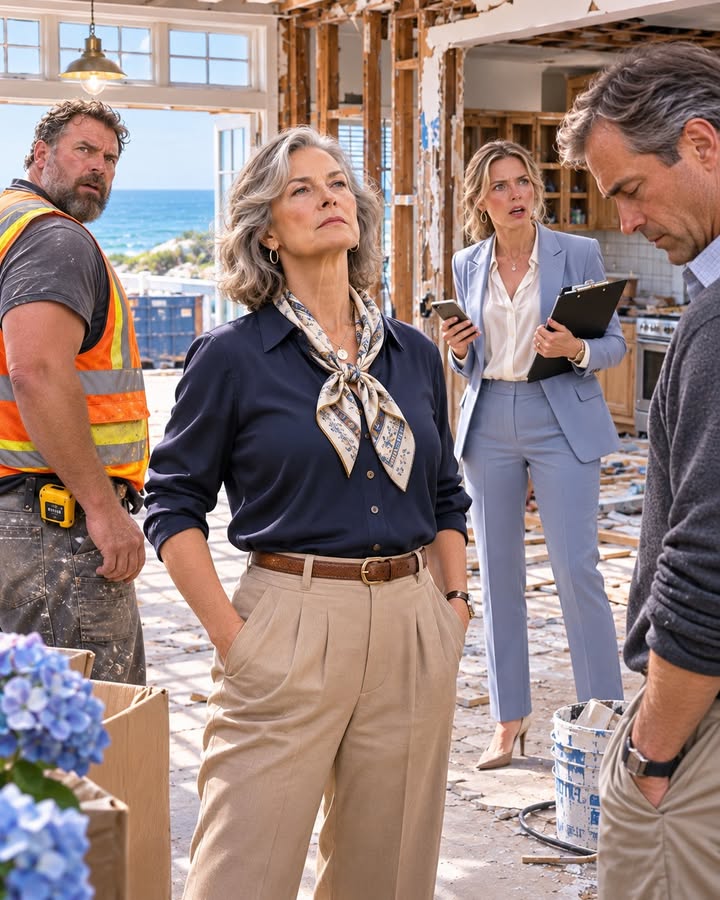
Part 6 – A House of Her Own
“The note says, ‘If Hannah chooses to keep the house, put these back.’”
For a moment, I could only hear the wind moving through the phone and the distant, steady hush of the ocean.
Then I looked at the open cabinet, the faint pencil marks inside it, and the letter lying beside my knee.
“Can you leave the cabinets where they are until I get there?” I asked.
“Of course,” Greg said. “I haven’t ordered anything.”
“I’ll come over.”
I ended the call and stood for a moment in the master bedroom, surrounded by the rooms that had been changed without my permission and the small pieces of the past that had somehow survived.
The words on the cabinet were not an instruction.
They were not a claim.
They were an invitation to choose.
I folded my husband’s letter and tucked it safely into my bag before driving to the work shed.
Greg waited beside the stored cabinets, each one wrapped in protective blankets and lined neatly along the wall.
The sight of them made something in my chest loosen.
They were scratched in places, and one had a corner chipped, but they were not lost.
Greg handed me a small piece of paper he had found taped inside one cabinet.
The handwriting was unmistakable.
“If Hannah chooses to keep the house, put these back,” I read aloud.
Below the words was a date from the year after we bought the property.
“He must have written it when he was making repairs,” Greg said. “The cabinet backs were removed for inspection, and the note was tucked inside.”
I turned the paper over, though I knew there would be nothing there.
“How did you know it was his handwriting?”
“I didn’t at first. David recognized it when I sent him a picture.”
That made me pause.
“David saw it?”
“He did. He said he’d come by if you wanted him to.”
I looked at the note again.
The words did not make the choice for me, but they reminded me that my husband had trusted me to make it.
I had known that already.
Still, seeing his handwriting among the saved cabinets gave the knowledge a place to rest.
“Tell David he can come,” I said. “But I want him to come because I asked, not because he thinks he needs to rescue anything.”
Greg nodded.
“I’ll make that clear.”
When I returned to the house, I set the note beside the letter and took a slow walk through the kitchen.
The open wall was still open.
The room was still damaged.
But the damage no longer looked like a decision I had to accept.
It looked like work I could choose to undo.
David arrived later that afternoon.
He came alone, carrying no tools and no plans.
At the doorway, he waited until I invited him in.
“Greg showed me the note,” he said.
“I saw it.”
“I didn’t know Dad had written it.”
“Neither did I.”
David studied the note on the table, but he did not touch it.
“Do you want the cabinets put back?” he asked.
“I want to decide what happens to them.”
“Of course.”
“I may use some of them. I may not use all of them. I haven’t decided yet.”
“That’s fair.”
He looked around the kitchen, taking in the missing cabinets and the exposed studs.
“I’m sorry this happened here.”
“So am I.”
His eyes stayed on the wall.
“I keep thinking I should have stopped it.”
“You should have.”
He nodded.
“I know.”
There was no defense in his voice, and no attempt to turn regret into a request for comfort.
That mattered, though it did not make the past disappear.
“I don’t want us to pretend that one letter or one good choice fixes everything,” I said.
“I don’t expect that.”
“Trust will take time.”
“I’ll give it time.”
“And when you’re tempted to make a promise on my behalf, remember this house.”
“I will.”
I watched him for a moment.
“Not because the house is more important than people,” I said. “Because people are important enough that they deserve the truth.”
He nodded slowly.
“I understand.”
I believed he was beginning to.
Not because he said the right words, but because he had stopped trying to rush me toward an answer that would make him feel better.
Sarah came the next day with the written repayment plan.
She had prepared it with David and Greg, listing the legitimate labor and materials, the items they could return, and the payments they could manage each month.
It was a serious commitment, but one they could meet without borrowing against my accounts or asking me to fill the gap.
I read it carefully, asked two questions, and signed to confirm that I had received it.
“You don’t have to sign anything,” Sarah said. “We know the contract is ours.”
“I’m acknowledging the plan, not taking responsibility for it.”
“I understand.”
She looked toward the kitchen.
“I’ve been thinking about how quickly I started describing your house as my parents’ home.”
“You were excited to help them.”
“I was,” she said. “But I let that excitement become certainty. I should have asked you before I planned anything, and I should have stopped when I realized I hadn’t.”
“Yes.”
“I’m sorry, Hannah.”
I studied her face.
The apology did not erase the damage, nor did I want it to.
But she was not asking me to erase it.
“Thank you for saying that.”
Sarah’s eyes moved to the porch, where the flowers had been bruised by the dumpster.
“I’d like to help you replant the bed, if you’ll let me.”
“After the contractor finishes moving the debris,” I said. “And we’ll decide together what goes there.”
“Together,” she replied.
It was a small word, but she said it carefully.
That afternoon, Elaine and Robert came by to sign the temporary housing agreement.
They had brought a few boxes for the guest rooms and a list of rental places they planned to visit.
The arrangement had a clear end date, and we agreed to check in each week without making assumptions about what would happen next.
“I still can’t believe you’re letting us stay,” Elaine said as we carried a box upstairs.
“I’m letting you stay for a while,” I replied. “You’re still expected to keep looking.”
“We will.”
Robert placed a box near the closet.
“We’re grateful for the time.”
“So am I,” I said, surprising myself. “It’s easier to offer help when everyone knows what the offer is.”
He smiled.
“That sounds like a good rule for all of us.”
The weeks that followed were not perfect, but they were honest.
Greg returned with a small crew to make the house safe and repair the worst of the damage.
He showed me which cabinets could be restored, which hinges needed replacing, and what could wait until I was ready to decide.
Nothing was ordered until I approved it.
Nothing was removed without my say-so.
The old kitchen cabinets were cleaned and repaired one at a time.
Some were too damaged to use again, but several returned to their places, and the carpenter built simple, matching shelves for the spaces we could not restore.
The result was not exactly the kitchen my husband and I had made years earlier.
It was not the kitchen Sarah had planned, either.
It became something new, made from the parts we could save and the choices I made in the present.
David came down most weekends to help with work I had approved.
He never arrived without calling first.
When he did, he asked what I wanted done before he picked up a tool.
Sometimes I gave him a task.
Sometimes I asked him to sit with me on the porch instead.
He learned not to treat the difference as a judgment.
Sarah joined him on several of those weekends.
She helped sand the porch rail and planted new flowers after I chose them.
The work was slow, and there were moments when the old hurt surfaced without warning.
Once, David reached for a box in the master bedroom and I watched him for several seconds before I could say what I needed.
“Please ask before moving anything in here.”
He stopped at once.
“You’re right,” he said, then waited.
It was a small correction.
It was also a small repair.
I began to understand that forgiveness might not arrive as a single bright moment.
It might come through a series of ordinary days in which people chose not to repeat what had broken things.
A month after the renovations were canceled, Elaine and Robert found a nearby apartment.
It was smaller than their old rental but close to the sea and within their budget.
They would be able to keep their savings and move in without the panic of a deadline hanging over them.
When they told me, Elaine was standing in the kitchen, carefully wrapping a mug in newspaper.
“We found a place,” she said.
“I’m glad.”
“It has a little balcony.”
Robert came in behind her carrying a box of books.
“Only room for two chairs,” he said, “but that’s enough for us.”
They had already begun packing, and the guest rooms looked less like borrowed space and more like the temporary shelter they had been meant to be.
Their last evening at the beach house, they asked whether we might all share dinner.
I said yes, and this time there were no assumptions hidden inside the invitation.
We ate at the dining table with the windows open.
Sarah brought a pie.
David made the salad, though he had to ask where I kept the vinegar.
Robert told a story about the first apartment he and Elaine had shared, and Elaine corrected him gently when he remembered the neighborhood wrong.
For a while, the conversation wandered from the house to ordinary things: the weather, the rental market, a neighbor’s new dog.
It was not a grand reconciliation.
It was better than that.
It was people being careful with one another and still finding room to laugh.
When Elaine and Robert left the next morning, they thanked me again.
“You don’t have to keep thanking me,” I said. “You were respectful of the agreement.”
“We can be grateful and respectful at the same time,” Elaine replied.
I hugged her.
Then I hugged Robert, who smelled faintly of cardboard and the coffee he had carried downstairs.
Sarah stood beside their car, holding the passenger door open.
“I’m glad they found a place,” she said.
“So am I.”
“I hope the house feels like yours again.”
“It does.”
She looked relieved, but she did not ask me to prove it by saying anything more.
After they drove away, David helped me carry the last of their boxes out of the guest room.
When the room was empty, he stood at the window looking toward the dunes.
“Do you think Dad would have liked their new place?” he asked.
“He would have asked whether it had enough light.”
David smiled.
“And then he’d have fixed something that wasn’t broken.”
“He would have called it preventative maintenance.”
We laughed together, and the sound did not erase the hurt.
It simply found a place beside it.
By the end of the season, the kitchen was whole again.
Not untouched, not exactly as it had been, but whole.
The restored cabinets held my dishes.
The new shelves held the jars and cups I used every day.
The old quilt had been washed and folded at the foot of my bed.
The master bedroom carpet was replaced, and the small built-in cabinet stood exactly where it had always been.
Greg had refitted the hidden panel, though I left the compartment empty.
My husband’s letter was kept in a frame on the small desk, where I could read it whenever I wanted.
The note about the cabinets rested behind it.
“If Hannah chooses to keep the house, put these back.”
I had kept the house.
I had also kept the right to decide what keeping it meant.
David and Sarah continued their repayment plan.
They never asked me to take over a payment or to speed the schedule.
When money was tight, they adjusted their own budget rather than pretending the agreement had changed.
David kept calling before he came over.
He kept asking before he moved things.
He kept telling me difficult truths even when a more convenient answer would have been easier.
Trust did not return all at once.
It returned in pieces, like the kitchen cabinets, with care and patience and no promise that the old version could be restored exactly.
On a warm Saturday in late summer, I invited the family back for a meal.
I set the table with the plates I had chosen years before, and David arranged the flowers on the porch.
Sarah brought the dessert.
Elaine and Robert arrived from their new apartment with a bottle of sparkling cider and stories about their balcony.
The house held the sound of conversation without seeming to surrender anything.
After dinner, we carried our cups outside.
The evening light lay across the water in long gold ribbons.
David stood beside me at the railing, leaving a comfortable space between us.
“Thank you for letting us come,” he said.
“You’re welcome here,” I replied. “That doesn’t mean you get to decide what happens here.”
“I know.”
He looked toward the ocean.
“I’m glad you kept it.”
“So am I.”
For a little while, we watched the waves move toward shore.
Then David went back to join the others, and I stayed by the railing.
When the sky began to darken, I took my husband’s letter from the table inside and carried it onto the porch.
I opened it beneath the last of the evening light.
The paper had softened at the folds, and his handwriting seemed as familiar as the sound of the water.
A house can hold guests and family and laughter.
It can be generous without becoming an obligation.
I read the lines slowly, then lowered the page.
Through the open door, I could hear my family talking around the table.
No one was deciding for me.
No one was asking me to surrender the place where my life had taken root.
I had opened the door because I chose to.
I had closed it when I needed quiet.
And with the ocean moving steadily beyond the porch, I understood that the house my husband and I had dreamed of was not a promise that nothing would change.
It was a refuge where I could decide what came next.
**–THE END–PLEASE
Share your thoughts or feedback to motivate us to create more stories ♥️
* * *
[PREVIOUS: PART 5](https://puretales.idolsgift.com/blog/part-5-the-wall-david-wanted-to-save-029)
✓ Lynn R. Adams
Part 6 – A House of Her Own “The note says, ‘If Hannah chooses to keep the house, put these back.’” For a moment, I could only hear the wind moving through the phone and the distant, steady hush of …