PART 6 (THE END): The Voice That Wouldn’t Hang Up5 025
Part 6 – A Future Built on Truth
The clerk called my name, and the sound seemed to gather every uncertain step I had taken and carry it across the courtroom.
I rose slowly, one hand resting beneath my belly, and followed Ms. Morales toward the witness stand.
Sarah gave my fingers a brief squeeze before I let go.
Across the room, Dad sat where I could see him, his face calm, his hands folded loosely in his lap.
Carter watched me take my place.
For a moment, I remembered the first time he had asked me to dance, the warmth of his palm against mine, and the certainty I had mistaken for safety.
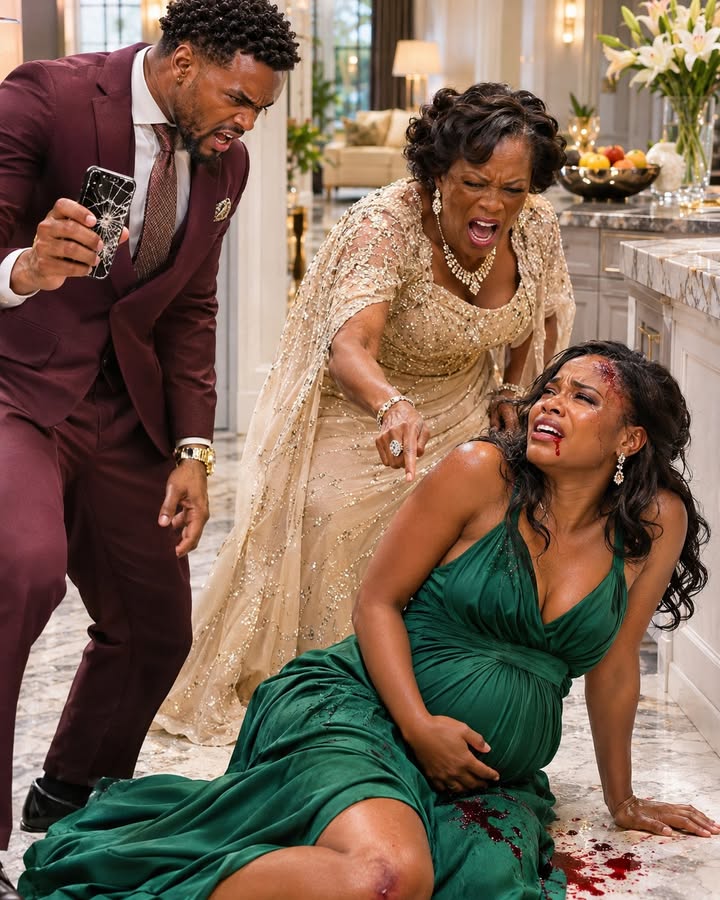
Then I remembered the kitchen floor, and the broken pieces of my phone.
Both memories belonged to me.
Neither could make the other untrue.
The questions began with ordinary things: my name, my work, how far along I was, where I had been on the evening of the incident.
I answered as clearly as I could.
When Ms. Morales asked what happened, I described coming home from my shift, the argument, Eleanor’s hands pushing me backward, and the pain when I struck the counter.
I told the court that I had asked Carter to call for help.
I told them he had broken my phone.
I did not make the story smaller to help anyone feel more comfortable.
I did not make it larger either.
I spoke only about what I remembered and what the evidence could support.
The defense asked about my marriage, the time I had kept my family’s identity private, and whether I had argued with Eleanor before.
They asked whether I had been tired after work.
They asked if I might have fallen.
I listened, took a breath when I needed one, and answered each question honestly.
“I was tired,” I said. “But tired is not the same as confused about being pushed.”
The courtroom grew very still.
After that, the recordings were introduced.
The kitchen camera showed Eleanor moving toward me and shoving me before I fell against the counter.
The neighbor’s doorbell camera showed Carter taking my phone and striking it against the wall.
The hospital records documented my injuries and the medical team’s careful monitoring of the baby.
No single piece of evidence could contain the whole evening, but together they made a record no one could easily reshape.
Carter’s lawyer spoke of a family argument and disputed intent.
Eleanor’s attorney argued that her actions had been misunderstood.
The judge listened to each side.
I sat through it all with Sarah beside me and Dad visible across the aisle, offering neither a gesture nor a word that might pull the choice away from me.
When the proceedings ended for the day, I was exhausted down to my bones.
Outside the courtroom, Ms. Morales told us the case would continue through the remaining testimony and evidence.
She made no promises about a result.
I appreciated that she did not try to offer certainty where none existed.
Dad walked with us to the courthouse entrance.
“How are you?” he asked.
“I’m tired,” I said. “And I’m glad I told the truth.”
He nodded.
“I’m glad you did, too.”
I studied his face.
“You’re not glad because it makes the case easier?”
“No,” he said. “I’m glad because you made a choice that was yours.”
The trial continued over the following days.
Lena Park testified about the old company messages and the warning she had sent before my wedding.
She did not claim to know what Carter had felt for me.
She explained what she had seen in the business records and what concerned her enough to write.
The company’s archived messages were authenticated.
They showed that Carter had learned my father was a decorated general before we married.
They showed that he had told a senior executive not to raise it with me yet, adding that he wanted to keep our family separate until the right opportunity arose.
The words were incomplete in places, and the business request itself had gone through ordinary channels.
There was no evidence that I had arranged a meeting or that Dad had granted Carter access to anyone.
That distinction mattered.
It mattered that the case did not turn into a story about my father’s influence or Carter’s wealth.
The trial was about the choices made in our home and the evidence of what happened there.
Still, the records changed the way I understood the years before that night.
When the prosecutor asked about them, I said that I had believed Carter did not know who my father was.
I said I had wanted to be loved without the weight of our family’s name.
I said learning that he had known before the wedding made me question memories I had once held close.
Then I added, “But it does not explain or excuse what happened that evening.”
The words felt steadier than I expected.
Carter’s lawyer asked whether I could prove that he had married me only to gain access to my father.
“No,” I said. “I can only tell the court what the records say, what he did, and what I experienced.”
That was the truth, and I would not claim more than I knew.
During a break, I sat in a quiet room with Sarah.
She brought me water and helped me settle back against the cushion.
“You were very clear,” she said.
“I didn’t feel clear.”
“You kept going anyway.”
I glanced at her.
“You used to worry that respecting my choices meant staying quiet.”
She nodded.
“I’m learning that I can respect your choices and still let you know I’m here.”
“I need that,” I said.
“I know.”
We sat together without trying to fill the silence.
It was not the careful distance we had once mistaken for independence.
It was closeness that left room for both of us to breathe.
On the final day, the court heard from the medical team and reviewed the records of my care.
The doctors explained that my injuries and bleeding had required close observation, and that the baby’s heartbeat had remained steady through the critical hours.
I listened to the monitor recording played for the court, and its fast, regular rhythm carried me back to the hospital room.
I remembered lying awake, unsure whether each passing minute was bringing us closer to safety.
When the judge issued the findings, I felt Sarah take my hand.
Carter and Eleanor were held responsible for their actions under the charges before the court.
The sentences and orders were set through the proper process, without spectacle.
The result did not undo what had happened.
It did establish that my account had not been a misunderstanding, a clumsy fall, or a story invented to injure a family’s reputation.
Richard Whitmore, Carter’s uncle, had not appeared in court as a prosecutor.
The conflict surrounding his earlier pressure on witnesses had been referred for independent review.
He was removed from any role connected to the case, and the appropriate authorities began investigating whether he had interfered with the handling of evidence.
His title did not protect him from scrutiny, and his family ties did not make him the judge of what was true.
When it was over, I did not feel triumphant.
I felt tired, relieved, and strangely quiet inside.
I had spent months preparing to speak, and now the words were no longer mine to carry alone.
Outside the courthouse, reporters stood at a distance, but no one crowded us.
Dad had arranged no grand arrival and made no public statement.
He waited while I decided whether I wanted to speak at all.
I chose not to.
The truth had been given where it needed to be given.
I did not owe the whole world an explanation.
Sarah walked with me toward the car.
Dad opened the passenger door, then stepped back so I could take my time.
Before I got in, I turned to him.
“You didn’t try to fix it for me,” I said.
“I wanted to,” he answered. “I didn’t.”
“Thank you.”
He reached for my hand only after I offered it.
“I’m proud of you,” he said.
“I know.”
This time, I believed him without needing to wonder whether pride came with a plan for my life attached.
The following weeks were measured in medical appointments, rest, and the quiet preparations of people who had learned to ask before helping.
Sarah came to each appointment I wanted her to attend.
Dad carried groceries upstairs but left the nursery decisions to me.
When he wanted to offer advice, he asked whether I wanted advice or company.
Sometimes I wanted both.
Sometimes I wanted neither.
He accepted the answer.
One afternoon, I asked Sarah to help me return to the estate with an officer so I could collect a few personal things.
The house felt smaller than I remembered.
The kitchen was exactly as it had been, except for the places where the investigators had marked and photographed evidence.
I did not linger there.
I collected the baby clothes from the upstairs drawer, my nursing books, and the old framed picture of Sarah and me at the clinic’s volunteer picnic.
Carter’s name was still on the mailbox.
I did not need to decide that day what should happen to the property or the belongings we had chosen together.
I only needed to leave with what felt like mine.
As we walked out, Sarah carried the small bag of clothes and asked whether I wanted to keep the framed photograph.
“Yes,” I said. “It reminds me I had a life before him.”
“And a life with me in it,” she added.
I looked at her.
“Especially that.”
We drove away without looking back.
My son arrived several weeks later, on a pale morning when rain had just stopped and the clouds were beginning to break apart.
The doctors had prepared us for the possibility that his arrival might require extra care, but when the time came, the room filled with a steady, focused calm.
Sarah stayed beside me, holding my hand and reminding me to breathe.
Dad waited just beyond the doorway until I asked for him.
When the nurse placed my son against my chest, the world narrowed to his warm cheek, his small fingers, and the soft, indignant sound of his first cry.
“William Carter Jr.,” Dad whispered, his voice unsteady.
The name had been chosen long before the kitchen, long before the trial, long before I understood how much a name could carry.
I had worried that naming him after my father might make him feel like a continuation of someone else’s story.
But as I held him, I understood that a name could also be a gift freely offered, with no demand attached.
Dad bent close enough for my son to curl one tiny hand around his finger.
“Hello, little one,” he said. “You don’t have to be anything except yourself.”
Sarah laughed softly through her tears.
I looked at them both, and for a moment the years of distance seemed to loosen their hold.
Not disappear.
Loosen.
My son was healthy, and I was safe, and the people who loved us were there without asking me to pretend the past had been simple.
That was enough.
In the months that followed, I built a quieter life in a small house not far from Sarah.
I returned to nursing when my body and heart were ready.
At first, I worked reduced hours, taking time to learn how to be a mother and a nurse again without demanding that either role erase the other.
I stayed in touch with the prenatal clinic.
With its director, I helped create a support fund for pregnant patients facing abuse or sudden financial hardship.
The fund provided transportation, temporary lodging, medical appointments, and confidential counseling.
We named it the Open Door Fund, because no one should have to prove they deserve help before someone opens a door.
Dad contributed quietly.
He did not place his name on it.
When the clinic thanked him, he said the work belonged to the people who showed up each day.
Sarah joined the volunteer committee, and the three of us learned how to disagree without turning disagreement into distance.
There were hard days.
Some nights, I woke from dreams about the kitchen and had to remind myself where I was.
Some mornings, I looked at the empty space beside me and grieved the marriage I had believed I was building.
Healing did not arrive as a clean line.
It came in small pieces: a meal shared with Sarah, a hospital shift I finished without feeling afraid, a family gathering where Dad listened more than he spoke, a day when my son’s laugh filled the room and I noticed that I was laughing too.
Dad and I never pretended that his silence before the wedding had not hurt me.
He never asked me to see his caution as perfect.
I never asked him to take responsibility for choices that belonged to Carter.
We spoke about what we had each hidden, and about how love could become unhelpful when it was afraid to speak plainly.
The conversations were not always easy.
They were honest.
That mattered more.
Years later, on a warm afternoon in the clinic’s garden, William sat on a blanket between Dad and Sarah, stacking wooden blocks and knocking them down with great satisfaction.
He had Dad’s dark eyes and my habit of studying a room before joining in.
When he looked up, he asked why Granddad’s name was part of his.
I sat beside him and brushed a leaf from his sleeve.
“Because your grandfather taught me that strength can be gentle,” I said. “And because your name belongs to you, not to anything he did or anything you’re expected to become.”
“Was he a general?” William asked.
“He was.”
“Was Dad a general?”
My father smiled from across the blanket.
“No, buddy. Your mother is the one with the stories.”
William considered that, then returned to his blocks.
I watched him build a small, uneven tower, and I thought of all the stories he might one day ask me to tell.
I would tell him that I had been loved before I knew how to ask for it.
I would tell him that mistakes and silence can hurt people even when they are meant to protect them.
I would tell him that no family name, no fortune, and no position can make a person’s choices harmless.
Most of all, I would tell him that family is defined by care, by honesty, and by the way people make room for one another to be fully known.
My son leaned against my arm, warm and solid beside me.
I placed my hand over his, and for once, I did not feel that the future was something I had to fight to reach.
We were already there, building it together.
**–THE END–PLEASE
Share your thoughts or feedback to motivate us to create more stories ♥️
* * *
[PREVIOUS: PART 5](https://puretales.idolsgift.com/blog/part-5-the-voice-that-wouldn-t-hang-up5-025)
✓ Lynn R. Adams
Part 6 – A Future Built on Truth The clerk called my name, and the sound seemed to gather every uncertain step I had taken and carry it across the courtroom. I rose slowly, one hand resting beneath …