PART 6 (THE END): The Voice in the Crystal 052
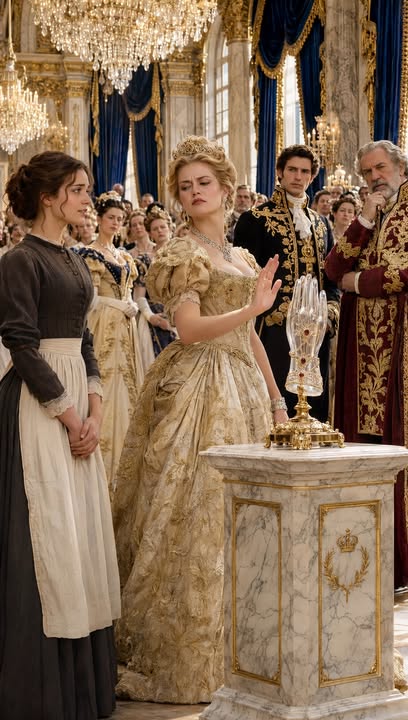
Part 6 – The Promise Freely Kept
Emily looked from the open carriage to Alexander, who held the newly discovered letter as carefully as if the paper might break beneath the weight of its words.
“May I read it?” she asked.
He glanced at the messenger, then back at her.
“Of course.”
Emily stepped away from the carriage and accepted the letter.
The handwriting was unmistakably her mother’s, and the familiar curves of Anne’s words brought the past close enough to touch.
At the top, Anne had written, “For Emily, if the day comes when she wishes to know.”
Emily’s throat tightened.
She had spent the morning believing she was ready to leave the palace behind, but her mother had left one more door open, not to draw her back, but to let her choose whether to enter.
She unfolded the page.
“My dear Emily,” the letter began, “if you are reading this, then you have found the truth about my mother and the family that sent me away.”
A breeze stirred the paper.
Emily moved nearer the palace wall to shelter it, and Alexander stood beside her without crowding her.
“My name at birth was Eleanor Anne,” she continued silently, “but I chose to be called Anne when I began again. The name was not a disguise forced upon me. It was mine to choose, and I kept it because it reminded me that I could build a life beyond the court.”
Emily paused at those words.
The name the palace had given her mother had been a means of concealment, but Anne had made it her own, choosing what it would mean.
She read on.
“Your father was Thomas Bell, an American healer who came to the palace to treat the village families during the fever that crossed the coast. He had no title, but he knew how to listen. I loved him because he never asked me to become smaller so that others might feel secure.”
Emily’s vision blurred.
She had grown up with only a few gentle stories about her father: a patient man with warm hands, a good listener, someone who had left the world before she could remember him.
Now she had his name, and a little more of the shape of the man he had been.
“Thomas knew who I was,” the letter continued, “and never once treated my birth as a reason I owed him anything. When we chose to marry, we chose one another freely. When I chose to leave the palace, he asked me what kind of life I wanted, then helped me make it.”
Emily lowered the page.
She could hear the bell’s last note fading over the rooftops, its sound carried away into the morning.
“He was a healer,” she whispered. “My father.”
Alexander nodded.
“Your mother wrote that he came from across the ocean,” he said. “The palace records may tell us more, but the letter tells us what mattered most to her.”
Emily looked down again.
There was one final passage.
“Do not return for me, Emily, and do not stay away for me. I did not leave so that you would spend your life fleeing the place that hurt me. I left so that your choices could be yours. If you find a home at the palace, it must be one you choose. If you find it elsewhere, I will be just as proud.”
Emily held the letter against her chest.
Her mother had not written to call her back or to urge her to leave.
She had given her the freedom to do either.
The carriage waited beside the road, its door open to the life Emily had chosen for herself beyond the palace gates.
The messenger stood quietly, giving her time.
Alexander waited too.
“Did you know your father’s name?” she asked him.
“No,” he replied. “I only saw that the letter named him. I thought you should decide when to read it.”
“Thank you.”
“I’m sorry the palace kept so much from you.”
“So am I.”
Emily folded the letter along its old creases.
The palace had once seemed like the place where her mother’s life had been taken from her.
Now she understood that it was also where her mother had made a choice, and where Emily could make her own.
“I was going to leave,” she said.
“I know.”
“I still may.”
“I know that too.”
His answer held no plea, no hidden expectation.
Emily turned toward the carriage.
The road beyond the gates ran through the city and toward the countryside, where she could find work, quiet, and a life that did not begin with anyone else’s decision.
She could go, and no one would call her ungrateful.
She could stay, and no one would be allowed to call it a duty.
For the first time, the choice felt truly hers.
Emily looked at Alexander.
“If I return, it will not be as a princess.”
“I would not ask you to be one.”
“And it will not be because the council thinks my name can mend the family.”
“It cannot mend what they broke by using you.”
“I want my work to matter,” she said. “I want to keep helping the people who come to the palace for care, whether or not anyone thinks it is royal work.”
Alexander’s expression softened.
“My father has been speaking with the household physician and the city healers. They want to establish a clinic near the palace gates, one open to the servants and families who cannot afford a physician.”
Emily’s eyes widened.
“Why didn’t you tell me?”
“It was only an idea yesterday. My father wants to fund it in your mother’s name, but he said the work should be led by people who understand what the community needs.”
“And he would let me choose whether to be involved?”
“He asked me to tell you that you may consider it without accepting a title, a position, or a promise to remain at court.”
Emily looked at the letter in her hands.
Thomas Bell had been a healer who listened.
Anne had chosen to begin again.
Perhaps the clinic was not a way to turn her family into a symbol after all, if it was built for people rather than for the palace’s reputation.
“Would you come back inside with me?” Alexander asked.
“Not yet.”
He nodded and stepped aside.
Emily climbed into the carriage, then looked through its open door at the palace entrance.
The king had tried to protect the crown by keeping her mother’s name buried.
Now he had begun to make the truth public, even though doing so would trouble the court.
Emily did not know whether she could forgive him for the years of silence.
She did know that he had finally allowed her to choose.
She stepped down from the carriage.
The driver closed the door and waited for her instructions.
“Please take the case back to my room,” Emily said. “I’ll come for it later.”
The driver tipped his hat and turned the horses toward the gatehouse.
Emily remained where she was, watching the carriage depart without her.
The choice to stay did not feel like surrender.
It felt like opening a new door with her own hand.
Alexander walked beside her toward the palace.
They did not touch, and neither spoke of marriage.
For now, the important thing was that Emily was returning because she wanted to see what might grow from the truth.
King Edward waited in the small council room, where the earlier papers had been arranged in careful stacks.
He stood when Emily entered.
“I read the letter,” she said.
“I am glad you were able to.”
“My mother’s name was hers to choose.”
“Yes.”
“And my father was Thomas Bell, an American healer.”
The king lowered his head.
“Your grandfather. I wish I had known him better.”
“Did you meet him?”
“Only once, briefly. He came to the palace to ask that Anne be allowed to return for a visit, after you were born.”
Emily held still.
“What happened?”
“I refused to let him see her.”
The words were quiet, but they carried the weight of a long regret.
“I told myself that the court was watching, that any sign of Anne’s return would reopen the scandal. I told myself I was protecting her and you.”
“And what did my mother say?”
“She told me I had mistaken secrecy for care.”
Emily felt the old hurt rise, not as anger, but as a sorrow she had no need to hide.
“She was right.”
“Yes,” the king said. “She was.”
He did not defend himself or ask Emily to comfort him.
That, too, was a change.
“I cannot give you back the years when she might have spoken to me about all of this,” Emily said.
“No.”
“But I can decide what happens now.”
“Yes.”
“I want her name restored, and my father’s name included. I want the truth recorded without making me a princess or a claim to anything.”
“It will be.”
“And I want the clinic to be open to everyone who needs it, not just those connected to the palace.”
The king regarded her with grave attention.
“That is what we will build.”
“Then I will help plan it,” Emily said. “But I am not accepting a royal title or a place in the succession.”
“I understand.”
“I may leave again if this becomes a way to control my life.”
“You should.”
Emily searched his face.
The king did not seem pleased by the condition, but he did not challenge it.
“I cannot undo what I helped preserve,” he said. “I can only make sure that my choices from this day forward do not repeat it.”
Emily felt something in her chest ease.
It was not forgiveness, not yet.
It was room for the possibility of a different relationship.
“I appreciate that,” she said.
The king bowed his head to her, not as a monarch granting favor, but as a man acknowledging a debt.
“Thank you for giving me the chance to begin making it right.”
“I have not promised to forgive everything.”
“I would not ask you to.”
Outside the council room, Alexander waited near the window.
He walked with Emily to the old chapel, where the glass case holding the former queen’s letters rested beneath the pale afternoon light.
Mr. Finch had brought the crystal glove from the west vault, though it remained covered with a light cloth on the marble pedestal.
The golden vines beneath the cloth could just be seen through the fabric.
“I thought the glove was going to remain sealed away,” Emily said.
“The king wants it brought out once, before the court, so he can explain what it was made to do,” Alexander replied. “After that, it will be kept as an artifact, not used to choose anyone’s future.”
“That seems right.”
Mr. Finch stood nearby, studying the pedestal’s eastern side.
“The small recess mentioned in the old inventory is here,” he said. “I found it when the glove was returned to the base.”
Emily drew out her pendant.
The old brass seemed warm in her palm.
She did not know whether she was ready to place it into the recess.
No one asked her to.
Alexander remained silent, and the king, who had entered behind them, did not move closer.
Emily turned the pendant over.
Her mother had carried it for years, and then given it to her with the hope that she would find the truth when she was ready.
The choice to use it belonged to Emily.
“I want to see what it reveals,” she said.
She fitted the worn pendant into the narrow hollow beneath the broken vine.
It slipped into place with a soft, exact click.
For a moment, nothing happened.
Then the line of gold etched into the pedestal brightened.
Light traveled along the vine, curling around the marble base until it reached the gap where one branch ended.
The crystal glove answered with a quiet golden glow.
The radiance was gentler than the blaze that had filled the ballroom, but it seemed more certain.
A faint voice rose from within the crystal.
“The promise must be freely kept.”
The words echoed once through the chapel, then faded.
Emily drew the pendant from its recess.
The glow remained for another breath before dimming.
Neither the king nor Alexander spoke at first.
“It does not choose anyone,” Emily said.
“No,” Alexander replied. “It reminds us that no one can choose for another.”
The king looked at the covered glove.
“That should have been the first lesson I learned from it.”
“Perhaps it is the lesson we can finally pass on,” Emily said.
She returned the pendant beneath her blouse.
The glove was lifted from its pedestal and placed in a clear cabinet, where it could be viewed without being presented as an instrument of marriage.
A record of its true purpose was written beside it, based on the former queen’s letter and the old chapel inventory.
When the public announcement was made, King Edward spoke plainly.
He restored Anne’s name to the royal history and acknowledged her marriage to Thomas Bell, the American healer.
He also admitted that the royal family had allowed fear of political unrest to erase a daughter from its own story.
There were no grand excuses.
There was no attempt to present the concealment as wise or necessary.
The king simply told the truth and accepted that the court would have to live with what it had done.
Some nobles questioned the decision.
Others accepted it quietly, and a few came forward to say that the old account had never made sense to them.
Lady Victoria was among those who asked that the record of Anne and Thomas be placed beside the family histories rather than hidden in an archive.
When Emily thanked her, Victoria replied, “The truth should not need a special room.”
The words stayed with Emily.
In the following weeks, she helped the palace physician and several city healers plan the clinic.
She spoke with servants about the ailments they put off treating, with kitchen workers about the long hours that left them exhausted, and with families in the nearby streets about what kept them from seeking care.
No one called her princess.
Most people called her Miss Emily, which she preferred.
The clinic was built beside the palace’s outer gate, where anyone could enter without asking permission from a courtier.
A painted sign above the door read, “The Anne and Thomas Bell Clinic.”
When Emily saw the names together for the first time, she rested her fingers against the lettering.
Her mother’s name had been restored, not as a reason to claim Emily, but as part of a life Anne had chosen.
The king visited on the clinic’s opening morning.
He did not give a speech about his own regret.
Instead, he thanked the healers, the servants who had helped prepare the rooms, and the neighbors who had trusted the new clinic enough to come inside.
Then he turned to Emily.
“You have made this place more than I knew how to make it,” he said.
“We made it together,” she replied. “That matters.”
The king nodded.
“I am learning that it does.”
Alexander helped in the clinic when his duties allowed.
He carried crates, repaired a loose shelf, and listened carefully when Emily showed him how the medicine records should be kept.
He did not treat the work as a royal favor.
He came because it mattered, and because he liked being beside her when no one expected either of them to perform a role.
Their affection grew in the quiet spaces left by honest conversation.
They spoke of what each feared, what they wanted, and what neither could promise yet.
Emily told him that she did not want to be praised for refusing a crown as though that choice made her more worthy than anyone who might accept one.
Alexander told her that he had spent years believing duty meant obeying the path laid out for him, until he realized that duty without honesty could become another kind of silence.
They did not hurry to name what had formed between them.
They let trust become something neither had to prove to the court.
As spring turned toward summer, King Edward ordered the old glove legend removed from the royal announcements.
The crystal glove remained in the chapel cabinet, accompanied by a complete account of its purpose and history.
No one would be asked to test their worth by placing a hand inside it again.
The court’s marriage arrangements would no longer rely on its supposed judgment.
At a small gathering to mark the change, Emily stood with the palace servants, Mr. Finch, the healers, and the neighbors who had helped shape the clinic.
The king stood before the crystal case.
“This object was made to defend the freedom of a promise,” he said. “We forgot its purpose and asked it to choose for us. That mistake ends here.”
He looked at Emily.
“It was not the glove that gave you the right to choose your life. You had that right before you ever touched it.”
Emily felt her eyes sting.
“Thank you, Your Majesty.”
The king stepped back from the case.
No ceremony followed, and no one asked Emily to place her hand inside the crystal.
Later, when the room had begun to empty, Alexander found her beside the chapel window.
The late sunlight fell across the floor, catching the golden vine in the glove’s design.
“I have something to ask,” he said.
Emily turned toward him.
“Is this a question you have already discussed with the council?”
“No.”
“Good.”
He smiled, though nerves had brought a slight tension to his shoulders.
“I would like to court you, if you want that too. Not because of the glove, the family record, or what anyone thinks our names could repair.”
Emily listened without rushing to answer.
Alexander continued.
“I want to know what you love when no one is watching. I want to hear the stories you remember about your mother. I want to build a life in which your work matters because it matters to you, not because it serves my title.”
He paused.
“But you may say no, or not yet, and I will respect it.”
Emily looked at the man who had once stood in a crowded ballroom and asked the court to honor a promise to give her a chance.
He had not tried to turn that moment into a debt.
He had stayed beside her as she uncovered her family’s history, and then let her leave when leaving was the choice she needed to make.
“I would like that,” she said. “But I want us to agree on something first.”
“Anything.”
“If we marry one day, I will not be hidden behind your title, and I will not be expected to give up the clinic.”
“I would never ask you to.”
“I want to remain Emily, not a solution to the palace’s history.”
“You will.”
“And we will tell one another the truth, even when it is difficult.”
Alexander’s smile softened.
“Especially then.”
Emily placed her hand in his.
The promise between them was not made before a council, a court, or a royal relic.
It began with two people listening to one another and choosing what came next.
In the years that followed, the clinic grew into a place of warmth and practical care.
Emily continued her work there, learning from the healers and welcoming each person who came through its doors.
She kept her father’s name in the records, not because of the place he might have held in the royal family, but because he had been a good man whose work deserved to be remembered.
King Edward restored Anne’s name to every history of the crown.
He also ensured that the truth of her life was told without turning her into a cautionary tale or a political correction.
The palace did not become perfect.
But it became more honest, and the people who lived and worked within its walls began to learn that a kingdom could be stronger when its promises were freely made.
When Emily and Alexander married, they did so by choice and without a test.
Their ceremony took place in the palace garden, beneath the open sky, with the clinic healers, servants, Mr. Finch, Lady Victoria, and the people who had become Emily’s friends gathered around them.
King Edward sat among the guests rather than at the center of the celebration.
No one asked the crystal glove to declare them destined.
No one needed it to.
After the vows, Emily and Alexander returned to the chapel together.
The crystal glove rested in its cabinet, its golden vine softly illuminated by the afternoon sun.
As they passed, a faint glow moved once along the crystal.
It did not flare or command.
It simply shone, warm as candlelight, then faded.
Emily looked at Alexander.
“The promise must be freely kept,” she whispered.
He squeezed her hand.
“Then we will keep choosing it.”
Beyond the chapel windows, laughter rose from the garden, where friends and neighbors gathered around a table full of bread, flowers, and summer fruit.
Emily heard her mother’s lullaby in her memory, the melody no longer a puzzle but a thread leading her home.
She had not returned to the palace because blood demanded it, nor stayed because a crown required it.
She had come back because she chose to build a life there, with work that mattered, a family whose truth was no longer hidden, and a love that asked for nothing she did not freely give.
And that, at last, was a promise worth keeping.
**–THE END–PLEASE
Share your thoughts or feedback to motivate us to create more stories ♥️
* * *
[PREVIOUS: PART 5](https://storyly.idolsgift.com/blog/part-5-the-voice-in-the-crystal-052)
✓ Lynn R. Adams
Part 6 – The Promise Freely Kept Emily looked from the open carriage to Alexander, who held the newly discovered letter as carefully as if the paper might break beneath the weight of its words. “May…