PART 6 (THE END): The Voice Beneath the Music 046
Part 6 – The Music We Keep
Vincent read the letter again, more slowly this time, his eyes following each line as if the words might soften if he gave them time.
Then he passed it to me.
I read:
Vincent, if you are reading this, Elena has heard the truth about us, and Thomas’s music has returned to its rightful place.
There is one thing I need you both to understand.
I did not hide Elena because I was ashamed of her, or because I loved her less.
I hid her because someone had begun asking questions about Thomas, and I feared our families’ old quarrel would make a weapon of any child connected to him.
The Morettis were not the only people watching.
A man named Adrian Falk came to the house more than once, asking about the concerto and about Thomas’s work.
He claimed he wanted to protect the music.
I never learned what he truly intended, but I saw how easily a kind face can conceal ambition.
Thomas knew I was afraid.
He promised to raise Elena with love, and I promised myself I would tell her the truth when the danger had passed.
I waited too long.
If I cannot be there when you learn this, please do not mistake my silence for a lack of love.
I was afraid of what the truth might cost you both.
I am sorry for the years it took from you.
I hope you will give each other what I could not: time, honesty, and the chance to begin again.
The letter ended with her name.
Vincent remained very still beside me.
I read the last lines once more, then laid the page on the piano.
“She was afraid,” he said.
“She was,” I replied.
“So was Thomas.”
“Maybe.”
I traced the edge of the photograph with one finger.
The date on its back was the day I was born.
For the first time, I imagined Isabella holding it, looking at the small proof of the daughter she had left in someone else’s care.
It did not erase the years between us.
It did not make the choice for her, or my father, painless.
But it gave the silence a shape I could begin to understand.
“Do you think Falk knew who I was?” Vincent asked.
“I don’t think so.”
“He asked about Thomas’s work.”
“He may have known your father’s name without knowing the rest.”
“And the payments?”
“We still don’t know what all of them meant.”
I looked at the ledger, open on the kitchen table where I had left it.
My father’s careful columns had recorded what he could explain.
The rest remained blank.
“We could ask Falk,” I said.
Vincent took a moment before answering.
“We could.”
“But I don’t want to turn every uncertainty into an accusation.”
“Neither do I.”
That was one of the things the truth had changed between us.
We no longer needed to fill every silence with the answer we feared most.
The next morning, we met Luca at the Moretti residence.
He read Isabella’s letter quietly, and when he reached the final lines, he lowered the page.
“I wish she had trusted me with this,” he said.
“Perhaps she thought keeping you outside it would protect you too,” Vincent replied.
“Perhaps.”
Luca looked at the photograph of Isabella.
“She never stopped worrying about the family’s old feud,” he said. “Even after she married your father, she thought the arguments would follow her.”
“Was there really danger to me?” I asked.
“I don’t know,” he said. “I remember tempers, suspicion, and people taking sides over matters that should have ended long before any of us were born.”
“Did the family pay Thomas to keep me secret?”
Luca considered the question carefully.
“I cannot prove that,” he said. “The ledger suggests money changed hands. Isabella’s letter suggests fear. Neither tells us the full reason for every payment.”
“So we may never know.”
“We may not.”
I looked at him, expecting the uncertainty to feel like another loss.
Instead, it felt like a boundary I could accept.
My father’s love did not depend on the ledger being innocent.
Isabella’s love did not depend on her having made the right choice.
And the years Vincent and I had missed could not be recovered by finding one more document.
“What do you want to do now?” Luca asked.
Vincent looked at me.
“I want us to stop being managed by the past,” he said. “I want to know Elena as my sister, not as the answer to a family mystery.”
“I want that too,” I said.
Luca nodded.
“Then begin there.”
In the weeks that followed, the findings were released.
The independent review confirmed that Thomas Marlow had written the concerto and that the alterations in his score matched the musical signature on the recordings.
Falk issued a statement acknowledging that he had performed the work under his own name and that his later claims of authorship were wrong.
He corrected the concert programs and transferred the performance rights to an independent music trust, as I had requested.
The Moretti family’s statement recognized Thomas’s authorship and named me as Isabella’s daughter.
It did not include her private testimony.
It did not tell strangers how frightened she had been, or what she had hoped her sons and daughters might become.
That part remained ours.
For several days, reporters called.
Some asked whether I planned to tell the whole story.
Some wanted to know what it felt like to discover I had a famous mother and a powerful brother.
I declined the interviews.
The truth did not belong to everyone simply because it had finally become known.
In the one public statement I gave, I spoke about my father.
I said he had spent his life restoring instruments and that the concerto carried his patience, his precision, and the particular way he believed music could remember.
I thanked the people who had helped establish his authorship.
I said nothing about the private things Isabella had told her son.
That spring, the opera hall announced a performance of Thomas Marlow’s concerto.
The program listed him as composer and credited Isabella for the lullaby that had shaped its central melody.
My name appeared beneath the title as soloist.
When the invitation arrived, I read it twice before telling anyone.
For years, I had imagined returning to music as a private act, something I might do in a small room after the rest of my life had finally settled.
But the room had never become still enough.
I had waited for grief to become manageable, for work to become easier, for money to stop being an immediate concern.
The years had taught me that a life could keep changing while a person waited for permission to begin it.
This time, I said yes.
The performance would take place on a Saturday evening, in the same hall where I had first challenged Vincent.
In the weeks before it, I practiced every morning.
At first, my hands remembered the concerto better than I did.
They knew where my father had changed the notes, where the melody softened, and where the final passage refused the grand ending Falk had made famous.
But the music had changed for me.
It no longer felt like an inheritance I had to prove I deserved.
It felt like a conversation among people who had loved one another imperfectly and left the rest of us the work of listening.
Vincent came to the practice room whenever his schedule allowed.
He never offered advice unless I asked.
Some afternoons he sat in the back with a book and listened.
Other times he brought tea, or waited quietly while I worked through a difficult passage again and again.
One day, I found him studying a small photograph of Isabella.
“She used to hum this part,” he said.
“Did you remember that?”
“I remember her humming in the kitchen. I didn’t know the melody was connected to this piece.”
“Does it make the memory clearer?”
“A little.”
I set the score aside.
He turned the photograph over.
“Luca says my mother used to make him sit through her practice sessions.”
“What did he think of her playing?”
“He said she was better at listening than she was at following the printed music.”
“That sounds familiar.”
“I thought so too.”
He placed the photograph back in its frame.
“I keep thinking about all the things we could have known.”
“I do too.”
“Does it make you angry?”
“Sometimes.”
“Does it make you wish we’d met earlier?”
I looked at him.
“Some days. Other days, I’m glad we met when we could choose what kind of relationship we wanted.”
He nodded, turning the thought over.
“I would have liked to know you as a child.”
“So would I.”
“But we can know each other now.”
“Yes.”
Neither of us tried to turn that answer into a promise that would solve everything.
We began with small things.
Vincent showed me the apartment where he had grown up, though he left the photographs on the wall exactly where they were rather than telling me what I ought to feel about them.
I told him about my father’s habits: the way he sharpened pencils to tiny points, the way he always listened to a piano before looking at it, and how he pretended not to hear me practicing when I was certain I had played a passage poorly.
Vincent told me about his mother’s perfume, the sound of her bracelets against a teacup, and the lullaby she used to sing when he woke from a bad dream.
At first, we traded memories like fragile objects.
Later, they became stories.
A month before the concert, Vincent lost his position as the Moretti company’s expected successor.
The board announced a new interim leader, and the family’s plans for him changed without ceremony.
He came to my apartment that evening, carrying a paper bag with two slices of cake from a bakery near the river.
“I’m sorry,” I said.
“For what?”
“For the things you gave up.”
He set the bag on the table.
“I didn’t give up being part of the family.”
“You gave up the future they planned for you.”
“Perhaps I was ready to stop living inside it.”
“Are you all right?”
“I’m still finding out.”
He took out the cake and placed one slice in front of me.
“Luca offered me a role on the foundation board,” he said. “Not as a successor, and not as a promise that I’ll return to the company.”
“Do you want it?”
“I think so. The foundation supports music programs in the neighborhoods where my mother grew up.”
“That sounds like something she would have liked.”
“I hope so.”
He sat down.
“I used to think losing the inheritance meant losing my place,” he said. “Now I’m not sure the two things were ever the same.”
I thought of the night he had stood on the opera steps and called me a musician in front of the people who had laughed.
“You have a place,” I said.
He looked at me.
“So do you.”
The evening of the concert arrived beneath a clear autumn sky.
The opera hall filled early.
I could hear the audience settling behind the curtains, the soft rustle of programs and the quiet movement of people finding their seats.
I stood in the narrow dressing room, wearing a dark blue dress that had belonged to my mother.
Luca had brought it to me two weeks earlier, wrapped in tissue paper.
He had found it in a storage box with Isabella’s letters and thought I should have the choice of keeping it.
I had nearly refused.
Instead, I tried it on in the privacy of my apartment.
It fit.
Not perfectly, but well enough.
I had the sleeves altered and wore it tonight because I wanted to, not because anyone expected me to.
A small framed photograph of Thomas sat beside the mirror.
I had placed a sprig of rosemary next to it, something he used to keep near the piano because he liked its smell.
There was a knock at the door.
Vincent stepped inside.
He wore a dark suit without a tie, and his expression was warm but restrained.
For a moment, neither of us spoke.
“You look like yourself,” he said.
“I was hoping I did.”
“You do.”
“Is Luca here?”
“In the front row.”
“And the board?”
“Some of them.”
“Are they watching you?”
“Probably.”
“Does that bother you?”
“Less than it used to.”
He looked at the photograph of Thomas on the table.
“I wish I could have met him.”
“He would have liked that you listen before you speak.”
“I’m not sure I always do.”
“He wouldn’t have expected you to be perfect.”
Vincent smiled faintly.
“Then I might have had a chance.”
The stage manager called my name from the hallway.
I stood.
My hands were steady, though my pulse was not.
Vincent walked with me to the curtain.
“I’ll be there,” he said.
“Not in the front row?”
“Where would you like me?”
“Somewhere you can hear.”
“I can do that.”
He did not call himself my brother as if the title alone could make us close.
He did not ask me to be brave for him.
He simply stepped aside and let me walk toward the stage.
The hall quieted when I entered.
The piano stood beneath the warm lights, its polished surface reflecting the gold of the ceiling.
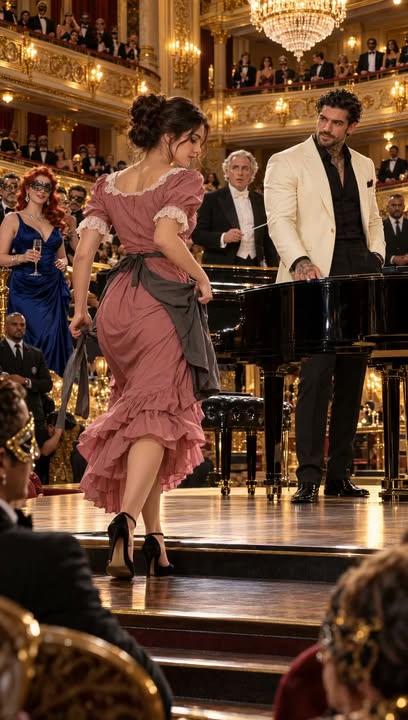
For an instant, I saw the opera house as it had been the night I first played: masks, laughter, Vincent’s ivory jacket, and Maestro Falk waiting to judge what I did with the music.
Then the image passed.
I sat at the piano.
The first notes sounded softly.
My father’s concerto unfolded around me, no longer a mystery to solve or a claim to defend.
The opening melody carried the patience of his hands.
The central theme opened into Isabella’s lullaby.
I imagined her at a piano before I was born, teaching the melody to Thomas.
I imagined my father listening and keeping it safe in the only way he knew.
When I reached the three altered notes, I did not hesitate.
They belonged in the music because they belonged to the people who had made it.
The final movement rose beneath my hands.
For years, I had heard my father’s ending as a small refusal, a choice not to reach for applause.
Tonight, I understood it differently.
The music did not end with a grand declaration.
It ended with a note that allowed the next person to answer.
I played it as he had taught me.
The final chord rang through the hall.
For one breath, no one moved.
Then the audience rose.
I stood beside the piano, the sound of applause gathering around me.
I looked toward the front row.
Luca was on his feet, his eyes bright.
Near the back, Vincent stood with one hand resting against the seat in front of him.
He was not watching the room.
He was watching me.
His face held no triumph, no claim, and no expectation that I owed him anything.
Only pride.
I bowed once, then turned toward the piano.
The score remained open on the stand.
Thomas Marlow’s name appeared clearly on the cover.
For the first time, it did not feel as if I had brought him back from somewhere.
It felt as if the music had finally arrived where it was meant to be.
After the performance, people gathered in the hall to congratulate me.
Some spoke about the concerto.
Some spoke about the story behind it.
I thanked them, then found a quiet room beyond the stage where Vincent and Luca were waiting.
Luca stood when I entered.
“You played beautifully,” he said.
“Thank you.”
“I think Isabella would have been proud.”
I looked at the framed photograph he had brought.
“I hope she would have recognized the ending.”
“I think she would.”
Vincent came to stand beside us.
For a moment, the three of us looked at the picture together.
We did not try to arrange ourselves into a family photograph.
No one asked us to make the past look easy.
The family we had become was smaller than a public story and more complicated than a name.
It was a photograph passed carefully between hands.
It was a letter read without pretending it answered everything.
It was Vincent learning how my father took his tea, and me learning the tune his mother used to hum.
It was Luca choosing to speak honestly, even when he could not offer certainty.
And it was a piece of music that could carry love without excusing silence.
Outside, the evening air was cool.
Vincent and I stepped onto the opera hall’s marble stairs.
The city moved around us, bright and restless, but for once I did not feel invisible inside it.
“You should come over for dinner this week,” he said. “I want to try the recipe Mother used to make.”
“Do you know how to cook it?”
“No.”
“Then I’ll bring something edible.”
“I was hoping you would.”
“I’ll bring the lullaby too.”
His expression softened.
“I’d like that.”
We stood for a moment beneath the lights, neither of us in a hurry to turn a good evening into a grand promise.
Then Vincent offered me his arm.
I looked at it, amused.
“Are you making another public challenge?”
“No,” he said. “I’m asking if you’d like to walk with your brother.”
The word was simple, offered without pressure.
I took his arm.
Together, we descended the steps toward the river, carrying the music with us—not as a secret that bound us to the past, but as something we could choose to share.
**–THE END–PLEASE
Share your thoughts or feedback to motivate us to create more stories ♥️
* * *
[PREVIOUS: PART 5](https://echoesofstories.idolsgift.com/blog/part-5-the-voice-beneath-the-music-046-10)
✓ Lynn R. Adams
Part 6 – The Music We Keep Vincent read the letter again, more slowly this time, his eyes following each line as if the words might soften if he gave them time. Then he passed it to me. I read: Vi…