PART 6 (THE END): The Voice Behind the Curtain 047
Part 6 – The Dance They Chose
The final page contained a signed statement from Dominic’s late wife, written just days before she disappeared.
He read it once, then again more slowly, as the rain tapped the car window and the city blurred beyond it.
She had written that Marcus had altered records, frightened her with stories of what Dominic would do if he learned the truth, and arranged for her to leave with Elena before the lies could become a danger to their child.
She had also written that Dominic had never known the full reason they were gone.
“I am sorry I made the choice for all of us,” the statement ended.
“But I was afraid, and I believed taking Elena away was the only way to keep her safe.”
“Please tell her, if you ever can, that I loved her father.”
Dominic lowered the phone.
He had spent years imagining a final explanation that would make the past simple.
Instead, the truth made it more human: his wife had been frightened and wrong about some things, right about others, and left with no easy choices.
The next morning, he sent Elena the statement through the prosecutor, as she had requested.
He did not add a message asking her to forgive anyone.
He did not ask her to call.
He simply made sure she had the words her mother had left for her.
The investigation moved slowly, as such things did.
The original ledger was examined alongside the records Elena had found in the old house.
Independent handwriting experts confirmed that the warning on the photograph had been copied by someone other than Elena, while the forged note Dominic had believed for so long was not in his wife’s hand.
The evidence also showed that Marcus had manipulated accounts and planted false records, using his access to the family’s business to make the betrayal appear to come from Elena’s mother.
The small brass key had opened the safe because Dominic’s father had arranged for it to be kept for Elena, believing she would one day be old enough to choose what to do with the truth.
The teddy-bear pin had been made to hold a hidden note, but no one could prove who had placed Dominic’s message inside it or when.
Its strange date remained unexplained.
The prosecutor concluded it might have been a copying error, added long after the note itself had been written.
Dominic could not say whether that was true.
He only knew that the message had brought them to the letters, and that nothing on the paper had given him permission to decide Elena’s future.
Marcus was charged for the fraud and for his role in the forged records.
He cooperated with investigators, handing over documents that helped establish the truth, but his cooperation did not erase what he had done.
Dominic gave the authorities his own records and answered their questions without trying to hide behind Marcus’s crimes.
Some of the investigators’ findings cleared him of acts Marcus had falsely attributed to him.
Other matters belonged to Dominic alone.
He faced the consequences of the business he had chosen to build, and spent long weeks with his lawyer sorting what could be surrendered, what could be transferred lawfully, and what had to end.
The old organization did not disappear overnight, but it no longer answered to him.
When men who had once waited for his orders asked what they should do, Dominic told them to seek counsel, obey the law, and make their own choices.
Some left.
Some stayed to answer questions.
None of them were sent to watch Elena.
He kept that promise even when the silence became difficult.
For a time, Elena and Daisy stayed with a friend outside the city while the investigation proceeded.
Dominic did not ask for their address.
He did not send a car.
He did not ask Niko to find out whether they were safe.
Instead, he gave the prosecutor his number and made himself available if Elena wanted him.
A week passed.
Then another.
He learned not to treat every quiet day as a rejection, though he was not always good at it.
He began meeting with a counselor recommended by Salvatore, first because the investigator advised it, and later because Dominic understood he had spent too long mistaking control for care.
He learned to sit with questions that had no quick answer.
He learned that an apology was not a key that opened every locked door.
Most of all, he learned that loving someone did not mean they owed him closeness.
One afternoon, a message arrived from Elena.
Daisy’s recital is Saturday at three.
The message included the name of a community arts center and no further instruction.
Dominic read it twice before replying.
Thank you for telling me.
He arrived twenty minutes early and sat in the last row.
The room was small, with a low stage, a painted sun hanging above the curtains, and rows of mismatched chairs.
Parents and grandparents filled the seats, whispering and taking photographs as children in bright costumes gathered backstage.
Dominic had come without Niko, without a security team, and without anyone who might mistake his presence for an announcement.
He wore a plain dark jacket.
The golden teddy-bear pin was not on his lapel.
He had left it with Elena after asking whether she wanted it returned.
She had said Daisy should decide.
Daisy appeared at the side of the stage in a pink dress and yellow satin bows, her hair braided into two neat pigtails.
When she spotted Dominic, she waved so enthusiastically that one bow nearly came loose.
“You came!”
“I did.”
Elena stood beside the curtain, one hand resting lightly on Daisy’s shoulder.
She looked tired, but the guardedness in her expression had softened around the edges.
“Thank you for coming,” she said.
“Thank you for inviting me.”
“I didn’t invite you for myself.”
“I know.”
Daisy took Dominic’s hand and leaned close.
“Are you going to clap?”
“If you want me to.”
“Not just a little clap.”
“I’ll clap as much as I can.”
She nodded, satisfied, then hurried back to her group when a teacher called her name.
The children’s dance was simple: a few practiced steps, a turn, and a final pose beneath the painted sun.
Daisy watched the other children carefully, then forgot the steps as soon as the music began.
She spun too early, swayed in the wrong direction, and finished by lifting both arms with such joy that the audience laughed warmly.
Dominic clapped until his palms stung.
He did not look around to see who noticed.
He watched Daisy.
At the end, she ran from the stage into Elena’s arms, breathless with pride.
“I did my dance!”
“You did,” Elena said.
“Did Grandpa clap?”
“I did,” Dominic answered.
“Everybody heard you.”
Daisy looked delighted.
“Then you’re learning.”
Elena’s smile appeared briefly, small but real.
After the recital, they walked to a nearby park where the children could run beneath the bare trees.
Daisy held Elena’s hand in one of hers and Dominic’s in the other.
For the first few minutes, Elena allowed it.
Then Daisy darted toward a patch of fallen leaves, and Elena let go to catch her before she stumbled.
Dominic did not reach for Elena’s hand again.
He stayed beside them and listened while Daisy described the dance in her own version, adding a shark song and a grand finale that had not been part of the recital.
When it was time to leave, Elena told him she could not promise when they would meet again.
Dominic said he understood.
She did not thank him for accepting that.
But she did not tell him not to come back, either.
The months that followed were not a quick repair.
They were made of small, ordinary things: short visits, unanswered questions, careful conversations, and the slow work of letting the truth remain true even when it hurt.
Elena read her mother’s letters in her own time.
Some made her angry.
Some brought back memories she had believed she understood.
A few made her laugh, especially the one describing her toddler habit of hiding biscuits in her shoes.
Dominic shared what he remembered, but learned to say when he did not know.
When Elena asked whether her mother had ever seemed afraid at the old house, he did not invent certainty to comfort her.
When Daisy asked why her grandmother had gone away, Elena told her that grown-ups sometimes made frightened choices and sometimes got things wrong.
“She loved you,” she said.
“She loved Grandpa too.”
Daisy looked between them.
“Then she should have brought everybody together.”
“Yes,” Elena said. “I wish she had.”
Dominic did not ask Elena to forgive her mother.
He did not ask her to forgive him.
Instead, he let her tell the story in her own order.
Over time, Elena began visiting the old house with Daisy.
They did not move back into it.
The place carried too many old questions to become a home again, but it became something different: a place where they could look at the past without pretending it had not happened.
Dominic had the grandfather clock repaired, with Elena’s agreement.
When it began ticking again, Daisy stood in the hall and listened.
“It’s counting,” she said.
“It always was,” Elena replied.
“Now we can hear it.”
Dominic looked at his daughter.
“Yes,” he said. “Now we can.”
He left the underworld behind.
The process cost him more than money or authority.
He lost a familiar name, a network of people who had followed his decisions for years, and the certainty that he could arrange every outcome before anyone else had time to choose.
In return, he gained nothing guaranteed.
Elena remained cautious.
Daisy still called him Grandpa Teddy, but she did not do so every day.
Dominic came to understand that this, too, was a gift rather than a claim.
The investigators eventually confirmed that Marcus had forged the evidence against Elena’s mother and used the family’s fear to keep his own actions concealed.
They also confirmed the warning on the photograph had been Elena’s, written in her own hand when she was young, but copied onto the image later by someone who wanted to turn its meaning against Dominic.
When Elena first wrote Trust nobody, she had meant Marcus’s people.
She had been a child repeating a warning she only partly understood.
The words had outlived the moment that gave them meaning.
That did not make them false.
It only made them incomplete.
Dominic was cleared of the crimes Marcus had deliberately pinned on him, though the inquiry into the choices he had made in the years afterward continued.
He accepted what the law required, cooperated when asked, and gave up every business he could no longer justify keeping.
He no longer called that surrender.
He called it an answer.
A year after the gala, Elena invited him to Daisy’s birthday celebration.
It was held in the back garden of a small community hall, with paper lanterns strung between the trees and a cake decorated with pink flowers.
There were fewer than twenty people there.
No politicians, no guards, and no men waiting for Dominic to speak first.
A children’s song played from a little speaker on the picnic table.
Daisy wore a yellow dress, though her hair was now a little longer and one braid had already come loose.
She danced in the middle of the grass, singing along in her own bright, uncertain tune.
Dominic sat with the other adults and clapped.
No one had to tell him.
Elena watched him for a moment, then lowered herself into the chair beside him.
“You’re getting better at that,” she said.
“At clapping?”
“At being there without taking over.”
He looked toward Daisy, who was spinning beneath the lanterns.
“I’m still learning.”
“I know.”
For a little while, they sat in companionable silence.
Then Elena reached into her bag and brought out the small golden teddy-bear pin.
Its clasp had been repaired.
“Daisy wants you to wear this.”
Dominic took it carefully.
“Are you sure?”
“She decided.”
He held the pin in his palm, feeling its familiar weight.
The tiny stamped bear caught the light.
“I’ll wear it.”
Elena fastened it to the front of his jacket.
Her fingers lingered for only a second, then fell away.
Daisy spotted the pin and rushed over.
“Now you match the key!”
Elena touched the brass key beneath her collar.
The key still belonged to her.
The letters were safe with the authorities, and copies rested in a place she had chosen.
The old safe remained open in the study, not because it had nothing left to hide, but because it no longer needed to be locked against her.
“Does the key still open the tiny door?” Daisy asked.
“It does,” Elena said.
“Maybe someday you can show me.”
“When you’re older.”
“Older than two?”
“Much older.”
Daisy considered that with grave patience.
Then she looked at Dominic.
“Are you Grandpa Teddy now?”
Dominic smiled.
“If you want me to be.”
“I already told you.”
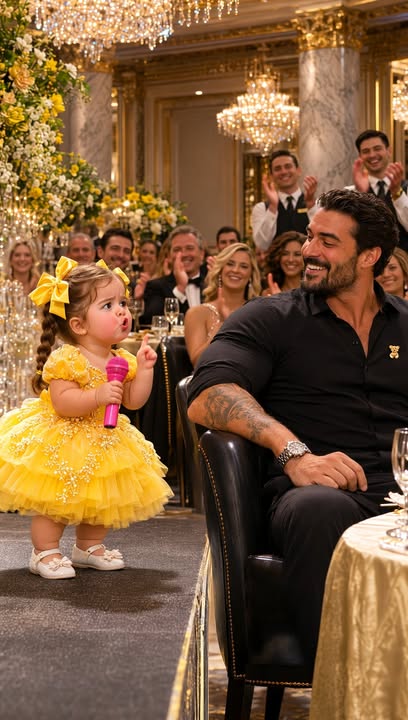
She pinned both hands to her hips, just as she had on the stage at the gala.
“You are Grandpa Teddy.”
The people nearby laughed, and this time Dominic joined them.
Daisy reached for his hand.
He looked at Elena before taking it.
Elena nodded.
Together, the three of them walked back toward the dancing children.
When the song began again, Daisy tugged at Dominic’s sleeve.
“Come dance.”
“I’m not very good.”
“Nobody is very good,” she said. “You just have to try.”
Elena stood beside them, watching him hesitate.
“You can clap if you’d rather,” she said.
Dominic looked at her.
“I’d rather try.”
He stepped onto the grass.
Daisy took one of his hands and Elena took the other, not because a child had ordered them to, but because Elena had chosen to.
The song rose around them, light and familiar.
Daisy spun beneath their joined hands, laughing as the golden bear flashed against Dominic’s jacket.
He stumbled once, and she laughed harder.
Elena laughed too.
Dominic did not try to make the moment grander than it was.
He did not ask whether it meant they were healed, or whether the future would be easy, or whether they would always stay.
He simply stood with them beneath the lanterns, clapping when Daisy danced and holding his daughter’s hand because she had chosen to place it in his.
For the first time in many years, the house of his family did not feel like a place he had lost.
It felt like something they might build again, one honest moment at a time.
**–THE END–PLEASE
Share your thoughts or feedback to motivate us to create more stories ♥️
* * *
[PREVIOUS: PART 5](https://echoesofstories.idolsgift.com/blog/part-5-the-voice-behind-the-curtain-047-3)
✓ Lynn R. Adams
Part 6 – The Dance They Chose The final page contained a signed statement from Dominic’s late wife, written just days before she disappeared. He read it once, then again more slowly, as the rain tap…