PART 6 (THE END): The Village Beneath the Paper 056
Part 6 – The Name on the Map
“We have kept the original promise.”
For a moment, the words seemed to hold the whole chamber still.
The prince reached for the note, then stopped before his fingers touched its damp edge.
“Who wrote this?” he asked.
“The messenger from the old river road, Your Highness,” the rider replied. “He said the village elder sent it.”
Adrian looked at the second hand on the reverse.
“Do we know what they mean by the original promise?”
“No, Your Highness.”
The protagonist felt the old question rise again, but it had changed shape.
The promise was no longer only a sentence in a queen’s letter or a line in a survey.
Someone in Reedbank had kept it, too.
“Where is the messenger now?” she asked.
“He’s resting in the outer hall. He was cold and tired, but unharmed.”
“Please bring him somewhere warm,” Adrian said. “And ask whether he can stay until morning.”
The rider bowed and hurried away.
The prince looked toward the noblewoman.
“The old boundary book,” she said quietly. “They want us to bring it.”
Her gaze had settled on the narrow ledger Mr. Vale had placed among the records.
The protagonist reached for it, then paused.
“Perhaps they have their own copy,” she said. “Perhaps the book tells us something the palace has missed.”
“Or perhaps they want us to see how the promise was remembered,” Adrian said.
He did not sound certain.
But he sounded ready to go.
The chief clerk returned from the corridor with a travel list and an expression of concern.
“Your Highness, the road will be passable by carriage after the snow eases, but the old river track is too narrow for a formal party.”
“Then we won’t take a formal party.”
“Your Highness, the council meets in the morning.”
“I will speak to them before we leave,” Adrian replied. “The land sale remains suspended, and the inquiry will proceed whether I am there or not.”
The clerk looked at the signed statement.
“I’ll see that the council receives the documents.”
“And that Reedbank is named in the record of the meeting.”
“Of course.”
The prince turned to the protagonist.
“If the road is safe, will you come with me?”
She looked at the paper in his hand, at her mother’s signature on the old receipt, and at the map showing a path through snow toward people she had never met but could no longer imagine as a number.
“Yes,” she said.
The noblewoman stepped closer.
“I will come as well.”
“You don’t need to decide tonight,” Adrian said.
“I know.”
She looked down at the survey bearing her family’s name.
“That is why I need to come.”
By dawn, the storm had softened to a fine snow that drifted lightly across the palace steps.
The prince spoke before the council in the smaller map room, where the papers could be laid out for everyone to see.
He did not call Reedbank a mystery.
He named it as a community displaced by the flood, moved to higher ground by royal leave, and left waiting while the boundary was disputed.
He said plainly that the royal records had failed to honor the promise made to its households.
Then he presented the queen’s letter, the survey, the temporary register, and the altered public map.
He explained what remained uncertain and what had already been established.
The village had not abandoned its land.
Its residents had been marked in residence after the relocation.
The crown had promised them the north rise, but never completed the permanent grant.
And the public count had later omitted them while the dispute remained unresolved.
Mr. Vale stood before the council and acknowledged that he had known Reedbank was missing from the current records and had failed to challenge the omission.
He offered the boundary accounts for examination and agreed to assist the inquiry.
The noblewoman placed her family’s copy of Martin Voss’s survey on the table.
“My family has treated the north rise as part of its estate,” she said. “I was taught that Reedbank’s residents had left. The records before us show that the truth is more complicated, and I should have asked how that belief was established.”
She did not accuse her relatives.
She did not pretend she could answer for them.
She simply refused to let the old map speak without the old evidence beside it.
The council listened, asked questions, and postponed the land sale until the residents’ claim could be reviewed.
Not everyone agreed with the prince’s account of the crown’s responsibility.
But no one could reasonably claim that Reedbank had never existed.
When the meeting ended, the prince signed an order confirming that supplies would be sent at once and that the village’s claim would receive an open review.
He also ordered the public register corrected to include the thirty households, with a note explaining that the original land grant had been promised but not completed.
It was not the final judgment Reedbank deserved.
It was the first honest record the village had received in years.
The rider returned as the party prepared to leave.
“The messenger has rested, Your Highness,” he said. “He says he can guide you to the north rise.”
Adrian held the old boundary book beneath one arm.
“Then let us go.”
They traveled with a small escort, taking blankets, flour, lamp oil, and dried beans in two sturdy carts.
The protagonist rode beside the prince in the lead carriage while the noblewoman followed with the chief clerk and the household records.
The snow lay smooth over the fields, but the rider knew the old road by its bends and sheltered places.
At Northfield, the village head met them near the last marked milestone.
He pointed beyond the familiar road toward a narrow track partly hidden by reeds.
“People still use the river path,” he said. “We simply stopped seeing it on the royal maps.”
The prince thanked him, and the carts continued.
The farther they traveled, the more the land seemed to withdraw from the neat boundaries of the printed map.
The road narrowed between winter-brown grasses.
A pale strip of water showed through the reeds where the old river had once curved.
At last, the track climbed toward higher ground.
The village appeared gradually, first as a line of low roofs, then as a cluster of houses gathered around a well and a long communal shed.
Smoke rose from their chimneys.
Children watched from a doorway.
A woman carrying a basket stopped on the path, her expression cautious but not unwelcoming.
The messenger went ahead to speak with her.
When the prince and the others stepped down from the carriage, a man in a heavy wool coat came out from the communal shed.
He was older, with a weathered face and a walking stick polished by use.
“I am Tomas Reed,” he said. “The village asked me to meet you.”
“Thank you for receiving us,” Adrian replied. “I am Prince Adrian.”
“I know who you are,” Tomas said, not unkindly. “We’ve seen your portrait on a notice once or twice.”
The protagonist had expected the moment to feel grand.
Instead, it felt ordinary and a little awkward, like arriving at a home after being away too long.
The prince looked at the village behind Tomas.
“I’m sorry the palace took so long to come.”
Tomas studied him for a moment.
Then he said, “An apology matters more when it comes with a reason to stay.”
Adrian nodded.
“Then we’ll begin by listening.”
The first questions were simple.
How many households remained?
Were there children or elders who needed blankets urgently?
Had the old road become unsafe?
Did the families still know which portion of the north rise had been promised to them?
The answers were practical, full of details the ledgers had never held.
Thirty households remained, though some had grown and some had joined with relatives over the years.
The old well needed repair.
Several roofs had lost shingles in the storm.
The village had kept a small patch of land by the stream for shared vegetables, and the families continued to gather at the communal shed when the weather turned cold.
They had not waited idly for the palace to remember them.
They had built a life with what they had.
The protagonist listened as Tomas explained that the villagers had kept an old wooden boundary marker in the shed, passed down from the first families who moved to the rise.
The prince asked to see it.
Tomas led them inside.
The communal room smelled of woodsmoke and wool.
A few children sat at a table sorting beans, and two elders warmed their hands beside a small iron stove.
On the far wall hung a carved board with faded letters.
“REEDBANK—NORTH RISE,” the protagonist read.
Beneath the name, someone had carved a date and the words “By leave of the crown, until the promise is entered.”
Adrian stood very still.
The village had kept the promise in the only place no palace clerk could erase.
Tomas brought out a narrow wooden case.
Inside lay a small book wrapped in cloth, its cover worn smooth at the corners.
“This is the original boundary book,” he said. “My grandmother said it was given to the families when they moved.”
The prince opened it carefully.
Its pages held measurements of the north rise, a rough drawing of the river, and signatures of several witnesses.
On the last page, in a hand matching the queen’s letters, was a short entry:
“The households of Reedbank are to remain on the north rise in safety, and the land shall be recognized as theirs when the boundary survey is complete.”
Below it appeared the royal seal.
The prince looked at Tomas.
“Do you know why this book was never brought back to the palace?”
Tomas considered the question.
“My grandmother said the crown’s surveyor told the families to keep it safe until the land was formally entered. He told them not to let the promise be misplaced.”
The noblewoman lowered her eyes.
“Martin Voss?”
“That was the name.”
The pieces fit together, but not as a tale of one villain and one innocent family.
Voss had measured the land and witnessed the promise.
The royal office had failed to complete the grant.
The estate’s later boundary copy had treated the unresolved line as settled.
The council had chosen the convenient map.
And the present steward had preserved the omission because reopening it seemed difficult.
Each decision had narrowed the space in which Reedbank could be seen.
The villagers had kept the boundary book safe through all of it.
Mr. Vale stood near the doorway, his face grave.
“I am sorry,” he said to Tomas. “I knew the village had disappeared from our public count. I should have come to ask what had happened.”
Tomas looked at him steadily.
“Yes,” he said. “You should have.”
The steward accepted the words without defense.
“I will tell the inquiry what I knew and what I failed to do.”
“That will be a start.”
The protagonist watched the exchange.
Accountability did not mend the years by itself.
But it began where the truth had been absent: with one person admitting what he had chosen not to see, and another refusing to make the apology easier than it was.
The noblewoman stepped forward.
“My family’s estate relied on the newer boundary map,” she said. “I believed the land was empty because that was what I had been taught.”
Tomas looked at her.
“Did your family know we were here?”
“I don’t know,” she answered. “I will bring the original papers to the inquiry, and I won’t hide anything they show.”
He nodded slowly.
“Then let the papers speak. But come back yourself, too.”
“I will.”
No grand forgiveness passed between them.
The promise was more modest and more meaningful: she would return, and she would keep asking.
Outside, the first cart had been unloaded.
Blankets were carried into the communal shed, where the villagers sorted them by need.
The prince did not announce a share for every household as if the number alone could settle the matter.
He asked Tomas and the village healers to identify the families whose homes were coldest, and the first blankets went to children, elders, and those whose roofs had been damaged.
More supplies would follow once the road was secure.
The protagonist helped carry a bundle inside.
A little girl with dark braids watched her set it on the table.
“Are you the woman from the winter council?” the child asked.
“I am.”
“My father said you found our name.”
The protagonist looked at the girl’s open, curious face.
“I found a line in a book,” she said. “You and everyone here were already keeping the name alive.”
The girl considered this, then nodded as if it made sense.
The warmth in the communal room seemed to deepen.
Later, Tomas invited the visitors to share soup and fresh bread.
There was nothing ceremonial about the meal.
A pot was set on the table, bowls were passed around, and the children were asked to make room for the guests.
The prince sat among the villagers without the formal distance of the council chamber.
The noblewoman listened to an elderly woman describe the first winter after the flood, when the families had slept in the communal shed while houses were raised on the north rise.
She asked careful questions and wrote down what the woman remembered.
The protagonist sat beside the prince, her mother’s receipt in a small folder near her hand.
“Do you think she came here?” he asked softly.
“I think she did,” she replied. “I wish I could have heard her tell it.”
Tomas, seated across from them, had been listening.
“There was a woman who brought blankets,” he said. “My grandmother spoke of her. She carried a bundle in one arm and a ledger in the other.”
The protagonist’s fingers tightened around her spoon.
“Do you remember her name?”
“Not clearly. My grandmother called her a friend of the queen.”
The room seemed to soften around the words.
The protagonist looked down at the receipt bearing her mother’s signature.
Her mother had not told her the story, but some part of it had remained in the village, held by a grandmother’s memory and now offered back to her.
“I think that was my mother,” she said.
Tomas studied her face.
“Then she was welcome here.”
The protagonist could not speak for a moment.
The prince rested his hand on the table near hers, not claiming the moment, only sharing its quiet.
When they returned to the palace, the inquiry began within days.
The original boundary book was copied in the village, with Tomas and two other witnesses present.
The public map was corrected to show Reedbank and the north rise, and the royal register recorded the thirty households under the village’s own name.
The land sale remained suspended.
The estate’s original papers confirmed that Martin Voss’s survey had described the land as a promised holding, and that the later boundary copy had been made from an incomplete version of the record.
The noblewoman presented the documents herself.
She did not excuse her family or condemn it before the evidence was reviewed.
She explained what she had been taught, what the papers showed, and what she had misunderstood.
Her testimony helped the inquiry see how an uncertain boundary had become a settled claim simply because no one had brought the older records into the same room.
Mr. Vale assisted the investigators and accepted a formal finding that he had failed in his duty to challenge the omission.
He remained steward while the inquiry continued, but no longer controlled the northern accounts.
He agreed to review other old records with village representatives, beginning with the settlements whose names appeared inconsistently across maps and registers.
The prince did not pretend that one restored name repaired every failure.
He established a public review of the winter rolls and ordered that village representatives could examine the records affecting their homes.
He also required that changes to household counts include a written reason and the testimony of those who lived there.
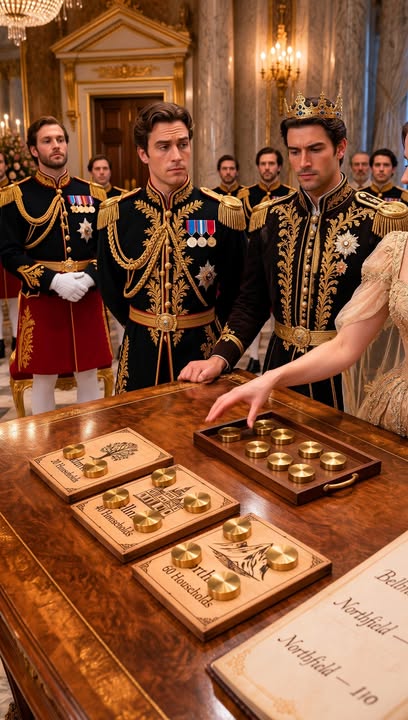
The first revised ledger listed Alderwick, Bellmere, Northfield, and Reedbank.
The total was one hundred and fifty households.
This time, no paper strip covered the number.
When the council confirmed the grant to the north rise, it did so in an open meeting attended by Reedbank’s representatives.
The land was formally recognized as belonging to the village, honoring the promise the families had kept for years.
The noblewoman signed as a witness to the boundary review.
Afterward, she returned to Reedbank more than once, helping organize the delivery of seed, tools, and timber for roof repairs.
She apologized to the protagonist again, this time without an audience.
“I thought being certain made me useful,” she said. “I see now that it sometimes only made me careless.”
“Then keep asking,” the protagonist replied.
The noblewoman smiled, small and sincere.
“I will.”
Their friendship did not appear all at once.
It grew through shared work, honest questions, and the steady effort of treating each other as people rather than symbols of what they had once believed.
The winter council resumed after the inquiry’s first findings.
The prince asked the protagonist to join its working sessions, not because the court needed a story of a woman who had found a hidden village, but because she had shown how to read a record without mistaking its neatness for truth.
She accepted on the condition that village representatives would have a voice in the council’s work.
Adrian agreed.
As spring approached, the people of Reedbank gathered in the open space beside the communal shed.
The palace had sent food for the celebration, but the villagers supplied bread, music, and a long table made from two sturdy planks.
Children ran between the chairs, carrying cups of warm cider.
A fresh sign had been placed at the edge of the old road.
Its painted letters read: REEDBANK.
The prince stood before the gathered villagers with no map held behind him and no prepared speech in his hand.
“The royal record should never have lost your name,” he said. “The promise made to your families should have been completed long ago. I cannot return the years in which you were left out, but I can recognize what was owed and work beside you to ensure it is not forgotten again.”
Tomas nodded once.
Then he stepped forward and shook the prince’s hand.
It was not a performance of perfect reconciliation.
It was the beginning of trust, offered with care.
The protagonist stood among the villagers, her deep-rose gown bright against the pale spring light.
The noblewoman stood a few paces away, speaking with one of the elders.
Mr. Vale had come as a witness to the restored record, carrying a copy of the corrected ledger.
Adrian turned to the protagonist after the formal words were done.
“I have a request,” he said.
She looked at him, expecting another question about the council or the winter stores.
“I would like you to help lead the restored winter council.”
His voice was warm, but not ceremonial.
“Not as a symbol of the night you found the missing line,” he continued. “Not because the court needs a lesson about appearances. I want you there for your judgment, your patience, and the way you remember that numbers belong to people.”
She looked at the sign by the road, then at Tomas speaking with the children and the bundles of supplies stacked inside the communal shed.
“Will the villages have a voice in the council?” she asked.
“Yes.”
“Will they be able to question the records?”
“Yes.”
“And if the council makes a mistake?”
“Then we correct it.”
She smiled.
“Then I’ll help.”
His shoulders eased, and for a moment the prince seemed less like the keeper of the kingdom’s promises and more like a man relieved to have found a partner who would tell him the truth.
The celebration rose around them in music and conversation.
Tomas invited the prince to try a slice of honeyed bread, and the children insisted the protagonist stand beside the new sign for a photograph.
The noblewoman joined them, awkwardly laughing when the youngest child pulled her gently into place.
Behind them, the road curved north between the reeds and the higher ground.
On the royal map, Reedbank now sat where it had always belonged, its name written beside the road, its thirty households included in the count.
The village had not returned from nowhere.
It had been there all along, keeping its promise and its name until the kingdom finally learned how to see them again.
**–THE END–PLEASE
Share your thoughts or feedback to motivate us to create more stories ♥️
* * *
[PREVIOUS: PART 5](https://storyly.idolsgift.com/blog/part-5-the-village-beneath-the-paper-056)
✓ Lynn R. Adams
Part 6 – The Name on the Map “We have kept the original promise.” For a moment, the words seemed to hold the whole chamber still. The prince reached for the note, then stopped before his fingers to…