PART 6 (THE END): The Thread Beneath the Hem 069
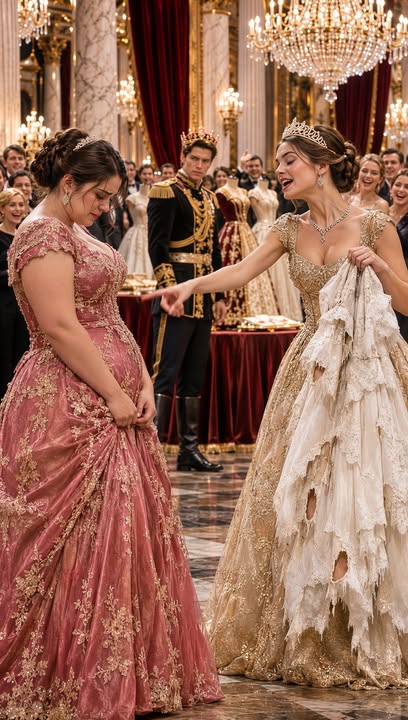
Part 6 – A Future Freely Chosen
Beneath it was another note, written much later.
Mara leaned closer to the narrow page, careful not to touch its faded edge.
The new line read: “One companion volume, wrapped with the bridal collection. Keep with the gown until the prince is ready.”
Adrian’s gaze remained fixed on the words.
“A companion volume,” he said. “Was it listed anywhere else?”
Mrs. Rowe, who had hurried back into the ballroom at the attendant’s message, took the page and studied it through her spectacles.
“Not in the main catalogue,” she said. “It may have been entered under a different number when the east wing was cleared.”
“Can you find it?”
“I can search the transfer records, Your Highness. It may take a little while.”
“Then we’ll wait.”
The ballroom had emptied, but the night did not feel finished.
Mara looked at the gown’s embroidered crescent and sprig of rosemary, at the page that had waited so long to be read, and at the prince whose mother had left him a message not to tell him whom to choose, but how to see people.
“What do you think the volume contains?” Adrian asked.
“I don’t know,” Mara said. “But your mother wanted it kept with the dress. Perhaps it belongs to the same story.”
He nodded, accepting the answer without trying to turn it into certainty.
Mrs. Rowe took the register to the archive office, while Master Vale arranged for the gown to remain under careful supervision.
Mara and Adrian walked back to the restoration rooms together, not as a prince and a contestant, but as two people who had learned to ask questions before deciding what an object—or a person—meant.
At the threshold, Adrian stopped.
“You’ve done more than uncover a hidden message,” he said. “You helped us see what we had mistaken for the truth.”
Mara shifted the magnifying glass case in her arms.
“I only followed the thread.”
“Sometimes that is how a person finds the way back.”
She looked at him, uncertain whether the warmth in his voice came from gratitude or something more tender.
Before she could ask, Master Vale called from inside.
“Mara, the sleeve will need your eye tomorrow.”
She smiled.
“Then I’ll be here.”
The next few days brought no grand revelation, only the patient work of recovering what had been lost.
Mrs. Rowe searched catalogues, transfer lists, and the loose papers left behind when the east wing was renovated.
Master Vale examined the old gowns under proper preservation conditions, while Mara recorded every seam, repair, and mark.
The work was quiet and exacting, but the story it revealed grew clearer with each careful comparison.
The silver ceremonial gown had been stored beside Queen Elara’s wedding dress during the wardrobe move.
Its hidden blue knot belonged to the same older repair practice, and the instruction to leave its lining untouched had been written because the queen had asked that a small keepsake be preserved there.
It was not a second letter or a secret meant to deceive the court.
It was a small square of linen embroidered with the same crescent and rosemary, made by Elara’s own hand and placed in the gown as a private reminder of the wedding day.
The thread had connected two garments entrusted to Mara’s grandmother.
The knots had shown where to look; the old records had shown why the dresses had been kept together.
And the note in the sleeve had explained what Queen Elara hoped her son would one day understand.
The companion volume proved more difficult to locate.
It was found at last in a cedar chest marked as household accounts, wedged between ledgers from the year of the east-wing renovation.
Its cover bore no title, only the tiny embroidered emblem worked into a square of linen.
Mrs. Rowe opened it in the archive with Adrian, Mara, Master Vale, and Celestine’s mother present.
The pages contained a record of Queen Elara’s wedding preparations, including sketches of the gowns and notes about the people who had made them.
There were entries about the silk, the embroidery, and the cost of repairs.
But the queen had also written down the names of the palace workers who had contributed their skill.
Mara found her grandmother’s name several times.
One note read: “She understands that a garment may be treasured without being worshipped, and repaired without erasing the hands that first made it.”
Mara pressed her lips together, the words blurring for a moment.
She had spent years wishing she remembered more of her grandmother.
Now the page offered something better than a perfect memory: proof that the woman she loved had been trusted, respected, and remembered by the queen herself.
Adrian stood beside her, reading the line again.
“Your grandmother’s name should never have disappeared from the record,” he said.
Mara touched the edge of the page through her glove.
“It didn’t disappear entirely.”
“No. But it should not have taken a hidden thread and a lost register to bring it back.”
He spoke with the quiet resolve that had begun to distinguish his choices from his title.
The archive records were corrected.
The royal household issued a formal account of the gown’s history, acknowledging the mistake that had led to the old theft story.
The staff who had cared for the collection were credited, including Mara’s grandmother, the first seamstress entrusted with Queen Elara’s dress.
The acknowledgment did not undo the years in which servants had been suspected or overlooked.
But it made the truth part of the record, where it could no longer be misplaced so easily.
Celestine kept her promise to support fair recognition for palace workers.
She helped establish a paid apprenticeship in the restoration rooms, open to applicants from every background, and used her family’s influence to ensure the program had enough materials and time to teach its students properly.
At the first gathering, she stood before the new apprentices without the glittering confidence she had worn in the ballroom.
“I was taught that belonging depended on being chosen,” she told them. “I was wrong. You belong here because your work, your curiosity, and your care matter.”
Afterward, she found Mara near the cutting table.
“I didn’t know whether I could say that without sounding as though I wanted everyone to approve of me,” Celestine admitted.
“Did you?”
“I wanted them to understand me.”
“That’s different.”
Celestine considered the words and smiled faintly.
“I’m learning that.”
They did not become close overnight, and neither expected them to.
But over the following months, they found a steadier way to speak to one another.
Celestine asked questions instead of assuming answers.
Mara answered when she wished and disagreed when she needed to.
Their respect grew not from forgetting the hurt, but from making better choices after it.
Adrian’s choice was more difficult to make visible.
He declined the council’s suggestions that he reopen the bride competition under a new name.
He also refused to announce that he would never marry, knowing that such a declaration would turn one uncertain moment into another story the court might mistake for a promise.
Instead, he told the council he would meet people as a person, not as a prize at the end of a contest.
Some nobles were pleased by the change.
Others were not.
The kingdom continued to turn, and the royal household learned to make room for a prince who did not hurry his heart to satisfy a schedule.
As for Mara, she returned each morning to the restoration rooms.
She worked on the queen’s gown with Master Vale, mending only what needed mending and preserving every stitch that could still carry its history.
Adrian visited often, at first to ask about the records, then to learn how the restoration was progressing, and finally because he wanted to speak with her when neither of them had a mystery to solve.
Their conversations began among worktables and cedar chests.
They spoke about Elara’s notebooks, Mara’s grandmother, and the ways a palace could be both beautiful and blind.
They spoke about the pressure of being watched, though from opposite sides of the same rooms.
Adrian told her how lonely it could be to have every ordinary kindness interpreted as a political promise.
Mara told him how often workers learned to make themselves small so that mistakes would not be blamed on them.
Neither of them tried to turn their differences into a romantic story before they understood one another.
That, more than any grand gesture, allowed their friendship to grow.
In the spring, the royal restoration rooms were given a larger workspace with proper light, padded tables, and an archive catalogue that included the names of the people who had repaired each garment.
Adrian offered Mara the position of leading the textile restoration rooms.
It came with a salary, a staff of skilled assistants, and authority to determine how the collection would be handled.
He did not call it a reward.
“Your talent deserves proper recognition,” he told her. “And the work needs someone who understands that preservation is more than making old things look new.”
Mara looked around the bright room, where her grandmother’s name had been copied into the new catalogue and carefully placed among the records.
“I’ll accept,” she said, “on one condition.”
“Name it.”
“You don’t make the appointment depend on whether I remain close to you.”
Adrian’s expression grew serious.
“It does not.”
“And you won’t expect me to agree with you because you are the prince.”
“I hope you won’t.”
“Then I accept.”
He held out his hand.
Mara took it, smiling as he shook hers with the solemnity of a treaty and the warmth of a friend.
The years did not change them all at once.
They changed them through the small, honest things that made their lives fit more closely together.
Adrian learned the names of the restoration staff and began asking what they needed before announcing what the palace would provide.
Mara learned that she could tell him when he was being stubborn without making herself less worthy of his respect.
They shared tea in the archive after long afternoons, read from Queen Elara’s companion volume, and sometimes sat in comfortable quiet while the palace settled around them.
When Adrian spoke of his mother, he no longer spoke only of what he had lost.
He spoke of the warmth of her hand on his shoulder, the way she laughed when ink smudged her fingertips, and the little rosemary emblem she had embroidered on her wedding gown.
Mara told him about her grandmother’s humming and the lavender scent that had clung to her sewing basket.
Their memories met without needing to be the same.
One late summer evening, after the old gown had been fully stabilized, Adrian asked Mara to walk with him through the palace gardens.
The roses had begun to fade at the edges, but the rosemary beds were green and fragrant.
He stopped beside a stone bench overlooking the western lawn.
“I’ve been thinking about what my mother wrote,” he said. “Not about finding the right person to stand beside me, but about becoming someone who can stand beside another person well.”
Mara waited, letting him find his own words.
“I care for you,” he said. “Not because you solved the mystery, and not because the court once imagined a contest would end with a bride. I care for the way you see people, including the parts they would rather hide from themselves.”
Her breath caught, but she did not look away.
“I would like a future with you, if that is something you want freely.”
Mara looked toward the palace windows, where the last light of day rested in the glass.
She thought of the girl in the rose-pink gown, trembling under the ballroom’s laughter.
That girl had wanted to prove she belonged.
She had not known she could build a life in which belonging did not depend on anyone’s invitation.
“I want to choose you,” Mara said. “Not because you are a prince, and not because the palace expects me to. I want to choose you because I know the man who has learned to ask before assuming, and to admit when he has been wrong.”
Adrian’s smile held relief, gratitude, and a tenderness that made her own eyes sting.
“Then I will keep trying to be that man.”
“And I’ll keep telling you when you’re not.”
He laughed softly.
“I would expect nothing less.”
Their wedding was held in the palace garden the following year, after months of planning that belonged to them rather than to the court.
No one selected a bride.
No one announced a contest.
They chose their future in conversation, one decision at a time.
Mara wore a newly restored gown inspired by Queen Elara’s, fashioned from soft ivory silk and embroidered with the crescent and rosemary.
The old gown itself remained in the royal archive, preserved with its original seams, its hidden note, and the record of every person who had cared for it.
Mara’s wedding gown carried the same emblem, but its stitching was new.
Along the inside of one sleeve, she asked that a small blue thread be left visible to her alone.
Not as a secret from Adrian, but as a quiet remembrance of the line that had led them back to the truth.
Before the ceremony, Adrian stood with her beneath the rosemary arch.
“Are you ready?” he asked.
Mara looked at him, at the assembled people who had come to celebrate them, and at the pale garden beyond.
“I’m ready to find out what comes next,” she said.
“That sounds more honest than most wedding vows.”
“Then you’ll have to make do with it.”
“I will.”
They exchanged their vows before the court, the palace workers, Celestine and her family, and the people whose names had once gone unrecorded.
Celestine stood beside her mother, offering Mara a warm smile without trying to claim a place at the center of the day.
When the ceremony ended, she embraced Mara and wished her a life filled with choices made freely.
Mara thanked her, and this time the words carried forgiveness—not for the harm as though it had never happened, but for the effort Celestine had made to become someone who would not repeat it.
The palace celebrated late into the evening.
The old story of the stolen gown was not erased from the kingdom’s memory; it was corrected.
People learned that the dress had been entrusted, misplaced, and preserved by generations of careful hands.
They learned that a palace could lose a truth even while keeping its records, and that listening closely could bring it back.
They learned, too, that a queen’s worth had never been in the silk she wore.
It had been in the judgment she left behind, and in the compassion her son chose to practice.
As the lanterns glowed over the garden, Adrian took Mara’s hand.
The small blue thread inside her sleeve brushed his fingers.
“What is it?” he asked.
“A reminder to look closely.”
He smiled.
“Then I hope I never stop.”
Together, they walked beneath the rosemary and the stars, not toward a life arranged for them, but toward one they had chosen—stitched patiently from truth, dignity, and love.
**–THE END–PLEASE
Share your thoughts or feedback to motivate us to create more stories ♥️
* * *
[PREVIOUS: PART 5](https://storyly.idolsgift.com/blog/part-5-the-thread-beneath-the-hem-069)
✓ Lynn R. Adams
Part 6 – A Future Freely Chosen Beneath it was another note, written much later. Mara leaned closer to the narrow page, careful not to touch its faded edge. The new line read: “One companion volume…