PART 6 (THE END): The Stitch Beneath Her Apron 057
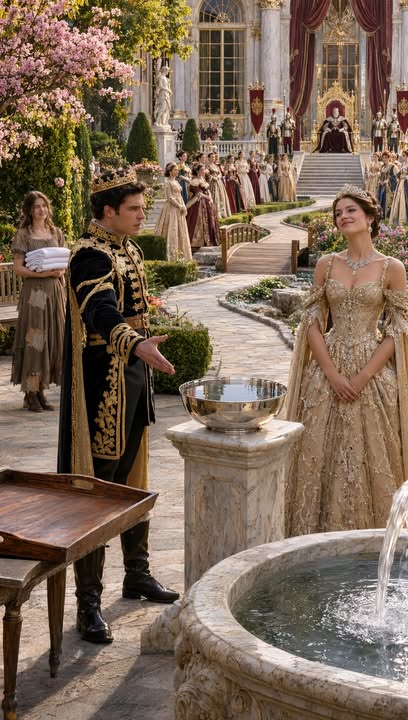
Part 6 – A Place Chosen Freely
Lena read the name again, then a third time, as if the ink might rearrange itself and spare her the ache of understanding.
It belonged to the woman who had raised her mother after Maris was gone: Ada, the gentle neighbor who had taught Lena to mend a seam, plant beans, and read the names on the jars in their little kitchen.
“The child was placed with Ada?” Lena asked.
Master Orren nodded.
“That is what the queen’s record says. Maris was to bring Princess Elowen’s daughter to her, and Ada was to keep her safe.”
Lena gripped the edge of the table.
“Then I knew her.”
The king’s voice softened.
“You may have.”
“Who was she?”
Master Orren looked down at the page.
“The record gives the name the child was to use beyond the court: Mira.”
The name opened a door in Lena’s memory.
Mira, with the pale scar on one eyebrow from falling into a rosebush as a little girl.
Mira, who had shared bread with Lena when there was not enough for two whole meals.
Mira, who had left their village years ago to work in another town, promising to write when she could.
Lena’s hand went to her apron pocket, where the locket rested.
“She was my sister,” she whispered.
“Not by birth,” the king said gently. “But she was raised beside you.”
“By Ada,” Lena replied. “And by my mother.”
The prince watched her, careful not to interrupt.
“My mother never told me,” Lena said. “She must have known what the truth could mean.”
The king studied the queen’s record.
“Perhaps she believed that knowing Mira’s birth would put her in danger. The queen’s instruction was clear: protect the child until the palace was safe.”
“And when did it become safe?”
The king had no ready answer.
“Perhaps Maris never knew for certain,” he said. “Perhaps she feared that safety could be lost again. Or perhaps she hoped Mira would be able to choose her own life before anyone told her who she was.”
Lena looked down at the name.
All those years, the princess’s daughter had not been a distant figure in a royal record.
She had been the girl who waited for Lena by the river, who knew when Lena was sad before Lena did, who had shared a home and a childhood with her.
“What happened to her after she left the village?” Lena asked.
Master Orren checked the remaining lines.
“There is no record here. The queen’s page ends with the arrangement.”
“She went to the town of Bellmere,” Lena said. “She wrote to Ada for a while. Then the letters stopped.”
“Do you remember when?”
“Several years ago. I was already working at the palace by then.”
The king folded the record with care.
“Would you like us to search for her?”
Lena thought of the words in the queen’s letter: do not claim her as royal.
She thought of Mira at the river, laughing with her shoes in her hands, telling Lena she would never care for palace life.
“Yes,” she said. “But not as a princess being summoned home.”
The prince nodded.
“We can search quietly, through the household’s ordinary contacts. No proclamation, no public inquiry.”
“And no one should tell her what she is before she has the chance to decide whether she wants to hear it.”
“Agreed,” the king said.
Lena looked at the old page.
“If she is still in Bellmere, I want to speak with her myself.”
“You may,” the king replied. “And if she does not wish to return, that choice will be respected.”
The words mattered.
The palace had taken enough choices from both women simply by hiding the truth in its records.
This time, Lena wanted the truth offered with an open hand.
In the days that followed, Master Orren wrote to the keeper of the Bellmere market and to the village schoolmistress, asking only whether a woman named Mira had been heard from.
The king made no announcement about the missing princess.
He did, however, sign a public order clearing Maris’s name and recording her faithful service to the late queen.
The order was read before the court and copied into the palace archives, where no loose page could quietly erase it again.
Lena listened from the garden as the clerk spoke her mother’s name.
When the reading was done, the king invited the palace workers to gather beside the nobles.
The invitation was unusual enough to create a murmur, but he did not retreat from it.
He spoke of those who kept the household running: gardeners, cooks, laundresses, messengers, and attendants whose work was often noticed only when something went wrong.
“Service is not made small by being performed out of sight,” he said. “From this day, the names of those entrusted with the care of the palace will be recorded with the same care as the names of those who rule it.”
Lena saw the gardeners exchange glances.
One of them, old Tomas, who had helped repair the bridge, gave a quiet nod.
It was not a grand transformation.
It was a beginning made in public, where the court could not easily pretend it had never happened.
The contest was held again three weeks later.
This time the stone path had been inspected from end to end, the bridge rebuilt on firm supports, and the steps cleared of the damp moss that had gathered in the shade.
The gardeners’ names appeared on the official report.
So did the judge’s, the attendants’, and the women who had helped revise the rules.
The challenge still involved a full silver bowl, a measured course, and a time limit.
But the contestants could stop the clock to call attention to a hazard, and each was asked afterward what she had noticed along the way.
Some contestants completed the course without a spill.
Others did not.
The results were considered carefully, and the women were judged not only by their balance but by their answers, their patience, and their willingness to listen.
Lady Celeste completed the course on her second attempt.
When she set down the bowl, she looked first at the water and then at the gardeners who had rebuilt the bridge.
“I could not have crossed safely without your work,” she said.
Tomas gave her a pleased, embarrassed smile.
Lena watched from beside the judge’s table.
Celeste had changed since the first afternoon, though not into someone quieter or less proud.
She had become more willing to let herself be uncertain.
When the prince asked her what she had learned, she answered honestly.
“That preparing to be chosen is not the same as knowing what I choose.”
The prince thanked her.
He did not announce a bride.
He announced that the contest had fulfilled its purpose, not by selecting a queen that afternoon, but by revealing the kind of partnership he wanted to build.
The noble families did not all approve.
A few objected that the prince had delayed too long and asked too many people for their opinions.
The king listened to their concerns, then invited the palace workers to speak in the same room.
Some nobles stayed.
Some left.
The prince did not change his decision to make the room more comfortable for them.
Lena remained at court while the contest concluded, but she was not placed beside the prince as a reward for winning.
She returned to her duties, though her work gradually changed.
At first, she helped organize a listening day for the servants, making sure their concerns reached the stewards rather than disappearing between corridor and council chamber.
She asked the prince to sit with them, not at the head of the table but among the people who knew which stair rails were loose, which kitchens lacked supplies, and which attendants were carrying work meant for three.
He listened.
Sometimes he learned things he did not like.
Sometimes the servants disagreed with one another, and he had to learn not to treat a single voice as the voice of everyone.
Lena learned too.
She learned that a palace could not be mended all at once, and that a good intention did not excuse a poor plan.
She and the prince argued over schedules, supplies, and whether a new household rule would help the people it meant to serve.
They apologized when they spoke too sharply.
They kept returning to the table.
Their closeness grew in small, unannounced ways.
It grew when the prince remembered that Lena preferred questions asked plainly.
It grew when Lena saw him admit, before the council, that he had made a decision without consulting the people who would have to carry it out.
It grew when he walked with her through the service corridors, not to inspect them like a curious visitor but to understand the rhythm of the lives lived there.
Neither of them mistook affection for obligation.
Neither called a promise love simply because the court wished to hear one.
The reply from Bellmere arrived near the end of summer.
Mira had been found.
She was working in a bookbinder’s shop and living above it in a small room filled with shelves, herbs, and more books than the landlord thought sensible.
She had not heard from Ada in years, but she remembered Lena.
Master Orren brought the letter to the garden, where Lena was helping Celeste review the household workers’ new roster.
Lena recognized Mira’s handwriting at once.
She unfolded the page beneath the old cedar.
Lena,
I have wondered whether you were still carrying towels through those palace halls, though I hope by now you have learned to let someone else carry a few.
I am well.
The bookbinder is patient with me, and I have made friends who do not mind that I ask what is inside every locked cabinet.
I remember Ada telling me that some truths should be given when they can be carried.
If you have one for me, I will listen.
But I do not wish to be called back to the palace, and I do not wish to be turned into a claim.
If you can promise me that, I would like to see you.
Lena lowered the letter.
The prince, who had been standing nearby, waited without asking what it said.
“She wants to meet,” Lena told him. “But she doesn’t want to come to court.”
“Then we will not bring the court to her,” he replied.
“Will the king agree?”
“I believe so.”
The king agreed.
He offered Lena a small escort for the journey, but she chose only one attendant she trusted, and asked that the royal crest be left behind.
Celeste offered to go with her.
Lena accepted.
The road to Bellmere was familiar in places and changed in others.
Fields she remembered as small had grown broad under the late-summer sky, and the river seemed narrower than it had in childhood.
When they reached the town, Lena found the bookbinder’s shop by following the smell of paste and paper.
A bell chimed above the door.
Mira looked up from the counter.
For a moment neither woman moved.
Then Mira came around the counter, and Lena crossed the little room to meet her.
They held each other tightly, with the fierce care of people who had been family before they knew there were words for the shape of it.
Mira had grown taller, and a few fine lines had appeared at the corners of her eyes.
Her hair was tied back with a green ribbon, and a streak of ink marked one thumb.
“You came,” she said.
“I said I would.”
“I thought the palace might have swallowed you.”
“It tried to give me a silver bowl first.”
Mira laughed, and the sound was so familiar that Lena’s eyes stung.
They sat in the room above the shop.
Celeste waited below, giving them privacy without being asked.
Lena told Mira about Maris, the queen’s letter, the missing page, and the child entrusted to her mother.
She did not say the word princess until she had explained everything else.
Mira listened with her hands wrapped around a cup of tea.
When Lena finished, she sat very still.
“So that was why Maris took such care of me,” she said.
“She cared for you because you were a child who needed her,” Lena replied. “The queen’s request may have given her a reason to bring you home, but it didn’t make her love less real.”
Mira looked down into her cup.
“She told me once that I had arrived in her arms during a time when everyone was afraid. I thought she meant I was a difficult baby.”
“She probably meant that too,” Lena said.
Mira smiled, then grew quiet again.
“Does the king want me to return?”
“He wants to know what you want.”
“And if I never go?”
“Then you never go.”
“Would they still tell everyone who I am?”
“Only if you chose to tell them.”
Mira let out a slow breath.
“I don’t know what I want yet.”
“You don’t need to decide today.”
Mira glanced at her.
“You sound like the prince.”
“I may have borrowed a useful sentence.”
“Is that why you stayed?”
Lena considered the question.
“I stayed because the contest was not fair, and the people who worked in the palace deserved to be heard. I stayed because the king needed to clear Maris’s name in public, not merely apologize to me in private.”
“And the prince?”
“He did not ask me to remain as a reward for my mother’s choices. He gave me room to decide for myself.”
Mira watched her, understanding more than Lena had explained.
“And do you love him?”
Lena looked out the small window at the roofs of Bellmere.
“I care for him. I trust the man he is trying to become. I don’t want to make a promise because the court expects a happy ending.”
“Then don’t.”
“I won’t.”
Mira reached across the table and touched Lena’s hand.
“I have missed you.”
“I have missed you too.”
They stayed in Bellmere for two days.
Mira did not agree to return to court, but she agreed to visit when she chose, and to read the queen’s letter in her own time.
She was not asked to take a title.
She was not asked to accept a place in the line of succession.
The king sent her a letter in his own hand, acknowledging the concealment, apologizing for the records that had made her life into a question, and telling her that the palace would respect her privacy.
Mira kept the letter beside her books.
When Lena returned to the palace, the prince was waiting in the garden.
He asked how the visit had gone.
“She remembers us,” Lena said. “She is well.”
“And does she want to come?”
“Not yet.”
“Then the palace will wait.”
Lena searched his face.
“You mean that?”
“I do.”
She looked toward the course.
It had been taken down after the contest, though the repaired bridge remained in place for the gardeners to use when tending the far beds.
The silver bowl had been returned to the household store.
Nothing in the garden now announced the day Lena had stepped forward.
The people who had watched her had gone back to their duties, but the changes made afterward remained.
The contest rules had been revised and recorded.
The gardeners had been thanked by name.
The servants’ concerns were now heard in a regular meeting, and not every request was granted, but none could be dismissed without an answer.
The king’s account of Maris remained in the public archive.
Lena’s patched apron hung on a peg in her small room, carefully mended but not replaced.
She wore it when she worked in the laundry garden, where the herbs needed tending and the linens dried in the sun.
The tiny stepped stitch inside its waistband had loosened with age.
Lena repaired it herself, using thread the same dark brown as the original.
She did not copy her mother’s pattern exactly.
She added one small stitch of her own at the end.
Months passed.
Lena remained at court by choice, and Mira came to visit when she wanted, never as a princess summoned home but as Mira, who liked bookbinding, river walks, and rooms with doors she could open or close herself.
Celeste remained a friend and ally.
She withdrew from the contest before any marriage decision was made, then stayed in court as a respected voice among the women who advised the royal household.
She never again treated a servant’s work as something beneath her.
The prince and Lena continued to talk, and to disagree, and to find one another again after each difficult conversation.
When he finally asked her to marry him, it was not in the garden before the court.
He asked in the old laundry courtyard, beside a line of clean sheets lifting in the breeze.
He had no ring hidden inside a silver bowl and no audience waiting to applaud.
“I love you,” he said. “I would like to build a life with you, if you want the same. You may say no, and I will still be grateful for every day we have shared.”
Lena looked at the sheets, bright against the evening sky.
She thought of the frightened girl who had once believed she had to stay small to remain safe.
She thought of Maris, who had kept a secret so carefully that it had taken years for its kindness to be understood.
She thought of Mira, who had chosen her own life beyond the palace.
And she thought of the prince, who had learned that love was not something a crown could award.
“Yes,” Lena said. “But not because you are a prince, and not because the palace has a story it wants to finish.”
“Then why?”
“Because you listen when the answer is not what you hoped to hear. Because you keep learning. Because when I stand beside you, I still feel like myself.”
He took her hands.
“That is more than I could have hoped for.”
Their wedding was held the following spring in the palace garden.
There were nobles beneath the flowering trees, but there were also gardeners, cooks, laundresses, messengers, and attendants whose names were spoken with the same care as those of the royal family.
Celeste stood beside Lena as her friend.
Mira sat among the guests, wearing no crown and claiming no title beyond the one Lena had always given her.
The king stood before them, his hands resting on the ceremonial book.
When he spoke of marriage, he spoke not of duty alone, nor of the joining of houses, but of two people choosing to meet one another honestly, even when the road ahead was difficult.
At the edge of the garden, the old bridge had been repaired for the last time, its wood replaced and its supports strengthened.
Tomas and the other gardeners had done the work.
The prince thanked them by name before the ceremony began.
Lena wore a gown of warm ivory linen, simple at the sleeves, with a narrow strip of brown cloth sewn inside the hem.
It came from her old apron.
She had asked for it to be placed there, hidden close to her skin, where no one would see it unless she chose to show them.
When the vows were spoken, she took the prince’s hand of her own accord.
The king watched them with an expression no longer shadowed only by grief.
He had not recovered the years in which he had failed to ask the right questions.
He had not restored the queen or given Maris another life.
But he had spoken the truth aloud, cleared a good woman’s name, and learned that love did not become less real when it was allowed to choose.
Afterward, the garden filled with music.
The nobles danced beneath the blossoms, and the servants joined them without waiting to be invited twice.
Mira laughed with Celeste beside the fountain.
The king sat with the gardeners and listened as they described the bridge they planned to build for the orchard path.
Lena stood beneath the old cedar, watching the garden gather around them.
Once, a crowd had laughed when she stepped forward in a patched dress.
Now the same garden held her wedding, not as a reward for a trick or a secret in a royal record, but as the beginning of a life she had freely chosen.
The repaired apron rested folded in her room, its small hidden stitch secure.
Its worn cloth remembered the hands that had carried water, washed linen, protected a child, and raised a daughter beyond the reach of courtly ambition.
Lena had once thought dignity belonged to people who were born near a throne.
Now she understood it could be carried quietly, through work done with care, truth spoken when silence would be easier, and kindness offered without asking what it might earn.
And when the music rose beneath the flowering trees, she took the prince’s hand and stepped into the future beside him—not because the palace had chosen her, but because she had chosen to stay.
**–THE END–PLEASE
Share your thoughts or feedback to motivate us to create more stories ♥️
* * *
[PREVIOUS: PART 5](https://storyly.idolsgift.com/blog/part-5-the-stitch-beneath-her-apron-057)
✓ Lynn R. Adams
Part 6 – A Place Chosen Freely Lena read the name again, then a third time, as if the ink might rearrange itself and spare her the ache of understanding. It belonged to the woman who had raised her …