PART 6 (THE END): The Step He Recognized 046
Part 6 – The Room We Made
The letter rested between Adrian and me, its pages thin with age and steady in my hands.
If Mara Ellis ever comes to the palace seeking a place here, do not give her one in my name; tell her the truth, and let her decide whether she wishes to stay.
I read the sentence once more, then looked at the people gathered around us.
Nia stood close to her mother, the original agreement tucked beneath her arm.
Celeste had gone quiet beside her grandmother.
The archive director watched us with the careful stillness of someone who understood that a private choice had become a public one only because so many people had waited for it.
Adrian did not reach for the letter.
He let it remain in my hands.
“What did she mean by a place here?” I asked.
“I don’t know,” he said. “But I won’t pretend it gives me permission to decide for you.”
“Did you know this letter existed?”
“No.”
“Did you know she asked your father to keep it?”
“No.”
His answers came without a defense tucked behind them.
I looked again at my mother’s handwriting, at the familiar way she made every letter of my name clear.
She had not left me a command.
She had left me room.
“Then tell me the truth,” I said.
Adrian’s gaze held mine.
“The palace records are incomplete, and the household office has begun an independent review of the funds and the decision to close the program.”
“Will the records be released?”
“Yes.”
“All of them?”
“Every record that can lawfully be made public, with private details protected where the families request it.”
“And the families will decide what happens next?”
“Yes.”
“Will the palace accept it if they don’t want the program reopened here?”
He took a breath.
“Yes.”
I folded my mother’s letter along its old crease.
“Then I have heard the truth.”
The ballroom seemed to release its held breath around us, though nobody had been waiting for me to give a speech.
Adrian’s shoulders lowered slightly.
“I’m glad,” he said.
“Don’t be glad yet.”
“I’ll wait.”
Despite everything, I smiled.
The silver-haired adviser approached, followed by the palace secretary.
“Your Highness,” the adviser said, “the household office will need a formal statement about the review.”
“Then we’ll prepare one with the archive director and the community representatives,” Adrian replied.
“The timetable may be difficult.”
“Then it will be difficult.”
The adviser glanced toward me, perhaps expecting me to offer an easier solution, or to soften the moment with a gracious word.
I said nothing.
The records did not need my charm.
They needed to be read.
Adrian turned toward Nia.
“Would you and your mother be willing to meet with the archive director tomorrow?”
“We’ll speak with the other families first,” Nia said.
“Of course.”
“And we’ll decide what we’re willing to share after that.”
“Of course.”
Her mother gave Adrian a small, thoughtful nod.
It was not approval.
It was a beginning.
The ballroom resumed its movement around us, a quiet tide of conversation and music.
Guests approached the archive director, then waited for their turn rather than crowding him.
Celeste went with her grandmother to speak to Nia and her mother.
She did not make the exchange on their behalf.
She simply stood nearby, listening.
When I caught her eye, she gave me a smile that carried no challenge in it.
I returned it.
The night was not finished, but the selection was.
No announcement named a future queen.
No couple was presented as the answer to the palace’s uncertainty.
Instead, Adrian told the guests that the review would continue and that the families would determine what they wished the palace to do.
Some people looked disappointed.
A few looked relieved.
Most listened.
When the musicians began a gentle waltz, no one announced that it was part of the event.
They simply played.
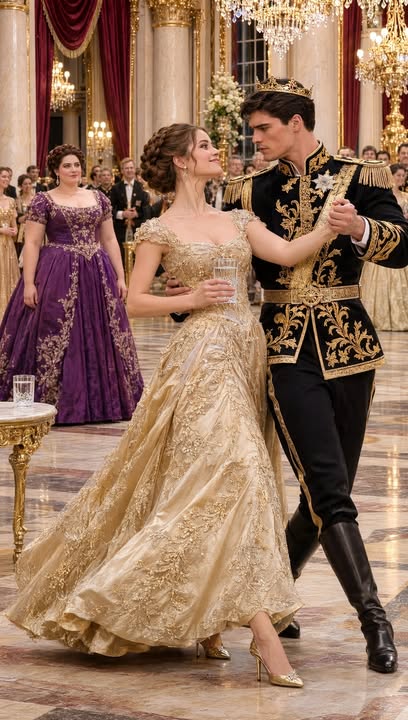
Adrian waited until the first couples had stepped onto the floor before he came to me.
“Would you like to dance?” he asked.
“Is this a selection?”
“No.”
“Is it a lesson?”
“Only if you want one.”
“Then what is it?”
“An invitation.”
I looked at his offered hand.
“An invitation I’m free to refuse?”
“Completely.”
I placed my hand in his.
“Then yes.”
We joined the dancers, not at the center of the floor but among the people who had come to watch.
The waltz moved slowly, its melody tender without demanding anything from us.
Adrian held me with care, leaving space for me to choose each step.
I did not need to anticipate his lead.
When he turned, I followed.
When I changed direction, he followed me.
For a few measures, there was no palace, no letter, no sealed archive, and no question of what we owed one another.
There was only the music and the floor beneath our feet.
When the song ended, we parted without an audience waiting for a verdict.
My aunt found me near the ballroom doors.
She had watched from beside a column, her eyes bright but her smile steady.
“Are you ready to come back to the hotel?” she asked.
“Not yet.”
“Then I’ll wait.”
“I might be a while.”
“I know.”
She touched my cheek, then turned to speak with Celeste’s grandmother, who had approached carrying a small plate of untouched pastries.
My aunt could make a place feel welcoming without asking anyone to explain why they had arrived.
I watched her laugh with the older woman and felt, for a moment, the ache of missing my mother settle beside the comfort of being remembered.
The next morning, the archive opened the first set of records for review.
Nia and her mother came with four former families, two retired instructors, and a box of papers preserved in different homes across Westbridge.
They brought lesson schedules, old photographs, handwritten accounts of travel costs, and letters from students who had gone on to dance elsewhere.
No one arrived expecting the palace to make amends with a single generous gesture.
They arrived to compare what they had kept against what the palace had kept.
Adrian came without an entourage.
He sat at the end of the long table and listened while the families decided how the work should proceed.
When the archive director proposed that the palace issue a summary before the review was complete, Nia shook her head.
“Not until we have seen the records ourselves.”
Adrian nodded.
“Then there will be no summary yet.”
When one of the retired instructors asked whether the palace would fund new classes, he did not promise a sum or an opening date.
“Tell us what you need,” he said. “Then the families can decide whether royal support is acceptable and under what terms.”
The instructor looked at the others.
“We’ll decide together,” she said.
“Good,” Adrian replied.
That answer mattered more than a pledge made before the question had been asked.
The review took months.
The household records were more complicated than anyone hoped, though not more mysterious than the ledger had suggested.
The remaining funds had been folded into a broader arts account after the program was suspended.
Some of the money had paid for unrelated palace events, while other amounts had disappeared into administrative costs that could not be fully traced.
The review found no evidence that King Edward had ordered the transfers.
His letters showed that he had wanted the program to continue, but the household office had taken control of its funding after his death, and the families had never been properly consulted.
That distinction did not undo the harm.
It did keep the past from being simplified into a convenient villain or an innocent legend.
Adrian released the surviving records, along with the review’s findings.
The palace acknowledged that the program had been abandoned without the families’ consent and that its financial records had not been made available when they were requested.
The statement did not claim that the problem had been resolved.
It named what had happened and who had been denied a voice.
The families chose to reopen the program, but not as a palace project.
They formed a community board made up of former students, parents, instructors, and local arts organizers.
The board chose the program’s name, its teachers, and the locations of its classes.
The palace offered funding under a public agreement that the families could review each year.
The agreement guaranteed that the program would remain under community leadership, and that its records would belong to the families who created them.
Nia’s mother brought the old founding agreement to the signing meeting.
She placed it beside the new one, the two pages aligned under the same clear glass weight.
“This time,” she said, “we keep copies everywhere.”
Everyone laughed, including the archive director.
Celeste had been true to her word.
Her grandmother contacted former teachers, and Celeste helped persuade her own family to support the program without attaching conditions or claiming credit.
She visited the first planning meeting with a notebook and no expectations.
At first, the families treated her politely but cautiously.
She did not ask to be thanked.
She listened, wrote down the names of the people she needed to call, and followed through.
By the time the first class was scheduled, she had become a familiar face at the community hall, where she helped arrange chairs and carried stacks of music.
She was still poised.
She was also more willing to laugh at herself.
One afternoon, she tried to demonstrate a turn and stepped neatly into a chair.
Nia’s mother laughed so hard she had to sit down.
Celeste laughed with her, cheeks flushed, and the room grew warmer for it.
“You don’t have to impress us,” I told her as we rearranged the chairs.
“I know,” she said. “It’s astonishing how much easier it is when I remember that.”
My own place in the work took longer to settle.
The families did not want a royal appointment, and I was grateful they said so plainly.
They did want me to help organize the archive copies and speak with former students who had lost touch with the program.
I accepted those tasks because they were useful, not because my mother’s name made me an obvious choice.
I did not sit above the others.
I sat beside them, taking notes and asking what had been missed.
Adrian never asked me to move into the palace.
He did not offer me a title or a role that could be mistaken for a reward.
He visited the planning meetings when invited, and sometimes when he was not needed, he stayed away.
When he came, he listened.
When a decision was not his to make, he did not make it.
Our friendship grew in the quiet spaces between those meetings.
We took walks in the palace gardens without staff announcing our arrival.
We drank tea in the east practice room after the musicians had gone.
Sometimes we talked about the program.
Sometimes we talked about ordinary things: a book I had been reading, a song he could never remember the second verse of, the way his father used to tap the table when he was thinking.
He told me that he had known the challenge might become a spectacle and had gone ahead with it anyway.
“I thought I could control the meaning of it,” he said one evening.
“You couldn’t.”
“No.”
“You can’t control what people make of you.”
“I’m learning that.”
“But you can decide what you do when they make it wrong.”
He considered that.
“Are you giving me another lesson?”
“Only if you want one.”
“I do.”
Months passed, and the old ballroom began to feel less like the place where I had nearly become a story about a prince.
It became a place where I could walk in without wondering what everyone had decided I meant.
The public dance was no longer a selection.
It was a celebration held for the first performance of the restored Westbridge program.
The community hall in Westbridge had been repaired, with its old wooden floor sanded and polished until it held the light like a calm pool.
A small stage stood at one end, though most of the dancers would perform on the floor itself.
The families had chosen the music.
The students had chosen their costumes.
No one had been asked to look royal.
I wore my burnt-orange gown.
It had been altered at the hem and sleeves so I could move in it easily, and the fabric carried faint creases from the first night I had worn it at the palace.
My aunt helped fasten the small clasp at the back of my neck.
“Your mother would have liked this color,” she said.
“She would have said it was impossible to miss.”
“She would have meant that as praise.”
“I know.”
My aunt smoothed the gown at my waist.
For a breath, her hands rested there, and I felt the memory of my mother’s hands in the same place, pinning a ribbon before a performance.
I had spent years believing the part of me that danced belonged to a life I had given up.
Now I understood that it had waited without asking me to return unchanged.
At the hall, Nia’s mother stood by the entrance, greeting the families as they arrived.
Celeste was beside her, helping a young student fix a loose ribbon.
The girl had tied it around her wrist instead of her hair.
Celeste looked serious as she corrected it, as though the whole evening depended on the knot.
When she noticed me, she waved.
“You look wonderful,” she said.
“So do you.”
She wore a simple blue dress, and her pale hair was pinned back with a silver clasp.
“I’ve been told I’m not allowed to give the dancers advice unless they ask,” she said.
“Who told you that?”
“Nia’s mother.”
“Wise woman.”
“I’ve also been told not to help with the music.”
“Probably wise as well.”
“I am learning to be useful in other ways.”
She held up a tray of cups.
“Tea?”
“Definitely.”
Inside the hall, the restored floor shone beneath the warm lights.
Photographs from the old program lined one wall, with copies of the letters and the founding agreement displayed nearby.
My mother’s photograph stood among the others.
She was not singled out at the center.
She stood with the other dancers and teachers, her silver medal resting at her collar, one hand lightly placed on the shoulder of the young woman beside her.
Below the photograph, the caption listed the names of all six performers and the families who had helped keep the program alive.
I stood before it for a long time.
My mother looked younger than I remembered her, though I recognized her at once.
The photograph did not reveal every part of her.
It did not explain why she had kept her dancing private, or why she had chosen caregiving when her illness came.
It did not need to.
The picture gave her back to me in one small part of her life, standing among people who had built something together.
Adrian came to stand beside me.
He wore a dark suit without a sash or ceremonial pin.
“I wish I had known more about this when you found the first photograph,” he said.
“Me too.”
“I wish I had told you what I knew about your name.”
“I wish you had.”
He did not turn the apology into a request for comfort.
“I thought silence would protect the possibility of something between us,” he said. “It only made me decide what you were allowed to know.”
“Yes.”
“I’m sorry.”
“I know.”
He looked at the photograph.
“Your mother looks happy.”
“She does.”
“Do you think she would have wanted you to dance here tonight?”
I considered the question.
“I think she would have wanted me to choose.”
“And you did.”
“Yes.”
He nodded, accepting the answer without claiming it.
The first performers gathered by the doors.
There were children in plain skirts and bright shirts, teenagers in soft blue and green, and three older women who had danced in the original program as girls.
The youngest group was nervous.
Their teacher stood among them, counting the opening beats with her fingers.
The music began.
The students stepped onto the polished floor.
Some moved with startling confidence.
Others forgot their steps and found them again.
A little girl near the edge of the group missed a turn, then laughed when her friend offered a hand.
No one stopped the music.
No one called her mistake a failure.
The dance simply widened to include her.
The audience applauded at the end, and the children bowed with more excitement than precision.
Nia’s mother cried openly.
She made no effort to hide it.
When the older students took their places, one of the retired instructors came to me.
“Elena used to tell us that the best room for dancing was the one where nobody had to ask permission to begin,” she said.
I looked at the students waiting by the floor.
“She sounds exactly like herself.”
The instructor smiled.
“She would be glad you came back.”
The words did not make me feel that I had owed the return.
They made me glad I had chosen it.
After the final group finished, the families invited the guests to dance.
The students scattered through the hall, pulling siblings and parents onto the floor.
Celeste danced with her grandmother.
Nia’s mother danced with the retired instructor who had taught her decades earlier.
My aunt took the hand of a former student and laughed when he spun her too quickly.
Adrian waited beside me.
“Would you like to dance?” he asked.
“Here?”
“Here.”
“Will anyone judge my step?”
“Only if you ask them to.”
“Will you lead?”
“Would you like me to?”
“I would.”
He offered his hand.
I placed mine in it, and we stepped onto the floor.
The first notes were soft and familiar.
My burnt-orange skirt opened around us as we moved.
Adrian’s hand rested lightly at my back, and I answered the pressure with a turn of my own.
He followed.
We danced one graceful turn, and then another, while the room moved around us.
The music carried the old courtesy step into the new one, not as a clue or a test, but as a thing we could share.
When the phrase ended, Adrian did not let go at once.
“May I tell you something without turning it into a promise?” he asked.
“You may.”
“I love the way you notice when a room has left someone out.”
I felt the warmth of the music still moving through me.
“I love that you are learning to notice it too.”
He smiled.
“I’m still learning.”
“So am I.”
“Would you like to keep learning beside me?”
There was no ring, no announcement, and no waiting crowd that needed to be pleased.
There was only the man who had once hidden a truth because he feared it would decide our future, and the woman who had learned to ask for the truth before choosing one.
“Yes,” I said. “If we keep choosing honestly.”
“I promise to try.”
“Trying is better than pretending you already know.”
“Then I’ll keep trying.”
The music began another turn, and we moved together into it.
Around us, the students were teaching their parents the steps.
Celeste was laughing with Nia’s mother.
My aunt had found her rhythm.
The room was full of people who had not been offered a place as a favor, but had made one together.
I rested my hand in Adrian’s and followed the music forward.
For the first time, the palace was not deciding whether I belonged.
We were choosing, step by step, what kind of room we wanted to make.
**–THE END–PLEASE
Share your thoughts or feedback to motivate us to create more stories ♥️
* * *
[PREVIOUS: PART 5](https://echoesofstories.idolsgift.com/blog/part-5-the-step-he-recognized-046)
✓ Lynn R. Adams
Part 6 – The Room We Made The letter rested between Adrian and me, its pages thin with age and steady in my hands. If Mara Ellis ever comes to the palace seeking a place here, do not give her one in…