PART 6 (THE END): The Star That Shouldn’t Have Matched 047
Part 6 – A Room That Made Space
“I don’t remember writing this,” Mrs. Bellini said.
Luca looked down at the letter, then back at her.
“Would you like me to read it?”
She studied the handwriting as if she might find the memory hidden between the loops of each word.
“Please.”
He unfolded the page carefully.
The letter was brief, dated two days after the evening in the report.
Mrs. Bellini had written that she was troubled by what had happened at Quiet Harbor and wanted Francesca Moretti to know that she had kept the incident record separate from the general files.
She had also noted that Eli’s mother had been contacted and that Eli was safe at home, though shaken and sore.
I closed my eyes for a moment.
Safe at home.
The words did not undo the fear of that night, but they gave it an ending I had needed without knowing it.
Luca continued reading.
The final paragraph said that Mrs. Bellini had spoken with the staff member who dismissed Eli’s distress, and that the woman had apologized to the family.
Then came one last sentence.
The second car was driven by the young man who brought Eli back; he says he had been following his cousin and saw the first car strike the child.
Luca stopped reading.
“His cousin,” I said.
Mrs. Bellini leaned toward the letter.
“I don’t remember this.”
“Does it say who the young man was?” Luca asked.
“No.” He glanced at the date. “But it gives us a direction.”
The next day, the independent investigator confirmed that the young man named in the letter had been Luca’s cousin, Daniel, then a teenager.
Daniel was now a quiet, gray-haired school counselor who lived in Connecticut and had never been charged with anything.
He agreed to speak with the investigator, then asked if Luca and I would come too.
Before we went, Luca called me.
“You don’t have to be there,” he said.
“I know.”
“I can tell you what he says afterward.”
“I know that, too.”
“But I want you to have the choice.”
I thought of the photograph, the report, the letter, and the years of wondering whether some missing fact might change the meaning of Eli’s last night.
“I’ll come,” I said. “But I’m not going to ask him to make the story easier for me.”
“I understand.”
Daniel met us in a small office at the investigator’s request.
He looked nervous, but not evasive.
His hands rested open on the table, and he kept glancing at the photograph of Eli as though he were trying to make sure he had not forgotten the boy’s face.
“I was driving without permission,” he said. “I was sixteen, and I had taken my father’s car to meet a friend.”
Luca sat very still.
Daniel continued, speaking slowly, pausing whenever he needed to choose his words.
“I saw Eli near the west road. He was upset and walking close to the curb.”
“What happened?” I asked.
“A car struck him and kept going.”
The investigator had already asked Daniel to describe only what he knew.
He said the road was dark, the first car had been moving too fast, and he could not read its plate before it disappeared around the bend.
He had stopped his own car farther down the road.
He had been frightened, and ashamed that he had been driving without permission, but he got out and went to Eli.
“He was crying,” Daniel said. “He kept saying he wanted to go back for his star.”
My hand curled around the edge of my chair.
“Did he seem badly hurt?” I asked.
“He was sore and shaken. He could stand. I didn’t know whether anything was broken, so I took him back to the center, where there were adults who could help.”
“You should have called for an ambulance,” Luca said, not accusingly, but with a pain that had waited decades to speak.
“I know,” Daniel replied. “I should have. At the time, I thought I could get him somewhere safe faster. I was scared of what my father would do when he learned I’d taken the car.”
He looked at me.
“I was a kid making a cowardly choice. I’m sorry.”
I did not tell him I forgave him.
I did not tell him I hated him.
I told him, “I’m glad you stopped.”
He lowered his eyes.
“I should have done more.”
“Yes,” I said. “You should have.”
The truth sat between us without needing to be made crueler.
The investigator asked Daniel what happened afterward.
He said Francesca Moretti had spoken to his family that night.
She had made sure Eli’s family was contacted and that he was checked by a doctor.
She had also insisted Daniel tell the truth privately, though he begged her not to tell his father he had taken the car.
At the time, Francesca believed Eli’s injuries were minor and that the driver of the first car would never be identified.
She chose to keep Daniel’s involvement out of the charity’s public records, partly to protect the child’s privacy and partly to keep the program from being blamed for an accident outside its doors.
In doing so, she had also hidden that a second teenager had driven Eli back.
“I asked her not to tell Luca,” Daniel said. “I thought he would look at me differently.”
Luca’s face had tightened, but he held his voice steady.
“I wish you’d trusted me enough to tell me.”
“I know.” Daniel’s eyes shone. “I’m sorry.”
The investigator explained that old records could not answer every question, and that the original driver’s identity might never be established.
The report, the letter, and Daniel’s statement would be formally recorded.
The earlier incident would be added to the information already submitted about Eli’s unsolved death, not as proof of who struck him years later, but as context that should never have been hidden.
There would be no false certainty, no dramatic accusation presented as fact.
There would only be what could be verified, and an honest account of what remained unknown.
That mattered to me.
Eli had not become a mystery to solve.
He was still my brother.
After the meeting, Luca and I walked outside beneath a pale, clear sky.
For a while, neither of us spoke.
Then he said, “I don’t know whether I’m angry with Daniel.”
“You don’t have to decide today.”
“I’m angry at my mother for keeping the truth from us.”
“You can love her and be angry with her.”
He nodded, taking in the words as if he had not known they were allowed to coexist.
“I’m also grateful she went back for Eli.”
“So am I.”
“And I wish she’d trusted us with the rest.”
“So do I.”
He looked across the street, where a school bus was letting children out in front of a brick building.
“My family kept calling silence protection.”
“Sometimes silence is protection,” I said. “But it shouldn’t be used to decide what other people can bear to know.”
He turned toward me.
“I’m going to say that in the report.”
“Say what happened, too.”
“I will.”
“And don’t make your mother a villain.”
“I won’t.”
“Don’t make Daniel one, either.”
“I won’t.”
“Then maybe you’re ready.”
He looked at me with quiet gratitude, but he did not ask whether I forgave him.
That evening, Luca gave the investigator permission to submit the records with his statement.
He also told his aunt what he had learned.
She did not apologize at first.
She said the family had believed it was protecting the charity, Francesca, and the children who depended on it.
Luca listened.
Then he told her that protecting a child’s privacy was not the same as hiding a driver’s name from the people who deserved the truth.
The conversation ended without an embrace or a perfect resolution.
It ended with his aunt agreeing to turn over the remaining files she had kept.
That was enough for the first conversation.
My mother chose to give her statement as well.
She confirmed that she had seen a second car near the road after Eli’s fatal hit-and-run and that she had told the police about it at the time.
The report did not identify Daniel as the driver of that car, and it could not connect the later accident to the one at Quiet Harbor.
The investigators made that distinction clear.
For the first time, my mother knew that someone had stopped for Eli on the earlier night and returned him to the people who could care for him.
She cried when she heard it.
“So he wasn’t alone,” she said.
“No,” I told her. “He wasn’t.”
That answer did not make the years less painful.
It gave one small corner of them a gentler light.
When the public statement was eventually released, Luca kept his word.
He did not turn the story into a family defense or a spectacle.
He named what had been concealed, acknowledged that his mother’s actions had protected some people while withholding information from others, and said that the records did not prove who had struck Eli in the hit-and-run that killed him.
He did not ask Mara to speak.
He did not put Sofia in front of a camera.
When reporters asked what Eli had been like, I chose to give one brief interview.
I spoke about his patience, his terrible jokes, and the way he remembered the name of every bus driver on our route.
I said he liked drawing stars and arranging his pencils by color.
I said the world should have listened when he asked for quiet.
I did not speak for his whole life.
I only gave them a small piece of the brother I knew.
Afterward, Luca thanked me.
I told him I had spoken for Eli, not for his family.
“I know,” he said.
And this time, I believed that he did.
The months that followed did not erase what had happened.
They made room for something else to grow beside it.
Luca asked Sofia’s pediatrician for guidance and found a child development specialist who helped their family understand what made daily life easier for her.
He stopped expecting her to tolerate every room and began changing the rooms around her.
He let her choose between two coats instead of hurrying her into the one he had picked.
He warned her before unfamiliar sounds.
He learned which songs she liked and which ones made her press her hands against her ears.
When she needed time, he gave it to her.
He also began speaking openly about her needs with the people who cared for her.
At first, some relatives tried to call it a phase.
Luca corrected them gently but firmly.
“Sofia doesn’t need to be fixed,” he told one of them. “She needs us to pay attention.”
I watched him grow more patient, not in sweeping gestures, but in the small spaces where love was practiced.
He learned to wait through her pauses.
He learned not to answer a question she was still forming.
He learned that the quietest person in a room might be noticing everything.
The charity files revealed another piece of the family story.
Francesca had kept a handful of letters from parents whose children attended Quiet Harbor.
She had wanted to reopen the program in a smaller, calmer space, but after her death the papers had been placed in a box and the plan had been forgotten.
Luca found notes she had written about soft lighting, quiet corners, and adults trained to notice when a child was overwhelmed before the child had to cry.
He asked me to help design the new program.
“You should lead it,” I said.
“I’m not the right person.”
“You can fund it and listen.”
“That seems more important than leading it.”
I smiled.
“It is.”
We worked with specialists, parents, and former staff from the old program.
We chose a community center with a garden and wide windows.
The rooms had soft lamps instead of bright overhead lights, shelves low enough for children to reach, and a quiet room where no one had to explain why they needed a break.
There were no prizes for staying the longest or talking the most.
Children could join, watch, or leave and return when they were ready.
We named it Quiet Harbor again.
The program was dedicated to Eli, but it did not try to turn him into a symbol.
His name appeared in a small line near the entrance, beside a photograph my mother chose from the tin box.
In the picture, he stood in front of our old apartment with his arm around me, the silver star pinned to his jacket.
My mother had kept it all those years without knowing that Luca’s mother had done the same with another piece of the story.
At the opening, she stood beside me in a dark green dress and watched children move through the rooms at their own pace.
One little boy sat beneath a table with a book.
His father started to call him out, then stopped when he saw the soft, careful way the staff made space around him.
My mother took my hand.
“You would have liked this,” she whispered.
“I think Eli would have liked that nobody was rushing anyone.”
She leaned her head against mine.
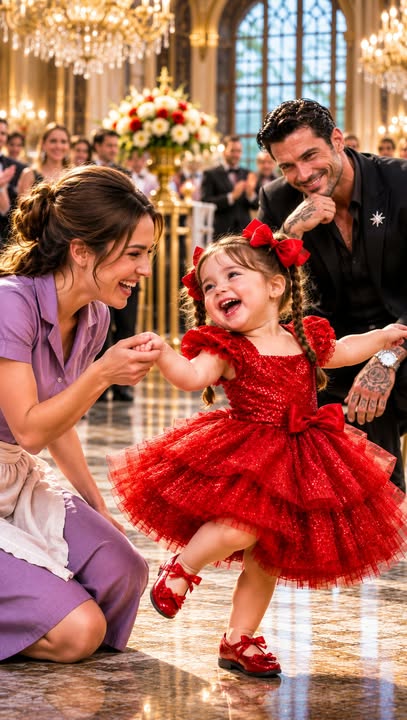
Sofia wore a simple blue dress, not the sparkling gown from the gala.
A small ribbon held her curls back from her face.
She walked through the rooms with Luca beside her, pausing at the quiet corner and looking at the little brass star fixed to the wall.
“Star,” she said.
“That’s right,” Luca replied.
She glanced at me.
“Mara.”
“Hello, sweetheart.”
She held out her hand.
In her palm lay a small star pin, its silver rays round at the tips and its blue stone set firmly in the center.
“It’s for you,” Luca said.
I took it only after Sofia nodded.
The pin was not Eli’s and not Francesca’s.
It had been made for the new program, a small token for anyone who wanted one.
“Thank you,” I said.
Sofia placed one finger on each of the first three rays.
“One, two, three,” she counted.
The room around us had filled with soft conversation, the rustle of pages, and the occasional happy squeal from the garden.
No music thundered from the ceiling.
No one laughed at a child for covering her ears.
Luca stood beside his daughter with one hand open, waiting for her to choose whether she wanted to hold it.
She took his finger, then mine.
“Again,” she said.
So we counted with her.
“One, two, three.”
Sofia smiled, and the little star caught the warm light from the quiet room.
For the first time, the pin did not feel like a question left unanswered.
It felt like something offered freely, with no demand attached.
Outside, late afternoon light rested over the garden.
Inside, children found their own ways through the room, and the adults learned to follow without rushing them.
I thought of Eli at the small table in the old photograph, watching before he decided whether he wanted to enter.
I wished he could have seen this place.
I wished he could have known that the things he needed would one day be understood by someone who had loved him.
The grief was still there.
It always would be.
But it no longer had to stand alone beside the silence.
Sofia tugged my hand and looked up at me.
“Book?”
“Which one would you like?”
She pointed to the blue-covered book on the low shelf.
I reached for it, then paused.
“Would you like me to read, or do you want to?”
She considered this, her eyes moving from the book to my face.
“Together.”
“Together,” I said.
We sat on the rug with Luca nearby and my mother in the chair beside the window.
Sofia opened the book to the first page.
She traced the picture of a small star floating above a harbor.
Then she leaned against my shoulder, safe in the quiet she had helped us make.
**–THE END–PLEASE
Share your thoughts or feedback to motivate us to create more stories ♥️
* * *
[PREVIOUS: PART 5](https://echoesofstories.idolsgift.com/blog/part-5-the-star-that-shouldn-t-have-matched-047)
✓ Lynn R. Adams
Part 6 – A Room That Made Space “I don’t remember writing this,” Mrs. Bellini said. Luca looked down at the letter, then back at her. “Would you like me to read it?” She studied the handwriting as…