PART 6 (THE END): The Slipper Turned Toward Me 046
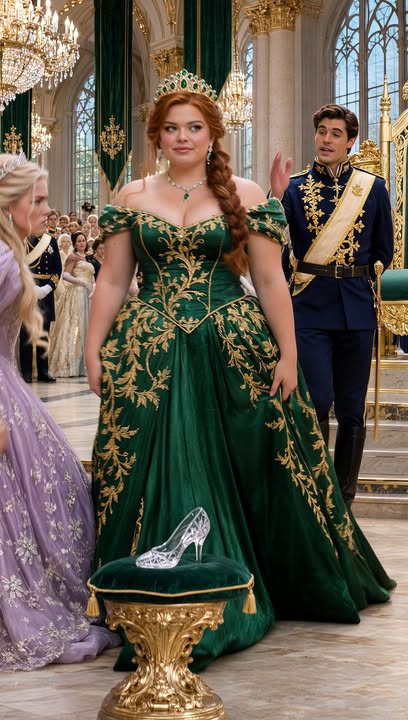
Part 6 – A Light That Could Rest
My hands began to shake.
William watched my face, waiting.
The letter continued.
The slipper is not a crown, and it is not a promise that you must become what others expect.
It is only a witness.
If it has found you, then it has done what I could not: it has brought the truth close enough for you to choose what happens next.
I had hidden the slipper because I believed the palace would use it to settle a question it had no right to answer for me.
The queen stepped closer, but did not reach for the page.
I read the final lines aloud.
“Choose the truth, even if you choose no title with it. Choose a life that belongs to you. That is all I ever wanted for you.”
The words blurred.
I lowered the letter, pressing it against my chest.
For years, I had carried Eleanor’s absence like a room in my life whose door I could never open.
Now, through her own handwriting, I felt her near—not as a princess, not as a keeper, but as the woman who had folded an emerald gown into a wooden trunk and left me a message about being seen.
“She knew I might find this,” I whispered.
“I think she hoped you would,” the queen said.
“She could have told me.”
“Yes,” the queen replied, her voice gentle. “She could have.”
William stood beside me, quiet and steady.
The queen looked at the letter in my hands.
“I cannot speak for Eleanor’s reasons,” she said. “But I can tell you what I should have done. I should have told you what we knew as soon as we understood enough to ask you what you wanted.”
I looked at her.
“Would you have?”
The question was not meant to wound her.
It was simply the question I needed answered.
The queen held my gaze.
“I hope I would have,” she said. “But hope is not proof. I am sorry that you had to demand the truth from us.”
I believed her apology.
I did not mistake it for a way to erase what had happened.
“Thank you,” I said.
The queen’s shoulders eased, though her eyes remained bright.
William looked toward the palace windows.
“The slipper is still in the secure chamber,” he said. “Would you like to see it?”
I glanced at the letter again.
“I think I would.”
The queen nodded.
“Then we’ll go together.”
This time, no archivist, attendant, or conservator followed us into the examination chamber.
The queen had asked that the room be kept quiet, and the others had respected her request.
The glass slipper rested inside its case beneath the soft, even glow of the ceiling lamps.
The golden pedestal stood nearby, its crack repaired but still visible as a fine line in the metal.
I stopped several steps from the case.
For the first time, I did not feel that the slipper was waiting to decide something about me.
It looked like what it had always been: beautiful, delicate, and old.
The queen remained behind me.
William stood at my side, close enough that I could feel his warmth without feeling enclosed.
“May I come closer?” I asked.
“Yes,” the queen replied. “The case is secure.”
I walked forward until I could see my reflection in the glass.
The woman looking back wore the emerald gown, the same gown Eleanor had worn in the portrait.
I did not look like a lost princess.
I looked like Amelia Brooks, tired from a long night and still uncertain about what the morning would bring.
That felt right.
I lifted my hand.
The blue light appeared beneath the pedestal.
It was faint at first, just a thread beneath the repaired seam.
Then it glimmered through the glass, gathering along the slipper’s curve.
William drew a quiet breath.
The queen said nothing.
The slipper did not turn toward me this time.
It remained still.
The blue light shimmered once, softly, and then spread through the glass like dawn through a window.
For a moment, its reflection touched the emerald crest on my gown.
Then the glow began to fade.
It did not vanish all at once.
It dimmed gently, as if a lamp were being lowered in a room where everyone had finally found their way.
I kept my hand near the case until the last trace of blue disappeared.
The slipper was clear again.
The room seemed warmer.
I lowered my hand.
“Is it over?” William asked.
“I think so,” I said.
The queen stepped closer to the case.
“Whatever the slipper was made to remember, it has done so.”
“And now?” I asked.
“Now it rests.”
There was a quiet dignity in the answer.
The slipper had not chosen me as a bride, a ruler, or a symbol.
It had recognized the line Eleanor had left behind, then given the choice back to the person who could finally make it.
The queen looked at me.
“Would you allow the slipper to be placed in the public archive with Eleanor’s corrected history?”
“Yes,” I said. “Not as a magical object or a royal prize. As part of the record of what happened.”
“That is how we will describe it.”
“And the ledger?”
“Made available to historians, with copies preserved. Eleanor’s name will be included in the official history beside the promise made to her.”
“Will the old accusation be removed?”
“It will be corrected, not hidden. The record will explain that she was entrusted with the slipper and that the earlier account was mistaken.”
The answer pleased me more than a perfect, polished revision would have.
A corrected history should not pretend the error had never happened.
It should show how the truth had been lost, and how someone had finally chosen to bring it back.
The queen extended her hand.
I took it.
Her fingers closed around mine with care.
“Thank you for giving the truth a place here,” she said.
“Thank Eleanor,” I replied. “She carried it long enough.”
The queen’s eyes filled, but she did not look away.
“Yes,” she said. “She did.”
Later that morning, the palace released a new statement.
It named Eleanor Brooks as King Edward’s daughter, acknowledged that she had chosen not to pursue the succession, and confirmed that she had been entrusted with the glass slipper.
It also stated plainly that the palace had allowed a false account of her dismissal to remain uncorrected.
The queen’s apology appeared beneath it.
There was no headline calling me a princess.
There was no suggestion that I had reclaimed a place I had never asked for.
The palace described me as Eleanor’s granddaughter, and it quoted my words from the previous day: My ancestry is part of my history, but it does not tell you who I am.
The first questions from the press came before noon.
Some asked whether I would accept a title later.
Some wanted to know whether the slipper’s light had been a miracle.
Others asked if the prince and I planned to marry.
I answered what I could, and declined to answer what belonged to the future.
“I am not accepting a title,” I told them. “The slipper’s light was a part of my family’s history, not a verdict on my worth.”
When a reporter asked whether I believed the old tradition should return in a different form, I glanced at Olivia, who stood with the other candidates nearby.
“I believe traditions can change when we understand what they have cost people,” I said. “The old ceremony measured women against a glass shoe. Whatever it once meant, that is not a measure anyone should live by.”
Olivia stepped forward beside me.
“I agree,” she said. “I thought the slipper would prove I belonged here. It could not do that, and it should never have been asked to.”
A quiet murmur passed among the reporters.
The queen addressed them next.
“The selection ceremony will not continue,” she said. “We are grateful to the candidates who took part, and we are sorry that a tradition meant to honor the royal family became a way of judging women by appearance.”
She announced that the palace would establish a new annual gathering in honor of Eleanor’s work: a celebration of community service, learning, and care for others.
No one would be selected as a bride.
No one would be required to prove that she deserved to stand in a royal room.
The recognition would be given to people whose work strengthened their communities, whether or not they had ever entered a palace.
When the announcement ended, Olivia found me near the garden doors.
“I’m not sure what happens to my family’s story now,” she said.
“Maybe it changes.”
“My mother will have questions.”
“Then you can ask them together.”
She studied my face.
“You’re very good at asking questions.”
“I had a lot of practice this week.”
A small smile appeared.
“I’m glad you did.”
“So am I.”
She hesitated.
“I’m sorry again.”
“I know.”
“And I know an apology doesn’t undo what I said.”
“No,” I replied. “But it can change what comes after.”
Olivia let out a breath she seemed to have held for a long time.
“I would like to help with the new gathering,” she said. “If the queen allows it.”
“Ask her.”
“I will.”
“Then we’ll see what we can make of it.”
She nodded, and for the first time, we stood together without either of us trying to measure the other.
By late afternoon, the palace had grown quieter.
The queen asked me to meet her in the old library.
She had removed the king’s papers from their case and set them beside the portrait of Eleanor.
The painting had been placed on an easel near the window, where the light could reach it.
My grandmother seemed to look out over the room with the same guarded, thoughtful expression I had seen in the letter.
“I wanted you to have this,” the queen said.
“You’re giving it to me?”
“If you wish. The palace will preserve a copy.”
I stepped closer to the portrait.
Eleanor’s painted hand rested beside the embroidered crest.
The painter had captured something in her eyes that I recognized now: a person who had learned to make peace with a choice without pretending it had not cost her.
“I would like to take it home,” I said.
“Then it is yours.”
The queen held out a small envelope.
“This was found beneath the portrait’s backing. It appears to be in Eleanor’s hand, though it may have been written much earlier than the letter you read.”
I accepted it.
Inside was a short note, folded around a photograph of a young woman standing beneath a tree.
Eleanor wore the emerald gown.
She was smiling—not for the camera, but at someone just beyond it.
On the back, in her handwriting, were the words:
A life is more than the place people make for you.
I swallowed against the ache in my throat.
“I wish I had known this side of her.”
“You did,” William said from the library doorway.
I turned.
He had entered without ceremony, carrying no papers and wearing no crown.
“You knew her as the woman who loved you,” he continued. “That was real. The rest explains the life she lived, but it does not replace the grandmother you knew.”
I looked at the photograph again.
The words did not make the years of silence disappear.
But they gave me a way to remember Eleanor without making her secret the whole of her.
“You’re right,” I said.
The queen watched us from beside the portrait.
“I have asked the council to review how family histories are recorded,” she said. “Not only for the royal line, but for the people whose work has been left out of our accounts.”
“Will they agree?” I asked.
“Some will. Some will need convincing.”
“Then keep asking.”
A faint smile touched her mouth.
“I intend to.”
She came closer to Eleanor’s portrait.
“I cannot give her back the years in which her name was missing from the history of this house,” she said. “But I can speak it now.”
She turned to the portrait.
“Eleanor Brooks, daughter of King Edward, keeper of the glass slipper, and a woman whose choices were her own.”
Her voice wavered on the last words.
The queen bowed her head.
I felt grief rise in me, but it no longer seemed to be pushing against a locked door.
“I think she would have wanted to hear that,” I said.
“I hope she did,” the queen replied.
The evening gathering took place in the palace gardens.
It was not a ceremony, and no one stood in a line to be examined.
Tables were set beneath strings of warm lights, and the guests included the former candidates, members of the household, historians, and people whose work had been chosen for the palace’s new service celebration.
There were no crystal pedestals.
There were no chairs waiting to test a woman’s worth.
The glass slipper remained in its secured display in the archive, beside the corrected record of Eleanor’s life.
The emerald gown had been carefully brushed and pressed.
I wore it again.
This time, when I entered the garden, I did not wonder whether anyone would laugh.
Some people looked at the gown because it was beautiful.
Others looked at me because they knew the story.
But the dress did not feel like a message I was obligated to understand.
It felt like something Eleanor had loved, and something I had chosen to wear.
Olivia joined me near the fountain.
She wore a simple blue dress rather than her lavender ceremony gown.
“You look happy,” she said.
“I feel more like myself.”
“That may be better.”
“It is.”
Across the garden, William was speaking with the queen and several members of the court.
When he noticed me, he excused himself and crossed the lawn.
“You came back,” he said.
“I was invited.”
“You could have refused.”
“I considered it.”
“And?”
“I decided I wanted to be here.”
His smile held relief, but he did not mistake my answer for a promise.
We walked toward the far end of the garden, where the trees stood close together and the music softened beneath their branches.
For a while, we talked about ordinary things.
He asked what I had been doing before the invitation arrived.
I told him about my job at the community arts center, the children’s painting classes I sometimes helped with, and the small apartment I had shared with my plants and a cat who never seemed impressed by my efforts.
He told me about the parts of his work he enjoyed and the parts he endured because they came with being prince.
Neither of us tried to make our lives sound more interesting than they were.
That made the conversation feel precious.
“I’m not asking you to stay at the palace,” William said at last.
“I know.”
“I’m not asking you to become part of the royal family in any official way.”
“I know that too.”
“I would like to keep seeing you, if you want that. Slowly. As two people getting to know each other, not as a prince and the woman a slipper recognized.”
I looked at him.
The moonlight lay pale along the garden path.
“What would that look like?” I asked.
“Dinner somewhere without a ballroom.”
“Could you go somewhere without a ballroom?”
“I think I could manage.”
“Would I have to wear a gown?”
“Only if you want to.”
“And would anyone ask me to try on a shoe?”
“Never.”
I laughed, and he laughed with me.
The sound felt different from the careful jokes we had traded in the palace corridors.
It was lighter, freer.
“I’d like to see you again,” I said.
“On your terms?”
“On both of ours.”
He reached for my hand, then paused.
I placed mine in his.
His fingers closed gently around them.
It was not the answer to the letter’s warning.
It was not a choice made for the court.
It was a beginning we had chosen together.
William glanced toward the palace.
“My mother says there will be questions about my future.”
“There will always be questions about your future.”
“I know.”
“You don’t have to answer every one tonight.”
“That sounds familiar.”
“My grandmother was wise.”
“She sounds as if she was.”
“She was.”
For a moment, neither of us spoke.
Then William said, “I may have to make difficult choices someday.”
“I know.”
“I won’t make them because an old letter tells me to.”
“Good.”
“And I won’t ask you to give up your life so mine can stay easy.”
I squeezed his hand.
“Then we understand each other.”
He nodded.
The lights above us trembled in the evening breeze.
Behind us, laughter rose from the garden gathering, warm and unguarded.
The palace did not suddenly become perfect.
The past was not repaired simply because its names had finally been spoken.
But Eleanor’s name would remain in the record.
The slipper would no longer be used to measure a woman against a story.
The queen had begun to change the habits she had once mistaken for protection.
Olivia had chosen to question the inheritance of her assumptions.
William had stopped treating his father’s warning as an answer and begun listening for the people it had left unheard.
And I had learned that being seen did not mean allowing other people to decide what they saw.
The next morning, I would leave the palace with Eleanor’s portrait and the emerald gown folded carefully in its case.
I would return to my own work, my own home, and the life I had lived before a glass slipper turned toward me.
There would be questions.
There would be cameras.
There would be days when the palace seemed close enough to reach and others when it felt like a place I had only dreamed.
But my name would still be Amelia Brooks.
Eleanor’s granddaughter.
A woman with a history, but not a destiny written for her.
William leaned close, his forehead almost touching mine.
“Ready to go back in?” he asked.
“Not yet.”
“All right.”
We stayed beneath the trees as the garden lights glowed around us.
For once, nothing in the palace was waiting to test me.
And somewhere in the archive, the glass slipper rested in the quiet, its blue light gone at last, its work complete.
**–THE END–PLEASE
Share your thoughts or feedback to motivate us to create more stories ♥️
* * *
[PREVIOUS: PART 5](https://echoesofstories.idolsgift.com/blog/part-5-the-slipper-turned-toward-me-046-9)
✓ Lynn R. Adams
Part 6 – A Light That Could Rest My hands began to shake. William watched my face, waiting. The letter continued. The slipper is not a crown, and it is not a promise that you must become what othe…