PART 6 (THE END): The Silver Bird Beneath the Lion 069
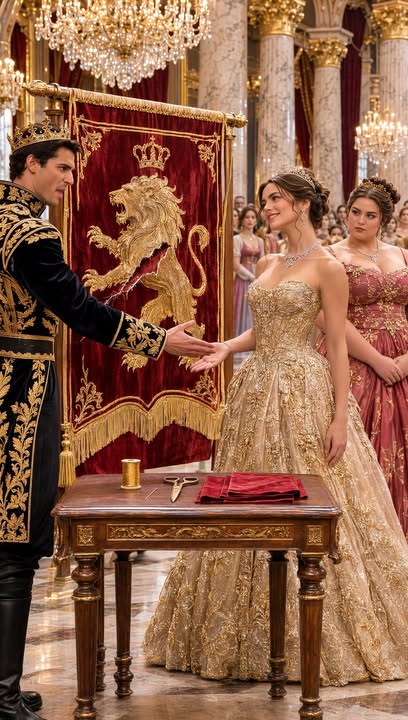
Part 6 – The Stitch That Held
Elara’s thumb rested beneath the four words.
If my daughter ever asks.
For a moment, she could not make herself unfold the velvet.
The council chamber had gone quiet around her, but the silence no longer felt like the silence that had followed her mother’s request for a hearing.
This silence was waiting.
She looked at the silver bird stitched into the cloth, at the careful little wings her mother had drawn with thread, and felt the years between them gather close.
“She left it for you,” Lysa’s voice seemed to say, though her aunt was miles away.
Elara eased the seam open.
Inside the folded velvet lay a thin sheet of paper, soft at its creases but still whole.
Her mother’s handwriting filled it in narrow, measured lines.
Elara recognized the slight tilt of each letter, the way Mara always gave a little extra space before a word she wanted to matter.
She began to read silently, then stopped.
“Would you like me to read it?” Adrian asked, his voice low.
Elara shook her head, but after a breath she looked up.
“Not alone,” she said. “Would you stay?”
“I will.”
Celeste drew nearer as well, but did not reach for the letter.
Mr. Vale stepped back from the table, giving Elara room to choose how much of her mother’s voice would be shared.
Elara read.
My dearest Elara,
If you have found this, then someone has finally asked about the silver bird, or you have followed it to the palace yourself.
I left the mark beneath the banner because I had been told that the cloth would remain in the east chamber until it could be repaired.
I wanted to leave one small piece of my work where it belonged, even after I no longer did.
The first cut was not mine.
I did not see who made it.
When the steward moved the banner, its edge caught on the brass hinge of his folding screen, and the tear grew through the lion’s chest.
I was asked to mend it, and I believed I could.
Then the steward’s report said the damage had happened in the sewing room.
I asked to speak with the king’s household, but my request was refused.
I was told the matter had been reviewed.
I could not remain in a place where my word was not needed, so I left.
I should have told you.
I thought silence might protect you from a story that had hurt me, and I was afraid that if I spoke of the palace, you would think my life had been defined by what it took from me.
It was not.
I was happy with you.
I was proud of you.
I made mistakes, and I sometimes let sorrow make my world smaller, but I never wanted you to carry my shame.
You were not born to repair what other people refused to mend.
If you choose to speak, speak because you believe the truth can help someone else.
If you choose not to, that is yours to decide.
Whatever you choose, my love for you was never hidden.
Your mother,
Mara
Elara reached the end and held the letter against her chest.
For several seconds she could not speak.
The ache in her was still there, but it had changed shape.
Her mother had not left because she was ashamed of Elara, or because she regretted the life they shared.
She had left because the palace had made her feel that there was no place for her voice.
And she had kept silent because she had mistaken silence for protection.
Elara could understand that without wishing it had happened.
“She was happy with me,” she whispered.
Celeste’s eyes shone.
“She wanted you to know that.”
Elara nodded, unable to answer.
Adrian looked down at the folded letter.
“May I ask what she wrote about the banner?”
Elara glanced around the chamber.
There were too many people for her to share every private line, but the truth at the heart of the letter did not belong only to her.
“She says the steward moved the banner and caught it on the brass hinge,” she said. “She says she asked for a hearing and was refused.”
Mr. Vale let out a slow breath.
“That confirms the account,” he said. “And gives us a first-hand record of her request.”
“It confirms what happened to the banner,” Adrian replied. “It does not confirm the name in the steward’s final notation.”
“No,” the archivist said. “That still requires examination.”
“Then it will remain under examination,” Elara said. “The correction must say what we know, and no more.”
The council members had been listening without interruption.
One of them, a gray-haired woman seated near the windows, lowered her gaze to the table.
“Lady Mara should have been heard,” she said. “There is no uncertainty about that.”
Another councilor nodded.
“And the record must say so plainly.”
Adrian turned to Mr. Vale.
“Will you prepare the correction tonight?”
“I can draft it tonight and have the source documents reviewed in the morning.”
“Do that,” the prince said. “The old accusation will remain in the archive, but it will be marked as false, with the steward’s account and Mara’s letter attached.”
“And the note about the missing hearing request?” Elara asked.
“It will be preserved and marked as unverified,” Mr. Vale said. “We will continue examining the hand and the associated correspondence.”
“Good.”
Adrian looked around the table.
“The correction will be presented publicly tomorrow in the great hall, before the court and the families who have taken part in the competition.”
The councilors exchanged glances, but no one objected.
Elara folded her mother’s letter carefully and returned it to the velvet.
“I will be there,” she said.
“You do not have to speak,” Adrian replied.
“I know.”
She looked at Celeste.
“Will you stand with me?”
“Yes.”
“Not in front of me.”
“Beside you,” Celeste said.
That answer was enough.
The council meeting ended without ceremony.
The competition was formally suspended, and the contestants were released from their obligations to the court.
Some left quickly, eager to return to their families before the news spread.
Others lingered to offer Elara quiet condolences or ask whether she needed anything.
She thanked them, but kept her mother’s letter close.
Celeste’s family approached her near the chamber doors.
Her mother looked composed, though concern had drawn a fine line between her brows.
“Celeste,” she said, “we should speak before you decide to stand in the hall tomorrow.”
Celeste’s shoulders tensed.
“I have decided.”
“Your father will worry that you are putting yourself into a royal dispute.”
“I am not entering a dispute,” Celeste said. “I am telling the truth about what I saw and what I did.”
Her mother looked toward Elara.
“Then I hope you will not mistake a public apology for a private one.”
“I won’t,” Elara replied. “I need the record corrected. I need the palace to admit what it did. That is not the same as forgiving everyone at once.”
Celeste’s mother considered this, then gave a slow nod.
“That seems fair.”
Her father, who had been standing behind her, looked at his daughter.
“You do not have to prove your worth by opposing your family.”
“I know,” Celeste said. “I’m not opposing you. I’m choosing what I believe.”
He held her gaze, and for a moment Elara saw Celeste’s fear return.
Then her father’s expression softened.
“Then choose carefully,” he said. “And speak in your own voice.”
Celeste smiled faintly.
“I will.”
The next morning, the great hall filled with people before the sun had reached the upper windows.
News of the sealed account had traveled through the palace, though no one had yet heard every detail.
The contestants stood together near one side of the hall, no longer arranged by rank or progress in the competition.
Celeste stood among them, her jeweled gown replaced by a simple blue dress.
Elara wore her deep-rose gown, its golden flowers catching the morning light.
She had asked that the repaired banner be lowered from its place above the throne and brought to the hall.
The attendants had done so carefully, protecting the velvet and its discreet patch.
Now it stood on a frame beside the council table.
The tiny silver bird beneath its lining could not be seen, but Elara knew it was there.
Adrian entered without his crown.
He wore a dark blue coat instead of his black-and-gold uniform, and he walked to the front of the room without the herald announcing him.
Mr. Vale stood beside the archive table, where copies of the verified records had been arranged.
Lysa had come from home and stood with Elara, her hand warm around her niece’s.
Elara was grateful that her aunt did not try to steady her too much.
Adrian waited until the hall quieted.
“We gathered here yesterday to discuss the marriage competition,” he began. “Instead, we learned that a woman who served this household was blamed for damage she did not cause.”
His voice carried clearly through the hall.
“Mara was a needleworker in the royal sewing rooms. A small cut appeared in the old lion banner before it came into her care. When the former steward moved it, the cloth caught on a brass hinge and the tear widened.”
A low rustle moved through the listeners.
“The steward later submitted a report that wrongly placed responsibility on the sewing room. His own account shows that he knew his handling of the banner had worsened the damage.”
Adrian paused, allowing the words to settle.
“Mara asked to be heard. Her request was refused, and the household accepted the steward’s account without a fair inquiry.”
Elara felt Lysa’s fingers tighten around hers.
“That failure belongs to the royal household,” Adrian continued. “It belongs to the system that trusted a convenient report instead of listening to the person who was blamed.”
He turned slightly toward Elara.
“It also belongs to my family’s history, though it was not my decision. I will not use that distance to avoid responsibility for correcting it now.”
The hall remained quiet.
“On behalf of the crown, I apologize to Mara for the false accusation and for denying her a hearing.”
His gaze met Elara’s.
“I apologize to her daughter, Elara, for leaving this wrong uncorrected for so long, and for making her discover it through an old banner that she herself had to repair.”
Elara felt tears rise, but she did not look away.
“I cannot return the years Mara spent carrying this in silence,” Adrian said. “I cannot ask her to come back as though nothing happened. I can correct the archive, preserve her own words beside the official record, and make sure the household remembers that a record is not the same thing as the truth.”
Mr. Vale stepped forward.
“I have entered the correction beside the original accusation,” he said. “The record now states that the steward’s account was false, that Mara asked for a hearing, and that she was denied one. The additional notation concerning another household member remains under investigation and is not presented as fact.”
He turned a page so the gathered people could see the corrected entry.
“The archive will preserve Mara’s letter with the official account, so her own voice remains beside the record written about her.”
Elara watched the hall listen.
No one applauded.
She was grateful.
This was not a performance that needed cheering.
Adrian stepped aside, leaving the center of the room open.
Elara moved forward with Lysa beside her.
Celeste joined them, standing not ahead and not behind.
Elara looked out at the assembled court.
“My mother was more than the woman accused of damaging a banner,” she said. “She taught me to mend cloth, but she also taught me to notice where strain was building before it became a tear.”
She glanced toward the velvet lion.
“She would have wanted the banner repaired. She might not have wanted her story made into a lesson for the court. I cannot speak for everything she would have chosen, but I know she deserved to be heard.”
Elara touched the edge of the table where her mother’s letter rested.
“I am grateful that the record has been corrected. I am not asking anyone to pretend the past did not happen, or to feel exactly as I do about it. I am asking that when someone says, ‘There is no need to hear her,’ we remember what that decision can cost.”
She stepped back.
Celeste moved forward then, her face pale but steady.
“I was the first contestant to damage the banner further,” she said. “I tried to pull the torn edges together because I was afraid of failing in front of everyone.”
She looked toward Elara.
“Elara understood that the cloth needed support, not force. She strengthened it without pretending the tear had never been there.”
Celeste faced the hall.
“I am sorry for mocking her before I understood her skill. I am sorry I treated the competition as a contest between women who should have been allowed to meet one another as people.”
She paused, searching for the next words.
“I don’t know what my family will think of my saying that. But I know it is true.”
For a heartbeat, the hall remained still.
Then one of the other contestants stepped forward.
“I agree,” she said. “We were encouraged to measure one another by a crown, and I think we all forgot to ask whether that was the right way to begin a partnership.”
Another woman joined her.
Then another.
No one made a grand speech.
They stood together, each in her own place, and the quiet of the room began to feel less like judgment and more like company.
Adrian looked at the women, then at the crown resting on a cushion beside the council table.
“I have decided that the competition will not continue,” he said.
A murmur passed through the hall.
“There will be no winner chosen from a series of challenges designed to measure who can best perform for the court. A marriage is not a reward for obedience, and a crown is not a prize for being the most agreeable person in a room.”
His eyes found Elara’s.
“I will choose no one today.”
The words were not a rejection.
They were a promise not to turn her mother’s story into a path to the throne.
Elara felt something inside her unclench.
Adrian continued.
“If I am to build a life with anyone, it must begin with honesty, freely offered and freely answered. I will not ask a woman to compete for the right to be heard.”
The hall’s attention shifted, but Elara did not move toward him.
Not yet.
She had learned that a true choice must have room around it.
The royal physician and two household attendants had been waiting quietly by the side doors.
Adrian turned toward them.
“Lady Mara has been invited to visit the palace whenever she wishes. She will be welcomed as a guest and honored for her work, not summoned as a witness or asked to make the court feel forgiven.”
Elara’s breath caught.
“You found her?” she asked.
“Your aunt gave us permission to send a letter,” Lysa said softly. “We did not know whether she would come.”
The side doors opened.
Mara stood there.
She was older than Elara remembered, her dark hair silvered at the temples and gathered in a simple knot.
She wore a plain green dress and carried a small sewing basket, its wooden lid worn smooth with use.
For a second, Elara could not move.
The entire hall receded until there was only her mother in the doorway and the silver bird carved into the basket lid.
Mara looked at Elara first.
Her eyes shone, but she did not rush forward.
“May I come in?” she asked.
Elara crossed the distance between them.
“You never have to ask.”
Mara’s arms opened.
Elara stepped into them.
The embrace was not graceful or royal.
It was the embrace of a daughter who had spent years missing her mother, and a mother who had believed that the past was safer if left untouched.
Elara pressed her cheek against Mara’s shoulder.
“I read your letter,” she whispered.
“I’m sorry I left it there and hoped that would be enough.”
“You should have told me.”
“Yes,” Mara said. “I should have.”
“I understand why you didn’t.”
“That doesn’t make it right.”
“No.”
They held one another for another breath.
Then Elara drew back enough to see her mother’s face.
“I’m angry that you kept it from me,” she said.
“I know.”
“But I’m glad you loved me.”
Mara’s eyes filled.
“I have never stopped.”
The words did not mend every lost year.
They did not need to.
They made a place where the two of them could begin speaking honestly.
Mara looked past Elara toward the banner.
“So that is the lion,” she said.
“It is.”
“And you repaired it?”
“With a patch behind the embroidery.”
Mara’s eyes brightened with recognition.
“You listened to the cloth.”
“I tried.”
“You did more than try.”
Elara smiled through her tears.
“I learned from you.”
Mara’s gaze moved to the people gathered in the hall, then to Adrian.
The prince did not approach until Elara turned toward him.
“Lady Mara,” he said, and bowed his head. “I am sorry. The household accepted a false report and denied you the chance to answer it. I cannot undo that, but I will make certain the correction remains part of the permanent record.”
Mara studied him.
“Do you understand what was wrong?”
“I believe I do,” he said. “But I also know believing is not the same as proving it through what we do next.”
Mara considered the answer.
“Then keep listening,” she said. “Even when the person speaking has no title.”
“I will.”
She did not offer him easy forgiveness.
She did not need to.
She had been heard.
Mr. Vale brought forward a copy of the amended record and laid it on the table beside the original account.
Mara read the correction slowly.
When she reached the words stating that her request for a hearing had been refused, she rested one finger on the page.
“That is true,” she said.
“It will remain there,” the archivist replied. “Beside the steward’s own account.”
Mara nodded.
“Then it is a better record.”
Celeste came to speak with her next.
“Lady Mara,” she said, “I am sorry for the way I treated Elara.”
Mara looked from Celeste to her daughter.
“I heard what you said.”
“I was afraid of failing,” Celeste continued. “I let that make me unkind.”
“Fear can make a person hurry,” Mara said. “It does not decide what they do afterward.”
Celeste absorbed the words.
“I hope I can do better afterward.”
“So do I.”
The answer was gentle, but it did not excuse her.
Celeste seemed to understand that kindness and accountability could stand together.
As the gathering began to loosen, the contestants moved among one another without the old careful distances.
Some spoke with Mara.
Some asked Mr. Vale how the archive would be opened to the public.
A few approached Elara and told her they were sorry for what had happened to her mother.
She accepted their words without asking them to repair everything with a single apology.
The banner was carried back to the throne room in the afternoon.
Mara walked beside Elara and the attendants, watching each movement.
When they reached the great room, she examined the patched lion from below.
“You used the embroidered lines to spread the strain,” she said.
“Yes.”
“And you did not try to hide the patch.”
“No.”
Mara smiled.
“Then you have understood the lesson better than I did.”
Elara frowned.
“What do you mean?”
“I spent too long thinking that if I kept the past quiet, it could not trouble you.”
“You were trying to protect me.”
“I was,” Mara said. “But I should have trusted you with the truth.”
Elara took her mother’s hand.
“We can tell each other more now.”
“We can.”
Together, they helped the attendants raise the banner above the throne.
The patched chest settled into place, the golden lion facing the hall with a strength that did not depend on looking untouched.
Mara stood beneath it, her head tilted to study the repaired seam.
“Your work will hold,” she said.
Elara looked at the patch.
“It will hold better because it is not carrying the whole weight alone.”
Mara’s hand found hers.
The days that followed were not transformed by a single speech.
The archive took weeks to complete its examination of the final notation, comparing the hand against old household correspondence.
The name in that last note could not be verified with certainty, so it was preserved as an unresolved clue rather than presented as fact.
The royal household did not invent an answer simply to make the record feel complete.
Adrian ordered a review of other disputed palace records, and Mr. Vale began a new practice of attaching requests for hearings to the reports they concerned.
The change was small in its first form: a line in a procedure book, a second signature required before a complaint could be marked settled.
But Elara knew that careful work often began with small stitches.
Mara returned to the palace as a guest, not as a former employee called to account.
She and Elara spent hours together in the sewing room, talking as they worked.
Some days they spoke about the old banner.
Other days they spoke about ordinary things: Lysa’s garden, the price of good thread, the best way to strengthen a worn cuff.
The truth did not become the only story they shared.
Celeste visited too.
She and Elara were not suddenly close, and neither pretended that the ballroom had never hurt.
But they learned to speak without the competition standing between them.
Celeste began studying the palace’s charitable sewing workshops, where local craftspeople taught repairs to families who could not afford to replace worn clothes.
She asked Elara to help plan the first gathering.
Elara agreed, on the condition that Celeste do the work alongside the others rather than simply lend her name.
Celeste accepted.
When Adrian invited Elara to walk in the palace gardens, he did not bring a crown or a proposal.
He brought a basket of apples from the kitchen and asked whether she had time to talk.
She went with him.
They walked beneath the late-blooming roses, where the hedges opened toward a view of the city.
“I would like to build a life with you,” Adrian said. “Not because you repaired a banner, and not because the court has decided you are admirable. I care for the way you notice what others overlook, and for the way you tell the truth even when it is not the easiest thing to hear.”
Elara listened, giving his words the time they deserved.
“I care for you too,” she said. “But I will not become a symbol the court uses to prove it has learned its lesson.”
“I would never ask you to.”
“Then promise me something more difficult.”
“Tell me.”
“Promise that if we disagree, you will listen before deciding that your title makes your answer final.”
Adrian’s expression grew serious.
“I promise to listen.”
“And if you fail?”
“Then I will hear you say so, and I will try again.”
Elara watched him, seeing the prince and the man together.
“And I will not be expected to make your life easier by keeping my thoughts to myself.”
“No,” he said. “I want the truth, especially when it is difficult.”
“Then I can imagine a future with you.”
His relief showed, but he did not reach for her before she offered her hand.
When she did, he took it gently.
Their understanding grew slowly, in the days and months that followed.
There was no new competition.
There was no public declaration that Elara had won something no one else could have earned.
There were conversations with the council, visits to the town, and long evenings when Adrian learned that listening was an action, not a quality one could claim once and keep forever.
Mara attended their eventual wedding with the silver-bird sewing basket resting on her lap.
Celeste stood among Elara’s closest friends, wearing no jewels heavier than a simple gold clasp.
Lysa sat beside Mara and cried through the vows, then pretended the room was dusty when Elara smiled at her.
The repaired banner hung above the hall.
Its patch remained visible in the embroidered lion’s chest, a small variation in the golden lines that no one attempted to conceal.
When the ceremony ended, Elara stood with Adrian beneath it.
Mara came to them and touched the banner’s lower edge.
“It has held through a great deal,” she said.
“So have we,” Elara replied.
Mara looked at the two of them, then at the banner.
“No,” she said softly. “We have learned not to ask one piece of cloth—or one person—to hold everything alone.”
Adrian offered his hand to Elara.
She took it, not as a contestant accepting a prize, but as a partner choosing to walk beside him.
Above them, the lion’s repaired chest caught the light.
The seam could still be seen by anyone who looked closely.
And that was not a flaw.
It was proof that the damage had been faced, that the truth had been told, and that the work of mending had been shared.
**–THE END–PLEASE
Share your thoughts or feedback to motivate us to create more stories ♥️
* * *
[PREVIOUS: PART 5](https://storyly.idolsgift.com/blog/part-5-the-silver-bird-beneath-the-lion-069)
✓ Lynn R. Adams
Part 6 – The Stitch That Held Elara’s thumb rested beneath the four words. If my daughter ever asks. For a moment, she could not make herself unfold the velvet. The council chamber had gone quiet …