PART 6 (THE END): The Shortcut No One Was Meant to See 057
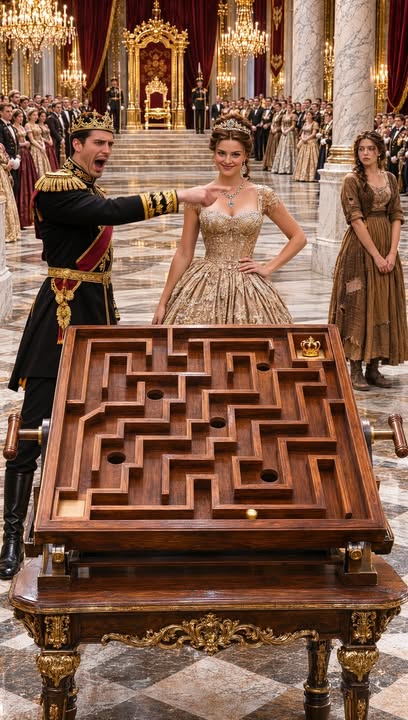
Part 6 – The Fairer Path
“The second witness has been chosen.”
Mistress Rowe’s words seemed to leave the room quieter than before.
Elara looked from the unfamiliar sentence to the queen’s letter resting in its protective case.
For a moment she saw only the ink, the old paper, and the careful lines of her father’s hand.
Then the meaning of the words reached her.
The quiet route had not been a secret meant to reward the person who found it.
It had been a way of bringing someone unexpected into the room where the truth would be told.
Adrian read the note again.
“Who wrote this addition?”
Mistress Rowe tilted the paper toward the lamp.
“The ink is newer than the original, but not new enough for us to identify its age precisely.”
“Could the handwriting be Lord Marlowe’s?” Celestine asked.
“It may be. I would need to compare it with other examples.”
Celestine’s aunt studied the words without touching the page.
“My family kept this book for years,” she said. “I wish we had understood what it contained sooner.”
“You could not have known,” Elara replied.
Her answer seemed to ease something in the older woman’s face, though not all of it.
Adrian turned to Celestine.
“Does this change what you want to do?”
“It changes what I understand,” Celestine said. “The note suggests my family’s papers preserved the very instruction we thought they might have helped erase.”
She looked at Elara.
“My family’s part in this is still uncertain, but it is not as simple as I feared.”
“Nor as simple as the court may want it to be,” Elara said.
Celestine nodded.
“We should let Mistress Rowe compare the handwriting before making any claims.”
The archivist agreed and placed the note beside the other documents.
For the rest of the evening, the three of them stayed in the garden room while guests drifted away.
They did not discover another letter or a hidden account that settled every question.
Instead, they read the evidence they already had, slowly and in order, letting each piece speak only for itself.
The council had authorized the exercise to be publicly presented after Queen Helena’s death.
Lord Marlowe had carried out the change and believed it would preserve the maze, though the public version omitted the queen’s purpose.
His family had kept records that later helped reveal what had been done.
Thomas Vale had built the quiet passage and worked with the queen as a trusted adviser.
The note identifying Elara as the second witness might have been written by Lord Marlowe, or by a clerk preserving his instructions.
No document proved that every person involved understood the cost of the decision.
No document made the decision harmless.
By the time Mistress Rowe closed the file for the night, Elara felt less as if she had found a neat answer and more as if she had been given a duty to carry carefully.
The next morning, Prince Adrian met with the council again.
This time, Elara, Celestine, her aunt, and the candidates who had taken part in the trials were invited to attend.
Mistress Rowe presented the records and explained which conclusions they supported, and which remained uncertain.
Adrian did not ask Elara to stand beside him as a symbol of the past.
He asked her whether she wished to speak.
She rose only when she was ready.
“My father helped build the maze,” she said. “The queen trusted him with an idea, not just a piece of wood.”
She glanced at the documents on the table.
“The records show that the purpose of her test was changed after her death, and that people later kept parts of the truth, even when they did not preserve the whole of it.”
A councilor near the head of the table shifted in his chair.
“Are you suggesting Lord Marlowe intended to deceive the court?”
“No,” Elara said. “The papers suggest he believed he was preserving the exercise. They do not tell us everything he thought or everyone who gave him instructions.”
She met the councilor’s gaze.
“I don’t want uncertainty turned into a story that is easier to tell than the truth.”
The room settled.
Celestine rose next.
“My family’s papers helped us find the record,” she said. “They also contained a note we had not understood. I will not defend every decision made by my relatives, but I cannot answer for choices I did not make.”
Her voice held steady, even when she glanced toward the councilors.
“I can help preserve what the papers show, and I can accept that the record may make my family uncomfortable. What I ask is that discomfort not be mistaken for proof.”
The council heard her without interruption.
When she sat down, her aunt rested a hand briefly on her arm.
Adrian stood.
“The trials will not resume in their former form,” he said. “The candidates who wish to continue may do so, but the remaining challenges will be explained in advance and designed to reveal more than speed, polish, or familiarity with courtly expectations.”
A councilor asked whether the prince still intended to choose a future queen through competition.
“I intend to choose a partner by knowing the person,” Adrian replied. “No challenge can make that decision for me.”
There was no applause in the council chamber, only the rustle of sleeves and a thoughtful silence.
Adrian went on to acknowledge Queen Helena’s purpose, Thomas Vale’s work, and the harm done when the exercise was presented without its true question.
He did not name a villain.
He did not call the past a harmless mistake.
He said the court had inherited an altered story and had repeated it without asking why.
That was enough to make several councilors lower their eyes.
After the meeting, the candidates gathered in the gallery.
Some chose to leave the trials, relieved to be free of a contest whose meaning had changed.
Others remained, curious to see what the revised challenges might become.
No one was declared a winner.
No one was told that the queen’s letter had secretly selected a person to stand at Adrian’s side.
The council agreed that the letter’s “second witness” referred to a role in the revelation, not a claim to a throne.
Elara found that answer a relief.
The queen had left her a place in the story, but not a life she was required to accept.
In the weeks that followed, the palace changed in small, practical ways before it changed in grand ones.
The trials were rewritten with the candidates’ input, and each challenge was designed to make the purpose clear rather than to reward those who already knew the court’s unwritten rules.
The maze was kept in the workshop, not as a test for selecting a bride, but as a teaching piece.
Its wooden brace was repaired where time had loosened it, and a small plaque was placed beside it.
The plaque named Queen Helena, Thomas Vale, and the palace joiners who had cared for the maze through the years.
It also explained that its quiet route had been designed to invite careful observation.
Elara was offered the paid position Adrian had mentioned, but she did not accept it immediately.
She asked to see the duties in writing.
She asked who would hear the servants’ reports.
She asked whether the position came with authority to recommend repairs, or whether she would merely be expected to notice problems that someone else could choose to ignore.
Adrian listened as she asked each question.
Then he asked the council to include written responsibilities, a regular meeting with the palace steward, and a modest budget for urgent repairs.
The position became real not because a prince had promised it, but because the work and the means to do it were set down plainly.
Elara signed the agreement after Mistress Rowe had read it through with her.
Her first days in the role were spent walking the palace with Master Pell and two senior servants.
She noted the loose laundry rail, the dim service passage, the kitchen door that stuck whenever the weather turned damp, and the narrow stair where trays were often carried at an awkward angle.
She also asked the servants which repairs had been reported before and what had happened afterward.
Some answered cautiously, unsure whether anyone intended to listen for long.
Elara took down every name and every detail.
When a report had already been made, she looked for the record and found out where it had stopped.
When a repair could not be made at once, she made sure the person who had asked knew why and when it would be reviewed.
The work did not make the palace perfect.
It made it harder for the palace to pretend that a problem had not been noticed.
Celestine became Elara’s closest ally in examining the old records.
She brought her family’s papers to Mistress Rowe, one bundle at a time, and helped sort letters from household accounts without assuming that every page would vindicate or condemn anyone.
The handwriting on the note about the second witness was eventually compared with Lord Marlowe’s surviving letters.
Mistress Rowe could not make a certain identification, though the shapes of several letters were similar.
That uncertainty was entered into the archive as carefully as the facts.
Celestine did not resent the lack of a decisive answer.
“I used to think not knowing meant I had failed to look hard enough,” she told Elara one afternoon in the workshop.
“Sometimes it means the record has a gap.”
“And sometimes we have to learn to leave the gap visible.”
Elara nodded.
Her father had taught her to study what was there before trying to force it into the shape she expected.
Celestine had learned something much the same way.
She was still proud, and still careful about how she was seen, but she no longer mistook being wrong for being ruined.
When the revised trials were held, Celestine entered one of them.
It asked the candidates to plan a day of royal duties while balancing conflicting requests from the town, the palace staff, and the council.
There was no hidden answer and no single perfect route.
The candidates had to explain what they would prioritize, what they would postpone, and whom they would consult.
Celestine listened closely to a young kitchen worker who had been invited to describe the strain of serving a large gathering.
Afterward, she thanked him for speaking plainly, and he thanked her for waiting until he had finished.
She did not win that challenge.
She did not seem to need to.
For Elara, the most unexpected change came in the quieter moments with Adrian.
He did not treat the new position as an excuse to keep her near him, and she did not mistake every conversation for a promise of something more.
They spoke about the repair schedule, about the trials, and about the people whose names were missing from old records.
Sometimes they spoke about nothing important at all.
Adrian learned to ask a question and wait through the silence that followed.
Elara learned that he could hear an answer he had not hoped for without punishing the person who gave it.
When he disagreed with her, he said so honestly.
When she was right, he did not make her spend half the conversation proving it.
One spring evening, months after the first challenge, they found themselves standing beside the restored maze in the workshop.
The golden ball sat in its starting square.
Master Pell had replaced a warped section of the board, but left the original route intact.
The tiny crown at the far end gleamed softly beneath the workshop lamps.
Adrian picked up the two wooden handles.
“Would you like to try it?” he asked.
“Not if you are hoping I’ll finish the route.”
“I’m hoping you’ll show me where I’m likely to hurry.”
“That may take a while.”
“I have time.”
Elara accepted one handle, and Adrian took the other.
They began slowly, keeping the board level between them.
At the first turn, he tilted too far.
The ball rolled toward the outer wall, but Elara eased her side down before it struck.
“You were about to force it,” she said.
“I was.”
“Why?”
“I thought we were losing momentum.”
“Sometimes stopping is how you find out what the board is doing.”
Adrian looked from the ball to her.
“I’m beginning to understand that.”
Together, they guided the golden sphere into the narrow passage.
It moved past the first trap without any flourish.
At the center of the maze, the ball settled against the inside wall.
Adrian did not rush to move it.
He watched where it rested, then adjusted the handle by a small degree.
The ball continued.
Elara felt a smile rise before she could hide it.
“You have learned something.”
“I had a patient teacher.”
“I am not sure patience is what you would call me when I’m trying to get a door repaired.”
“No,” he said. “Then I would call you right.”
Their laughter was quiet, but it belonged only to them and the old wooden maze.
The ball reached the final turn.
Adrian eased his handle down, and Elara steadied hers.
This time, it entered the crown square without touching the metal marker.
They both let go.
The golden ball rested in the center of its destination.
No one applauded.
No crowd had gathered to decide what the moment meant.
Elara found that she liked it better that way.
Adrian turned toward her.
“I have been thinking about what you said in the garden room.”
“Which part?”
“That you wanted a chance to do useful work, and that you did not want anyone else pushed aside to make room for you.”
She waited.
“I hope you know I value the work you do,” he said. “But I also value you when there is no repair to discuss and no question for you to answer.”
Elara’s fingers rested on the wooden handle.
“Is that a question?”
“It is an honest statement.”
“Then I’ll answer honestly.”
She took a breath.
“I value the way you have changed your mind without asking everyone to pretend you never had one.”
His shoulders eased.
“I am glad.”
“And I value that you listen.”
He did not reach for her hand.
He did not tell her that the maze had brought them together, or that the queen’s letter had somehow arranged their future.
He simply stood beside her, allowing the answer to be enough.
Elara looked at the small crown marker.
For months, it had seemed to her like a finish line, a prize, and a question all at once.
Now it was only a piece of brass fixed to a wooden square.
The meaning of her life had never rested in reaching it.
It rested in what she chose after she did.
“I would like to keep talking,” she said.
Adrian’s smile was warm and unguarded.
“So would I.”
They did not announce anything to the court.
They let their friendship grow in its own time, through walks in the garden, long conversations in the gallery, and the occasional disagreement over whether a repair should be made at once or tested first.
Celestine remained beside them, no longer an opponent but never required to become someone else in order to belong.
In the years that followed, she helped establish an archive for the names of palace builders, attendants, and household workers whose contributions had gone unrecorded.
Mistress Rowe supervised the project, and Elara made sure the work included people still living in the palace, not only those who had long since become lines in ledgers.
The palace staff began to leave written notes about repairs, and those notes received replies.
A new rail was fitted on the laundry stair.
The kitchen door was rehung so it opened easily.
The service passages gained better lamps.
None of these changes made a grand story on its own.
Together, they changed the way the palace moved.
The golden ball maze remained in the workshop, ready for anyone who wished to learn its routes.
Visitors were invited to try it, but no one was told that a single path proved they were clever or worthy.
Some chose the broad route.
Some found the quiet passage.
Some dropped the ball into a trap and tried again.
Whenever a visitor grew frustrated, Elara remembered her father’s lesson and let the board rest until the ball showed where it wanted to go.
Years later, Adrian asked Elara to share a life with him.
By then, they had already built something more lasting than a courtship shaped by ceremony.
They had learned to speak plainly, to question the paths offered to them, and to make room for each other without asking either to disappear.
Elara accepted because she loved the man he had become, not because she had won a royal challenge.
At the small wedding, the palace did not crown her as a prize.
The king placed a simple gold band in Adrian’s hand, and Celestine stood beside Elara with her own hand clasped firmly around hers.
In the front row, Master Pell sat beside Mistress Rowe.
The palace servants were invited by name, not counted as part of the furniture of the hall.
On the table near the windows rested a small wooden token carved with the three-pronged mark of Thomas Vale.
Its single word had been worn smooth by many careful hands.
Listen.
Elara touched it once before the ceremony began.
For an instant, she could almost hear her father’s voice, calm and familiar, telling her to study the thing before she tried to master it.
Then the music began, and she turned toward Adrian.
The hall was bright with candles, but the light did not belong only to crowns or jewels.
It belonged to every person who had helped carry the truth into the open and chosen to make something kinder with it.
And when Elara stepped forward, she did not follow the easiest path or the one others had drawn for her.
She chose the one they had learned to make together.
**–THE END–PLEASE
Share your thoughts or feedback to motivate us to create more stories ♥️
* * *
[PREVIOUS: PART 5](https://storyly.idolsgift.com/blog/part-5-the-shortcut-no-one-was-meant-to-see-057)
✓ Lynn R. Adams
Part 6 – The Fairer Path “The second witness has been chosen.” Mistress Rowe’s words seemed to leave the room quieter than before. Elara looked from the unfamiliar sentence to the queen’s letter re…