PART 6 (THE END): The Secret Selena Knew 008
Part 6 – A Memory Freely Kept
“A letter Selena wrote to Julian the night Elise died.”
The envelope looked older than anything else in the room, its paper softened at the folds and its edges browned with time.
Julian’s name was written across the front in a hand I recognized from the careful notes Selena had left in our kitchen.
For a moment, no one spoke.
Then I looked at Mara.
“Has Julian read it?”
“Not yet,” she said. “The records manager found it inside the box, separate from the accident report.”
“Was it sealed?”
“It was.”
Lena glanced toward me.
“You don’t have to read it today.”
“I know,” I said, though my attention had fixed on the envelope.
“Would you like to see it?” Mara asked.
I took a slow breath.
“Yes, but not alone.”
Mara nodded and set the envelope on the table, where Lena could open it while I watched.
The paper inside had been folded twice.
Selena’s handwriting filled one side, with a date written at the top in a youthful, slanted script.
Lena read silently first, then asked whether I wanted her to read it aloud.
I nodded.
The letter began with an apology for not telling Julian the truth at the crash site.
Selena wrote that she had been driving too fast for the rain, that Elise had asked her to slow down, and that Selena had lost control.
She said she had panicked when she saw the damage and heard people calling for help.
Then she wrote that Julian’s family had told her to say she had been a passenger, that they would handle everything, and that no one needed another tragedy to destroy them.
But the last paragraph was in a different tone.
Selena wrote that Julian deserved to know the truth, and that she would tell him herself when she could face what she had done.
The promise had been made the night Elise died.
It had never been kept.
I stared at the page, feeling sorrow arrive before anger could take its place.
“She knew from the beginning,” I said.
Mara nodded.
“The letter supports that.”
“And the family told her to lie?”
“The letter says they did,” Mara replied. “We’re verifying who was involved and whether the original report was altered by particular family members.”
“Did Julian know there was a letter?”
“Not until we found it.”
I looked again at Selena’s final sentence.
When she could face what she had done.
Years had passed.
She had returned to Julian’s life, hidden the old report, and tried to keep the truth away from him again.
All those years, the truth had been waiting in a sealed envelope while the people around it built their lives on silence.
“What happens to the letter now?” I asked.
“It will be preserved as evidence,” Mara said. “Julian will be given an opportunity to read it with his attorney present.”
“And Selena?”
“She’ll be interviewed about it.”
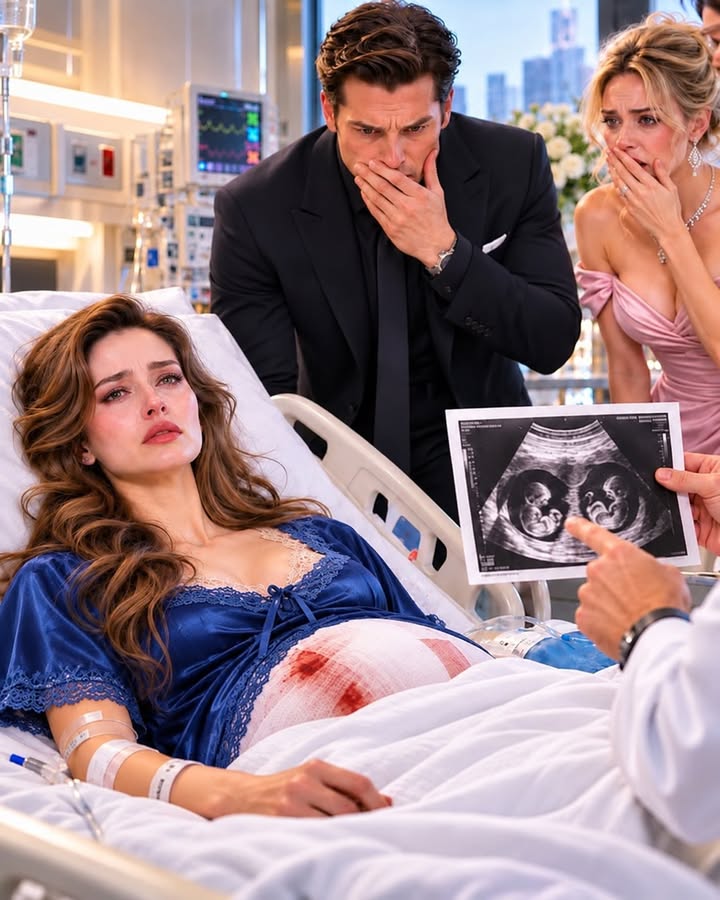
I lowered my eyes to the ultrasound picture beside the folder.
The two small shapes were still blurry, still impossible to understand without being told what they were.
Yet they felt more certain to me than the words on the old page.
A nurse arrived to check my medication, and the conversation paused.
By the time she left, the letter had been returned to its protective sleeve.
The room seemed different, not lighter exactly, but less crowded with unanswered questions.
Mara explained that investigators had obtained the original accident report from the records room and were comparing it with the altered copies held in the family archive.
The report, the letter, and the messages would help establish how Selena’s role had been concealed and who had helped keep the account from being corrected.
“We’re not going to draw conclusions before we finish,” she said.
“I understand.”
She looked at me with quiet kindness.
“You’ve been very patient.”
“I haven’t felt patient.”
“That’s not the same as giving up.”
After Mara left, Lena stayed with me.
“Would you like to talk about what the letter means to you?” she asked.
“I think I feel sorry for Elise.”
Lena nodded.
“And for Julian?”
“I do, in a way.”
The admission surprised me.
It did not soften what he had done to me, but it made room for a grief that had nothing to do with forgiving him.
“He spent years believing Selena had been in the car beside his sister, grieving with him,” I said.
“He did.”
“She let him keep that version because the truth was too costly for her.”
Lena gave me a moment.
“And now he knows.”
“Yes.”
I wondered whether the truth would change the way Julian remembered his sister.
Perhaps he would have to begin again, not with a new memory of Elise, but with a more complicated understanding of the people around her.
That evening, Julian’s attorney sent word that he had read the letter.
Julian asked whether he could speak with me briefly.
I did not answer at once.
Lena reminded me that I could decline, agree to a written message, or set any conditions I wanted.
After a while, I asked for one short conversation, with Lena present, and no discussion of the marriage unless I chose to bring it up.
Julian arrived the next day.
He was carrying no flowers, no gift, and no explanation written on a card.
He stopped beside the chair and waited until I invited him to sit.
His face held a grief I had not seen before.
It was quieter than shock, and it seemed to have no place to go.
“I read the letter,” he said.
“I’m sorry.”
He nodded slowly.
“I spent years believing Selena was there with Elise, that she was a passenger who had lost someone she loved.”
He looked toward the window.
“I thought we had shared that grief.”
I said nothing.
“She was driving.”
“Yes.”
“And she knew.”
“Yes.”
Julian let out a careful breath.
“Part of me keeps wanting to defend the family, because they were trying to protect me when I was young.”
“Were they?”
“I don’t know anymore.”
His eyes came back to mine.
“They may have thought they were protecting me from the truth, but they also protected Selena from facing what she had done.”
“And you promised to hide the file.”
“Yes.”
He didn’t ask me to make the promise understandable.
He didn’t say he had only been confused, or that Selena had pressured him, or that grief had made him do things he could not control.
“I’m giving the investigators everything,” he said. “The messages, the records, and the names of the people who handled the family archive.”
“That’s the right thing to do.”
“I should have done it before.”
“Yes.”
He lowered his gaze.
“I used to think the worst thing I could do was lose the version of my family I had left.”
“And now?”
“Now I understand that keeping that version required other people to carry the truth for me.”
His hands rested open on his knees.
“I don’t expect you to comfort me about it.”
“Good.”
“I know I hurt you.”
“You stabbed me, Julian.”
“I know.”
“I need you to understand that I’m not going to turn what happened to Elise into an excuse for what you did to me.”
“I understand.”
He looked at the bandage beneath my blanket, then away.
“I won’t ask you to forgive me.”
The words did not repair anything, but they did not ask me to repair it for him either.
That was new.
“Then what are you asking?” I said.
“Nothing.”
He drew a breath.
“I wanted you to know I won’t fight your request to keep the twins’ names and medical details private.”
“Thank you.”
“And I’ll follow whatever boundaries you set about contact.”
I held his gaze.
“That will matter more than anything you say today.”
“I know.”
He stood, then paused by the chair.
“I hope they’re all right.”
“They’re being watched closely.”
“I hope you’re all right, too.”
I did not promise him an answer.
He accepted that, nodded once, and left.
Lena closed the door behind him.
I rested my head back against the pillow.
“That went better than I expected,” she said.
“It was still hard.”
“Both can be true.”
The weeks that followed moved slowly, then all at once.
The hospital released me to a quiet recovery apartment arranged by the social worker, a place with wide hallways, soft afternoon light, and enough distance from the house to let me breathe.
I chose who could visit.
Lena came often, bringing updates and asking before discussing anything difficult.
Caleb stopped by when his schedule allowed, sometimes with medical news and sometimes with a book he thought I might enjoy.
He never treated my gratitude as an invitation to become something more.
That steadiness became its own kind of comfort.
The twins remained fragile, but each appointment brought a new sign of progress.
A heartbeat, then two.
A small movement on the screen.
A doctor’s cautious smile after a scan.
I learned not to ask for promises.
I learned to treasure the good news I had, one appointment at a time.
The investigation continued beyond the hospital.
Selena was charged in connection with the assault and with her role in concealing the truth about the crash.
The family’s influence could not make the old record disappear once investigators had recovered the original report, the letter, and the messages.
The facts were examined carefully, without turning the case into a spectacle.
When I was asked to testify about the day Selena came to the house, I agreed.
I also repeated the boundaries I had set from the beginning: no publication of the twins’ names, no release of their medical information, and no photographs identifying them.
The court granted the privacy protections it could.
Not every question was easy.
I spoke about the scratch, the knife Julian had been holding, and the moment I saw him step over me.
I did not have to perform fear for anyone.
I did not have to make my voice break to prove what had happened.
When the recording was played, the room became still.
Julian’s voice came through the speakers, clear enough to leave no doubt about what he had said.
“She’s gone.”
Then, after the pause, his admission.
“I did it, Selena. Just like you said.”
Selena’s attorney argued that the recording lacked context.
But the recording had been preserved, verified, and supported by the hospital records, the physical evidence, the messages, and the accounts of those who had seen us in the days before and after.
The old file was no longer a rumor whispered between them.
The letter established that Selena had known the truth about Elise’s death from the beginning.
Her messages showed that she had been trying to keep the report from being found after Nora had discovered it in the house.
The evidence also confirmed that I had not attacked her.
The scratch on Selena’s arm had come from her own struggle to retrieve the folder from me, not from any attack I had made.
When she told her story again, there was less room for it to change.
Julian cooperated with investigators and provided the family messages and records.
He did not ask me to speak on his behalf.
He did not call me from the courthouse.
He accepted the consequences of what he had done.
The legal process took time, and the waiting was difficult, but it no longer felt like the same helpless waiting I had known in the hospital.
I had chosen to speak.
I had chosen what would remain private.
I had chosen who stood beside me.
That made the hours my own again.
Julian was convicted for stabbing me and accepted responsibility in court.
Selena faced justice for her role in the cover-up and the assault.
The family’s older decisions were reviewed separately, and the record of Elise’s death was formally corrected.
Julian’s sister had been a passenger in the car.
Selena had been driving.
The road had been wet, and her decision to drive too fast had contributed to the crash.
No sentence could return Elise.
No corrected report could return the years Julian had spent believing a lie.
But at last, the truth belonged to the record, not to the people who had tried to hide it.
When the proceedings ended, Julian did not ask me to forgive him.
He sent one final message through Lena, confirming that he would respect my boundaries and would not seek contact with the children unless I chose to revisit the question in the future.
I read it, then put it away.
There was nothing cruel in the choice to leave the message unanswered.
There was only the understanding that his regret did not give him a claim on me.
The months passed.
My body grew stronger.
The twins grew stronger with it.
I returned to work gradually, beginning with a few hours from home and later taking on projects that belonged to me, not to a life I had once built around Julian’s plans.
The first day I returned to the office, Caleb met me in the lobby with a paper cup of tea.
“You look like yourself,” he said.
“I’m not sure I remember what that means.”
“It means you’re wearing your own coat and carrying your own bag.”
I looked down at the bright green coat I had bought because I liked it, not because it matched anything in Julian’s wardrobe.
“That seems a reasonable place to start.”
He walked with me to the elevator.
He did not ask whether I would ever love again.
He did not suggest that healing should lead toward him.
He was simply there, as he had been when I woke in the hospital, letting the future stay mine.
When the babies were born, the day was long and bright with nurses moving softly through the room.
I held one small child against each arm, their faces warm against my skin, their cries rising and settling like two different kinds of music.
For a while, I could not speak.
Then I laughed, and the laughter turned into tears.
Caleb stood nearby, holding the first cup of water I had asked for, his eyes shining.
“You did it,” he said.
“We did,” I answered.
The twins were safe.
They were here.
The world outside the hospital did not become simple, but the room belonged to us for that moment.
I chose when the family heard the news.
I chose the photographs that could be shared.
I chose the names we would keep close until I was ready.
Privacy no longer felt like hiding.
It felt like care.
In the months after their birth, the children learned the world through warmth, milk, music, and the familiar rhythm of our home.
I learned them, too: the tiny signs that meant one was hungry, the sleepy frown one made before a nap, the way the other’s hand always found my finger.
We found a small house with a garden and a room full of afternoon light.
It was not the house I had shared with Julian.
It was smaller, quieter, and chosen by me.
I painted one wall a soft yellow and filled the shelves with books that belonged to the children.
I returned to work on a schedule that left room for doctor visits, missed naps, and the uneven, ordinary days that made a life.
Caleb remained my friend.
Sometimes he brought dinner.
Sometimes we sat on the porch while the twins slept inside.
Once, when he asked whether I wanted to go to a concert, I said yes.
We went as friends, and we came home still friends.
There was no need to hurry affection into a shape before either of us was ready.
One evening, nearly a year after the day I woke in intensive care, I was sitting on the rug with the twins when one made a bubbling sound that caught the other’s attention.
The second baby answered with a laugh.
The first tried again.
Their laughter met in the middle of the room, bright and startled, as if they had discovered a secret language.
I reached for my phone.
For a heartbeat, the old instinct returned: preserve the moment, collect the proof, make sure no one could ever deny that it happened.
Then I remembered the smartwatch beneath the rug, and the recording I had made because I was afraid no one would believe me.
I looked at the children.
They were laughing because one had touched the other’s nose.
No one needed to be exposed.
No one needed to be convinced.
I opened the camera and recorded the sound, not as evidence, but as a memory I had freely chosen to keep.
**–THE END–PLEASE
Share your thoughts or feedback to motivate us to create more stories ♥️
* * *
[PREVIOUS: PART 5](https://puretales.idolsgift.com/blog/part-5-the-secret-selena-knew-008-2)
✓ Lynn R. Adams
Part 6 – A Memory Freely Kept “A letter Selena wrote to Julian the night Elise died.” The envelope looked older than anything else in the room, its paper softened at the folds and its edges browned …