PART 6 (THE END): The Secret Rosa Kept5 025
Part 6 – The Cup That Stayed
Elena read the first line aloud.
“If you are reading this, then you have already decided to tell Everett I approved the transfer.”
Rosa drew in a careful breath, and I felt the old house around us shrink to the size of that page.
Elena continued, her voice steady but quiet.
“Beverly, the document you gave me to sign authorized a temporary transfer to the holding account, not a personal payment to you.”
“After I signed, you told me the company needed a different record for its files.”
“You said the funds would be returned and that there was no reason to alarm Everett’s father or the board.”
“But I have now seen the ledger, and the entry has been altered.”
“If the balance has been moved to your account, it must be returned to Lowell Holdings.”
“I have kept copies of the original authorization, the amended page, and the transfer record.”
“I am giving you one chance to correct the matter before I bring the records to the company’s counsel.”
The letter ended with my mother’s name, written in a firm, unmistakable hand.
For a few seconds, the only sound in the room was the soft ticking of the clock on the mantel.
“She was trying to give Beverly a chance to return the money,” I said.
Daniel nodded.
“And to establish that the altered record was not her instruction.”
Elena looked again at the receipt.
“Her signature may have been copied onto the typed instruction after she wrote this letter.”
“So the receipt doesn’t show that she transferred the money to Beverly herself,” Savannah said.
“It shows that someone made it appear that way,” Daniel replied.
Savannah’s face had gone pale, but she did not turn away.
“My mother told me Margaret had approved the transfer,” she said. “She said the paperwork was proof.”
“Did she show you the receipt?” I asked.
“No. Only the altered authorization.”
“You could have questioned her.”
“I could have,” Savannah said. “I should have.”
There was no effort in her voice to push the blame aside.
“I thought if I believed her, I wouldn’t have to choose between her and you,” she continued. “I see now that I was choosing not to know.”
I had spent much of the previous week wishing she would say exactly that.
Hearing it did not return us to the life we had imagined.
It did give her words the dignity of being heard.
Daniel gathered the original receipt, the letter, and the two versions of the authorization into separate evidence sleeves.
“We’ll have the documents examined, and the company’s independent counsel will submit everything to the appropriate authorities,” he said. “Beverly will have a chance to respond through her lawyer.”
“I don’t want this handled as a public contest,” I said.
“Then we’ll keep our communications factual and let the process do its work,” Daniel replied. “No statements about motives that we can’t prove.”
I looked toward Rosa.
“Are you comfortable with your statement being included?”
Her fingers had settled around the edge of the table.
“I’m not comfortable,” she said. “But I’m ready.”
Elena moved closer to her mother.
“We can tell the whole story, including the pressure Beverly put on you and the letter Margaret left.”
Rosa looked at me.
“I signed those words. I can’t ask anyone to pretend I didn’t.”
“No one should,” I said. “But no one should pretend you made that choice freely, either.”
Her eyes glistened.
For years, she had carried a version of the past that left her alone with the blame.
Now, at least, the evidence would speak beside her.
The following weeks were occupied by interviews, document examinations, and long conversations with lawyers who asked careful questions and made no promises.
The paper examiner confirmed that my mother’s signature on the original authorization was genuine, while the expanded language in the later copy had been added afterward.
The transfer receipt had been altered as well.
The bank records, ledgers, and archived correspondence showed that the funds had never been returned to Lowell Holdings.
They also established that Beverly had authorized the transfer and later directed the money into an account she controlled.
The old finance executive confirmed that Beverly had presented the amended paperwork as an approved correction.
My mother had recognized the change and begun collecting records.
She had died before she could take the evidence to the board.
The investigation did not make the past simple.
It made it possible to describe accurately.
Beverly’s lawyers argued that the transfer had been part of a broader arrangement and that old records had been misfiled.
The evidence did not support that claim.
After an independent review, the company recovered a portion of the diverted funds through the settlement process, and the remaining amount became part of a formal civil judgment.
Beverly also faced legal consequences for the forged documents and the misuse of company money.
The outcome was measured and private, not the dramatic spectacle she had feared or threatened.
It was more difficult than that.
It required records, testimony, patience, and a willingness to let the facts stand without turning the people involved into symbols.
Rosa gave her statement in her own words.
She described the conference room, the cold air, and Beverly’s insistence that the company needed her signature.
She explained that she had not witnessed Margaret approve the transfers and that fear for Elena had made her sign a lie.
When the interview was over, she did not look relieved.
She looked tired, as if setting down a heavy box had reminded her how long she had carried it.
Elena stayed beside her throughout.
On the drive home, she reached across the console and rested her hand over Rosa’s.
“I’m still angry that you hid it from me,” she said.
“I understand.”
“But I’m glad you let me hear it from you.”
Rosa’s eyes softened.
“I should have trusted you with the truth.”
“I wish you had,” Elena said. “I also know why you thought you couldn’t.”
They drove the rest of the way with their hands joined between them.
The trust between them did not return all at once.
It returned in small acts: Rosa answering questions without turning aside, Elena asking them without trying to punish her, and both of them making room for the hurt without letting it become their only language.
Savannah testified too.
She confirmed that she had seen the power-of-attorney papers in my study, that she knew her mother wanted my signature, and that she had chosen not to tell me what she suspected.
She also confirmed that Beverly had discussed Margaret’s old authorization with her, though she had not known there were two versions.
Her testimony did not erase her earlier silence.
It did establish that she was no longer using silence to protect herself.
When the legal process was complete, Savannah came to the estate one quiet afternoon.
She stood beneath my mother’s portrait, looking at the space where the old garden room had once been visible through the glass doors.
“I don’t expect you to take me back,” she said.
“I know.”
“I also don’t expect you to tell me I’m a good person because I finally did what I should have done before.”
“I wouldn’t say that.”
She gave a small, rueful smile.
“That’s fair.”
We sat in the garden for a while, with the late sun resting on the hedges and the house windows bright behind us.
“I loved you,” she said.
“I loved you too.”
“Do you still?”
I considered the question carefully.
“I still care about who you are,” I said. “But I can’t build a marriage on the hope that you’ll become honest when honesty costs you something.”
Savannah lowered her gaze.
“I understand.”
She had no easy defense left, and I did not ask her to invent one.
“I’m sorry for what I did to Rosa,” she said. “Not because it made you doubt me, but because she deserved better from me.”
“Then keep showing her that.”
“I will.”
We said goodbye without a promise that the future would bring us back together.
It was sad, but it was not cruel.
Some endings did not need an enemy.
They only needed two people to admit that affection could not repair what accountability had not yet changed.
In the months that followed, Savannah began working with a local legal-aid group that helped people understand confusing estate and financial paperwork.
She did not tell me about it as proof of anything.
Rosa mentioned it once while we were having coffee.
“She doesn’t ask me to praise her,” Rosa said. “That’s new.”
“Do you think she means it?”
“I think she’s learning to do the right thing without knowing whether anyone will reward her for it.”
Rosa looked toward the garden, where Elena had set out folding chairs for the graduation celebration she had once been afraid to leave home and attend.
“That is a better place to start than a promise.”
Elena graduated in June.
Rosa sat in the front row this time, dressed in a blue suit she had chosen for the occasion and holding a bouquet of white flowers in her lap.
I sat beside her.
When Elena walked across the stage, Rosa stood before anyone else did.
Her applause rose above the crowd, bright and full of the pride she had carried for years.
Afterward, Elena found us near the courtyard steps and hugged her mother so tightly that Rosa laughed into her shoulder.
“You made it,” Rosa whispered.
“I did,” Elena said. “And you were there.”
“I should have been there from the beginning.”
Elena drew back enough to look at her.
“You’re here now.”
Rosa’s face changed, and I saw the years of regret loosen, if only a little.
At the estate that evening, we set a long table in the garden.
Elena’s friends came, along with Walter, Daniel, a few colleagues from Lowell Holdings, and people who had been part of Rosa’s life long before I understood how much of my own she had held together.
The celebration was not grand.
It was generous.
There was food, music, a stack of graduation cards, and more laughter than the old house had heard in months.
Savannah did not come.
She had sent Elena a note congratulating her, and Elena had chosen to answer with thanks.
It was enough for that day.
Before dinner, I brought the chipped cup from the hall cabinet and set it beside Rosa’s plate.
She turned it gently in her hands.
“I thought it had cracked after Savannah spilled the coffee,” she said.
“The crack was there before.”
“You never noticed?”
“I never had a reason to look closely.”
She traced the blue flowers with her thumb.
“Margaret used to say that flaws didn’t make something less worthy of keeping.”
“She told me the same thing when I chipped it as a child.”
“She was right.”
I looked across the table at Elena, who was laughing with Walter while trying to keep a curl from falling across her face.
Rosa followed my gaze.
“You’ve both grown up,” she said.
“Some of us more reluctantly than others.”
That made her laugh, a warm, unguarded sound that carried into the garden.
The cup held fresh coffee now, dark and fragrant.
I lifted it with both hands.
The chipped rim touched my mouth, unchanged.
For years, I had believed that the cup belonged to my mother, then to Rosa, then to the past I had tried to keep polished and untouched.
Now I understood it belonged to the people who had held it carefully, even when it was imperfect.
Later, after the guests had gone and the lanterns were dim, Elena found me in the quiet kitchen.
“Mom is asleep in the sitting room,” she said. “She told me to make sure you didn’t work through the night.”
“I was only going to check one email.”
“That is what she expected you to say.”
I smiled.
Elena leaned against the doorway.
“Thank you for letting me help,” she said. “You could have hired a team and kept all of us at a distance.”
“I could have.”
“Why didn’t you?”
“Because this was your mother’s truth as much as it was mine.”
She considered that, then nodded.
“I’m glad you knew the difference between protecting us and deciding for us.”
“I’m learning.”
“So are we all.”
She crossed to the table and lifted the cup, checking the chipped rim as carefully as Rosa had.
“Are you going to keep it out?” she asked.
“Yes.”
“Good.”
She set it back in its place, close enough to reach but far enough from the edge.
The house was quiet around us.
It no longer felt like a place built to preserve a family’s reputation, or a museum of my mother’s absence.
It felt lived in.
The next morning, when I walked downstairs, sunlight rested across the foyer marble.
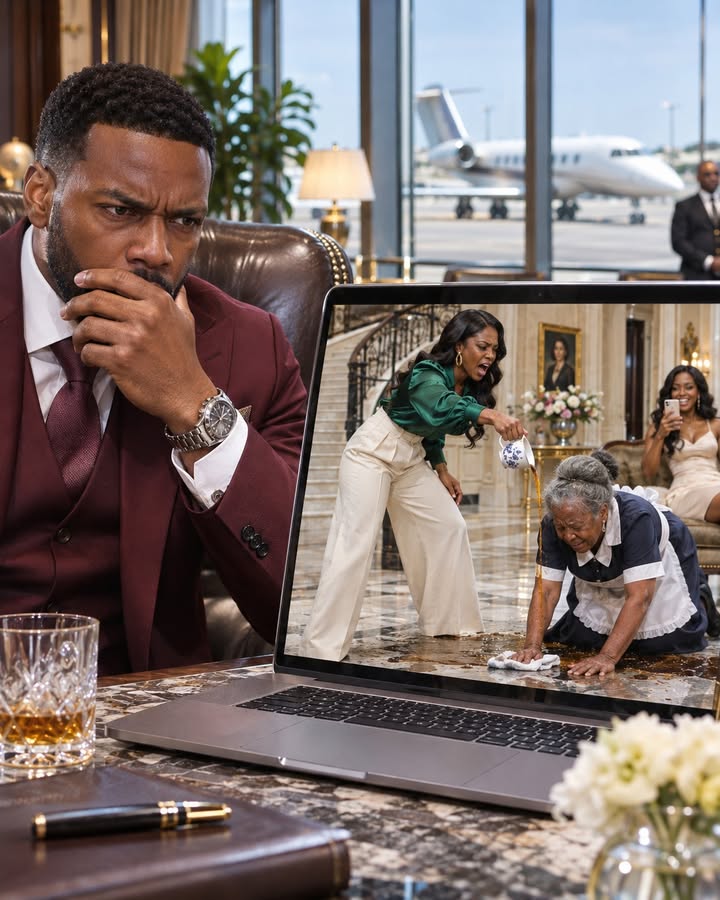
The spot where the coffee had spilled had long since been cleaned, but I remembered Rosa kneeling there and Savannah standing above her, and I remembered the moment I had chosen to stop watching from a distance.
I could not undo that morning.
I could choose what came after it.
Rosa entered from the kitchen carrying the chipped cup.
“Coffee, Mr. Everett?” she asked, the old teasing warmth returning to her voice.
“Only if you’re having some too.”
“I am.”
She set the cup between us, then reached for another.
Outside, the garden stirred in the early light.
Inside, the house held no hidden document that either of us was afraid to name.
My mother’s letters were preserved, Rosa’s statement was understood in its full context, and the truth had reached the people who needed to hear it.
Nothing about the past had become perfect.
But the people standing in the present had finally stopped asking fear to speak for them.
Rosa handed me the cup, its blue flowers bright against the white porcelain.
I took it carefully, grateful for the crack, grateful for the hands that had kept it, and grateful that love, when joined with honesty, could survive what silence never could.
**–THE END–PLEASE
Share your thoughts or feedback to motivate us to create more stories ♥️
* * *
[PREVIOUS: PART 5](https://puretales.idolsgift.com/blog/part-5-the-secret-rosa-kept5-025)
✓ Lynn R. Adams
Part 6 – The Cup That Stayed Elena read the first line aloud. “If you are reading this, then you have already decided to tell Everett I approved the transfer.” Rosa drew in a careful breath, and I …