PART 6 (THE END): The Secret of the Handkerchief 057
Part 6 – A Home Built on Truth
Sophia looked from the folded sheet to the sealed letter, feeling the past gather around the small table in the flower shop.
“Who was the name written there?” she asked.
Hargreaves turned the second document so Marian could see it.
“Vale,” he said. “Mr. Vale’s name.”
Marian’s hand tightened around the edge of her chair.
“Then the letter wasn’t the only thing hidden.”
“No,” Hargreaves replied. “But we should not guess what this document means before it is read.”
The Queen’s secretary glanced at the old envelope.
“Her Majesty is waiting.”
Sophia looked at her mother.
Marian’s face had gone pale, but her eyes were steady.
“Take both papers,” she said. “And make sure they are opened in front of the inquiry panel.”
The secretary hesitated.
“The Queen asked to read Eleanor’s letter privately first.”
“She may read it,” Marian said. “But the second document must be recorded and witnessed.”
Sophia felt a quiet admiration rise in her.
Her mother had spent years being told that the palace knew best; now she was asking for the truth to be handled openly, and no one hurried to take that right from her.
Hargreaves nodded.
“I agree. The letter and the note should be entered into the inquiry record before either is opened.”
Sophia lifted the papers with both hands.
“We’ll bring them together.”
At the palace, the Queen waited in the library beside Eleanor’s old traveling case.
Alexander stood near the window, his expression tense but composed.
When he saw Sophia, his eyes moved first to her face, searching for any sign that she had been hurried or pressured.
She held out the envelope.
“My mother asked that it be read with witnesses.”
The Queen bowed her head.
“She is right.”
The inquiry chair and two members of the review panel were called to the library.
Once everyone had arrived, Hargreaves described where the papers had been found and showed them the conservator’s report.
The envelope and the second folded sheet were entered into the record.
Only then did the Queen break Eleanor’s seal.
Her hands trembled as she unfolded the letter, and Alexander moved closer—not to read over her shoulder, but to be there if she needed him.
For a moment, the Queen could not speak.
Then she began.
“Mother,” she read, her voice catching on the first word. “If this letter has reached you, I hope you have had time to look beyond the fear that has kept so many people quiet.”
The Queen stopped, pressing her lips together.
Alexander laid a hand on the back of her chair.
She continued.
“Mr. Vale has altered the charitable accounts. The winter relief money intended for families in the western districts was not fully delivered. He has entered payments as complete when they were not, and he has kept the supporting receipts from the household files.”
The panel chair made a note.
The Queen went on, each sentence making the silence in the room deeper.
“Among the families affected are the Bells, whose flower shop was promised assistance after a difficult season. Marian Bell has served this household with honesty and kindness. I have entrusted her with this letter and my handkerchief because I fear she may be dismissed before the truth is heard.”
Sophia’s throat tightened.
She looked at Hargreaves, who had gone very still.
The Queen read the next lines.
“Please do not make her answer for the missing money. Ask her what she saw. Listen to her. If the Bell family’s help was withheld, repay them, and find every other family whose name is on my list.”
At the bottom, Eleanor had written a series of names and amounts, followed by a final sentence.
“Do not let my silence become the reason they remain unheard.”
The Queen lowered the letter.
Her eyes shone, but she did not look away from the words.
“She asked me to listen,” she whispered.
Alexander’s voice was quiet.
“And we will.”
Hargreaves unfolded the second sheet.
It was a carbon copy of a short memorandum, its edges browned with age.
The document bore Mr. Vale’s signature and a date close to the week Marian had been dismissed.
It instructed the household clerk to transfer Eleanor’s personal papers and sewing materials into the Queen’s traveling case “for secure keeping,” while noting that the charity inquiry should be considered closed unless “further evidence is formally produced.”
The final line was written in a different hand.
The household sewing case is to be removed from the west rooms before the staff inventory is completed.
Marian closed her eyes.
The room seemed to hold its breath.
“Does that mean Mr. Vale took my case?” she asked.
“It suggests he arranged for it to be moved,” Hargreaves said carefully. “It does not yet establish who placed Eleanor’s letter inside the Queen’s case, or when.”
The panel chair studied the memorandum.
“But it confirms that the sewing case was removed before Mrs. Bell was dismissed and that the inquiry was closed while evidence remained outstanding.”
The Queen looked at Marian.
“I am sorry.”
Marian breathed in slowly.
“I believe you are.”
The answer did not absolve the Queen, and the Queen did not ask it to.
Alexander looked at the names on Eleanor’s list.
“Then we know who was harmed.”
“We know who may have been harmed,” the panel chair corrected gently. “The payment records must still be compared with the families’ accounts and the district records.”
The Queen nodded.
“Do it properly.”
The investigation continued for several weeks.
The independent panel traced each payment against the surviving city records, interviewed the families named in Eleanor’s letter, and examined the accounts Mr. Vale had kept after leaving the palace.
The work uncovered no grand conspiracy, only a deliberate, quiet pattern of falsified entries and missing receipts that had endured because people trusted the household records and were reluctant to question them.
Mr. Vale admitted that he had recorded several grants as delivered before the money had reached the intended families.
He claimed that he had meant to replace the funds later, but the panel found that the shortfalls had never been repaid.
He could not explain away Eleanor’s notes, the missing supporting pages, or his own memorandum directing the removal of her papers.
The panel referred the financial findings to the appropriate authorities and recommended that the palace formally acknowledge its failure to verify the accounts.
The stolen funds were recovered where possible, and the palace restored the remainder from its own charitable reserve.
Every family identified in Eleanor’s letter received the amount it had been promised, with a clear account of why the payment had been delayed.
The Bell family’s name was cleared in the official household record.
Marian received a written statement acknowledging that she had not been accused on evidence, had not taken royal property, and had been dismissed without being given a fair explanation.
When Hargreaves brought the document to the shop, Marian read it twice.
Then she folded it and placed it in the wooden box where she kept the few things she wanted Sophia to remember.
“I used to think I needed them to say I was innocent,” she said.
Sophia sat beside her.
“You are innocent whether the palace writes it down or not.”
“I know,” Marian replied. “But it matters that they have finally written the truth.”
The Queen made her own statement in the palace gardens, before the review panel and the families whose names had appeared in Eleanor’s letter.
She did not speak of her good intentions or the difficult years following Eleanor’s death.
She said plainly that she had accepted a steward’s assurance instead of asking the families, had allowed a loyal member of staff to be dismissed without hearing her, and had failed to follow Eleanor’s request.
She apologized to Marian and to each family, and she announced new independent oversight of the palace’s charitable accounts.
The changes were practical rather than grand.
Every grant would require confirmation from the recipient, the records would be reviewed by an outside office, and no single steward would be able to approve, distribute, and reconcile the same funds.
When the statement ended, there was no applause.
There was only a quiet recognition that the work of repairing trust would take longer than the words had.
The Queen seemed to understand that.
She did not turn toward Sophia or ask her to stand beside her.
Instead, she remained with the families and listened as each person described what the missing money had meant in their lives.
Sophia stayed near her mother.
When one of the panel members asked whether the Bell family would accept repayment for the winter grant, Marian answered that they would, but only as part of the same process offered to every family.
The money allowed the shop to replace its broken cooler, repair the front window, and buy fresh stock for the spring season.
Marian insisted that they keep a reserve for slow months before ordering anything more.
Sophia added several buckets of tulips and ranunculus, then filled the window with bright arrangements that could be seen from the street.
For the first time in years, the shop looked less like a place trying to hold on and more like a place ready to welcome someone in.
The Queen visited the shop a month later without a carriage waiting in the street.
She arrived with Alexander and Lily, carrying no entourage and no request for a photograph.
Marian invited her inside.
“I brought nothing,” the Queen said, looking at the flowers filling the shelves.
“Good,” Marian replied. “We have plenty to sell.”
The Queen smiled, and the smile held a little more ease than it once had.
She spoke with Marian about the new charitable review, answered her questions, and listened when Marian suggested that local families should be involved in choosing how relief was distributed.
Before she left, the Queen asked whether she could see Eleanor’s handkerchief.
Sophia opened the small wooden box beneath the counter.
The ivory cloth lay folded in a square, its pink stitching still delicate after all the years it had travelled from one life to another.
“Eleanor made that for Lily,” the Queen said.
“Then Lily should have it,” Marian replied.
Sophia carried the handkerchief to the palace the following weekend.
Alexander met her in the nursery, where Lily was sitting on the rug with a basket of wooden blocks.
The child looked up, saw Sophia, and hurried toward her on unsteady hands and knees.
She had learned to walk by then, though she still preferred crawling whenever she was excited.
Sophia knelt and opened her arms.
Lily tumbled against her with a delighted little laugh.
Alexander watched them, smiling.
“Would you give this to her?” Sophia asked.
He recognized the ivory cloth at once.
“Are you sure?”
“It belongs with her.”
He took it gently and unfolded it beside Lily.
The baby touched the pink stitches with one careful finger.
“Lily,” Sophia said, “your mother made this for you.”
Lily looked from the handkerchief to Sophia, then nestled against Alexander’s side.
He kissed the top of her head.
They did not ask Lily to choose anything.
The handkerchief was placed in a little frame in her room, where it could be taken out whenever she wanted to touch the soft cloth or hear the story of the woman who had stitched her name.
Eleanor’s photograph remained beside it.
In the months that followed, Sophia visited the palace often, but she returned to the shop each evening and kept her own keys in her pocket.
She helped Marian with orders, learned which customers preferred wildflowers and which wanted roses, and began planning a small greenhouse behind the shop.
Alexander never asked her to move into the palace.
He visited the flower shop instead.
Sometimes he came with Lily, and sometimes he came alone after a day filled with meetings.
He learned to wrap bouquets without crushing the stems, though Sophia had to show him more than once how to tie the string so the flowers would not lean to one side.
Their closeness grew in ordinary moments.
Alexander carried crates through the back door when the delivery cart arrived late.
Sophia sat with him in the palace garden while Lily slept in her pram, and they spoke about Eleanor without turning her memory into something they had to step around.
He told Sophia what he missed most: Eleanor’s quiet humor, her habit of humming while she read, and the way she could make an ordinary breakfast feel like a celebration.
Sophia told him about her father, who had taught her to tell when a rose needed one more day before it was cut, and about the first time Marian let her arrange the shop window alone.
Their silences became comfortable.
Their laughter came more easily.
When Lily reached for Sophia, Alexander never treated it as a sign of what Sophia ought to do.
He simply let his daughter show affection in her own way, and he trusted Sophia to answer in hers.
One bright morning in late spring, Alexander asked Sophia to meet him in the palace garden.
She found him beside the old stone fountain, holding nothing in his hands and wearing no formal coat.
A bed of white flowers curved along the path behind him.
Sophia stopped a few steps away.
“Is something wrong?”
“No,” he said, then gave a small laugh. “At least, I hope not.”
“What is it?”
“I have tried to decide how to say this without making it sound like a duty, a favor, or something the palace has already arranged.”
Sophia waited.
Alexander looked at her with the same steadiness he had shown when she first told him she would testify.
“I love you,” he said. “Not because Lily chose you, and not because of what you did for my family. I love the way you tell me when I’m wrong. I love that you built a life with your mother and intend to keep it. I love that you can care deeply without letting anyone turn your kindness into an obligation.”
Sophia’s eyes filled, though she did not look away.
“I want to marry you,” he continued. “If you want to marry me. I will understand if you need time, and I will respect whatever answer you give.”
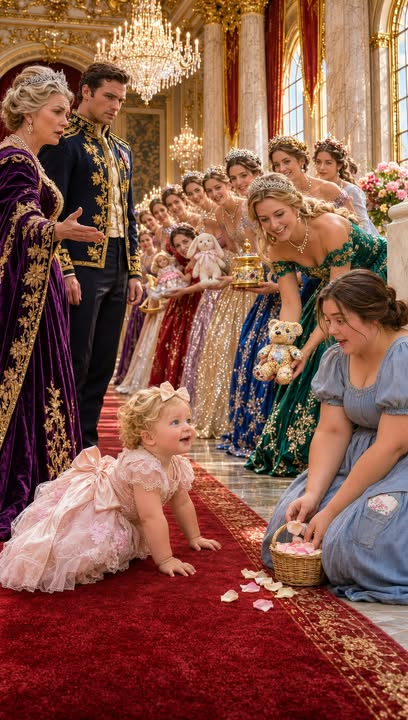
She remembered the ballroom, the glittering princesses, Lily’s tiny voice, and the handkerchief slipping from her pocket.
She remembered the questions that had followed, and the way Alexander had eventually learned to ask rather than decide.
Most of all, she remembered that he had let her choose the truth even when it might have taken her away from him.
“I won’t leave my mother or the shop behind,” she said.
“I would never ask you to.”
“I want our life to include ordinary days, not just palace ceremonies.”
“I want that too.”
“And Lily deserves to know her mother’s memory without being told she must replace her.”
“Agreed.”
Sophia reached for his hand.
“Then yes.”
Alexander let out a breath he seemed to have been holding for months.
He leaned down and kissed her gently, while the fountain whispered behind them and the white flowers shifted in the spring breeze.
A small voice called from the garden path.
“Papa!”
Lily hurried toward them with her nurse following a few steps behind.
Sophia bent to catch her, and Lily wrapped both arms around her neck.
“Mama,” she said, the word clear now but no longer startling.
Sophia closed her eyes and held her close.
She loved the child.
She also knew that love had not made the choice for her.
When the wedding day came, the palace doors opened not for a contest or a spectacle, but for the people who had become part of their lives.
Marian sat in the front row beside the Queen.
Hargreaves stood among the household staff, no longer merely the keeper of records but one of the people who had helped set them right.
The families named in Eleanor’s letter were invited, though none were expected to attend.
Several came, carrying small flowers from their own gardens.
Sophia wore a simple gown with a blue ribbon sewn at the waist, a quiet tribute to the faded dress she had worn on the day Lily first crawled to her.
She and Alexander exchanged their vows beneath a canopy of white blossoms arranged by the flower shop.
The Queen spoke of Eleanor, not as a shadow to be overcome, but as a beloved mother whose courage had helped bring a better future into being.
Marian held Sophia’s hand before the ceremony began.
“You chose your own life,” she whispered.
“So did you,” Sophia replied.
Afterward, the celebration moved between the palace garden and the shop’s newly opened greenhouse.
The palace cooks prepared a simple supper, and the flowers came from the Bell family’s own beds.
Lily fell asleep halfway through the evening, her small fingers curled around the corner of Eleanor’s handkerchief.
Alexander carried her upstairs, while Sophia stood in the doorway of the nursery and watched him settle their daughter into her bed.
The handkerchief rested beside Eleanor’s photograph.
Outside, the palace no longer seemed quite so grand or distant.
It was still a place of stone corridors and old memories, but it had begun to make room for people who had once been expected to remain outside its doors.
In the years that followed, the flower shop thrived.
Its greenhouse filled with seedlings, fragrant herbs, and bright seasonal blooms.
Marian continued to advise the charitable review committee, and the Queen made sure the families’ voices were heard before any new relief program was designed.
Alexander learned that a home was not made by finding someone to fill an absence.
It was made by telling the truth, listening when it was difficult, and choosing one another freely, again and again.
And whenever Lily asked about the ivory handkerchief, Sophia told her about Eleanor’s careful stitches, Marian’s loyal hands, and the long journey that had brought it back to the little girl whose name had never been forgotten.
**–THE END–PLEASE
Share your thoughts or feedback to motivate us to create more stories ♥️
* * *
[PREVIOUS: PART 5](https://storyly.idolsgift.com/blog/part-5-the-secret-of-the-handkerchief-057)
✓ Lynn R. Adams
Part 6 – A Home Built on Truth Sophia looked from the folded sheet to the sealed letter, feeling the past gather around the small table in the flower shop. “Who was the name written there?” she aske…