PART 6 (THE END): The Secret Madeleine Kept 052
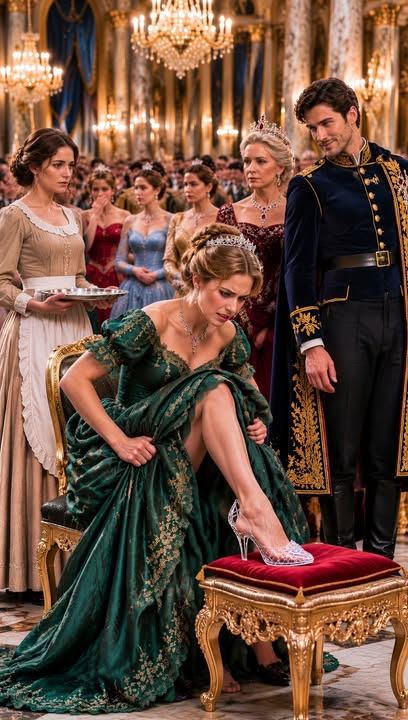
Part 6 – A Future Chosen Honestly
The note lay open on the ballroom table, its last line pointing toward the old nursery and the night Claire escaped.
For several breaths, nobody spoke.
Sofia felt the old instinct to look to someone else for the answer.
Then she remembered that the inquiry was no longer a promise someone else had made to her.
It was a choice she had helped bring into being.
“We should take this to the council,” she said. “And we should go to the nursery together, with the clerk and the witnesses.”
Madeleine nodded.
“No one should search that room alone.”
Victor glanced toward the corridor.
“If someone is still carrying this secret, they may have had years to remove whatever was left.”
“Then we’ll learn what we can from what remains,” Sofia said. “We won’t guess at what we don’t find.”
The inquiry clerk gathered the note and sealed it inside a clear document sleeve.
Before they left, Sofia paused beside the crystal slipper.
Its surface reflected the chandeliers in a pale, steady gleam.
The relic had once seemed to offer a simple answer: touch it, and the truth would appear.
Now she understood that truth did not arrive complete.
It needed people willing to listen, to preserve what they found, and to admit when they had been wrong.
The council joined them in the old wing.
They brought two independent record keepers, the palace steward, and a guard whose only duty was to keep the corridor clear.
The nursery door opened with its familiar, reluctant click.
In the light of afternoon, the room seemed smaller than it had the day before.
The wooden horse waited beside the hearth, its faded red saddle bright against the dust.
Sofia looked toward the narrow recess behind the desk, where they had found the arrest record.
The clerk examined the wall and the desk, then asked the steward whether any original furnishings had been moved.
“Not since the nursery was closed,” the steward said. “The room was kept locked, but the household records were stored here for a time.”
“Who had the key?” Victor asked.
“The steward of the east wing, the keeper of the archive, and the queen’s household secretary.”
Madeleine’s face grew thoughtful.
“My secretary then was Mrs. Bell,” she said. “She retired soon after Claire disappeared.”
“Is she alive?” Sofia asked.
“Yes,” Madeleine replied. “She lives at the river estate. She may remember who requested the records be moved.”
The councilor overseeing the inquiry made a note.
They continued their search carefully, examining the desk, the shelves, and the floorboards without forcing anything open.
The wooden horse caught the clerk’s attention.
“One of its runners is loose,” he said.
Victor knelt beside it.
“May I?”
Sofia nodded.
He lifted the toy gently, then turned it so they could see the underside.
A narrow strip of green ribbon had been tied around one of the wooden supports.
It was faded almost to gray, but its knot was still intact.
Victor’s fingers hovered above it.
“I remember this,” he murmured. “Not the message. Just the feeling of carrying something and being told not to lose it.”
Madeleine looked at him with quiet tenderness.
“You were very small.”
“I keep wanting to remember more than I can.”
“You don’t owe the past a perfect memory,” Sofia said.
Victor looked up at her.
Something in his expression eased.
The clerk carefully untied the ribbon.
A thin scrap of paper lay tucked inside the knot.
Its edges had darkened with age, and the writing was so small that the record keepers brought it to the window for better light.
The note contained two lines in a hand the council secretary recognized from old household records.
*The west passage is clear.*
*The child is safe with Rowan.*
Beneath them was a date: the night Claire escaped.
Madeleine closed her eyes.
“It was Mrs. Bell’s handwriting,” she said.
The councilor looked to the clerk.
“Can it be verified?”
The clerk compared the note with the household records.
“It appears consistent, but Mrs. Bell should confirm it herself.”
Sofia studied the little message.
The words carried no grand confession, no accusation, only the quiet work of people helping a mother keep her child safe.
“She helped Claire,” Sofia said.
“Yes,” Madeleine replied. “And she kept the secret.”
They did not search further that day.
The note was preserved, the room was sealed under the inquiry’s authority, and a messenger was sent to invite Mrs. Bell to give testimony.
The following morning, she arrived at the palace in a modest carriage, wrapped in a soft blue shawl.
She had once stood behind the queen during formal ceremonies, Madeleine told them, but age had bent her shoulders and gentled her voice.
When the old secretary saw the green ribbon, her hands trembled.
“I wondered whether Claire had left it,” she said.
“Did you write the note?” Sofia asked.
“I did.”
“Why?”
“Because Claire asked me to help her leave, and I wanted there to be a record that Sofia had been taken safely to Mrs. Rowan.”
“Why wasn’t it placed in the official archive?”
Mrs. Bell glanced at the council members.
“Because the official archive was not safe.”
She looked toward Madeleine.
“Your Majesty knew that.”
“I did,” Madeleine said. “I should have found a way to preserve the truth more openly.”
“You were trying to keep the child from being discovered,” Mrs. Bell replied. “So was I.”
Sofia sat across from the older woman.
“Did you know who forged the arrest papers?”
Mrs. Bell lowered her eyes.
“I knew Lord Rook had brought them to the king. I did not know he had forged them himself.”
“Who gave him instructions?”
“I never heard a name.”
The councilor leaned forward.
“But Claire’s note says the person was still alive when she wrote it.”
“Yes,” Mrs. Bell said. “She believed someone within the palace had guided Rook. She did not know who.”
“Did she leave any other record?”
Mrs. Bell thought for a while.
“There was a second message, hidden in the nursery, but it was not meant to name anyone. Claire feared that a name without proof could ruin an innocent person.”
Sofia felt the weight of that restraint.
Her mother had been wronged, yet even then she had feared what an accusation might do without evidence.
“Where was the second message?” Victor asked.
Mrs. Bell pointed toward the painted wooden horse.
“Inside its wooden saddle, beneath the red flap.”
The record keepers examined the toy with care.
Under the worn leather saddle they found a folded page, protected by a thin layer of waxed cloth.
It was not a confession.
It was a list of people who had access to the archive on the day the forged papers were filed, along with the times they had entered and left.
Lord Rook’s name appeared first.
Below it were the names of three clerks, the captain of the guard, and a senior household officer named Alistair Venn.
The final entry had been crossed out.
It was not because someone had tried to erase a name.
Claire had drawn a single line through it and written beside it:
*Asked too many questions to be the one who wanted silence.*
The crossed-out name belonged to Madeleine.
The queen studied the page, her expression unreadable.
“She was protecting me,” she said softly.
Sofia looked at the old secretary.
“Did you know?”
“I suspected she had been watched,” Mrs. Bell replied. “I did not know what Claire had written.”
The inquiry traced the remaining records over the next several weeks.
The papers showed that Venn had received a payment from a private account shortly before the forged documents appeared.
They did not prove that he had created the forgery, but they established that he had met with Lord Rook and asked him to bring evidence against Claire directly to Gabriel.
Venn had died years earlier.
The inquiry therefore did not declare him guilty of forging the papers.
It recorded what could be supported: that he had arranged the meeting, concealed the source of the documents, and helped make the accusation seem official.
The same records showed that Gabriel had never been told the documents were forged.
He had signed the arrest order based on a false account, then failed to demand a full investigation after learning that Claire had escaped.
The distinction mattered.
It did not erase his responsibility.
It allowed the truth to be more than a single person’s fear turned into a convenient story.
The inquiry also established that Gabriel had learned of Claire’s death three months after the escape.
A letter from Dr. Vale, kept with the physician’s private papers, confirmed that the king had not known Sofia survived.
When Gabriel received the report, he had ordered the palace to keep Claire’s escape private, fearing a succession dispute and the exposure of his earlier arrest order.
He had not arranged Claire’s death.
He had helped bury the truth that she had lived.
When the council finally released its findings, the kingdom heard them in the same chamber where Sofia had chosen an investigation over immediate power.
Claire’s name was cleared of treason.
The council acknowledged that the evidence against her had been forged and that the royal family had allowed a false account of her death to stand.
Gabriel stood before the council and accepted its judgment.
He stepped down from the throne that afternoon.
He did not ask Sofia to take his place at once.
Instead, he handed the royal seal to the council and agreed to remain available to answer questions, repair what he could, and live without the authority that had once made it easy to avoid them.
The council confirmed Sofia as the lawful heir of Valmont.
It did not crown her that day.
Sofia asked for one further condition: the reforms the council had proposed must be approved before the transfer of power.
The court archive would be placed under independent oversight.
Any royal arrest order would require a written record of its grounds and a later public review.
The household accounts would be open to examination by the council, and the crown could no longer declare a person guilty or dead simply because the truth was inconvenient.
Some members objected that the reforms would slow the work of the monarchy.
Sofia listened, considered their arguments, and did not retreat.
“If the rules are strong only when they are easy to follow,” she said, “then they are not rules at all.”
The council approved the changes.
Victor supported them without hesitation.
He gave up his place in the line of succession, not as a gesture meant to win praise, but through a signed declaration that made clear he would not let his position be used to weaken Sofia’s claim.
When the council thanked him, he looked uncomfortable.
“I did not give up anything that belonged to me,” he said. “I gave up the chance to use my birth as an argument against the truth.”
After the council session, Sofia found him in the old nursery.
He was standing beside the wooden horse, the green ribbon resting in his palm.
“I thought I would feel different,” he said.
“Different how?”
“Lighter, perhaps. Or angry. I don’t know.”
“You can feel more than one thing.”
He looked toward the window.
“I’m angry that no one told me what I was carrying. I’m grateful Claire trusted me. I’m ashamed of how I treated you before I understood any of this.”
“You were a child when you carried her message.”
“I was not a child when I laughed at you.”
“No,” Sofia said gently. “You weren’t.”
He accepted the answer without trying to soften it.
“I don’t expect you to forget.”
“I won’t.”
“I hope we can become something better than the people we were when this began.”
Sofia thought of the ballroom, his sharp laughter, and the lonely fear she had seen beneath it after the letter was read.
“Then keep choosing better,” she said. “That’s how trust grows.”
Victor closed his fingers around the ribbon.
“I will.”
They left the nursery together.
In the weeks that followed, the palace changed in small ways before it changed in any visible one.
Records that had once been locked away were brought into the archive and catalogued.
Household workers were invited to speak to the inquiry without fear that their words would cost them their positions.
The old wing was opened for careful restoration, and the nursery became a place where the council could hold public lessons about the kingdom’s history.
Sofia asked that the names of the people who had helped Claire be recorded beside the facts of her escape.
Mrs. Bell’s testimony was preserved.
Dr. Vale’s account was added.
Mrs. Rowan’s kindness, though she was no longer alive to see the recognition, was written into the official record as the woman who had raised Sofia beyond the palace walls.
Madeleine attended the first meeting of the restoration committee.
She did not chair it.
She sat beside Sofia and listened as the people who had once served beneath her spoke about what the palace had failed to notice.
Afterward, as they walked through the garden, Madeleine said, “I thought protecting you meant keeping you away from every danger.”
“Sometimes it did.”
“And sometimes it kept you away from the truth.”
“Yes.”
The queen nodded, accepting the answer.
“I would like to know you as Sofia,” she said. “Not only as Claire’s daughter, and not only as the woman who may wear the crown.”
Sofia looked at the garden path ahead.
“I would like that too.”
They did not become close in a single conversation.
Their bond grew in quieter ways: over tea in a sunlit room, through stories about Claire, and in the pauses when neither tried to turn affection into an obligation.
Madeleine told Sofia how Claire used to hum while reading.
Sofia told her about Mrs. Rowan’s kitchen, where the bread always browned too quickly on one side.
Sometimes they laughed.
Sometimes they cried.
Sometimes they could do neither and simply sat together, letting Claire’s absence be part of the room without allowing it to be the only thing in it.
Gabriel began his amends without asking for applause.
He met with the families of the household members who had been threatened with punishment after Claire escaped.
He funded the preservation of the records that had survived because of Madeleine, Mrs. Bell, and Dr. Vale.
He attended the council’s public hearings and answered questions without demanding that anyone admire his honesty.
Sofia met with him only when she chose.
The first time, they sat in the library with the door open.
Gabriel spoke about the king he had been when Claire was arrested, and the frightened man who had believed a false story because it made his choices easier.
Sofia listened.
When he finished, she told him that understanding his fear did not mean she would excuse his silence.
“I know,” he said.
It was not forgiveness.
It was not yet trust.
But it was a beginning neither of them tried to pretend was more than it was.
Months passed.
The inquiry’s recommendations took form as laws.
The council established a permanent archive office independent of the royal household.
Royal judgments required clear evidence, and those accused were given the right to answer before any decree was issued.
The people of Valmont were invited to hear public reports on the reforms, not as a performance, but as a promise the crown would have to keep.
Sofia attended every session.
She learned which council members asked questions because they were afraid and which asked because they cared.
She learned that leadership was less like standing above a room than staying inside it long enough to hear what people could not say easily.
When the reforms were complete, the council held a simple ceremony in the palace courtyard.
There were no lavish displays.
The gardeners had planted new pear trees along the wall, and white flowers opened beneath the stone arches.
The crystal slipper stood on a plain pedestal, its surface clear in the afternoon sun.
Sofia wore a gown of deep green, with Claire’s pendant resting above her heart.
Madeleine stood beside her.
Victor stood on her other side, not as rival or heir, but as an ally who had chosen his place.
Gabriel watched from the first row, without a crown.
When the council confirmed Sofia’s succession and offered her the royal seal, the courtyard grew quiet.
She looked at the seal, then at the people gathered beneath the arches.
Some were servants who had once passed her in the corridors without knowing her name.
Some were council members who had helped make the inquiry possible.
Some were citizens who had listened to Claire’s story and asked that the kingdom do better by those who had no title to protect them.
Sofia accepted the seal.
“I accept this crown only with the reforms the council has approved,” she said. “Not as a reward for what was hidden, and not as proof that the old ways were right.”
She paused, feeling the warmth of the pendant against her skin.
“My mother was once treated as a danger because people feared the truth she carried. I was once overlooked because no one knew what my name could mean. I will not promise that this kingdom will never make mistakes.”
Her voice strengthened.
“I promise that no one will be dismissed as invisible when they ask to be heard.”
The council placed the crown upon her head.
It was lighter than she had imagined.
The cheering that followed did not sound like a verdict.
It sounded like people welcoming a choice they had helped witness.
After the ceremony, Sofia stepped away from the crowd and walked toward the Crystal Slipper.
The relic caught the sunlight, but it did not glow.
She touched its cool surface with one hand.
Nothing happened.
She smiled.
For the first time, the crystal did not need to reveal anything.
The truth had already been spoken, examined, and placed where no one could hide it again.
A small glimmer stirred within the glass, green as the leaves on Claire’s pendant.
It did not flare or shake the room.
It rested there, quiet and steady, like a light in a window at the end of a long road.
Madeleine came to stand beside Sofia.
“She would have been proud,” she whispered.
Sofia looked toward the courtyard, where Victor was speaking with Mrs. Bell and the council clerks.
She thought of Claire’s last note, asking her to choose for herself.
“I hope so,” Sofia said. “But I’m glad I don’t have to become her to honor her.”
Madeleine slipped her hand into Sofia’s.
This time, Sofia let it stay.
Across the courtyard, Gabriel waited until she looked toward him.
He did not ask for forgiveness.
He only bowed, and Sofia returned the gesture with a small, honest nod.
The future before her was not free of grief.
It was not free of the choices her family had made or the truths they had once been too afraid to tell.
But it belonged to her now, not because a crystal had declared it, and not because a crown had settled it.
It belonged to her because she had chosen to lead with what the palace had once tried to bury: honesty, courage, and room for every voice to be heard.
**–THE END–PLEASE
Share your thoughts or feedback to motivate us to create more stories ♥️
* * *
[PREVIOUS: PART 5](https://storyly.idolsgift.com/blog/part-5-the-secret-madeleine-kept-052-1)
✓ Lynn R. Adams
Part 6 – A Future Chosen Honestly The note lay open on the ballroom table, its last line pointing toward the old nursery and the night Claire escaped. For several breaths, nobody spoke. Sofia felt …